




Abstract
To evaluate the system reliability and the constellation availability of remote sensing satellite, in this study, a novel single satellite availability modeling and analysis strategy using on-orbit backup and ground added launch backup is proposed. First, considering the characteristics of remote sensing satellites, the calculation formulas of constellation availability are given in detail. Then, the process of system reliability modeling is also illustrated step by step. Finally, an availability evaluation example of remote sensing satellite constellation is introduced to show the effectiveness of the proposed method.
Introduction
The utilization of remote sensing satellite is a powerful approach to acquire the necessary remote information of the earth meteorological, nature resource, environment disaster monitoring, and so on. After collecting these necessary data, remote sensing satellites send the information to researcher to satisfy the requirements of modern productions.1–7 To reduce the return cycle time and increase the time coverage, it is necessary to increase the number of on-orbit satellites, which can help to form a stable configuration and maintain a fixed temporal and spatial relationship. This fixed temporal and spatial relationship is termed as the constellation of satellite generally.
Former researches on remote sensing satellite usually focused on the inherent reliability of constellation, which did not consider the interaction between satellites in the constellation. The impact of failure on service performance did not take into account generally. According to publicly available information, the studies of constellation availability are currently focusing on navigational satellite constellations. However, the researches on the remote sensing satellite constellation are less. For example, Zheng et al. 8 proposed a method for navigating constellation availability using the Bayesian network and Markov chain. Hou et al. 9 gave a single satellite availability algorithm and constellation availability modeling based on the Markov process. Zhou et al. 10 analyzed the relationship between the reliability of single navigation satellite and constellation availability.
The ability of the satellite constellation to run in a stable manner and provide normal service is the key concern of users. In this study, a single satellite availability calculation method, which considers satellite on-orbit backup and ground added launch backup, is proposed. According to the characteristics of remote sensing satellite constellation, availability modeling and calculation method are given. They can provide a reference for the constellation layout and backup strategy.
Basic concept of remote sensing satellite constellation availability
At present, there is no unified definition of constellation availability, and the conceptual connotation of remote sensing constellation availability is presented on the basis of combining and analyzing the relationship between constellation reliability and usability.
Constellation reliability
The definition of reliability can be given as “the ability of the product to complete the specified function within the specified conditions and within the specified time.”11–16 Reliability is usually measured by normal working probability or mean time between failures.17–22
The constellation reliability in the satellite area mainly refers to the inherent reliability, which is the ability of the satellites to work normally.
Constellation availability
For satellite constellations, which require multi-satellite collaboration to complete a mission, the requirement for indicators changes from satellite reliability to satellite service ability. Furthermore, the capabilities of the individual’s satellites are weakened. More attention is given to whether terrestrial collaboration can reach the requirements of ground users.
In order to ensure the service performance of the constellation, the concept of constellation usability is introduced in this study. According to the usability definition of Global Positioning System, Galileo Satellite Navigation System, and other systems, constellation availability generally refers to the service availability, mainly the percentage of time that the service performance provided by the satellite reaches the user’s requirement.
Single satellite usability
For a single satellite, the usability is the degree to which the satellites are in a working state and a comprehensive reflection of product reliability and maintainability.
Remote sensing satellite usability
The remote sensing satellite availability can be described as constellations to provide the ability to meet the task requirements in the target area and can be measured by the ratio of normal working time to total time.
Modeling and analysis of single satellite availability
Single satellite availability is a quantitative reflection of satellite reliability and maintainability. However, the interruption caused by the satellite failure is a direct factor affecting the availability of the satellite.
Single satellite availability

where
Satellite failure interruption includes short-term interruption and long-term interruption. Short-term interruptions include disruptions caused by satellite orbital control and maintenance, as well as interruption of satellites short-term failure, such as orbit adjustment, single event upset, and discharge abnormalities. Long-term interruptions generally refer to the satellite failure. The satellite failure interruption model is shown in Figure 1.

The single satellite failure interruption model.
In Figure 1, states


where
In equations (2) and (3), the short-term interruption failure rate and repair rate are calculated as

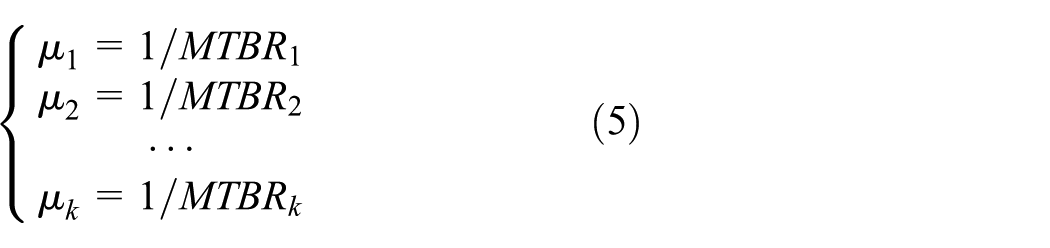
where
In equations (2) and (3), the long-term interruption failure rate

where

where
On-orbit backup satellite can only be used as a backup for the same orbit satellites. However, ground added launch satellite can be used as a backup for any satellite in the constellation. So that if the constellation has

If the constellation has

Repair rate of using on-orbit backup satellite and ground backup satellite is

Among them,
Substituting equations (4)–(10) into equations (2) and (3), the single satellite’s failure rate and repair rate can be obtained. Then, according to equation (1), the availability of single satellite can be obtained.
Modeling and analysis of remote sensing satellite constellation availability
In the remote sensing satellite constellation, the failure of a single satellite or many satellites can affect the overall performance of the constellation, which results in decreased availability. However, the remote sensing tasks can still be degraded performed by the constellation in this situation. Similar to the calculation method of single satellite availability, constellation availability modeling is mainly to establish the constellation’s state model and to calculate the state probability in each state. Then, simulate the constellation performance of each state to get the remote sensing task coverage of the target area and the availability of the remote sensing constellation.
For example, for the constellation of

Constellation state diagram.
State

where

Then, the constellation availability

Similarly, analyze the state probability and task coverage of other states, and the total constellation availability

Example analysis
In order to realize the needs of 24 hours fire prevention for China’s forest resources, the Walker constellation which includes 30 constellations, is deployed on 6 orbital surfaces. Each surface has five satellites. One of them is a hot backup of the other four satellites.
First, calculate the availability of single satellite. According to the former satellite on-orbit experiences, make the following assumptions:
Satellite adjusts the orbit twice a year, each time takes 12 h;
Satellite adjusts the attitude six times a year, each time takes 4 h;
Satellite occurs recoverable failure four times a year due to single event upset, and each recovery costs 2 h;
The design life of the satellite is 3 years and the end-of-life reliability is 0.8;
Each satellite replacement time after the fault is 0.1 year.
Based on the above assumptions, the single satellite availability model parameters are shown in Table 1.
Single satellite availability model parameters.

From Table 1, we can see that single satellite interruption failure rate and repair rate are as follows
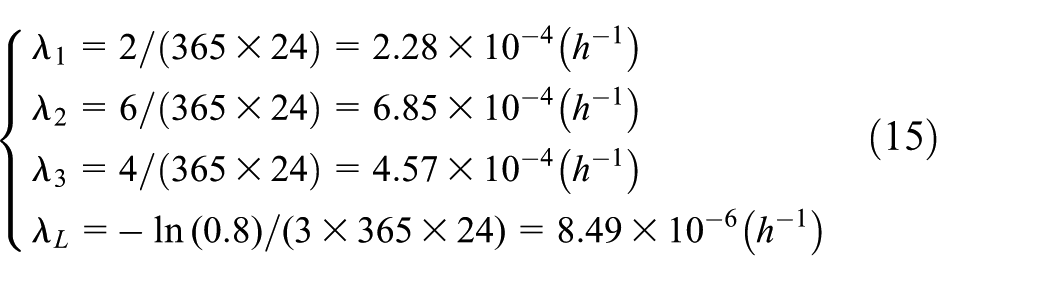

According to equations (2) and (3), the single satellite’s failure rate and repair rate are


Then, according to equation (1), the availability of the single satellite is

The constellation availability is calculated below.
First, the target area can be divided into 1000 small areas. Each small area is represented by the center point of the area. Then, according to the constellation of different satellite failures, 1 satellite failure, 2 satellite failures, … , 30 satellite failures, and by the satellite load angle of ±60°, calculate the time coverage
As to
Five satellite failure modes and average time coverage.
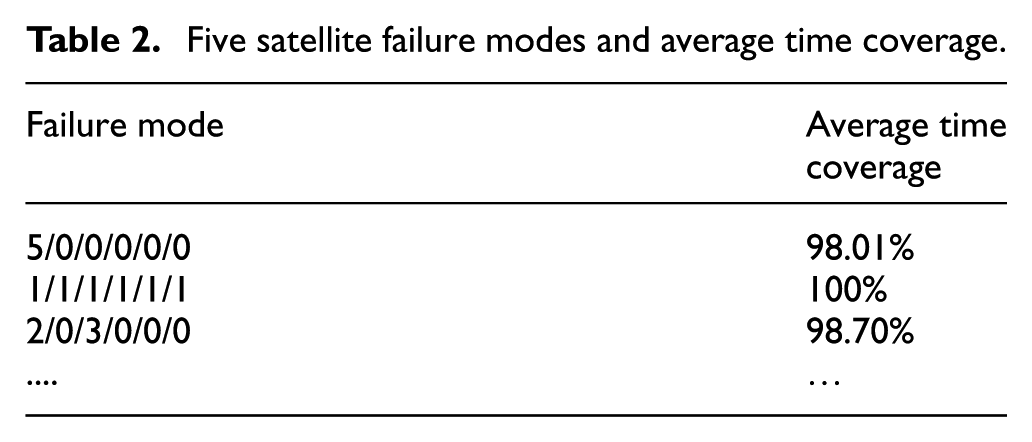
The cumulative probability of zero satellite failure is 0.9995, which is bigger than
Time coverage rate and state probability of the constellation to the target area.

As each orbit has four satellites and backup one satellite, one satellite failure does not affect the constellation time coverage. According to equations (1) and (2), the constellation available can be calculated using equation (20). In this study, the value of A is 99.84%

Conclusion
This article combines the basic concept of the availability of remote sensing satellite constellation, clarifies the modeling method of single satellite availability, and put forward the single availability calculation method with on-orbit backup and ground backup. Finally, taking a remote sensing satellite constellation as an example, the specific calculation process of constellation availability is introduced and the operability of the method is verified. In addition, we will study the calculation methods of other constellations, such as communication satellite constellations, hoping to form a common satellite constellation availability calculation method, so as to provide a reference for scheme optimization such as constellation backup strategy.
Footnotes
Handling Editor: Guian Qian
Declaration of conflicting interests
The author(s) declared no potential conflicts of interest with respect to the research, authorship, and/or publication of this article.
Funding
The author(s) disclosed receipt of the following financial support for the research, authorship, and/or publication of this article: The supports from the National Natural Science Foundation of China (grant no. 51605080), the China Postdoctoral Science Foundation (grant no. 2015M580780), and the China Postdoctoral Science Special Foundation (grant no. 2017T100685) are gratefully acknowledged.
