




Abstract
As for the problems of car rescue scheduling delay caused by the information separation from traffic accident rescue departments, the service-oriented architecture technology has been adopted to integrate the information systems in related rescue departments within the transport accident region after the deep analysis of information characteristics of rescue departments. A transport accident rescue model with the acquisition and processing of information has been established, and the methods of the optimal resource scheduling and the optimal path selection in the process of rescue have been proposed. Meanwhile, with the support of Web Service and Android, a mobile assistant decision-making system based on service-oriented architecture for transport accident rescue has been designed, and the effectiveness and feasibility of rescue planning of assistant decision-making have also been demonstrated by examples. The research not only provides theoretical basis for the traffic management departments to make a reasonable rescue planning but also greatly improves the efficiency of transport accident rescue.
Keywords
Introduction
In recent years, a high incidence of transport accidents still exists in China, and the lethality of traffic accidents is much higher than that of the developed countries. According to the statistics from National Bureau of Statistics of China in 2016, the death toll of transport accidents has risen to 210 persons per million cars, which accounts for 78.8% of the number of deaths in all kinds of accidents. One of the main reasons is the delay of car rescue scheduling, which results in high casualties of transport accidents due to the delay of medical treatment. The related research shows that 18%–25% of the seriously injured can be saved if the emergent rescue measures are available within 5 min and the emergency treatment is done within 30 min after transport accidents.1,2 The transport accident rescue mainly covers transport administration, subsidiary hospitals, fire departments, and so on. However, the information management systems in the above departments are still stand-alone systems, respectively, without mutual coordination, which severely restricts the high efficiency of transport accident rescue.
The transport accident rescue mainly involves the resource scheduling and the planning of rescue paths for rescue departments. However, service-oriented architecture (SOA) is a set of component models, which can be linked by the external interfaces of different systems, and the interfaces can be independent of hardware platforms, operating systems, and programming languages for implementing the services.3,4 Based on the current situation of transport accident rescue, the SOA technology was applied to integrate information systems from different departments, such as transport, hospital, and fire, in this article. A unified data processing platform for transport accident rescue was established to integrate different subsystems and share information, which can provide data support for mobile decision-making system of transport accident rescue.5,6 Combined with multi-modal route planning theory and Dijkstra’s algorithm,7–10 which involves famous intelligent path selection algorithms, a novel model of transport accident rescue has been established, which has taken into consideration the optimal resource scheduling and the optimal path selection in the process of transport accident rescue. The model can produce the rescue planning of transport accidents in real time and help transport authorities optimize the rescue planning for higher efficiency of transport accident rescue.
Data platform of transport accident rescue
The integration of information management systems in the departments of transport administration, hospital, and fire using SOA is aiming at generating the rescue planning of transport accidents with data support. The data source mainly comes from different systems, such as transport information acquisition system, transport database management system, transport information processing system, transport simulation system, transport dispatching system, transport information release system, hospital information management system, and fire information management system. The structure of data processing platform is shown in Figure 1. Due to the different data sources, the data display the multi-dimensional heterogeneity, which mainly involves different data representations, different data uncertainties, different data formats, and so on. Therefore, the data extraction, data formatting, and data filtering should be done.

Structure of data processing platform of transport accident rescue.
Model of transport accident rescue
Currently, there are two main problems in the traffic accident rescue, which are resource scheduling and routing decision-making. In order to solve the two problems, a traffic accident rescue model based on the optimal planning and improved Dijkstra’s algorithm has been established. Through the analysis of rescue resource scheduling in the case of multiple accidents and path selection during the traffic accident rescue, the model not only solves the optimal resource scheduling problem in the case of multiple-incident multiple-response (MIMR) but also solves the problem of optimal decision path. The model structure is shown in Figure 2.
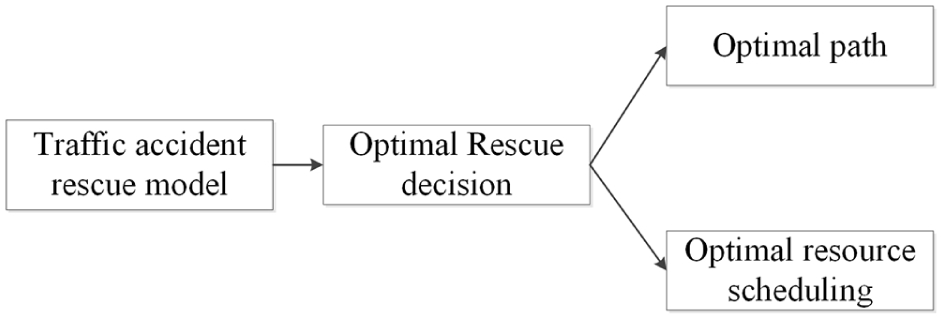
Model of traffic accident rescue.
Optimal resource scheduling
Regarding the issue of resource scheduling, it must be taken into account that there is often a chance or multiple chances of traffic accidents occurring in the actual urban road network. After the first traffic accident occurs, if sending aid from its nearest rescue is only considered, then the problem of rising costs of rescue when the second traffic accident occurs will often be overlooked. So traffic accident rescue resource scheduling is an MIMR problem. By considering the road transport network

In equation (1), C represents the rescue costs, L represents the rescue point set, F represents the accident point set,
For example, there is a transport network comprising four nodes, as shown in Figure 3. Two rescue points are

Traffic network example.
In this example, there are only two incident points to consider so there will be the following two conditions:


Traffic accident rescue is mainly related to traffic police, road, hospitals, and fire departments, so accident levels can be divided into five levels according to the four contents. A different number of rescue vehicles and rescue teams should be sent to each level; in the actual application process, the number of rescue vehicles dispatched according to accident levels is shown in Table 1.
Rescue resource allocation.

Optimal decision path
As for the actual path networks in urban road transport, the best path is not necessarily the one with shortest distance but the one with shortest time, which should comprehensively take into consideration the various factors, such as traffic flow and road condition, to determine the road weight. After the deep analysis of the traditional path planning methods, including Dijkstra’s algorithm,
11
A* algorithm,
12
Floyd algorithm,
13
and so on, combined with the theory of multi-modal path planning, the improved Dijkstra’s algorithm is adopted to select the rescue paths in the model of transport accident rescue, and the time complexity and path weight
For time complexity of the problem in the algorithm, we can separate the accident and rescue node. Suppose there are m rescue points and n accident points, the time complexity of the algorithm becomes

In equation (2),
In order to study the time complexity of Dijkstra’s algorithm in this model, the following formula can be obtained according to the definition of time complexity

As can be seen from equation (3), time complexity of the system is the largest of four time complexity subsystems; in the actual rescue process, the number of rescue resources are very limited, then

As can be seen from equation (4), scale of the problem has been largely reduced. It follows that
How to determine the path weight

As can be seen from equation (5) that the current road traffic conditions p and road traffic accident rank dynamic r will change over time, such that the path weight
Mobile assistant decision-making system of transport accident rescue based on SOA
Design of system architecture
As shown in Figure 4, the SOA model is divided into seven layers. 14 The first layer of the platform is located at the bottom of the system layer. The layer is mainly the resources that the system owns and needs to provide external service interface. The second layer of the platform is the component layer. The function of this layer is to encapsulate the resources in the first tier system as a component and then use the Web Service to release the service layer. 15 The third layer of the platform is the service layer. The layer is the most important layer of SOA seven-layer system architecture models and plays connecting role in the architecture. The layer provides services to the upper layer by calling the related components. The fourth layer of the platform is the process layer. The layer combines the services that the third layer provides according to the service flow. The fifth layer of the platform is the presentation layer, which defines the interface to the service consumer. The above five layers encapsulate of the system service. The five layers need an integrated environment to support the normal operation, so the enterprise bus of the sixth layer is designed to solve this problem. The seventh layer is the assistant management layer. The main function of this layer is to monitor the whole system and ensure the service quality of the system.

SOA.
In this article, the system architecture is based on the SOA seven-layer architecture model. However, directly constructing the system architecture in accordance with the seven-layer system architecture model may result in too high coupling degree and too large redundant degree. Therefore, this article summarizes and designs the architecture model of the system. The system model is divided into five layers, including data layer, service layer, process layer, presentation layer, and application layer, as shown in Figure 5:
Data layer is the traffic rescue data processing platform, which provides data support for the traffic accident rescue plan and provides the interface for the service layer.
Service layer composes business process to obtain the service candidate operation.
The process layer uses the service candidate operation which service layer provides to build the service business process.
The presentation layer packages the services that the process layer provides and releases the external service to search and access. All functions of the layer are implemented by Web Service technology.
The application layer is the Android handheld terminal for users and completes the relevant operation by calling the service search and access interface.

System architecture.
Analysis of model case
The mobile assistant decision-making system based on SOA for transport accident rescue acquires the related information and outputs the rescue planning. The related information includes places of transport accident, grades of traffic jam, grades of vehicle losses, casualty grades, fire grades, and so on. Suppose a major accident takes place at Qidaoliang section along National Road 212 (G 212), the fire grade is grade 1, the casualty grade is grade 2, the grade of vehicle losses is grade 1, and the grade of traffic jam is grade 3. Thus, the output of rescue planning is shown in Table 2.
Output of rescue planning.

As shown in Table 2, Lanshi firehouse and Traffic Police Brigade in Qilihe District, Lanzhou, will drive through “Wuwei Road-Jianxidong Road” at the same time. So in order to validate the model validity, assume that this section is the place where the second accident occurs. The new rescue plan is shown in Table 3.
New rescue planning.

If the second accident occurs, fire department’s rescue route changes to “Guazhou Road–Renjiazhuang Street–Wuwei Road–Jianxidong Road–Langongping Road–G212” and emergency department changes to “Lanshi firehouse.” From the results, it can be found that the fire department’s rescue route avoids the occurrence of the second traffic accident, and the new emergency department is located in the new rescue line. Similarly, the rescue route of traffic police department changes to “Xizhanxi road–Wuwei road–Jianxidong road–Langongping road–G212” and the corresponding emergency rescue department changes to “Division of Traffic Police in Lanzhou city”. Because the second accident does not occur in the hospital and road rescue routes, the rescue plan does not need to be changed.
Conclusion
After the deep analysis of information characteristics of rescue departments, the SOA technology has been adopted to integrate the information systems in related rescue departments within the transport accident region. A mobile assistant decision-making model based on SOA for transport accident rescue has been established. The optimal resource scheduling and the optimal path selection in the process of rescue have been proposed. Moreover, the technologies of Web Service and Android have been adopted to establish the mobile assistant decision-making system based on SOA for transport accident rescue. Not only ordinary users can know about the daily travel information at all times and in all places but also traffic police can immediately make up the corresponding rescue scheme according to road traffic accident rank when a traffic accident occurs, which will greatly improve the efficiency of traffic accident rescue. In the near future, the optimization of resource scheduling and path selection will be further researched to improve the reliability and adaptability of assistant decision-making system for transport accident rescue.
Footnotes
Handling Editor: Wuhong Wang
Declaration of conflicting interests
The author(s) declared no potential conflicts of interest with respect to the research, authorship, and/or publication of this article.
Funding
The author(s) disclosed receipt of the following financial support for the research, authorship, and/or publication of this article: This work was supported by the Natural Science Foundation of Gansu (no. 145RJZA086).