




Abstract
Dowel joints are installed at the end of floating slabs and can effectively reduce the discontinuity of deformation between adjacent floating slabs. The shear spring model had been proposed for modeling the dowel joints of the floating slab track, while the constraint effect of dowel joints on the bending/rotation has not been considered. For a more comprehensive investigation of dowel joints, two idealized dowel models are introduced here, that is, the shear spring–dashpot model and the bending spring–dashpot model, respectively. The effects of these two models on the vibration of train–floating slab track system are analyzed by numerical examples. It is concluded that both shear dowel model and bending dowel model can reduce the dynamic responses of the train–floating slab track system. In detail, the shear dowel model can effectively reduce the displacement difference between adjacent floating slabs but can hardly decrease the displacement amplitudes of the rail and slabs, while the bending dowel model can effectively decrease the displacement amplitudes but has little influence on reducing the displacement difference. In addition, the spring stiffness of these two dowel models has significant influence on the vibration performance of the train–floating slab track system, while the effect of damping coefficients can almost be neglected.
Keywords
Introduction
Floating slab track (FST) is widely used to reduce the vibration or noise induced by passing trains, especially in areas with poor foundation conditions or high vibration isolation requirements.1–4 The heavy floating slabs are rested on high-elastic supports to reduce the dynamic responses due to train/rail interaction, such as rubber bearings and steel springs. The floating slabs can be either continuous if they are casted in situ or discontinuous if discrete precast sections are used and mounted end to end. For a discrete FST subjected to a moving train, a parametric excitation may occur due to the discontinuity of slabs, which increases the train–track vibration and, therefore, has negative influence on the train–track system. 5 In this case, the dowel bars or plates are usually installed between adjacent floating slabs to reduce the stiffness discontinuity of slabs and improve the overall dynamic performance of the train-FST system.
The vibration problems of an FST system have been widely investigated based on the theoretical methods6–8 and experimental methods.9,10 Cui and Chew 4 discussed the force transmission of the Singapore FST system using an analytical method. Hussein and Hunt5,11 modeled the discontinuous and continuous FST systems as infinite beam systems and investigated the dynamic performance of FST subjected to oscillating moving loads. The vehicle–track impact at the connection between the FST and ballasted track was studied by Li and Wu. 12 Gupta and Degrande 13 established a coupled model for the FST and tunnel–soil system, and the vibration isolation efficiency of continuous and discontinuous FST systems was discussed.
As mentioned before, dowel joints are usually installed at the end of discrete floating slabs to reduce the vibration and noise induced by the slab discontinuity. However, the studies on the effect of dowel joints in a discrete FST system are rare. Chung et al. 14 tested four floating slabs with different dowel joints, and the effects of dowel joints on the load transfer efficiency of the FST were studied. A theoretical model which considered the dowel joints as shear springs was also calculated and compared to the experimental results. Hussein and Costa 15 also used the shear spring model for the connection between adjacent slabs and investigated the effect of shear spring stiffness on the dynamic responses of the FST. A more complicated shear spring–damper element was adopted by Xu et al.,16,17 and the influence of slab length on the dynamic performance of train-FST system was studied, as well as the environmental vibration induced by the subway track. It is noted that the aforementioned work considered only the vertical constraint of dowel joints on the discrete FST, while the restraint effect of dowel joints on the bending or rotation at slab ends is not taken into account.
In this article, two dowel models are introduced to analyze different effects of dowel joints on the train-FST vibration, that is, the shear spring–dashpot model and the bending spring–dashpot model. The dynamic responses of the train-FST system with different dowel models are calculated based on the modal superposition method and Newmark-β method. The effects of two dowel models on the vibration reduction of the train-FST system are analyzed by numerical examples.
Modeling of train–track system with dowel joints
Consider a train-FST system with dowel joints. A quarter model of a carriage with
four wheel axles and two bodies is used here, as shown in Figure 1. The mass for a quarter of the
carriage is

Model of a quarter train.
According to the theory of structural dynamics, the governing equation of a quarter train can be written as follows

where

where
The rail is modeled as a long simply supported Timoshenko beam with length

Model of a discrete floating slab track with dowel joints.
Based on the Timoshenko beam theory, the equation of the rail is given by

where
The external force of the rail
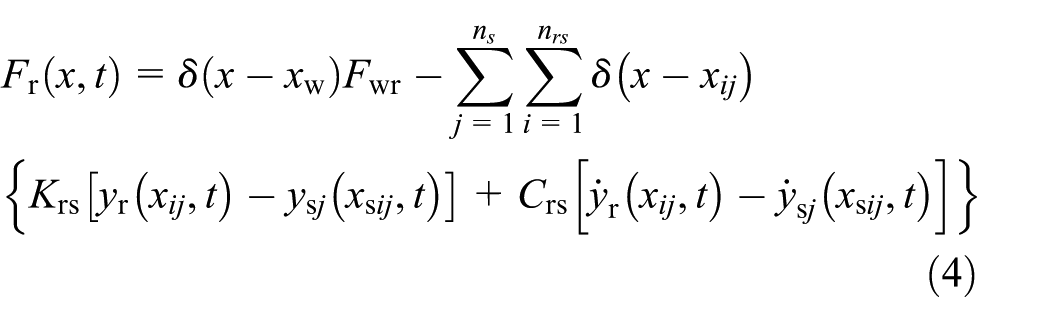
where
The floating slabs are modeled as a Timoshenko beam with free-free ends. Different dowel materials and joint types have been adopted in FSTs to reduce the slab discontinuity, 14 for example, the steel dowel bars/plates installed either on the top of the slabs or embedded in the middle of the slabs. In this article, two idealized dowel models are introduced to stimulate different types of dowel joints, that is, the shear spring–dashpot model as shown in Figure 3(a) and the bending spring–dashpot model as shown in Figure 3(b).
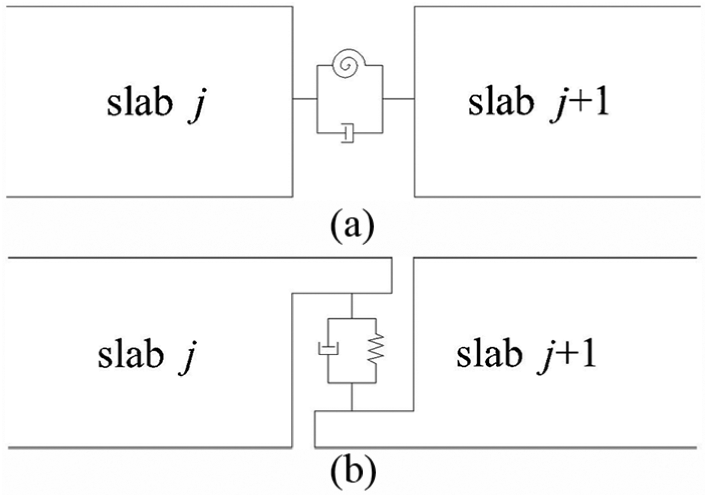
Model of dowel joints at the end of slabs: (a) shear spring–dashpot model and (b) bending spring–dashpot model.
For the dynamic analysis of slabs with the shear dowel joints or bending dowel
joints, the governing equation of the jth slab under local
coordinates

where
The detailed expressions of
The shear dowel model
The external moment


where
The bending dowel model
Both external force


where
Solution of train–track vibration equation
Based on the modal superposition method, the displacement and rotational angle of the rail can be assumed as

where
For a simply supported Timoshenko beam, the mode shape functions of the rail are given as

in which the wavenumber

The displacement and rotational angle of the jth slab can also be obtained similarly as

The mode shape functions for the free-free Timoshenko beam can be written as

where

Substituting equations (10) and (13) into equations (3) and (5), the partial differential equations of the rail and floating slabs can then be turned into the ordinary differential equations. Combining with equation (1), the coupled equations for the train-FST system can be obtained. The dynamic responses of the train-FST system are finally solved based on the modal superposition method and the Newmark-β method.
Numerical results and discussions
In this section, the dynamic responses of FST with dowel joints under a moving train are calculated based on the aforementioned theoretical model. According to the properties of B-type metro train in China subway and FST system, the parameters adopted for the simulation are listed in Table 1. The train speed is assumed to be 20 m/s.
Parameters of train and floating slab track.

Effect of dowel joints on train–track vibrations
Three different cases are considered here to investigate the effects of dowel joints on the dynamic responses of the train-FST system, that is, the floating slabs with no dowel joints, with shear dowel model and with bending dowel model, respectively. The effects of shear dowel model and bending dowel model on reducing the vibration performance of train–track system are analyzed through numerical results. Here, the stiffness of the shear dowel model is taken as 100 MN/m, while the stiffness of the bending dowel model is 100 MN m/rad. The damping coefficients for these two dowel models are assumed to be zero. A more detailed parametric analysis on stiffness and damping coefficients of dowel models can be found in the next subsection.
Figures 4 and 5 show the vertical displacements of the rail and floating slabs under a moving train, respectively. A total of three different cases are discussed here, that is, the floating slabs with no dowel joints, with shear dowel model, and with bending dowel model, respectively. It can be seen that both shear dowel model and bending dowel model can decrease the amplitudes of rail displacement and slab displacement, and the bending dowel model is more effective compared to the shear dowel model. Besides, it is found that the bending dowel model can barely reduce the displacement difference between adjacent floating slabs, while the shear dowel model can effectively smooth the displacement curve compared to the case of no dowel joints.

Vertical displacement of the rail under a moving train in three cases.
Vertical displacement of floating slabs under a moving train in three cases.
Figure 6 shows the
acceleration of the carriage in three different cases. It can be seen from Figure 6 that the
acceleration amplitudes in three cases are 0.0588, 0.0432, and
0.0492 m/s2, respectively. Both shear and bending dowel
models can reduce vertical acceleration of the train compared to the case with
no dowel joints. In addition, the FST system with shear dowel model has a smooth
acceleration curve near the end of slabs (
Carriage acceleration in three cases.
The fastener forces and slab bearing forces at the different positions of the sixth floating slab are depicted in Figures 7 and 8, respectively. It can be seen that the fastener force and bearing force near slab ends are reduced obviously in the FST system with shear dowel model, especially for the tensile force of the fastener (negative value in Figure 7(a)). However, both shear and bending dowel models have little effect on the forces of the fastener and slab bearing in the middle of the slab, as depicted in Figures 7(b) and 8(b).
Fastener forces at different locations of the sixth floating slab in three cases: (a) fastener force at the left end of the sixth slab and (b) fastener force in the middle of the sixth slab.
Slab bearing forces at different locations of the sixth floating slab in three cases: (a) slab bearing force at the left end of the sixth slab and (b) slab bearing force in the middle of the sixth slab.
Parametric study of dowel models on train–track dynamics
The influence of dowel parameters on the dynamic performance of the train-FST system is further investigated in this subsection. Different stiffness coefficients and damping coefficients for the shear dowel model and the bending dowel model are considered, and their effects on the vibration performance of train–track system are discussed.
Parametric study of shear dowel model
The effect of shear damping coefficient on the dynamic responses of
train–track system is analyzed first. A total of three different
damping coefficients are adopted here, that is,
Rail displacement under different damping coefficients
The influence of shear stiffness coefficient
Rail displacement under different shear stiffness
Slab displacement under different shear stiffness
Figure 12 shows the
curves of the carriage acceleration under different shear spring stiffness
Carriage acceleration under different shear stiffness
Fastener force at the left end of the sixth slab under different
shear stiffness
Slab bearing force at the left end of the sixth slab under different
shear stiffness
Parametric study of bending dowel model
A similar parametric study has been conducted for a floating slab track with
bending dowel joints. As can be seen in Figure 15, the damping coefficient
Rail displacement under different damping coefficients
Figures 16 and
17 show the
displacements of the rail and floating slab, respectively, under different
stiffness coefficients
Rail displacement under different bending stiffness
Slab displacement under different bending stiffness
Figure 18 shows the
variation of the carriage acceleration under different bending spring
stiffness
Carriage acceleration under different bending stiffness
Fastener force at the left end of the sixth slab under different
bending stiffness
Slab bearing force at the left end of the sixth slab under different
bending stiffness
Effect of a mixed dowel model on train–track dynamics
By referring to the research of Chung et al., 14 we consider a dowel joint constructed by 20 steel dowel bars with each diameter of 25 mm, as shown in Figure 21(a). For such a dowel joint, both shear stiffness and bending stiffness may exist and need to be considered in the train–track system. Here, we introduced a mixed dowel model as shown in Figure 21(b).

Floating slab with dowel bars: (a) cross section of floating slab and (b) a mixed model for the dowel joint.
The shear stiffness

where

in which
The shear stiffness so obtained is

Fixed-fixed beam model: (a) vertical deformation and (b) rotational deformation.
The rail displacement and slab displacement so calculated are shown in Figures 23 and 24, respectively. It is found that the mixed dowel model can effectively reduce the displacement differences near slab ends and also decrease the displacement amplitudes. Since the shear stiffness is much larger than the bending stiffness in this example, the results obtained here are mainly dominated by the shear stiffness and are, therefore, very similar to those obtained in case of the shear dowel model.

Rail displacement under a moving train.
Slab displacement under a moving train.
Conclusion
In this article, a two-dimensional model for a train-FST with dowel joints is developed, and the influence of dowel joints on the vibration performance of train–track system is investigated. A total of two idealized dowel models are introduced to investigate the restriction effect of different dowel joints on the train–track coupling vibrations, that is, the shear spring–dashpot model and the bending spring–dashpot model. The parametric analysis of the shear and bending dowel models is also conducted. The numerical results are calculated using the modal superposition method and Newmark-β method, and the following conclusions are obtained:
Both shear dowel model and bending dowel model can reduce the vibration of the train–track system and can thus improve the dynamic performance of the train–track system. For these two dowel models, the damping coefficient has little effect on the vibration responses of the train–track system, while the spring stiffness has significant effect on the train–track coupling vibrations.
The shear dowel model can effectively reduce the displacement difference near the end of floating slabs but can barely reduce the displacement amplitudes of the rail and slabs. The spring stiffness of the shear dowel model should not be taken too large since the carriage acceleration and fastener force may be magnified.
The effect of bending dowel model on the dynamic performance of train-FST system is just opposite. The two dowel models have complementary effects on improving the dynamic responses of train-FST system.
Footnotes
Handling Editor: ZW Zhong
Declaration of conflicting interests
The author(s) declared no potential conflicts of interest with respect to the research, authorship, and/or publication of this article.
Funding
The author(s) disclosed receipt of the following financial support for the research, authorship, and/or publication of this article: This work was supported by Zhejiang Provincial Natural Science Foundation of China (nos. LY17E080005 and LQ15E080008), the National Natural Science Foundation of China (nos. 51778576 and 11472244), and Hangzhou Major Science and Technology Plan Project (no. 20172016A06).