




Abstract
Rolling element bearings are one of the most precarious components and play an important role in the effective operation of rotating machinery. Bearings are one of the foremost sources of nonlinearity in rotating machineries which significantly affect the behavior of the system. The main sources of nonlinearity are radial internal clearance, unbalanced force, bearing preload, stiffness, damping, number of rolling element, and so on. Surface defects such as localized and distributed defects are also accountable for the nonlinear behavior of the system. A large number of studies and methodologies have been proposed in the last two decades to understand the nonlinear dynamic behavior of rolling element bearings considering various bearing parameters and surface defects. In this work, the authors have presented a review of different theoretical models and experimental works proposed for the analysis of the nonlinear behavior of rotating systems. This review article first quotes various techniques which have been explored for the nonlinearity analysis in rolling contact elements such as rotor-bearing system and gears. Some of the important gaps are highlighted in this work which can be considered for future studies.
Keywords
Introduction
Rolling element bearings are the widely used components in rotary machines. These are considered as the most critical components which play an important role in the health of machinery and its life in the modern production system. In today’s competitive environment due to increases in demand on running accuracy and nonlinearity involved in such systems, advanced modeling and dynamic analysis of rotating systems are gaining more popularity. Varieties of techniques were developed for monitoring and maintaining the health of rolling element bearings. The health of these rolling element bearings is always of prime importance in applications such as turbines, aircrafts, jet engines, power plants, automobiles, and robots, where a microscopic imperfection may lead to dangerous results. Besides these applications, the abnormal operation of bearings cannot be avoided in other applications such as in agricultural equipment, material handling devices, machine tools, and other general applications. A number of factors, such as installation, lubricant and lubrication mechanism, alignment with other components, load, temperature, and speed, affect the healthy operation of the bearings. Moreover, a large number of influencing parameters such as microslip and irregularities on contact surfaces, lubricant contamination, lubrication regimes, wear debris, crack formation and propagation, and others also affect the health of the bearing during operation.
Rolling element bearings are also major sources of nonlinearity in a rotor-bearing system. The nonlinearity not only affects the health of the rotor-bearing system but is also an important parameter which has considerable effect on the associated systems. The nonlinearity in a rotor-bearing system mainly arises due to the internal radial clearance between the rolling element and races, lubricant, unbalanced forces, Hertzian contact force, defects, stiffness, preloading, speed, number of rolling elements, and so on. Nowadays, the majority of research is focused on the development of new advanced signal processing techniques such as fuzzy logic, envelope analysis, and wavelet transform. More details on such techniques are available in the literature.1–7 However, comparatively few attempts have been made toward the nonlinear analysis of rolling element bearings, which can be more productive for the industries. Over the years, various dynamic models have been proposed to understand the nonlinear behavior of rolling element bearings, but only some of them gained popularity. Since the nonlinearity analysis is more realistic, various sources of nonlinearity should be considered in the modeling of rolling element bearings, which will further be helpful in health assessment of the system and can predict the behavior of the system closely to the actual one. In this review article, a detailed review of the earlier addressed works in the field of nonlinear dynamic analysis of rotor-bearing system has been presented, which will be very helpful for the researchers. Further, various nonlinear analysis techniques are also discussed which have been used to understand the nature of the system.
The rest of the article has been divided into the following sections: section “Health assessment techniques of rolling element bearings” presents a brief summary of the various health assessment techniques of rolling element bearings, section “Bearing defects and characteristic frequencies” discusses various bearing defects and bearing characteristic frequencies. The nature and the major sources of nonlinearity are discussed in section “Nature and sources of nonlinearity.” The previous research work related to nonlinearity in rolling element bearings such as clearance, unbalanced forces, preloading, localized defects, and distributed defects are discussed in section “Nonlinear analysis of rolling element bearings.” This section also includes the nonlinearity analysis techniques. Finally, section “Conclusion and future aspects” draws some brief conclusions of the reviewed literature and some of the important suggestions for future work are also included in this section.
Health assessment techniques of rolling element bearings
Rolling element bearings are the key components of almost all rotary machines. These are commonly used in a wide variety of applications which include various industrial applications such as automobiles, power plants, space shuttles, steel industries, and small household appliances such as washing machines, sewing machines, juicer mixer grinder, and floor cleaner. In its general form, a rolling element bearing has a set of rolling elements, which are spaced equally with the help of a cage between two races/rings. The brief outline of a rolling element bearing is shown in Figure 1. Various profiles of rolling elements such as ball, cylindrical roller, needle roller, tapered roller, symmetrical barrel roller, and unsymmetrical barrel roller are used based on the type of application. A variety of lubricants are used for the lubrication of rolling bearing. The lubricant tries to avoid the mating of contact surfaces and also reduces the heat generated during operation.

Brief outline of a rolling element bearing.
Studies have reported that more than 40% failure of rotary machines happens due to the bearing failure. 8 Therefore, the bearings are considered as one of the most critical machine components. The malfunction in bearing can develop into a dangerous failure mode without any notable sign. It may result in costlier shutdowns, machinery accidents, and moreover sometimes human causalities. Various existing maintenance strategies are employed for the health monitoring of rolling element bearings over the past few decades. These are breakdown maintenance strategy, preventive maintenance strategy, and predictive maintenance strategy. A maintenance activity mainly comprises three stages: detection, diagnosis, and prognosis. The identification of unusual operation of rolling element bearing is called detection; however, to find out the faulty component comes under diagnosis. On the other hand, prognosis deals with the severity of damage and remaining useful life (RUL) estimation of bearing. All the three stages have paramount importance for the effective health monitoring of rolling element bearings.
A variety of techniques are utilized for the health monitoring of rolling element bearings. These are vibration, acoustic emission, lubricant properties, temperature, current, voltage, humidity, pressure, moisture, and so on. Among various health monitoring techniques, vibration-based techniques are frequently used due to their sensitivity.3,9,10 Vibration-based techniques offer various advantages over other techniques such as continuous as well as intermittent monitoring: analyses can be performed without stopping the machine and problems can be identified before they become serious. Besides that, due to the ease of use, sensitivity toward faults, less time consumption, robustness, wide available range, and other several advantages, about 82% of health monitoring has been carried out using vibration-based techniques. 11 Moreover, an accelerometer is one of the most suitable sensors for health monitoring. 12 Health monitoring of rolling element bearings through vibration signature analysis is one of the most commonly and widely used techniques in practice. These vibration signals are further examined to interpret meaningful results.
The vibration analysis of rolling element bearings refers to processing and analyzing the vibration signals extracted from the bearing using a vibration transducer. Various vibration transducers such as proximity probes, accelerometers, laser vibrometers, velocity pickups, and shaft encoders are available depending upon the application. The outline of a rotary machine monitored using vibration signal analysis is shown in Figure 2. It basically comprises a vibration transducer, a data acquisition system, and a medium of interface such as computer. When these basic components are coupled together, a continuous health monitoring system is formed.

A rotary machine monitored using vibration signal analysis.
On the other hand, for effective health monitoring of rolling element bearings, the nonlinear dynamic analysis is also performed. For this purpose, the system is modeled to understand its dynamics under various conditions such as healthy, defective, varying speed, and varying clearance. Nonlinear modeling is not only the realistic way of analyzing the health of the rotor-bearing system, but also a proved technique can be employed to monitor the performance of the system under severe conditions.
Bearing defects and characteristic frequencies
Rolling element bearings work continuously under different operating and environmental conditions. It leads to the generation of various defects over the operating surfaces of bearing components. Moreover, some of the defects may arise during their manufacturing and installation. The defects in rolling element bearings can be broadly categorized as localized and distributed as shown in Figure 3. 3

Various defects in rolling element bearings.
For a balanced rotor-bearing system with no defect, the peak amplitudes of vibration are observed at varying compliance (VC) frequency and its harmonics because of the finite number of rolling elements entering in the load zone. However, in real-world applications, it is quite impossible to make a rotor-bearing system perfectly balanced, even with the best possible balancing practices. In the presence of initial unbalance of a rotor-bearing system, system excites at shaft rotational frequency (X). Therefore, the peak amplitudes are observed by varying compliance frequency or shaft rotational frequency or as their interaction depending upon the amount of unbalance and rotational speed. Besides that, in the presence of any of the localized or distributed defect in the bearing component, the system excites at the corresponding defective frequency of the component.
For a rolling element bearing, having fixed outer race, various corresponding frequencies are 2


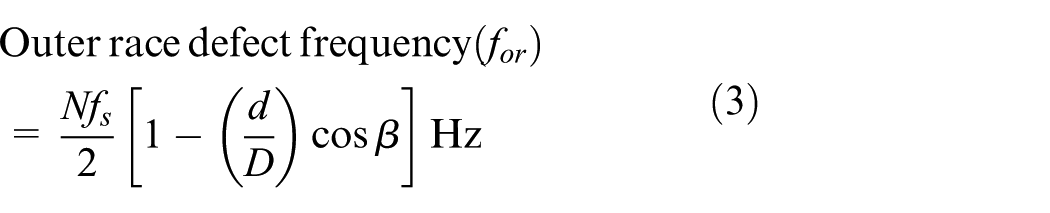
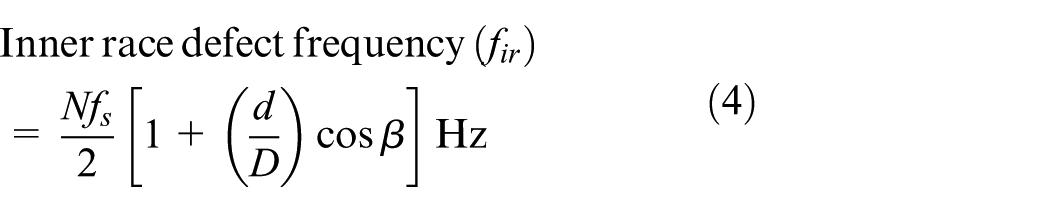

where N is the number of rolling elements, fs is the shaft rotational frequency, d is the rolling element diameter, D is the pitch circle diameter, and β is the contact angle.
Nature and sources of nonlinearity
The dynamic modeling of the bearing for high-performance applications enters into the domain of nonlinear systems. This is not surprising since the nonlinear modeling of the system has proved to be more realistic under stringent conditions. The deterministic nonlinear equations do not necessarily have regular solutions. During the last 40 years, researchers have documented irregular and unpredictable dynamic behavior of rigid rotors supported on rolling element bearings under external excitation. Nonlinear phenomena occurring in these systems are responsible for these irregular and unpredictable effects that lead to chaos. When the system is linear, the output is periodic and predictable too. When the system is nonlinear, the output is unpredictable, that is, it may be periodic or aperiodic like sub-harmonic or even chaotic. It is a characteristic of nonlinear systems that minor causes can have major effects, that is, the dynamic behavior is highly sensitive to parameter changes. For a linear system, the output frequency is of the same order as the input frequency and changes take place in terms of magnitude and phase change. However, for a nonlinear system, apart from frequency shift some additional frequencies are created as shown in Figure 4. Additional frequencies appear as harmonics of input frequencies or inter-modulation between them.

Output possibilities of (a) a linear system and (b) a nonlinear system.
In a real physical system, it is almost impossible to find an ideal or linear behavior under all conditions. The nonlinearity of the system may be aroused in a real system due to geometry, body forces, inertia, material, friction, and so on. 13 The nonlinear phenomenon, generated due to any of these reasons, is responsible for the irregular and unpredictable behavior of the system.
Nonlinear analysis of rolling element bearings
Nonlinear analysis of rolling element bearings include detailed physical modeling and is a useful tool for insight analysis. The nonlinear analysis of a rotor-bearing system also helps understand the system’s dynamics and predicts the system’s behavior under various operating conditions. Bearings are one of the major sources of nonlinearity in rotating machines which considerably affect the performance of the system, which leads to focus on the nonlinear analysis of rolling element bearings.
Having various sources, nonlinearity arises in a rotor-bearing system mainly due to internal radial clearance, unbalanced forces, preload, damping, and so on. This leads to the generation of nonlinear vibrations. Moreover, during continuous operation, many localized and distributed defects originated. These are also responsible for the development of nonlinear vibrations in bearings. However, bearings generate vibrations even if they are geometrically perfect. This is due to the use of a finite number of rolling elements that carry the load. The number of rolling elements and their positions change in the load zone with the rotation of the bearing, giving rise to a periodical variation of the total stiffness of the bearing assembly. This variation of stiffness produces vibrations, known as varying compliance (VC) vibrations.
Rolling element bearings act as one of the sources of vibration and have attracted substantial attention because of their nonlinear effects due to the Hertzian force deformation relationship, varying compliance, internal clearance, and defects such as waviness, spall, and dents. A rotor-bearing system with a circular cross-section of the shaft and with a circular disk, which is also called a symmetrical rotor, was the first system to be studied experimentally by Yamamoto 14 and theoretically by Mitropolskii 15 using an asymptotic method. Different models have been proposed to represent the vibrations of bearings. The first generalized analytical formulation of a cylindrical roller bearing has been proposed by Gupta.16,17 The study of nonlinear rotor dynamics and phenomena of chaos in rotor dynamics have been reviewed extensively by Ishida. 18
This article summarizes the literature on nonlinear analyses of rolling element bearings. It mainly focuses on nonlinearity generated through clearance, unbalanced forces, localized and distributed defects, and preload. Besides these, the nonlinearity analysis techniques are also reviewed and documented in this work. These are discussed in subsequent sections.
Nonlinearity due to clearance
Clearance, provided in the design of bearing to compensate for the thermal expansion, is also a source of vibration and introduces nonlinearity in its dynamic behavior. The study of the effect of clearance nonlinearity on the response of rotors has attracted a lot of attention, lately because of the development of high-speed rotors such as space shuttle main engine turbopump rotor. Yamamoto 19 has analytically investigated the vibratory behavior of a vertical rotor supported on ball bearings with radial clearance. He has concluded that the maximum amplitude of vibration at critical speeds decreases with the increasing radial clearance. Tamura and Taniguchi 20 have experimentally studied the motion of a horizontal shaft supported on ball bearings. The balls were moved in small steps for one ball passage. Bently 21 and Muszynska 22 examined the effect of bearing clearances at subcritical speeds. The authors noticed the presence of second- and third-order sub-harmonic vibrations based on their investigations. Sunnersjo 23 has reported theoretical and experimental work on a nonlinear model of rolling element bearings supporting a horizontal balance rotor with a constant vertical radial load. Nonlinearity was introduced due to Hertzian contact, radial internal clearance, and parametric effect owing to varying compliance. Gad et al. 24 analyzed the effects of varying compliance of a rigid rotor under pure radial load. Results showed the phenomenon of resonance when the frequency of the system coincides with the varying compliance frequency.
Ehrich 25 studied the Jeffcott rotor theoretically with clearance and in local contact with a bilinear oscillator. The authors observed the presence of subcritical super-harmonic and supercritical sub-harmonic responses. The dynamics of a shaft disk arrangement with bearing clearance nonlinearity has been analyzed by Flowers and Wu. 26 Numerical simulation and limit cycle analysis have been performed in the investigations. The authors have shown the generation of super-harmonic response, multivalued response, and periodic behavior. They have also performed experiments to study the effect of bearing clearance on shaft disk lateral vibration response and observed the presence of super-harmonics. The appearance of super-harmonics is attributed to bearing clearance and nonsymmetrical stiffness. Raghothama and Narayana 27 have examined the nonlinear responses of a rotor-bearing system equipped with gears. The authors employed incremental harmonic balance (IHB) method for the analysis and obtained promising results. Tiwari et al. 28 investigated the dynamic responses of a rotor-bearing system. The authors performed theoretical investigations and considered internal radial clearance for the examination.
Harsha et al. 29 developed a mathematical model for the examinations of structural vibrations of rolling element bearings. They performed theoretical investigations and demonstrated that the system shows undesirable jump phenomena with various nonlinear responses due to the internal radial clearance. Harsha 30 analyzed the nonlinear vibration responses of a rigid rotor-bearing system. The author considered the effects of clearance and speed and observed the periodic, sub-harmonic, and chaotic responses of the system. Harsha 31 also proposed a theoretical model for the analysis of nonlinear vibration of ball bearings due to internal radial clearance. The author observed chaotic responses of the system at higher speeds. Lioulios and Antoniadis 32 analyzed the nonlinear responses of a ball bearing. The authors have studied the effect of internal radial clearance and rotational speed and concluded that a small variation in rotor speed may lead to major changes in the system dynamics. Liqin et al. 33 studied the nonlinear phenomena in rolling element bearings theoretically. The authors analyzed a roller bearing with clearance and demonstrated that, as the clearance increases, both the nonperiodic and period-doubling bifurcation regions increase. Ghafari et al. 34 carried out theoretical investigations for the analysis of healthy bearings. The authors have employed lumped mass–damper–spring model and Hertzian contact theory for the investigation and summarized that, as the clearance increases, the equilibrium point of the bearing experiences a supercritical pitchfork bifurcation.
Kappaganthu and Nataraj 35 performed theoretical examinations to perform the nonlinear analysis of ball bearings. The authors proposed a 2-degree-of-freedom (DOF) model and solved the governing equations of motions using Runge–Kutta method. Various nonlinear phenomena such as limit cycle, quasi-periodic, chaotic, and others have been observed during the investigations. The authors also employed Lyapunov exponent to study the stability of the system. Gupta et al. 36 investigated the combined effect of rotating unbalance, clearance, and rotor flexibility on the dynamics of deep groove ball bearing. The authors summarized that the flexible rotor is less susceptible to instability at higher speeds. Xu et al. 37 analyzed the dynamic responses of the rotor-bearing system with clearance. The authors performed theoretical investigations and concluded that the proposed methodology is useful for the theoretical analysis of the rotor-bearing system. Nan et al. 38 have proposed an analytical model of the rotor-bearing system. The model accounts for the internal radial clearance, stiffness, and the shaft rotational speed. The results show that the variation in clearance leads to considerable changes in the responses of the system. Therefore, its value should be selected very carefully. Fernandez-del-Rincon et al. 39 presented a mathematical model for a geared rotor-bearing system. The authors investigated the system considering the clearance, variable compliance of bearing, and the meshing forces and meshing stiffness of the gears. The authors highlighted that the proposed model can be effectively used when the gear center distance is modified due to the shaft and bearing flexibilities.
Nonlinearity due to unbalanced forces
The development of unbalanced forces in real practices is an unavoidable effect. It is a challenging task to eliminate the unbalanced effect in a rotor-bearing system. Furthermore, the unbalanced effect cannot be avoided with the good balancing exercises and can only be reduced up to some extent. Various efforts have been made to examine the rotor-bearing system considering the unbalanced forces. Ruhl and Booker 40 have examined the effect of unbalanced forces in a turbocharger using finite element formulation. Results highlighted that, for a system having unbalanced effects, a fewer DOF model provides more accurate results over the others. Nelson and McVaugh 41 have further extended the work of Ruhl and Booker 40 and summarized that finite element model (FEM) is a useful tool to analyze the unbalanced forces in a rotor-bearing system. Saito 42 has studied the effect of an unbalanced Jeffcott rotor supported on ball bearings. The author also analyzed the effect of varying internal radial clearance in the investigations and concluded that maximum vibration amplitude is generated when the system exceeds the critical unbalance.
Tiwari et al. 43 have investigated the effect of unbalance along with internal radial clearance in the horizontal rotor-bearing system. The authors carried out theoretical investigations and concluded that in the presence of unbalanced forces the system exhibits multi-frequency excitations, while the higher value of clearance leads to more sub-harmonic components in the response. Harsha and Kankar 44 have investigated the nonlinear responses of ball bearing due to surface waviness and number of balls. The authors also considered the effect of unbalanced forces and concluded that a stiffer system has resulted by increasing the number of balls. Harsha 45 has examined the nonlinear behavior of a roller rotor-bearing system with the combined effects of unbalanced forces and speed fluctuations. The author utilized Poincaré maps to show the nonlinearity of the system and observed period doubling and mechanism of intermittency, which lead to chaos. Qiu and Rao 46 have adopted a fuzzy approach for the analysis of an unbalanced rotor-bearing system considering the uncertain parameters. The authors summarized that the fuzzy approach can predict the possible behavior of the system and it results in a more versatile and robust tool for the analysis.
Shen et al. 47 have considered unbalanced effects, originated from mass eccentricity and permanent deflection for the investigations of nonlinear vibrations of a rotor-bearing system theoretically. The authors observed promising results and concluded that the proposed model can be used effectively in practical applications. Sinou 48 has considered an unbalanced rotor-bearing system having a flexible coupling in his study. The author utilized harmonic balance method for the analysis and concluded that mass unbalance and radial clearance affect the nonlinear contact forces and the whirling motion of the rotor. Upadhyay et al. 49 have carried out nonlinear analysis of ball bearings considering the unbalanced rotor effects and internal radial clearance. The authors proposed that for a healthy rotor-bearing system, in the presence of unbalanced forces, the peak amplitude of vibrations is observed at an interaction effect of varying compliance frequency with shaft rotational frequency.
El-Saeidy and Sticher 50 have investigated the rigid rotor-bearing system considering the base excitations and mass unbalance. Kankar et al. 51 have studied the rotor-bearing system having distributed defects. Besides the defects, the authors considered unbalanced effects for the analysis. The authors utilized response surface methodology and Poincaré maps for the examination. Later, Kankar et al. 52 have analyzed the nonlinear performance of healthy and defective ball bearings theoretically. The authors considered localized defects in all the bearing components and summarized that severe vibrations are associated with defected inner race in the presence of unbalanced forces. Chouksey et al. 53 have carried out experimental studies on the rotor-bearing system. The authors employed finite element analysis (FEA) for the examinations. The results highlighted that FEA is an effective tool for the analysis of a rotor-bearing system under dynamic conditions. Upadhyay et al. 54 and Metsebo et al. 55 have proposed an analytical formulation for the investigations of the rotor-bearing system. The authors considered the rotor as a Timoshenko beam and the unbalanced forces were taken into account. Results highlighted that shaft dynamics has an influence on the dynamical response of ball bearings along with the unbalanced forces.
Nonlinearity due to preloading
For rolling element bearings, in the spindle of machine tools, it is necessary to manage specific negative values of the operational clearances between the bearing races and the rolling elements to improve the rotational accuracy and stiffness of the bearings. For attaining these aims, the internal load has been applied to bearings, which is known as preload. It is also a very important factor which affects the behavior of the rolling element bearing. However, a very small amount of work has been found in the field of bearing preload. Aktürk et al. 56 have analyzed the influence of bearing preload and the number of balls on the vibration of the rolling element bearing. The authors observed that the preload and the number of balls are among the most important parameters that affect the vibration signature of the system, and if the preload and the number of balls are selected correctly, the amplitude of the vibration can be reduced significantly. Mehra et al. 57 have investigated the effect of various factors such as damping, ball rotational frequency, and preload on the vibration characteristics of ball bearings. They noticed that in the presence of preload the oscillation frequency of the system increases. Alfares and Elsharkawy 58 analyzed the effect of the axial preloading on the dynamics of the angular contact ball bearing. The results indicate that the initial axial preload applied on the bearings plays an important role in decreasing the vibration amplitude levels of the grinding machine spindle system. Bai and Xu 59 have proposed a general dynamic model to analyze the dynamic behavior of the rotor-bearing system supported by ball bearings. They observed that the axial preload is an important governing parameter which affects significantly the stability of the rotor-bearing system. Bai et al. 60 have presented a similar 5-DOF bearing model to investigate the stability of the rotor-bearing system and suggested that unstable periodic behavior could be eliminated by applying adequately higher axial preload. Gunduz et al. 61 have investigated the effect of the bearing preload on the modal characteristics of the rotor-bearing system. The authors observed that the initial bearing preloads considerably influence the vibration response of the rotor-bearing system because of major changes in both off-diagonal and diagonal elements of the stiffness matrix. Wang et al. 62 investigated the responses of angular contact ball bearing considering the preload, Hertz contact, and elastohydrodynamic lubrication.
Nonlinearity due to localized defects
The vibration in rolling element bearing might be generated because of varying compliance frequency 23 or contact forces which exist between the different elements of the rolling element bearings. 63 This vibration signature changes in the presence of defects in bearing components. Generally, the bearing defects are classified as localized or point defects which include spalls, dents, pits, cracks, and bumps on the working surface, along with the bearing lubricant and particle contamination. Defects of this kind manifest themselves in the bearing’s vibration signal as vibratory transients, which result from discontinuities in the contact forces as the defect undergoes rolling contact.
The bearing characteristic frequencies, as discussed above, provide a theoretical approximation of frequencies, when numerous defects occur in the bearing components. These frequencies are based on the assumption that whenever the balls pass over the defect impulses have been generated. Igarashi and Hamada 64 presented their experimental study on the vibration responses generated by rolling element bearings with the defect. They formulated a mathematical expression for the main frequency and recurrence frequency of the vibration response. The intervals of these vibration pulses were found to be fixed irrespective of the pulse recurrence frequency and dent size. In another study, Igarashi and Yabe 65 investigated the sound characteristics of the rolling element bearing with single-point defect either on the rolling element or on the races. Swansson and Favaloro 66 presented a mathematical model of the contact action considering the spall on the rolling element. They demonstrated that the energy transferred to the impact point is proportional to the square of the velocity. The resultant acceleration of the impacted bearing race is also proportional to the energy of impact. The dominant factors in the impact action were found to include the defect size, bearing geometry, and rotor speed. They observed that the sound and vibration have the similar recurrence frequency but the vibration pulse has the sharper waveform. Furthermore, Igarashi and Kato 67 have examined the vibration responses generated by bearings with multiple defects. The responses help detect the ball bearing defects, number, their locations, and size.
McFadden and Smith68,69 have presented mathematical models to analyze the vibration response and the effect of several parameters such as transmission path and loading, along with single and multiple localized defects. Su and collegues70,71 extended the work of McFadden to describe the vibration responses recorded from a bearing with various defective components and subjected to a number of loading conditions. Ma and Li 72 have presented a system for the diagnosis and detection of localized bearing defects using hypothesis test theory. It was investigated that the vibration response of the defected bearing contains two alternating zero-mean Gaussian components with different variances, representing defect signature and background noise. Tandon and Choudhury 73 have presented a theoretical model to forecast the amplitude and vibration frequencies of rolling element bearings because of a localized defect on the inner race, outer race, and rolling elements, which are subjected to both axial and radial loads.
Kiral and Karagülle74,75 proposed a force model for the localized rolling element bearing defects. They employed time- and frequency-based technique for the diagnosis of bearing defects. Ghafari et al. 76 have inspected the influence of localized defects on the chaotic vibration of bearings. The presence of chaotic behavior has been validated using experimental vibration data. They found an infinite number of open orbits in the phase plane and strange attractor in Poincaré which confirm the chaotic nature. Rafsanjani et al. 77 have analyzed the influence of the localized surface defects on the dynamic response and stability of the rotor-bearing system using an analytical model. The vibration response obtained from the bearing system was also compared with the data obtained experimentally. It was observed that the defect frequencies are somewhat different from the calculated values as a consequence of skidding and slipping in the rolling element bearings. Patil et al. 78 have proposed an analytical model in which the nonlinearity due to the Hertzian contact was considered to predict the effect of the localized bearing surface defects. Kankar et al. 52 have presented a new improved theoretical model to analyze the behavior of the system at various rotating speeds of the rotor. In this model, the authors considered the localized defects on the bearing; in addition to the clearance, the Hertzian force was also considered in modeling. In another work, Kankar et al. 79 presented an analytical model to analyze the vibration signature of the high-speed rotor supported on a rolling element bearing with localized defects. Recently, Upadhyay et al. 54 have presented a model in which the shaft dynamics, localized defects, effect of unbalance, Hertzian force, and bearing clearance are considered. They observed that in the presence of a defect the system behavior is highly irregular or unstable. Patel and Upadhyay 80 have presented a 9-DOF system to analyze the nonlinear dynamic behavior of the rolling element bearing. They have concluded that the defect frequencies are somewhat different from the simulated results because slipping and skidding were not considered in the formulation of the rotor-bearing system.
Nonlinearity due to distributed defects
The other type of bearing defects is distributed defects, which are distributed over the complete surface of the bearing elements. These defects include surface waviness on the bearing races, off-sized rolling element, and misaligned races. 63 These defects may give rise to large contact forces, which result in untimely failure of the system. Defects of this kind occur because of either abrasive wear or manufacturing error. Therefore, the study of vibration responses generated because of distributed defects is essential for condition monitoring as well as quality inspection.
It is generally noted that it is not possible to manufacture a perfect product even with the finest possible machine tools and this also applies to the manufacturing of ball bearings. A defect is termed waviness if the wavelength of the waviness profile is considerably lengthier than the Hertzian contact width. 81 It may be generated by various manufacturing errors such as variable interfaces between the workpiece and the tool, irregular wear of the grinding wheel, vibrations in machine components, or the movements of the workpiece in the fixture. The significance of surface waviness from the perspective of vibration has been identified for a long time, but few investigations have been conducted because the measurement of surface waviness is very difficult. The main contribution in the analysis of rotor bearing system addressed in the 1960s with the development of vibration testing equipments. Moreover, these equipments were also able to measure the surface waviness. 82 A well-organized theoretical as well as experimental study of the vibrations generated by geometrical deficiencies was first carried out by Tallian and Gustafsson.83,84 They found the nature of the vibration responses of the outer race imperfection with axial loading. They also investigated the influence of surface waviness and observed that the small order race waviness also affects the amplitude of vibrations. Yhland 85 has noticed the relationship between the resulting vibration spectrum and surface waviness. He has calculated the radial and axial vibration frequencies for different waviness orders experimentally.
The distributed defects in the bearing races produced an excessive amount of repetitive surface and subsurface stresses, which cause their fatigue failure. Meyer et al. 63 have presented a mathematical model to forecast vibration displacement because of the distributed defects on the bearing races or on the rolling elements which are subjected to axial load. They derived the expressions for radial displacement of the stationary bearing race. Sayles and Poon 86 and Wardle and Poon 81 have observed that the main characteristics of the surface waviness are severe noise and vibration problem in rolling element bearings. They noticed that waviness generates vibrations at frequencies around 300 times the rotor speed, but when the speed is 60 times the rotor speed the phenomenon is more predominant. Wardle and Poon 81 have found the relationship between the number of waves and the number of balls for the occurrence of severe vibrations. If the numbers of waves and balls are the same, the vibration response is severe due to the regularity of loading and all balls vibrate in the same phase.
Wardle87,88 has shown theoretically as well as experimentally that outer race waviness produces vibrations at the harmonics of the outer race ball passage frequency. Similar observations have also been reported by Tallian and Gustafsson. 83 Franco et al. 89 have found that to a certain extent the inner race surface waviness is more complex than that forecast by Tallian and Gustafsson 83 and Meyer et al. 63 Prasad 90 has investigated the causes of failure of rolling element bearings used in alternators and established the reasons as to why the bearings used in a particular design of alternators fail prematurely. The voltage across the bearings leading to the passage of electric current and the development of magnetic flux density on the bearing elements is experimentally determined, which causes premature failure of the rolling element bearings of the alternators. His findings provide overall guidelines to designers to avoid premature failure of bearings.
Choudhury and Tandon 91 have presented a theoretical model to find out the vibration response of rolling element bearings having distributed defects. They discussed race mode or flexural vibration of races because of the various types of distributed defects in rolling bearings. Aktürk 92 has inspected the influence of the bearing surface waviness on the vibration response of the rotor. He observed that the frequency spectrum has specific frequency components for each order of surface waviness for outer race, inner race, and ball waviness. Lynagh et al. 93 have proposed a brief model for the analysis of bearing vibration, which incorporates the impact of nonlinear contact spring in ball-to-raceway contacts. The model also includes the effect of the internal radial clearance, surface waviness, and off-sized balls on the dynamics of the bearing. This model is used successfully in the recognition of complex real-time vibration spectra of a precision routing spindle, obtained by accurate noncontact sensors.
Tiwari 94 has presented an experimental model for the examination of vibration responses of the rotor-bearing system and observed the period-doubling phenomenon. Jang and Jeong95,96 presented a nonlinear model to investigate the vibration response of the ball bearing having waviness on the rotor. They have observed the exciting frequencies and their harmonics resulting from the various kinds of waviness in rolling elements. Fillon et al. 97 and Fillon and Bouyer 98 have measured the thermo-hydrodynamic performance of a worn plain journal bearing. The defects caused by wear are centered on the load line and range from 10% to 50% of the bearing radial clearance. However, the conclusions of the study showed that wear defect could lead to an increase in thermo-hydrodynamic performances.
Harsha et al. 29 have presented a mathematical model for the rotor-bearing system by considering the different sources of nonlinearity like surface waviness, Hertzian contact force, and redial internal clearance. It has been observed that due to the surface waviness and radial internal clearance the system shows unwanted jump phenomenon with sub-harmonic, quasi-periodic, and chaotic motions. In another study, Harsha et al. 99 have proposed a theoretical model to find out the nonlinear dynamic behavior of a rotor-bearing system having surface waviness. The authors compared the findings of their work with the results of earlier studies and observed a good agreement. The stability analysis of the rotor-bearing system in which the rotor is considered as rigid and supported by ball bearings has been performed by Harsha and Kankar. 44 They observed that the number of waves and the number of balls in the bearing are the most significant factors that affect the dynamic behavior of the rotor-bearing system. Harsha 100 has investigated the nonlinear behavior of a rotor-bearing system in which a balanced rotor is supported by ball bearings, and derived the mathematical expression for tangential motions of roller element bearings along with inner and outer races. They observed the presence of regimes such as periodic, quasi-periodic, sub-harmonic, and chaotic, which are strongly dependent on surface defects. Harsha and Nataraj 101 have presented an analytical model to investigate the nonlinear vibration analysis of the rotor-bearing system having waviness on rolling elements by factorial design of experiments.
It is impossible to produce an identical set of rolling elements even with the finest machine tools. There are always some variations in their dimensions (less than the machine tolerance). This variation is known as off-sized rolling element. The existence of off-sized rolling element in a bearing further generates problematic vibrations in the rotor-bearing system. As an outcome of experiments, a precise relationship has existed between the vibration factors and the internal dimensions of bearings for the different elements. The rolling elements affect the system behavior more in comparison to the inner and outer races 82 under the application of dynamic loading. Gupta 102 has investigated the influence of the size of an off-sized ball on the performance of rolling element bearings, and found that if the size increases, it results in degraded performance of the system. He also noticed that if the size of the balls increases, the profile of the cage whirl orbit has been changed from circular to slightly polygonal. Barish 103 has also noticed the similar observation as Gupta. 102 Franco et al. 89 have analyzed the vibrations generated due to an off-sized rolling element at the cage speed which is distributed randomly within the bearing. They found that when there is only single oversized ball, then the most leading vibration appeared at the cage rotation speed. Aktürk and Gohar 104 have analyzed the influence of the variation of rolling element size in the bearings on the vibration of the rotor. They observed that off-sized balls in the bearing cause vibrations at a particular cage speed and its harmonics, depending on the arrangement within the bearing.
Harsha 105 has presented a mathematical model to analyze the dynamic behavior of a rotor-bearing system due to the off-sized rolling element. The results highlighted that the peak amplitude of vibrations due to off-sized ball are at a speed of the number of balls times the cage speed. In another work, Harsha et al. 106 developed a mathematical formulation to examine the influence of the cage run out on the nonlinear dynamic behavior of a rotor-bearing system. In this mathematical model, the sources of nonlinearity such as the cage run out and Hertzian contact forces, resulting transition from no contact-to-contact state between the balls and races has been considered. Harsha 107 has presented an analytical model to investigate the nonlinear dynamic behavior due to cage run-out in a rotating system supported by two rolling element bearings. It has been observed from the response plots that because of nonuniform positioning, the ball passage frequency is modulated with the cage frequency. Nataraj and Harsha 108 have investigated the vibration signature of an unbalanced rotor-bearing system because of cage run-out. The vibration response has been divided into three regions: periodic, quasi-periodic, and chaotic. Cao and Xiao 109 have developed a dynamic model for the double-row spherical roller bearing and analyzed various bearing surface defects, such as distributed and localized, in their model. Kankar et al. 79 and Wang et al. 62 have presented an analytical model for the analysis of nonlinear vibration signature of rolling element bearing with race imperfection. They have included nonlinearity due to surface waviness, contact stiffness, Hertzian contact, and radial internal clearance. Babu et al.110,111 have developed a mathematical model for a rigid rotor supported by two angular contact bearings by considering the 6-DOF system and waviness on the bearing races and rolling element. They observed that waviness in rolling elements increases the nonlinear load–deflection characteristics, which produces sideband frequencies, and the amplitude of these frequencies are comparatively small.
Nonlinearity analysis techniques
The stability of the rotor-bearing system can be classified into three categories: periodic, quasi-periodic, and chaotic. The qualitative assessments of the stability of rolling element bearings have been performed using Poincaré maps or phase trajectory in most of the studies. On the other hand, the quantitative assessments have been carried out using Lyapunov exponent, correlation dimension, fractal dimension, and others. Mevel and Guyader 112 have performed theoretical investigations for the analysis of ball bearings. The authors employed Lyapunov exponent in their investigations and observed the sub-harmonic and quasi-periodic nature of the system at resonance. Logan and Mathew113,114 have attempted to quantify the chaos in rolling element bearings theoretically and experimentally. The authors utilized correlation dimensions and summarized that the correlation dimensions can be used effectively up to a limited number of time series data points; however, it failed beyond that. This study also suggests taking the utmost care during the analysis using correlation dimensions. Jiang et al. 115 have explored the applicability of correlation dimensions for gearbox condition monitoring. The authors summarized that the proposed methodology can be effectively used for health diagnostics, but is significantly affected by the presence of high noise levels. Rolo-Naranjo and Montesino-Otero 116 have proposed a correlation dimension–based methodology for the analysis of rolling element bearings. The authors performed theoretical and experimental investigations for the analysis and concluded that the proposed methodology is effective for the extraction of correlation dimensions, which can further be used to examine the nonlinearity. Choy et al. 117 used the improved Poincaré map for the quantification of damages in roller and taper bearings. They observed that the modified Poincaré map gives information on the type of damage based on the cage rotation speed.
Changqing and Qingyu 118 have carried out an extensive study to observe nonlinearity of a balanced rotor-bearing system with varying clearance. The authors employed Lyapunov exponent to diagnose the nonlinearity. Results highlighted that clearance is an important factor which should be determined by operating conditions of the bearing and Lyapunov exponent can be effectively used to identify the nonlinearity of the system. Inayat-Hussain 119 has performed theoretical investigations to study the nonlinear vibrations of an unbalanced rigid rotor supported on magnetic bearings. The authors analyzed the nonlinearity of the system using Poincaré maps and suggested that the nonsynchronous and chaotic vibrations generate cyclic stresses in the rotor and may lead to fatigue failure of the system. Ghafari et al. 76 have examined the effects of localized defects on ball and roller bearings. The authors carried out experimental investigations and employed Lyapunov exponent and correlation dimension for the analysis. The study summarized that chaotic parameters have great potential and can be used to monitor the health of the rolling element bearings effectively.
Chang-Jian 120 has studied a geared-bearing system considering the nonlinear suspension, nonlinear oil film, and nonlinear gear mesh force. The authors employed several chaos quantification parameters such as phase diagrams, power spectra, Poincaré maps, Lyapunov exponent, and fractal dimensions for the analysis and obtained satisfactory results. Hou and Li 121 have proposed a delay vector variance (DVV) method to diagnose the nonlinearity of a geared system. The authors performed theoretical investigations and observed that the methodology is useful to detect the nonlinearity of the system. Kappaganthu and Nataraj 35 and Gupta et al. 36 have employed Lyapunov exponent and Poincaré maps to recognize the chaotic regions in the rotor-bearing system and recognized various nonlinear regimes. Yan et al. 122 have examined the stability of a rotor-bearing system by permutation entropy. The authors performed theoretical and experimental investigations for the analysis and compared the performances of other complexity measures such as Lyapunov exponent and approximate entropy with the permutation entropy. The results showed that permutation entropy can effectively diagnose and detect the dynamic changes and characterize the bearing operating conditions. Sharma et al.123,124 have employed Poincaré maps and other response plots for the stability analysis of the healthy unbalanced rotor-bearing system, equipped with cylindrical roller bearings. The authors analyzed the responses of the system over a wide range and the results showed that the dynamic behavior of the system is sensitive to small variations of the system parameters and Poincaré maps can be used for common analysis of the system. Patel and Upadhyay 80 carried out theoretical investigations for the analysis of cylindrical roller bearing. The authors have employed orbit plots and Poincaré maps for the analysis of nonlinearity.
Conclusion and future aspects
The rolling element bearings are used in a wide range of rotating machines and play a vital role in their healthy operation. The performances of bearings are closely associated with the several governing parameters such as the lubricant, load, temperature, speed, irregularities on contact surfaces, lubrication regimes, and others. Studies show that the atmospheric conditions also affect the performance of the bearings.125–127 This work has summarized the earlier published literature on nonlinear dynamics analysis of rolling element bearings, and from this study the following conclusions are drawn:
A large number of analytical models have been proposed by several authors. Every model has its own advantages and limitations over the others. The rotor-bearing system is observed as an extremely sensitive component, and small variations in the system parameters such as the number of rolling elements, speed, load, and initial conditions will change the behavior of the system.
The internal radial clearance is an important parameter in the investigations of the nonlinear dynamic behavior of the rotor-bearing system. The smaller values of clearance would lead to the direct metal-to-metal contact between the ball and races, and the higher clearance values would result in larger unstable regimes. Moreover, it has been observed that the higher clearance would also increase noise at low and moderate rotor speeds, which covers the useful frequencies of the bearing.
The localized and distributed defects are generated over a period of time on the surfaces of bearing components. However, some of the localized defects are generated during handling and installation of the bearings. The profiles of these defects are unpredictable and produce undesired and stochastic vibrations. It is also observed that the rotor-bearing system produces severe unstable (chaotic) vibrations when the defects are located on the inner race surface. The severity of defects has a great impact on the stability of the system; however, its permissible limit depends upon the application.
The following points can be drawn as research gaps and can be considered for future studies:
In most of the previous studies, the shaft is considered as rigid, but at higher rotating speeds, this assumption will provide inaccurate results. Thus, the shaft should be considered as flexible for more accurate modeling.
The optimal values of clearance, damping, and preloading for every operating condition need to be identified.
In the majority of works, the effects of the unbalance forces were neglected, but actually it is not possible to avoid the unbalance completely. So, to develop a more realistic model, the effect of the unbalanced force should be considered.
The defects are generated in the bearings over a period of time. However, in previous studies for the analysis of defects, the developing stages of defects were not considered. The bearing produces notable signals in their developing phase and these are helpful for the effective health assessment of the bearings and associated system.
Fewer methodologies have been developed for the qualitative and quantitative analyses of nonlinearity in rolling element bearing. More robust and simplified techniques need to be explored. These techniques can further be examined on rotor-bearing systems in various operating conditions by performing a number of theoretical and experimental investigations.
Footnotes
Handling Editor: Ayan Sadhu
Declaration of conflicting interests
The author(s) declared no potential conflicts of interest with respect to the research, authorship, and/or publication of this article.
Funding
The author(s) received no financial support for the research, authorship, and/or publication of this article.
