




Abstract
An improved multi-objective particle swarm optimization with time-varying parameter and follower bee search is proposed in this article. In this algorithm, the weight of personal best solution decreases gradually as the iteration continues. This approach eliminates the effect caused by its poorer quality compared to global best solution so that the convergence ability of the algorithm is improved. Furthermore, the follower bee search in artificial bee colony algorithm is introduced to strengthen the randomness of the algorithm and discover more non-dominated solutions. A comparative simulation study is carried out using internal raw ore dispatching in an iron mining group that contains multiple stopes and concentrating mills. The results show that the proposed algorithm can significantly improve convergence and diversity.
Keywords
Introduction
Multi-objective problems exist extensively in industrial production and daily life. Since there are conflicts between each objective, a unique optimal solution does not exist in a multi-objective problem. 1 Therefore, the goal when analyzing a multi-objective problem is to find a set of non-dominated solutions rather than a single solution. A non-dominated solution is also called a Pareto solution and a set of them form the Pareto front in the objective space. Moreover, the solutions are required to be as close as possible to the real front, distributed uniformly and broad. Particle swarm optimization (PSO) 2 is more and more widely applied in various optimization problems, including complex multi-objective problem. 3 The PSO that is used to solve a multi-objective problem is called the multi-objective particle swarm optimization (MOPSO). Recently, some scholars have improved the MOPSO by introducing chaotic sequences 4 and mutations. 5 There are numerous MOPSO applications, such as actuator designs, 6 train scheduling for urban rail transit, 7 electrical distribution systems, 8 and the design of efficient automatic train operation (ATO) systems’ speed profiles for metro lines. 9
An iron mine group contains a number of stopes and concentrating mills with years of development. The raw ore can be transported from any stope to any concentrating mill inside. For various reasons, different stopes and concentrating mills have different technical and economic indexes. The raw ore dispatching inside the group directly affects the iron concentration indexes. Therefore, the allocation of raw ore can be regarded as a multi-objective problem in which the decision variables are the amounts transported from each stope to each concentrating mill.
According to the interaction and variation between global best solution (gbest) and personal best solution (pbest) in the PSO search iteration, an improved PSO with time-varying parameter and the follower bee search is proposed and named TF-PSO (PSO based on time-varying parameter and follower bee search). In this method, the effect of pbest is weakened in the iteration process (as its quality is below gbest) in order to improve the solution quality. Moreover, the follower bee search is executed for expanding the search space, especially in later iterations. Consequently, the TF-PSO is transformed into TF-MOPSO (MOPSO based on time-varying parameter and follower bee search) by introducing external memory and its maintenance method, redesigning the selection operators and search range of the follower bee and updating pbest in order to solve the multi-objective problem. Moreover, the simulation studies and results show that the Pareto front obtained by the proposed algorithm has a more uniform distribution than the traditional MOPSO and other improved MOPSO that were recently reported.
An improved PSO with time-varying parameter and follower bee search
Analysis of the traditional PSO
PSO is a kind of swarm intelligence optimization algorithm that imitates the foraging behavior of a flock of birds. In this method, each bird is viewed as a particle, and the particle is driven by gbest and pbest to search for the optimal solution. The velocity and position updating equations are shown as follows


where
Tian
10
proved that the position of a single particle will approach
Time-varying parameter
After the analysis above, a modification that gradually reduces the coefficient of pbest is necessary. The method decreases

where
Follower bee search
The follower bee search is the operator that improves the search effectiveness of follower bees around leader bees in an artificial bee colony (ABC) algorithm.11,12 It can effectively modify the randomness of the algorithm. This operator consists of two parts. One part is the selection of a leader bee selection based on roulette. It makes the leader bee with a higher quality attract more follower bees. The other part is that each follower bee stochastically searches around the selected leader bee. The one who finds the best honey source becomes the new leader bee. In the TF-PSO, a particle is treated as the leader bee in an ABC, and the particle with best fitness value has the higher probability of being chosen.
An improved MOPSO with time-varying parameter and follower bee search
Since the final goal in solving a multi-objective problem is to acquire a set of uniformly distributed non-dominated solutions, the following operators are also necessary for the MOPSO.
Maintaining the external memory
The set used to store non-dominated solutions is called external memory and its capacity is usually the same as the population of the MOPSO. When the number of non-dominated solutions exceeds the external memory capacity, partial non-dominated solutions need to be removed. Likewise, in order to further enhance the uniformity of non-dominated solutions, the more crowded non-dominated solutions based on Euclidean distance in the objective space will be preferentially removed. The maintenance steps are listed as follows:
Step 1. Sort all non-dominated solutions according to the fitness values of the first objective;
Step 2. Calculate the Euclidean distances between sorted non-dominated solutions based on the fitness values of all the objectives;
Step 3. Find the shortest distance, denoted as
Step 4. Compare
Step 5. Repeat Steps 2 through 4 until the number of non-dominated solutions is equal to the capacity of the external memory.
Calculating the selection probability and search range of the follower bee
In TF-MOPSO, non-dominated solutions are the followed objects of follower bees. Furthermore, the selection probability and search range of the follower bee calculation method are based on the average distance on both sides of the sorted non-dominated solution in order to make the non-dominated solutions spread as uniformly as possible. The chosen probability of each non-dominated solution is calculated by equation (4)

where
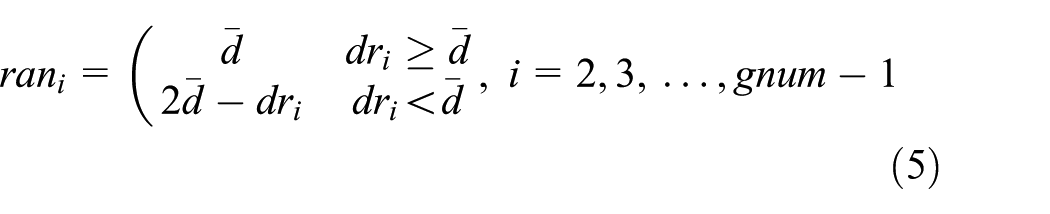
where

where
Updating the pbest of each particle
Each objective conflicts with each other in a multi-objective problem. Therefore, the fitness values of all the objective functions should be treated as the factors applied to compare the two solutions. Furthermore, because the value range of each objective is usually not the same as each other, even with several orders of magnitude, a criterion up is proposed in the article and used to compare two non-dominated solutions for updating the pbest of each particle

where
The steps of TF-MOPSO
The complete TF-MOPSO consists of the operators mentioned above in a certain order, and the concrete procedure for implementing the proposed algorithm is given by the following steps:
Step 1. Initialize the positions and velocities of all the particles in the swarm;
Step 2. Calculate the fitness value of every objective for each particle, pick up the non-dominated solutions and store them to the external memory;
Step 3. Select a non-dominated solution from the external memory instead of gbest in equation (2) and update the positions and velocities of all the particles according to equations (2) and (3); update the pbest of each particle;
Step 4. Merge the new solutions obtained by the step above with the solutions in external memory and pick up the non-dominated solutions. If the number of non-dominated solutions exceeds the capacity of the external memory, execute the maintenance;
Step 5. Execute the follower bee search operator according to equations (4)–(6); update the pbest of each particle again;
Step 6. Execute Step 4 again;
Step 7. Return to Step 3 until the iteration runs up to the maximum number.
Raw ore dispatching problem in an iron mining group
The production of iron concentrate includes the two major steps of mining and concentration. The site of the mining operation is called the stope, and the site of concentration is called the concentrating mill. A mine group consists of five stopes and ore concentrating mills, and raw ore produced at the different mining sites can be sent to any concentrating mill for processing. Because of the differences in raw ore properties and mining technology, the raw ore indexes and prices of different stopes are also different. Similarly, due to the management level, process differences and other factors, production capacity and the cost of each concentrating mill, are different. Consequently, by adjusting the amount of raw ore transported from different stopes to different concentrating mills, the technical and economic indexes of iron concentrate production of the whole mine group can be changed. Combined with the constraints existing in the real production of the mine, a multi-objective optimization problem is formed.
The multi-objective optimization problem includes the two objectives of maximum output of concentrate in unit time and minimum variable cost of unit concentrate. Moreover, there are four constraints. The first constraint is the mill feed grade of each concentrating mill. Due to the requirements of the concentration process, the concentrating mill can only handle raw ore of a certain grade. The second constraint is the concentration ratio of the whole mining group. To ensure the effective utilization of raw ore, it must be less than a certain value. The third constraint is the mill feed grade of each concentrating mill. This means that the raw ore transported from each stope during the unit time cannot exceed its mining capacity and must be less than the requirements of the group. The last constraint is the processing capacity of each concentrating mill, which is similar to the constraint of the stopes.
Objective 1: maximum output of concentrate

where

where

is the mill feed grade of the jth concentrating mill and
Objective 2: minimum variable cost of unit concentrate

where

and

where
Constraint 1: mill feed grade of each concentrating mill

where
Constraint 2: concentration ratio of the whole mining group

where
Constraint 3: raw ore output of each stope

where
Constraint 4: processing capacity of each concentrating mill

where
The parameters required for the above model are listed in Tables 1–4.
Comprehensive production parameters.

Raw ore parameters.

Concentrating mill parameters.

Transportation cost.

The mining group studied in this article includes 5 stopes and 5 concentrated mills, which results in 25 raw ore transportation paths. The volume of the raw ore transported on these 25 paths are the decision variables of the dispatching problem. By integrating the objectives and constraints mentioned above, a 25-dimension bi-objective problem with numerous constraints is formed as the object of the TF-MOPSO and contrast algorithms.
Simulation
In this article, the traditional MOPSO, Multi-objective adaptive chaotic particle swarm optimization (MACPSO), 4 and Multi-objective particle swarm optimization with two normal mutations (MN-PSO) 5 are selected as the compared algorithms. The proposed method and the comparison algorithms are applied for internal raw ore dispatching in an iron mining group. All the simulations are performed on a personal computer (PC) with the Windows 7 operating system, VC++, an Intel® Core™ i3-330M Processor, and 3 GB of memory. The general parameters of the proposed algorithm are selected as ω = 0.7, a = 0.9, c1 = c2 = 1.35; the external memory and population number are 100, and the maximum number of iterations is 500.
The fitness values of the four pairs of endpoints are shown in Table 5, where
Simulation result.
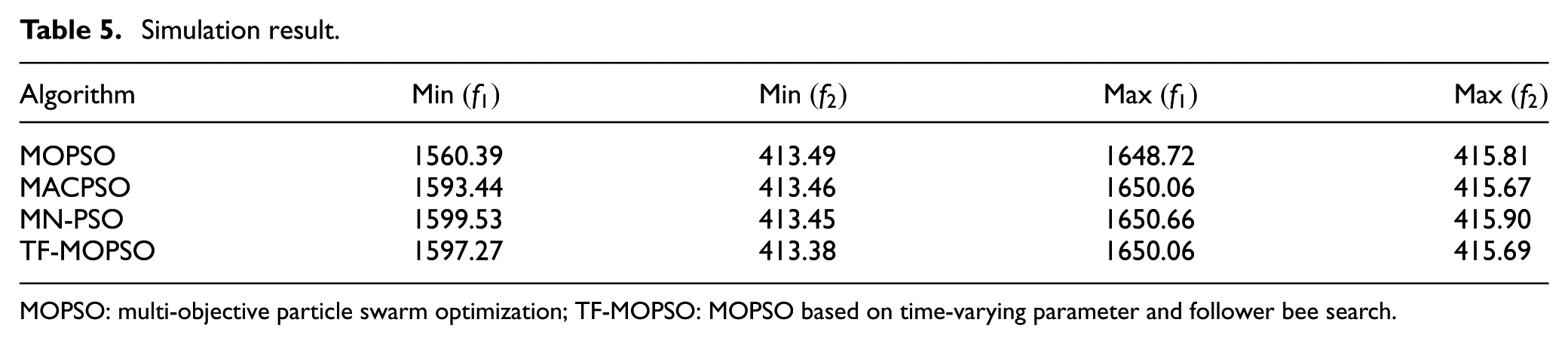
MOPSO: multi-objective particle swarm optimization; TF-MOPSO: MOPSO based on time-varying parameter and follower bee search.

Simulation results.
Conclusion
The main contributions of this article are a new improved MOPSO with time-varying parameter and follower bee search and its application in internal raw ore dispatching in an iron mining group. Contrasted simulation results with several algorithms show that the proposed algorithm has the best performance in convergence and distribution to the multi-objective problem with multiple constraints presented in this article. Future studies will focus on the theoretical research of the stability of the proposed algorithm in order to ensure its reliability.
Footnotes
Handling Editor: Gang Chen
Declaration of conflicting interests
The author(s) declared no potential conflicts of interest with respect to the research, authorship, and/or publication of this article.
Funding
The author(s) disclosed receipt of the following financial support for the research, authorship, and/or publication of this article: This work was supported by the Beijing Key Discipline Development Program (No. XK100080537).