




Abstract
A multidisciplinary design optimization model is developed in this article to optimize the performance of the hard rock tunnel boring machine using the collaborative optimization architecture. Tunnel boring machine is a complex engineering equipment with many subsystems coupled. In the established multidisciplinary design optimization process of this article, four subsystems are taken into account, which belong to different sub-disciplines/subsytems: the cutterhead system, the thrust system, the cutterhead driving system, and the economic model. The technology models of tunnel boring machine’s subsystems are build and the optimization objective of the multidisciplinary design optimization is to minimize the construction period from the system level of the hard rock tunnel boring machine. To further analyze the established multidisciplinary design optimization, the correlation between the design variables and the tunnel boring machine’s performance is also explored. Results indicate that the multidisciplinary design optimization process has significantly improved the performance of the tunnel boring machine. Based on the optimization results, another two excavating processes under different geological conditions are also optimized complementally using the collaborative optimization architecture, and the corresponding optimum performance of the hard rock tunnel boring machine, such as the cost and energy consumption, is compared and analysed. Results demonstrate that the proposed multidisciplinary design optimization method for tunnel boring machine is reliable and flexible while dealing with different geological conditions in practical engineering.
Keywords
Introduction
Tunnel boring machine (TBM) was first designed by Maus in 1846. 1 However, it was not widely adopted until 1960s when Robbins and Wilson mostly solved the challenges in cutter adjustment, cutterhead driving, and thrust. 2 With the rapid modern technology development of cutters, actuation, support, regripping, and thrust, the applications of TBM have exhibited high effectiveness, security, and environmentally friendly characteristics. Up to now, TBM, especially the hard rock one, has become one of the most important equipment in the constructions of railway, highway, water conservancy, and urban construction. Nevertheless, there are many challenges existing in the practical tunneling engineering, such as the tool wear, inefficient excavation, and inaccurate control. 3
To address these challenges, a significant amount of work has been done in the past decade. Rostami 4 gave a review on the existing prediction models for TBM’s performance and the current development in performance estimation for TBM utilization. Zare and Mikaeil 5 used the two-dimensional (2D) discrete element method (DEM) to optimize the cutter spacings and found that the optimum cutter spacings are in the range about 110–140 mm for different joint frequencies. Armaghani et al. 6 developed a new prediction model for the TBM’s performance based on the gene expression programming (GEP), which was certified to be capability and superior in comparison with other prediction models. Fattahi and Babanouri 7 used the hybrid of support vector regression (SVR) and the differential evolution (DE) algorithm, artificial bee colony (ABC) algorithm, and gravitational search algorithm (GSA) to predict the TBM’s performance and found that the hybrid of DE and SVR is more robust than other combinations. Acaroglu et al. 8 established a fuzzy logic model based on cutting tests to predict specific energy requirement of constant cross-sectional disk cutters in the rock cutting process; they reported that the model could provide a realistic estimate of specific energy level by inputting variable conditions. Benardos and Kaliampakos 9 used the artificial neural network (ANN) to assess the advance rate of TBM considering the geological and geotechnical site conditions and successfully applied this method in practical tunneling engineering. Martins and Miranda 10 used data mining tools, including ANN and support vector machine (SVM) algorithms, to establish models for predicting the penetration rate of TBM and found that the ANN model performs the best and the peak slope index is the most critical parameter among all the input variables. Cho et al. 11 performed a numerical simulation of three-dimensional (3D) dynamic failure by AUTODYN-3D to determine the optimum cutter spacing. The results showed that the optimum cutter spacing deduced from numerical simulations agreed well with those determined from linear cutting machine (LCM) tests. Xia et al. 12 designed and optimized the TBM cutters utilizing the multi-geologic conditions optimization (MMCO) program, and the results showed that the optimization significantly improved the working performance of the cutters under all geological conditions considered. Sun et al. 13 proposed a new cutter layout design method named variable-velocity spiral and optimized the edge disk cutters oblique angle, polar radius, and polar angle using nondominated sorting genetic algorithm II (NSGA-II). By applying this method to the TB880E models cutterhead, it is found that the TBM’s performance was significantly improved.
Nevertheless, TBM is a complex engineering equipment composed by many subsystems that belong to different disciplines, such as the cutterhead system, the cutterhead driving system, and the thrust system, as shown in Figure 1. Most of the previous studies only focused on a single subsystem or sub-discipline and ignored the inter-effects between different disciplines. Thus, it is essential and desirable to design and optimize the TBM from the perspective of the whole machine. Multidisciplinary design optimization (MDO) has been proved to be an effective optimization method to deal with the complex engineering systems by exploiting the interactions between disciplines, and it has been successfully applied in the design of complex engineering systems, such as aircrafts, automobiles, and underwater vehicles. 14 To this end, a MDO of the hard rock TBM using collaborative optimization (CO) architecture is developed in this paper to solve the multidisciplinary coupling problem, thereby significantly improving the design performance of the hard rock TBM.

The whole structure of the hard rock TBM. 3
The reminder of this article is organized as follows. Section “Review of MDO and CO algorithm” provides the description of the MDO and CO architecture. Section “Technology models of the hard rock TBM’s subsystems” gives the TBM’s performance indexes used in this article and analyzes the technology models of the subsystems of the hard rock TBM, including the cutterhead system, the thrust system, the cutterhead driving system, and the economic analysis. In section “MDO based on CO architecture,” the MDO for hard rock TBM is established using the platform of MATLAB based on the CO architecture. Section “Optimization results” gives the optimization results and does analysis on the optimization objective, the design variables, and the constraints. Section 6 gives the conclusion of this article.
Review of MDO and CO algorithm
MDO description
MDO is a design methodology prompting the designers to consider the coupling relationship between the parameters from different disciplines in a strongly multidisciplinary coupling system, as defined by the Langley Center of NASA. 14 A typical mathematical model of MDO can be formulated as follows
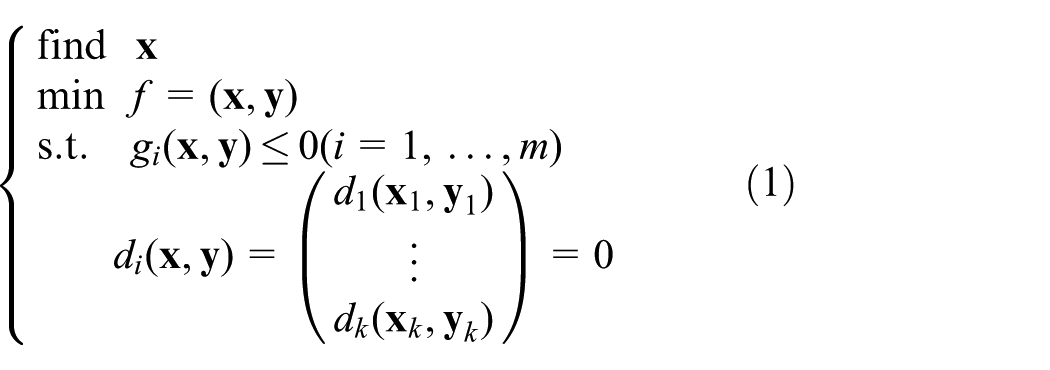
where
There are two types of design variables: the global design variables related to multiple sub-disciplines simultaneously and the local design variables only related to their respective sub-disciplines.
CO algorithm description
Among the algorithms of MDO, CO architecture has developed into a highly effective optimization design method since it was first proposed by Braun et al. 15 CO performs in a highly efficienct manner in decomposing, collaborating, and comprehensive optimizing. During computing, every sub-discipline in CO architecture can keep a high self-consistency without taking other sub-disciplines into account, so the CO architecture can realize the distributed design and collaborative design. Due to these advantages, the CO architecture has been widely used in the MDO of complex engineering systems, such as undersea vehicles, 16 aircrafts,17,18 and automobiles.19,20
A typical CO architecture consists of two levels: a system level and a parallel sub-discipline level, as shown in Figure 2. The system-level optimizer distributes the objective expectations of the system design variables to each individual sub-discipline level; the sub-discipline optimizer seeks to minimize the difference between the objective expectations of the system design variables and corresponding local sub-discipline design variables. After the optimization in the sub-discipline level, the systematic consistency constraint is formed to solve the inconsistency problem between different sub-disciplines. Through multi-iterations, an optimal solution with an acceptable consistency between different disciplines is obtained.

A typical collaborative optimization (CO) architecture.
Technology models of the hard rockTBM’s subsystems
Cutterhead system
During the tunneling operation, the cutters change is complicated and time-consuming, which can increase the total cost and prolong the construction period. The cost of the cutterhead system is mainly affected by the cutter life. The cutters installed at the edge (the maximum radius) of the cutterhead generally have a shorter lifetime than other cutters due to the large turning radius. The cutter lifetime model proposed by Wijk 21 is adopted and modified in this article

where, the corresponding notations are explained in the Appendix.
Thrust system
The thrust system provides the power for the whole TBM to break the rock and excavate forward on. A suitable and stable thrust means a high tunneling rate and accurate tunnel route, which significantly affects the tunnel construction quality of the hard rock TBM. The thrust provided by the thrust system has been modeled by Ozdemir and Miller 22

So, the total thrust and power of the thrust system are


Cutterhead driving system
The cutterhead driving system is the power source for the cutterhead to rotate and overcome the rock resistance. Owing to the complex geological conditions, a high power output is desired for the cutterhead driving system. The tangential force provided by the cutterhead driving system can be formulated 22

And the total torque and power of the cutterhead driving system are


Economic analysis
Tunneling cost per unit length is used in this article to assess the cost of the tunneling engineering excavated by the hard rock TBM, and it consists of two parts: the normal excavation cost and the tools cost as formulated in equation (9)

The energy-consumption index is defined as the energy consumption per unit length, and it could be obtained as follows

Performance
In general practical engineering, a minimum construction period is usually set as the overall project objective considering the constraint of cost and energy. In this article, the construction period is divided into two parts, including the normal construction time

where

MDO based on CO architecture
MDO establishment
According to the technology models established in the section above, the overall MDO model of the hard rock TBM based on CO algorithm can be described as follows

where
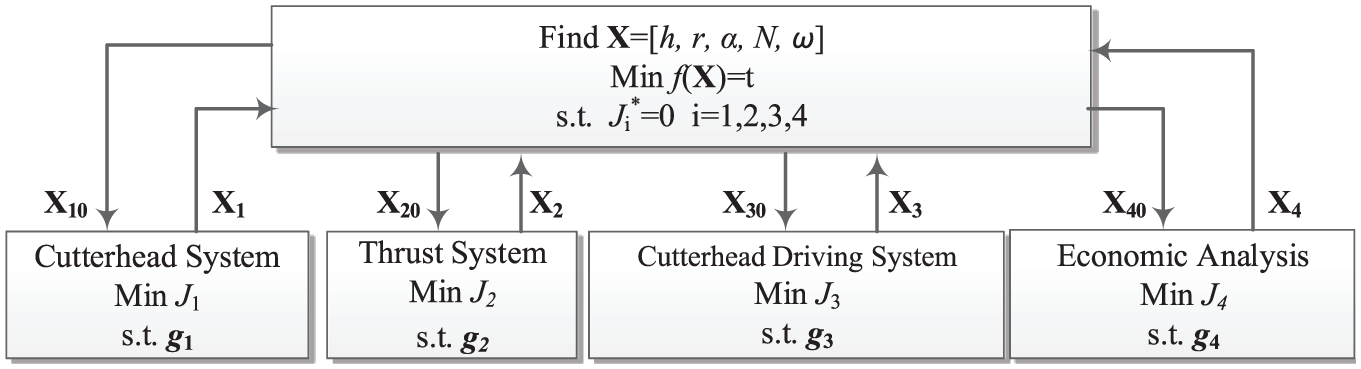
The MDO architecture of the hard rock TBM based on CO architecture.
The lower and upper bounds of the five design variables are determined by the inherent characteristics of the physical parts and the performance requirements of the hard rock TBM. According to the structure of the cutter, the blade angle

Lower and upper bounds of design variables.

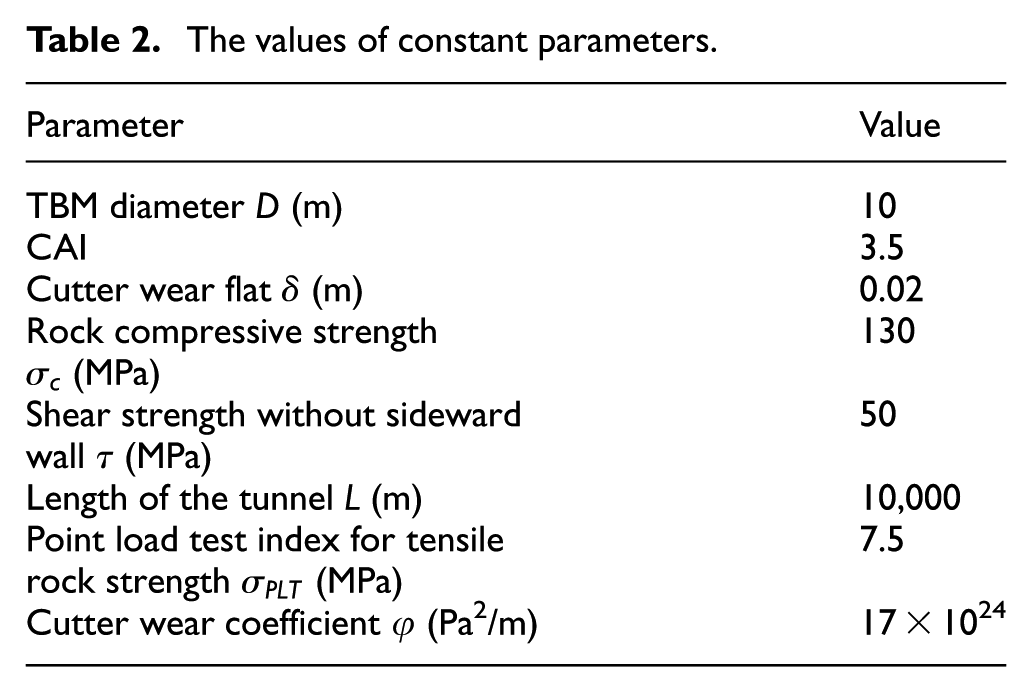
In addition, a set of the constant parameters are predefined as listed in Table 2.
The values of constant parameters.
Constraint analysis
To some extent, the constraints of the sub-disciplines can be taken as the TBM’s performance. According to the practical tunneling engineering, in this article, the following constraints are taken into account to realize the fixed performance of the whole machine of the hard rock TBM from the system level.
The cutterhead system: for the cutter life, the lower limit is set to ensure a satisfied cutter life; in this article, the cutter life
The thrust system: the total thrust
The cutterhead driving system: the total torque of the cutterhead
The economic analysis: to ensure a reasonable cost and energy consumption for the TBM, the cost per unit length is set as Cl ≤ 500 $/m and the energy consumption per unit length is set as El ≤ 1000 kW h/m.
Thus,

Optimization results
The convergence history of the objective function is shown in Figure 4(a), where the iterative curve approaches to the optimal construction period of approximately 7.16 months, which is shortened by 29.67% from the initial construction period of 10.18 months. The consistencies of the four sub-disciplines in CO are illustrated in Figure 4(b), from which the consistencies decrease to a reasonable range (

Convergence histories of the objective and consistencies: (a) construction period and (b) the consistencies of the four sub-disciplines in CO.
To further analyze the MDO results, the correlation between the five design variables and the performance of the hard rock TBM is explored. Figure 5(a) illustrates the effects of the penetration

Correlation of penetration
Figure 6 shows the optimization histories of design variables, and Table 3 lists the optimization results compared with the initial values of the design variables, the constraints, and the optimization objective. By comparing with the initial values of the five design variables, the optimized penetration

Optimization histories of the design variables: (a) optimization history of the penetration, (b) optimization history of the cutter radius, (c) optimization history of the blade angle, (d) optimization history of the cutter number, and (e) optimization history of the cutterhead speed.
Optimization results of the MDO.
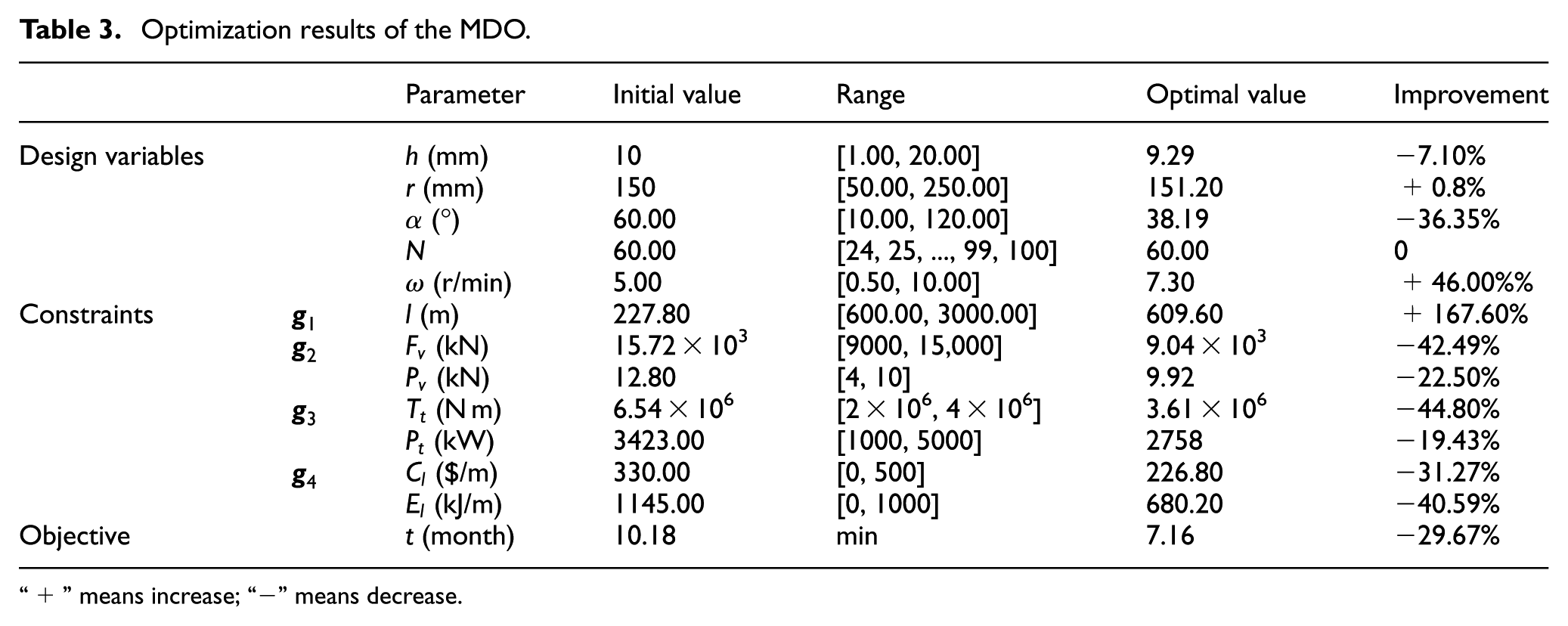
“+” means increase; “−” means decrease.
The performance is also improved significantly as illustrated in Figure 7. The cutter life

Optimization histories of the performance (constraints): (a) optimization history of the cutter life, (b) optimization history of the total thrust, (c) optimization history of the total thrust power, (d) optimization history of the total torque, (e) optimization history of the total motor power, (f) optimization history of the cost per unit length, and (g) optimization history of the energy consumption per unit length.
To evaluate the capability and reliability of the proposed MDO method in this article, the performance of the hard rock TBM are further optimized under three different types of geological conditions as defined in Table 4. Rock type 2 is the one that has been already used in the MDO built above. Rock type 1 is softer than rock type 2, and rock type 3 is harder than rock type 2. For different rocks, the constraints of the cutterhead system and the cutter life are set differently, as shown in Table 4.
Three different rock types.

Figure 8 shows the optimization results under these three different geological conditions. It is seen as expected that the harder the rock is, the longer the construction period will be. In addition, there will be more optimization iterations when the rock is harder. Figures 9 and 10 compare the design variables and the performance of the three MDO processes for the hard rock TBM. It shows that when rock becomes harder, the penetration

Optimization histories with three different rock types.

Comparison of design variables of the MDO process with respect to three different rock types: (a) penetration, (b) cutter radius, (c) blade angle, (d) the cutter number, and (e) cutterhead speed.

Comparison of the performance of the MDO process with respect to three different rock types: (a) the cutter life, (b) the total thrust, (c) the total thrust power, (d) the total torque, (e) the total motor power, (f) the cost per unit length, and (g) the energy consumption per unit length.
Conclusion
A MDO using collaborative optimization (CO) architecture for the hard rock TBM was developed. The MDO model consists of four subsystems belonging to different disciplines, including the cutterhead system, the thrust system, the cutterhead driving system, and the economic analysis. The technology models of the four subsystems are formulated. The correlations between the five design variables and the TBM’s performance are analysed for better adjusting the relevant parameters to realize better performance for the hard rock TBM. By using MDO, the performance of the hard rock TBM has been improved significantly through reducing the construction period, the cost, and the energy consumption from the system level. Usually, the TBM should be redesigned and optimized in different tunneling engineering referring to the correspondingly special geological environment even the tunnel diameter is the same. Due to this essential redesign and optimization in different geological conditions, the optimum performance of the hard rock TBM under three different geology conditions, such as the cost and energy consumption, is compared and analyzed. It is found that the proposed MDO method for the TBM is reliable and flexible while dealing with different geological conditions. Based on this research, the design and optimization for the hard rock TBM can be conducted automatically and concurrently. By taking some more subsystems or sub-disciplines into account, the performance of the hard rock TBM could be further enhanced in the future work.
Footnotes
Appendix 1
Handling Editor: Yangmin Li
Declaration of conflicting interests
The author(s) declared no potential conflicts of interest with respect to the research, authorship, and/or publication of this article.
Funding
The author(s) disclosed receipt of the following financial support for the research, authorship, and/or publication of this article: The research is supported by National Basic Research Program of China (973 Program, Grant No. 2013CB035402), National Natural Science Foundation of China (Grant No. 51505061), Natural Science Foundation of Liaoning Province of China (Grant Nos 2015020155 and 2015106016), and the Fundamental Research Funds for Central Universities (Grant No. DUT14RC(3)133).