




Abstract
The parametric vibration instability of a riser is studied in consideration of a complex pre-stress distribution. Differential equations of the riser are derived according to Euler–Bernoulli beam theory, and a method to solve the differential equations is proposed. With the parametric vibration of a top-tensioned riser as an example, the effects of the amplitude and direction of complex pre-stress on frequency, mode shapes, and instability characteristics are investigated. Results show that welding residual stress influences the dynamic response of the riser structure. A new approach to eliminate the complex loading of the riser is obtained.
Introduction
With the growing demand for crude oil and gas in recent years, deep-water exploitation has become the focus of offshore equipment. The riser structure, as the key equipment linking the platform and wellhead at the sea base, has become a popular issue in engineering design. Aside from the influence of gravity, riser structures are subjected to wave- and current-induced loading and high-pressure oil and gas. Thus, several dynamic responses, such as parametric vibration, vortex-induced vibration (VIV), and collision, occur in riser structures. The longitudinal vibration (i.e. parametric vibration) of risers is caused by the heaving of a floating platform, which easily leads to the destruction of risers. Many studies that involved theoretical analysis, numerical calculation, and experimental investigation have been conducted to investigate the fundamental mechanism of parametric vibration. The non-linear resonance arising from parametric excitation problems has been discussed, and closed-form solutions for a riser have been obtained on the basis of first and second modes through extensive mathematical manipulations. 1 The parametric vibration caused by the wave-induced motions of a floating platform is practically important because it can destroy risers. 2 A stability analysis of the riser structure was performed in a previous study using Lyapunov stability theory, in which the top boundary controller is considered.3,4 The finite element method has also been employed to analyze the influence of water depths, environmental conditions, and vessel motions under combined parametric and forcing excitations. 5 Structural natural frequency is an important structural dynamic property of riser structure. However, the natural frequencies of riser structure possess a low modal, and these frequencies are close to one another because of the structural stiffness problem in risers. A closed-form solution for the natural frequencies and associated mode shapes of axial loading has been deduced with Timoshenko beam theory. 6 The tension force in a riser structure consists of constant and varying parts. 7 According to Spark’s theory, the influence on bending stiffness is defined as tension force; natural frequency and mode are deduced with the segmentation method. 8 Simple trigonometric functions are employed as approximations for vibration modes in Galerkin’s method, in which the riser assumes a Bernoulli–Euler beam model and small rotations. 9 If the frequency of external excitation and the natural frequency of a riser satisfy a certain condition, then the parametric instability problem is defined as Mathieu instability. Hsu 10 was one of the first researchers who analyzed parametric resonance in offshore cable applications and the instability region problem. The asymptotic solution of the Mathieu instability problem under stochastic parametric excitation and non-linear damping has been studied with the combination of linear and non-linear power-law damping. 11 Any possibly undesirable phenomena that occur in the transverse vibration of the riser structure caused by this fluctuation need to be investigated to develop a frequency domain method for linear systems with general time-varying parameters. 12 A suitable mathematical model to explore the stability of a submerged floating pipeline between two floating structures under vortex and parametric excitations has been presented and discussed. 13
Pre-stress (initial stress) often exists in complex structures and may be caused by welding residual stress, structural manufacturing defects, material thermal effects, static external loading, and so on. Pre-stress can resist or aid in structural deformation and alter the static and dynamic characteristics of structures. Pre-stress exerts a significant influence on local and global stiffness matrices, and the natural frequencies of a structure increase or decrease with pre-stress distribution. Welding residual stress must be considered when analyzing the influence of pre-stress on the dynamic characteristics of risers. The effects of uniform pre-stress distribution on natural frequencies and dynamic responses have been investigated. 14 With regard to uniform Euler–Bernoulli beams under linearly varying fully tensile stress, a structure’s natural frequencies may increase or decrease; parameters change the forbidden frequencies of the mechanical system after pre-stress is considered. 15 The vibration equation was modified in previous studies to analyze the influence of pre-stress, and the effects of variation in flow velocities and hydrostatic pressure on the dynamic behavior of fluid-conveying shells were defined as pre-stress.16,17 Pre-stress includes linear and non-linear parts, and the superposition principle applies to the linear parts. 18 The effects of welding residual stress on the added virtual mass and the quality factor of the diaphragm have been presented. 19 In addition, the differential equation of the vibration of a cylindrical shell with welding residual stress has been derived, and a theoretical solution has been presented. 20 The analytic expression of the influence of complex pre-stress force on a riser structure was derived in a previous study, and the VIV response was compared. 21 The influence of complex pre-stress on the mechanical response of risers, especially on their structural dynamic characteristics, requires further study. However, only a few studies have considered the effects of complex pre-stress on the dynamic response of risers.
The main objectives of this study are to investigate the influence of complex pre-stress (welding residual stress) on the natural frequency, modal shape, and size of instability domains for the parametric vibration problem of a top-tensioned riser (TTR). The developed analytical method can analyze the dynamic behavior of riser structures with/without pre-stress distribution, local area or overall pre-stress distribution, and even non-uniform pre-stress distribution. The outline of this article is as follows. A model of complex pre-stress force theory is presented in section “Pre-stress force model of a beam structure.” A brief description of governing equations for a riser structure with a complex pre-stress distribution is given in section “Governing equation of a riser with complex pre-stress distribution.” A vibration-free analytical solution of a riser structure with complex pre-stress is introduced in section “Free vibration of the riser with complex pre-stress distribution.” The parametric vibration instability problem of riser structures is presented in section “Parametric vibration instability of the riser structure.” A numerical analysis is implemented in section “Numerical results and discussion,” and the conclusions are presented in section “Conclusion.”
Pre-stress force model of a beam structure
Pre-stress force (initial stress) usually exists in continuum structures. The existence of pre-stress force significantly affects the local and global stiffness matrices of riser structures. Existing pre-stress force can resist or aid in the deformation of beam structures. The influence of complex pre-stress force on the static and dynamic characteristics of riser structures, especially on their structural dynamic characteristics, is worthy of studying. In this study, only welding residual stress, structural stress caused by deep-water pressure, and axial tension are discussed. These three types of pre-stress force can be defined as a complex pre-stress force that is unaffected by external dynamic excitation force. If complex pre-stress force satisfies the linear superposition principle, then it can be expressed as follows

where
Governing equation of a riser with complex pre-stress distribution
In this section, the governing equation of riser structure with complex pre-stress distribution is established.
Modeling of TTR
To reveal the parametric vibration problem, a TTR in a complex ocean environment is discussed in consideration of the heaving of the platform and the motion of the tension ring, and the riser structure is subject to current. The riser can be regarded as a long, continuous, tubular member that is straight and vertical, and the boundary conditions at the two ends are known. The heaving of a floating platform, which induces axial tension fluctuation in the riser, is considered. The top of the riser is connected to the main body of the platform through a compensator, and the heave compensator can be simplified as an equivalent spring with stiffness K.
Several hypotheses are defined as follows: (1) the material and mechanical properties are uniform along the overall riser structure; (2) the tension variation along the riser length varies linearly with depth; (3) cross-flow vibration is considered, whereas in-line vibration is excluded; and (4) the effect of shear strain is small and can be disregarded. In addition, the pipe wall behaves elastically, that is, no internal damping is considered.
A rectangular Cartesian coordinate system is introduced to establish deformation in the riser structure. The riser moves on the plane, as shown in Figure 1. The sea surface is set as the origin of the coordinate system, the x-axis is parallel to the flow velocity, and the z-axis is measured from the top of the riser.

Mechanical model and reference frame of the riser.
The motion equations on the two principal vertical planes are identical and can be derived independently for each plane because of the symmetry of the riser cross section. The riser structure can move only on the xOy plane because the lateral deflection
Differential equations of the riser structure
With the assumption on the riser structure, the governing motion equation of the lateral deflection

where the first item is the bending stiffness of the riser structure and the second term is the axial riser tension force. The third term is the inertia of the riser structure and includes riser structure, internal fluid, and fluid addition masses.
Differential equations of the riser structure with complex pre-stress distribution
According to Wu and Zhou, 19 axial riser tension force can be defined as a type of pre-stress force. Then, the partial differential equation of a deep-water riser structure with a complex pre-stress distribution can be written as follows

where
Equation (3) is a modified function of the riser structure that considers complex pre-stress force distribution. By comparing this equation with the traditional differential equation of deep-water riser structures, the parameter of pre-stress
Free vibration of the riser with complex pre-stress distribution
The structural modes and modal problem of the riser with a complex pre-stress distribution are also discussed.
Definition of boundary conditions
The physical boundary condition at both ends of the riser can be modeled as simple support. The displacement at each end is zero, and the boundary conditions can be written as follows

Modal decomposition is based on the assumption that the mode of the riser may be expressed as a sum of eigenmodes or eigenfunctions at any point in time. The solution to this equation can be obtained with a form of power series expansion. To obtain the solution of equation (3), Galerkin’s procedure is employed. The solution of linearized equation (3) under the simple support boundary can be expressed as follows

where z is the axial coordinate, L is the length of the riser, t is the time parameter,
The free vibration differential formulation of the riser with complex pre-stress can be obtained by introducing orthogonal series

where
Solution of the beam structure
The free vibration of the riser with a complex pre-stress distribution is analyzed, and the analytical solution for equation (6) is discussed as follows:
1. If the complex pre-stress satisfies the equation
2. If the complex pre-stress is in a uniform distribution form, then the pre-stress can be written as
3. If the complex pre-stress is a function of variable z, then the complex pre-stress is a one-dimensional (1D) complex pre-stress distribution problem. Its distribution can be fitted by a trigonometric function and can be expressed as follows

where

According to the trigonometric function, function R can be written as follows

According to the orthogonal characteristic of the trigonometric function, the solution of equation (9) can be written as follows


By substituting equation (10) into equation (9), function R can be written as follows
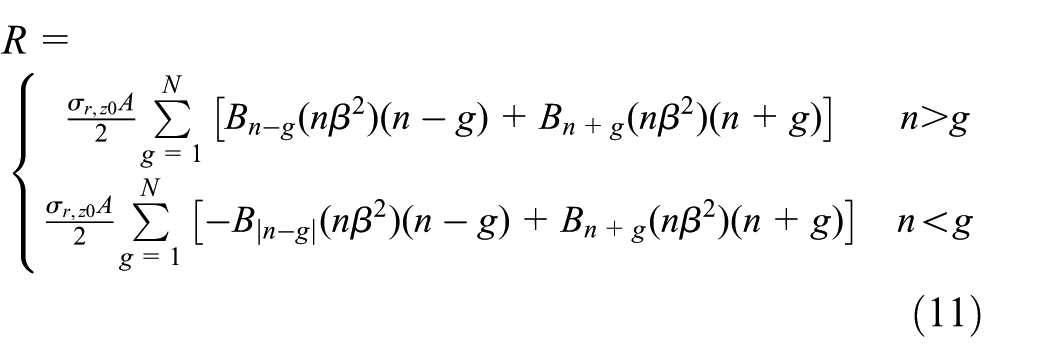
According to equation (11), N number functions exist and can be written in a matrix form as follows

where
If
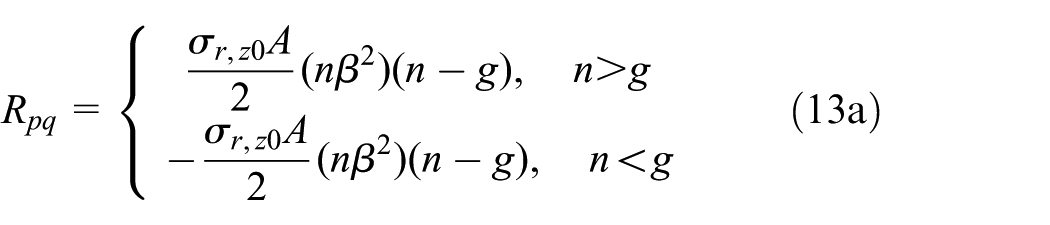
If

4. If the distribution of the complex pre-stress has high complexity, then the complex pre-stress is a function of variable z and a 1D complex pre-stress distribution problem. The distribution of the complex pre-stress can be fitted by a trigonometric function and expressed as follows

where
By substituting the complex pre-stress function into equation (6), N number functions exist and can be written in a matrix form as follows

where

Modal analyses
According to the complex pre-stress function, the dynamic response function of the beam structure with complex pre-stress can be obtained because the structural complex pre-stress can be expressed as a trigonometric function. For a beam structure with/without a complex pre-stress distribution, the equations are linear, and the determinant factor to the characteristic equation is zero, which can be expressed as follows

In equation (17), if no complex pre-stress force distribution
Parametric vibration instability of the riser structure
The diameter ratio of the riser is relatively large and causes the modal frequencies to be very close. If the vibration frequency of the structure is equal to half of the external excitation frequency, then parametric resonance could easily occur.
Parametric vibration equation
The parametric excitation problem is caused by the motion of the platform, which leads to the variation of the axial tension force of the riser. Parametric excitation depends on the axial tension force of the riser structure. The axial tension force of the riser includes static and dynamic axial tension forces. The amplitude and frequency of dynamic axial tension force depend on the motion of the platform heaving, which can be simplified as a harmonic force.
External excitation, structure damping, and hydrodynamic damping are omitted. Then, the differential equations of the riser with complex pre-stress distribution are deduced as follows

where
Solution of the unstable regions
According to equation (3), the Mathieu equation of the riser can be obtained as follows

where
In equation (19), the riser will resonate if the frequency of platform heaving satisfies
Numerical results and discussion
Model description
The design parameters of the riser structure for the numerical analysis of parametric vibration are shown in Table 1. The effects of complex pre-stress on the riser’s natural frequency and mode are compared.
Design parameters of the model system.

Modeling of welding residual stress
To analyze the influence of welding residual stress on the dynamic characteristics of the riser, three types of welding residual stress distribution, namely, two types of tensile residual stress and a compressive residual stress, are compared.
The three types of welding residual stress distribution are as follows: distribution model I is tensile stress; distribution model II is tensile stress, but its maximum amplitude is smaller than that of model I; and distribution model III is defined as compressive stress.
The welding residual stress in the riser follows a non-uniform distribution. According to the common welding technology for risers, the peak value of stress is distributed periodically by a certain distance. In this study, every 2 m is defined as peak stress, and the welding residual stress is zero at the end of the riser structure. The welding residual stress in the riser can be fitted by a trigonometric series.
With the characteristic of the periodic distribution of welding residual stress considered, five peaks are shown in figures to describe the welding residual stress distribution. Figure 2 shows distribution model I of welding residual stress; a positive value denotes tension stress. Figure 3 shows distribution model II of welding residual stress, and a positive value also denotes tension stress. In comparison with that in Figure 2, the peak value of welding residual stress in Figure 3 exhibits a decrease.

Distribution model I of welding residual stress.

Distribution model II of welding residual stress.
Figure 4 shows distribution model III of welding residual stress. A negative value denotes compressive stress. In comparison with that in Figures 2 and 3, the welding residual stress in Figure 4 is compressive stress. The absolute value is similar to that in model I.

Distribution model III of welding residual stress.
Effect of welding residual stress on vibration frequency
According to the function of welding residual stress, the complex pre-stress in the riser can be written as
Constant axial loads
Constant axial loading is also considered. The complex pre-stress in the riser structure can be written as
Varying axial loads
Vertical pipe weight and internal tension are then considered. The complex pre-stress in the riser structure can be written as
Varying axial loading and welding residual stress
In this case, welding residual stress, vertical pipe weight, and internal tension are considered. The values of welding residual stress are obtained from the measurement data of the riser structure or through a numerical simulation analysis. The cosine function is used to fit the welding residual stress parameter. The welding residual stress in the riser can be written as

Table 2 shows the natural frequency of the riser structure with variation from the first order to the tenth order.
Comparison of natural frequencies of the riser.
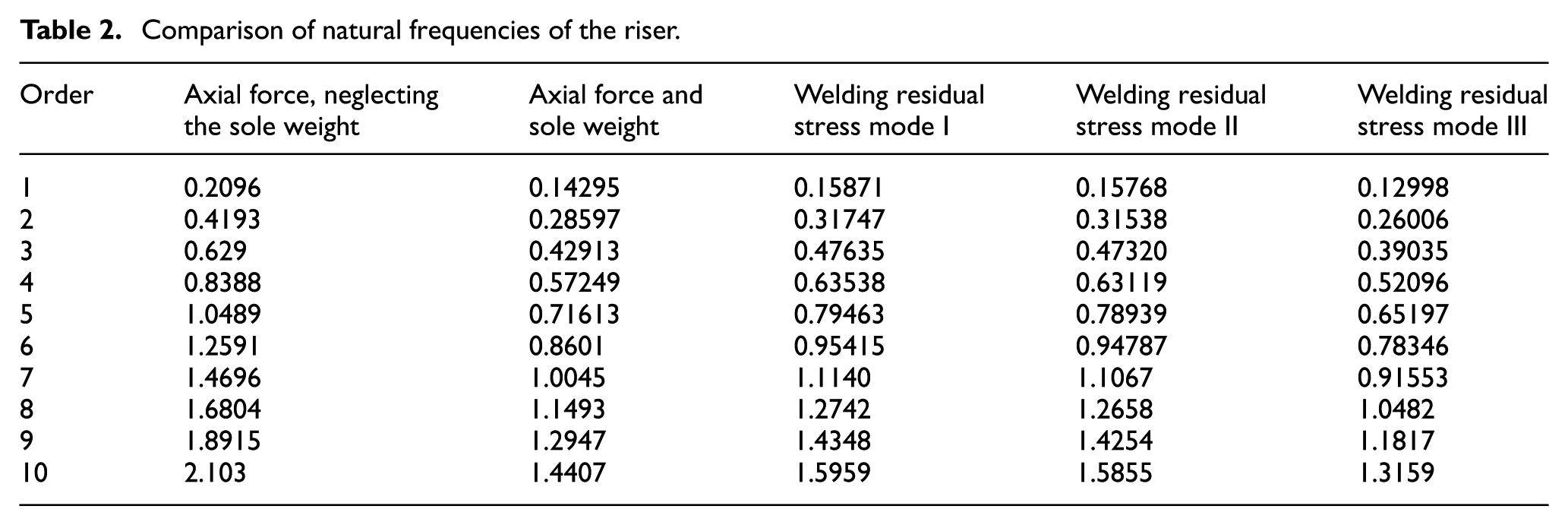
Table 2 shows that complex pre-stress exerts a significant effect on the natural frequency of the riser. If the welding residual stress is positive, then the natural frequency of the riser will increase. If the welding residual stress is negative, then the natural frequency of the riser will decrease. In addition, with the increase in the order, the influence of complex pre-stress on natural frequency becomes increasingly significant. These results show that the peak value of welding residual stress distribution is not too evident in natural frequency. A reason is that the range of the riser in the peak area is relatively narrow. According to Table 2, analyzing the influence of welding residual stress is necessary in riser design.
Modes of the riser structure
Figure 5 shows the first-, second-, third-, fourth-, fifth-, and sixth-order modes of the riser structure. The modes are not standard sine functions.

First six mode shapes in different loading cases: (a) first mode, (b) second mode, (c) third mode, (d) fourth mode, (e) fifth mode, and (f) sixth mode.
As shown in Figure 5, the maximum amplitude of the mode is moved to the bottom when the sole weight is considered. Welding residual stress exerts a great effect on the mode shapes of the riser structure. The mode shapes become increasingly complex when welding residual stress is considered. The influence of welding residual stress on the riser structure vibration mode is evident. When welding residual stress exists, the mode shape of the riser becomes a rough curve with mutation. The mutation direction depends on the direction of welding residual stress. The reason is that the welding residual stress had changed the local stiffness of the riser.
Instability analysis for the riser structure
Stability analysis is important for a linear system under parametric excitation. The stability chart is a well-known tool to examine the properties of parametric instability. The chart consists of massive transition curves above which are unstable zones and below which are stable zones.
Using the small parameter L-P method, the boundary line expression of the stable and unstable regions of the standard Mathieu equation is obtained, as shown in Figure 6. The stability chart is obtained according to the relation between the stable region and unstable dividing line for π or 2π periodic solution.

Comparison of stability charts for the riser structure (the shaded areas are unstable): (a) axial force with the sole weight neglected, (b) axial force and sole weight, (c) welding residual stress distribution mode I, (d) welding residual stress distribution mode II, and (e) welding residual stress distribution mode III.
Considering engineering conditions, the motion cycle of platform heaving not less than 4 s, and a mode number of more than six orders can be neglected. In this study, only the first-order instability region of the riser is discussed, as shown in Figure 6. In the figure, δ denotes the time parameter, and ε denotes displacement:
Several conclusions are obtained from Figure 6. The riser parametric excited instability area significantly increases when the gravity influence is considered. The unstable region migrates when the welding residual stress is considered. Tensile stress causes the unstable region to migrate to the left direction, and the unstable region is slightly reduced. Compressive stress causes the unstable region to migrate to the right direction, and the unstable region is slightly increased. The reason for this change is that the existence of welding residual stress had changed the local and overall stiffness.
Conclusion
In this study, to investigate the influence of welding residual stress on the natural frequency, modal shape, and size of instability domains, a new approach to analyze the dynamic characteristics of the riser structure is proposed. A corresponding differential equation is established. The numerical results show that complex pre-stress force exerts a significant influence on parametric vibration. The distribution of complex pre-stress causes the resonance point of the riser to migrate, and the migration direction corresponds to the complex pre-stress direction. The mode shape is no longer a smooth curve, and the distortion direction depends on the amplitude of complex pre-stress. In addition, the unstable region moves when complex pre-stress is considered. In this study, pre-stress (welding residual stress) possesses periodic distribution. The aperiodicity problem of pre-stress distribution will be considered in the future.
Footnotes
Handling Editor: Jianqiao Ye
Declaration of conflicting interests
The author(s) declared no potential conflicts of interest with respect to the research, authorship, and/or publication of this article.
Funding
The author(s) disclosed receipt of the following financial support for the research, authorship, and/or publication of this article: This work was partially supported by the Fund of State Key Laboratory of Ocean Engineering (grant no: 1507).