




Abstract
The analysis of random vibration of a vehicle with hysteretic nonlinear suspension under road roughness excitation is a fundamental part of evaluation of a vehicle’s dynamic features and design of its active suspension system. The effective analysis method of random vibration of a vehicle with hysteretic suspension springs is presented based on the pseudoexcitation method and the equivalent linearisation technique. A stable and efficient iteration scheme is constructed to obtain the equivalent linearised system of the original nonlinear vehicle system. The power spectral density of the vehicle responses (vertical body acceleration, suspension working space and dynamic tyre load) at different speeds and with different nonlinear levels of hysteretic suspension springs are analysed, respectively, by the proposed method. It is concluded that hysteretic nonlinear suspensions influence the vehicle dynamic characteristic significantly; the frequency-weighted root mean square values at the front and rear suspensions and the vehicle’s centre of gravity are reduced greatly with increasing the nonlinear levels of hysteretic suspension springs, resulting in better ride comfort of the vehicle.
Keywords
Introduction
In recent years, vehicle vibration induced by a rough road profile, including its measurement and elimination, has received significant interest.1–3 Random vibration is generated when vehicle traverses a rough road, which not only affects driving safety and ride comfort but also has a great influence on integrity of components and service life of a vehicle. Therefore, it is of great significance for characteristic simulation and structural optimal design to study random vibration of a vehicle under irregular excitation from a road surface.
Generally in the vibration analysis of vehicle systems, suspension elements are modelled as linear springs and dampers for simplicity of analysis. Nevertheless, the force–displacement characteristic of springs exhibit nonlinear behaviour especially of hysteretic type in reality, and modelling of deteriorating hysteretic behaviour is increasingly important. Many models have been developed to describe hysteretic restoring force, such as bilinear hysteresis model, Ramberg–Osgood model and Bouc–Wen hysteresis model.4–6 The Bouc–Wen auxiliary differential equation model is widely used for its good applicability, straightforward description of various hysteretic characteristics by adjusting hysteresis parameters properly and simple solution of differential equations of motion. 7 And nonlinear suspension elements such as hysteretic stiffness elements were modelled by the Bouc–Wen model in many literatures.8–12
In cases where the stiffness coefficient varies with responses, the analysis becomes complicated because the resulting equations of motion involve nonlinearities. The study of random vibration of nonlinear systems has always been a subject of great interest for researchers, for example, Fokker–Planck–Kolmogorov (FPK) equation method, 13 stochastic averaging methods, 14 equivalent linear method, 15 equivalent nonlinear system method 16 and Monte Carlo method,17,18 were developed in recent decades.
The equivalent linear method substitutes the original nonlinear system with a linear system according to a criterion and can solve the original nonlinear system approximately, which is applied more extensively in engineering. Nevertheless, when the equivalent linearisation technique is used to analyse the random vibration of a vehicle with nonlinear hysteretic suspension, the Lyapunov differential equations always need to be solved after linearisation, and the high-order covariance matrices of displacement, velocity and hysteretic displacement of each degree of freedom (DOF) must be computed, resulting in a more complicated computing process and a higher computational expenses consumed in the linearisation iteration procedures.
As a highly efficient and accurate algorithm, the pseudoexcitation method (PEM) has been developed to analyse the random vibration of linear time–invariant system in recent two decades, which transforms a stationary random vibration analysis into a deterministic harmonic analysis and has the wider applicability in engineering fields.19–22 An approach combining the PEM with the equivalent linearisation technique is developed to realise the nonlinear random vibration analysis of a vehicle with hysteretic suspension springs in this article. It is shown that the covariance responses of a small number of DOFs need to be computed as the solution of Lyapunov equations is replaced by the PEM, and an appropriate algorithm can be established to achieve equivalent linearisation iterative solution for random vibration of a nonlinear vehicle system and meanwhile the solving process is greatly simplified.
The main purpose of this article is to investigate the random vibration response of a half-car model with hysteretic nonlinear suspensions. The Bouc–Wen model of hysteretic suspension spring and its equivalent linearisation model is presented; the dynamic model of a half-car with hysteretic suspension springs is established, and its corresponding state space equation is derived; and the general random vibration analysis approach of a vehicle with hysteretic suspension springs is established based on the PEM and the equivalent linearisation technique; a Sedan is selected for numerical simulation and the power spectral density (PSD) of the vehicle responses (vertical body acceleration, suspension working space and dynamic tyre load) at different speeds and with different nonlinear levels of hysteretic suspension springs are discussed, respectively, and the vehicle ride comfort is evaluated in a further discussion. Numerical results show that random vibration analysis of the vehicle with hysteretic nonlinear elements can be carried out effectively using the PEM and the equivalent linearisation technique, and hysteretic nonlinear suspension elements influence the vehicle’s dynamic characteristics significantly with the frequency-weighted root mean square (RMS) values of the vehicle body reduced greatly, resulting in better ride comfort of the vehicle.
The Bouc–Wen model of hysteretic nonlinear suspension spring and its equivalent linearisation
The restoring force of a hysteretic nonlinear element can be represented as

where

where
The hysteretic nonlinear suspension spring in this article is considered to have a restoring force of the Bouc–Wen type; when

where
An equivalent linear system can be used to represent the original nonlinear system approximately according to a criterion (the mean square value of error, that is, the difference between nonlinear and linear equations, is minimum) when the hysteretic system is under stationary random load, and the governing differential equation of which is

where the equivalent damping coefficient and stiffness are 15

and where
Therefore, the dynamic equations of a vehicle can be established according to linear multi-body dynamic theory as the hysteretic suspension spring modelled by the Bouc–Wen model are linearised from equations (4) and (5).
The dynamic model and state space equation of vehicle
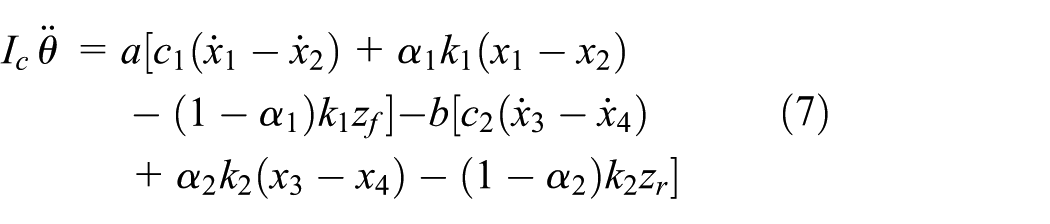
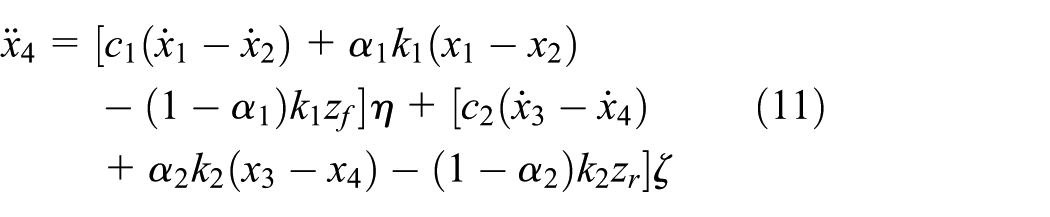
A 4-DOF half-car model is shown in Figure 1. As the constitutive relation of the front and rear suspension springs is given by equation (3), the equations of motion of the half-car model can be derived from Lagrange equation as





where
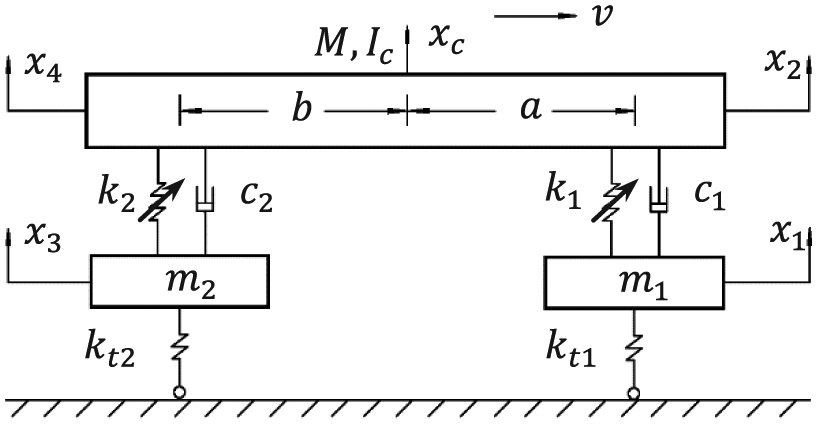
Half-car model with hysteretic suspension springs.
The stiffnesses of the front and rear hysteretic suspension springs in the equations of motion are modelled using the Bouc–Wen model according to section ‘The Bouc–Wen model of hysteretic nonlinear suspension spring and its equivalent linearisation’, and the hysteretic displacements in equations (6)–(11) satisfy the following differential equations of equivalent linear system

where

Introducing the state vector

where
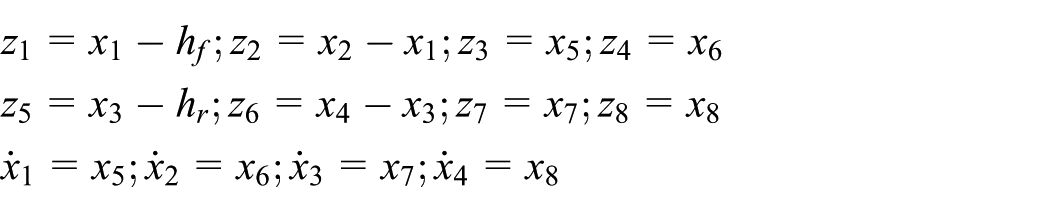
Combining equations (6)–(11) and (13), the equations of motion for the vehicle can be rewritten in state space form as

With

The PEM-based random vibration analysis of a vehicle with hysteretic suspension springs
Road roughness
The displacement PSD of the road profile is given by the study of Thompson and Davis 23

where
Supposing vehicle travels at constant speed

where
The amount of road excitation imposed at the vehicle tyres depends on both the road roughness coefficient and vehicle velocity. It is assumed that the rear wheel follows the same path as the front wheel but with a constant time delay

The PEM of random vibration analysis for vehicle
Two problems need to be considered in computational procedure, one is computing efficiency as the conventional linear process requires iterative iteration to compute the equivalent coefficients (parameters in equation (14)), and the other is the coherent effect between the front and rear wheels as it is assumed that when the vehicle travels at constant speed, the rear wheel follows the same path as the front wheel but with a delay phase.
As the PEM is a highly efficient algorithm for analysing stochastic vibration of linear system, which transforms a stationary random vibration analysis into a deterministic harmonic analysis, it can easily solve these two problems by constructing the pseudoexcitation as equation (20) and analysing the corresponding pseudoresponse and can realise spectrum analysis by vector multiplication calculation of the pseudoresponse. Moreover, the PEM can deal with the coherent stochastic loads of the system by constructing proper pseudoexcitation. Combined with the PEM and the equivalent technique, the detailed procedure of the stochastic vibration analysis of the nonlinear vehicle system are as follows.
Introducing the pseudoexcitation 19

where

Substituting equation (20) into equation (15)

The stable solution of the vehicle system under pseudoharmonic excitation can be obtained as

For any vehicle responses

Accordingly, the variance and covariance of the vehicle responses can be expressed as

The equivalent linearisation iterative procedures
The basic idea of the equivalent linearisation technique is the mean square value of error, that is, the difference between the nonlinear and linear equations is minimum; therefore, the equivalent linear system approximates the original nonlinear system step by step in terms of a iteration scheme. 24 Based on the foregoing discussion, the implementation process of the random vibration analysis of a vehicle with hysteretic suspension springs using the PEM and the equivalent linearisation technique are as follows:
Suppose the initial equivalent coefficient in equation (13)
Construct the pseudoexcitation from equation (20); equations (22)–(24) are employed to determine the stationary random vibration power spectrum of the equivalent linear system, and variance and covariance of the vehicle responses could be calculated from equation (25).
Calculate the equivalent coefficient
The norm

If
In addition, the following iterative scheme is applied to deal with the problem as the iteration results cannot obtain the stable solution in some condition 16

where
Vehicle ride comfort analysis
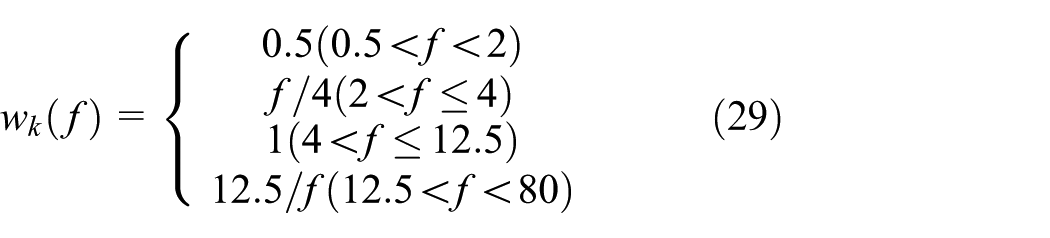
The ISO2631-1: 1997(E) standard is adopted to evaluate the ride comfort of a vehicle, and the frequency-weighted RMS of body acceleration response can be expressed as

where f denotes the frequency in Hz;
Numerical results
The main parameters of the half-car model are from Ford Granada Sedan;
25
The PSD curves of the vehicle responses (vertical body acceleration, suspension working space and dynamic tyre load) at different speeds with different nonlinear levels of hysteretic suspension springs are discussed, respectively; the RMS values of the vehicle responses, the frequency-weighted RMS values of the front and rear suspensions, and the vehicle’s centre of gravity are also calculated separately.
Vehicle model with linear suspension springs at different speeds
First, the random vibration responses of the half-car model with linear suspensions at 15, 20 and 30 m/s are computed.

PSD of vehicle responses: (a and b) vertical body acceleration (BA) at front and rear suspension, (c and d) front and rear suspension working spaces (SWS) and (e and f) front and rear dynamic tyre loads (DTL) (the black, red and blue line corresponding to v = 15, 20 and 30 m/s, respectively).
PSD peak frequencies of the vehicle responses (Hz).

PSD: power spectral density; PEM: pseudoexcitation method.
Table 2 gives the RMS values of the vehicle responses. It shows that the RMS values of vertical body acceleration, suspension working space and dynamic tyre load all increase with vehicle speeds. Similarly, the frequency-weighted RMS values of vertical acceleration at the front and rear suspension and the vehicle’s centre of gravity all increase as the vehicle speed increases.
RMS values of linear vehicle’s responses.

RMS: root mean square.
Vehicle model with different nonlinear levels of hysteretic suspension springs
The vehicle speed is now selected as

PSD of vehicle responses: (a and b) vertical body acceleration (BA) at front and rear suspension, (c and d) front and rear suspension working spaces (SWS) and (e and f) front and rear dynamic tyre loads (DTL) (the purple, blue, red and black line corresponding to α1 = α2 = 1.0, 0.9, 0.7, 0.5, respectively).
It also shows from Table 3 that the bounce frequencies of the vehicle body attenuated greatly with increasing the nonlinear level of hysteretic suspension springs, and the bounce frequencies of the front and rear wheels change slightly.
PSD peak frequencies of the vehicle responses (Hz).

PSD: power spectral density.
Table 4 gives the RMS values of the vehicle responses with different nonlinear levels of hysteretic suspension springs. As can be seen, the RMS values of the vehicle responses are more or less reduced as the nonlinear levels of hysteretic suspension springs increases except that the RMS value of the front suspension working space is increased slightly when
RMS values of nonlinear vehicle’s responses.

RMS: root mean square.
Frequency-weighted RMS values of body acceleration (m/s2).

RMS: root mean square.
Conclusion
The PEM is an effective method to analyse the random vibration of a system, which transforms a stationary random vibration analysis of time-invariant linear system into a deterministic harmonic analysis. The random vibration analysis on a half-car model with hysteretic suspension springs under road irregularity is made using the PEM and the equivalent linearisation technique:
The hysteretic characteristic of the nonlinear suspension spring is represented by the Bouc–Wen model, and a general random vibration analysis of a vehicle with hysteretic nonlinear suspension springs is carried out.
The random vibration of a half-car model is analysed, the PSD of the vehicle responses (vertical body acceleration, suspension working space and dynamic tyre load) at different speeds and with different nonlinear levels of hysteretic suspension springs are discussed and the vehicle ride comfort is also evaluated. The numerical results show that the PSD of a road surface can be used to evaluate the PSD of vehicle responses accurately and efficiently.
Hysteretic nonlinear suspension springs influence the vehicle dynamic responses significantly; and the frequency-weighted RMS values of the front and rear body, and the vehicle’s centre of gravity are reduced remarkably with increasing the nonlinear levels of hysteretic suspension springs, resulting in better ride comfort of the vehicle.
Footnotes
Handling Editor: Elsa de Sa Caetano
Declaration of conflicting interests
The author(s) declared no potential conflicts of interest with respect to the research, authorship, and/or publication of this article.
Funding
The author(s) disclosed receipt of the following financial support for the research, authorship, and/or publication of this article: This research is supported by National Natural Science Foundation of China (no. 51405399).
