




Abstract
With increasingly severe market competition, it is necessary to promote railway value–guaranteed transportation. The objective of this article is to propose a pricing strategy to optimize railway value–guaranteed transportation to increase revenue. The article describes the competitive and cooperative relationships between value-guaranteed transportation and railway freight insurance and details an appropriate charge rate for railway value–guaranteed transportation. First, the concept, the current situation and the relevant research on railway value–guaranteed transportation and railway freight insurance are introduced. Second, the service level and charge rate are chosen as indexes with which to calculate the generalized cost, and the logit model is used to analyze the market share. Third, the revenue function of railway value–guaranteed transportation and railway freight insurance is formulated under the scenarios of competition and cooperation. Finally, this article describes the optimal charge rate combination for railway value–guaranteed transportation and railway freight insurance under these two scenarios, and the feasibility of the model is verified.
Keywords
Introduction
Railway value–guaranteed transportation and railway freight insurance
Railway value–guaranteed transportation is freight transportation service provided by railway enterprises. Transportation enterprises must compensate for losses incurred when goods are lost, short, deteriorated, contaminated, or damaged. Railway value–guaranteed transportation is a component of the transportation contract as a whole rather than a separate contract.
Railway freight insurance provides compensation for the economic losses caused by natural disasters and accidents (which is not the liability of the carrier). The insurance contract is an independent agreement between the applicant and the insurer.
Therefore, both similarities and differences exist between railway value–guaranteed transportation and railway freight insurance, with both competitive and cooperative aspects.
The relevance of the research
Railway value–guaranteed transportation plays an important role in railway transportation service and contributes considerably to the safety and development of railway transportation. With minimal advertising, administrative measures can be used to control the marketing of railway freight insurance. However, with the development of the social economy and marketization, both railway transportation enterprises and railway freight insurance companies must adjust their pricing strategies according to one another’s actions.
Currently, the growth rate of the macroeconomy in China is slowing, and the price and volume of the staple freight are declining. Additionally, the competition between railway value–guaranteed transportation and railway freight insurance is becoming increasingly fierce, which will lead to intense pressure in the value-guaranteed transportation market.
To address this challenge, the railway department has decided to implement a floating rate strategy to enhance the market competitiveness of railway value–guaranteed transportation. Therefore, it is important to conduct thorough research on the competitive and cooperative relationships between railway value–guaranteed transportation and railway freight insurance and to optimize the pricing strategy to improve the market competitiveness and income of railway value–guaranteed transportation.
Relevant research
Factors affecting the revenue of railway value–guaranteed transportation
Railway value–guaranteed transportation revenue relates to the total value-guaranteed fees produced by all the value-guaranteed goods

where Y denotes the revenue of railway value–guaranteed transportation,
According to the relevant regulations, the declared value of the goods is equal to the actual value of the goods

where
Pr denotes the market share (i.e. the proportion of the value-guaranteed goods represents the total volume of the consigned goods)

where Q denotes the total volume of the consigned goods.
According to equations above, the factors that affect the revenue of railway value–guaranteed transportation are the total volume of the consigned goods
Research on the charge rate of value-guaranteed transportation
Research on the charge rate of the railway value–guaranteed transportation is relatively minimal. A classic algorithm proposed by Xie and Chen 1 is as follows: First, use the fuzzy evaluation method to rank the value-guaranteed goods; then, determine the suitable charge rate according to the seven-level charge rate standard.
In the field of freight insurance, the charge rate mainly depends on the probability and severity of the loss of the goods. Typical methods used to analyze the probability and severity are risk evaluation and data statistics.2–4
Research on the market and model
Multiple freight insurance companies provide similar insurance products on the market today. The internal competition among these insurance companies can be ignored due to the strong substitutability of the service. Assuming that there are only two choices for consignor, railway value–guaranteed transportation (i = 1) or railway freight insurance (i = 2), the relationship between value-guaranteed transportation and freight insurance is a duopoly.
Under the conditions of a duopoly, oligarchs interact with each other, and the relationship between them is complicated. Before implementing a pricing strategy, a company must consider the possible effect on other companies and the corresponding reaction of other companies.
There are classic models regarding an oligopoly market, including those described by Cournot,5–7 Stackelberg,8,9 Bertrand,10,11 and Hotelling.12,13 The classic models above take the output, the pricing strategy, or the price as the relative decision variable.
However, with the development of information technology, the productivity of railway value–guaranteed transportation and railway freight insurance service has improved greatly. Currently, customers prefer to make their decisions after comparing both the utility and the price of the service. Therefore, a customer’s choice becomes the main factor affecting the improvement of the service, which means the classic oligopoly competition and cooperation models above are not sufficiently practical.
Therefore, based on the current situation, this article defines the appropriate generalized cost function and analyzes the market share of railway value–guaranteed transportation and railway freight insurance using the logit model.14,15 The revenue function and optimal pricing strategy are then described.
Market share model
Generalized cost function
When the railway transportation enterprise and freight insurance company adopt specific strategies, the generalized cost function

where
Evaluation indexes of the service level
The following factors are chosen as indexes to reflect the competitiveness of the service: safety, timeliness, rationality, and convenience.
Therefore, the service level function

where
Dimensional consistency of the indexes of service level
To avoid decimal omission, the dimension of different indexes should be unified.
Situation 1. When the index value inversely varies with service level, the nondimensionalized standard function is

Situation 2. When the index value directly varies with the service level, the nondimensionalized standard function is

Generalized cost function
According to the demand curve features in economics, when the price decreases and the service level improves, the acceptability of the service increases. Since there is no correlation between price and service level, we choose a linear function to describe the generalized cost function; therefore, the relationship between generalized cost

where
This article uses the moment estimation to calculate the values of
According to random utility theory and the discrete choice model, the random utility of the service can be expressed as follows

where
Market share
The logit model shows that the market share will be affected by the strategies implemented by the railway enterprise or the insurance company, that is, the market share

Based on the assumption that the random item
The probability that one of the services will be chosen by the consignor can be expressed as follows

where
The probability that neither of the service will be chosen by the consignor can be described as follows

Competition and cooperation model
Competition model
The construction of the competition model
According to the analysis regarding the market share, the revenue function of value-guaranteed transportation and freight insurance can be expressed as follows

where
In the competition between value-guaranteed transportation and freight insurance, the railway transportation enterprise and the freight insurance company will adjust their charge rates according to the action of the opposite side.
Assume that the initial charge rate combination is
Solving the competition model
According to the revenue function above, a parameter


According to the analysis above, the revenue functions of both value-guaranteed transportation and freight insurance are continuous piecewise differentiable functions. Therefore, the maximum value of the revenue function may appear at the zero point or the subsection point of the derivative function. The equilibrium result of the competition model

Situation 1. If the charge rates of value-guaranteed transportation and freight insurance are the same, the equilibrium may appear at the subsection point (where

Additionally, calculate the derivative with respect to the charge rate to determine the optimal strategy
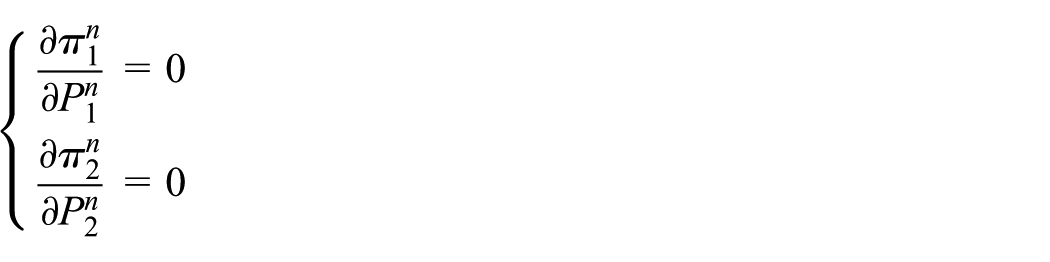
The calculation shows that
Situation 2. The charge rates of value-guaranteed transportation and freight insurance are different. The equations above demonstrate that the equilibrium solution of the competition model will not appear at the subsection point but, rather, when the derivative function equals zero, that is

After the calculation, the solution of equation (14) cannot be obtained with MATLAB; therefore, equation (14) must be solved sectionally:
When
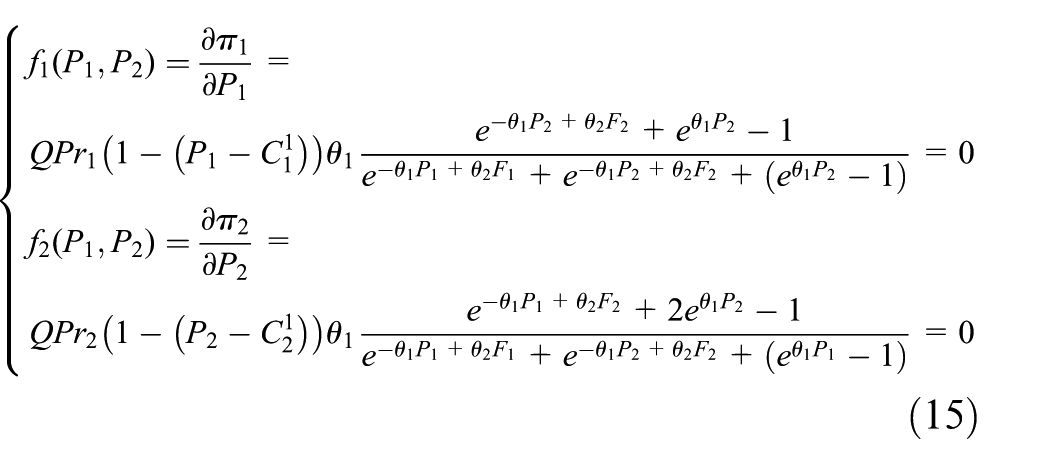
When
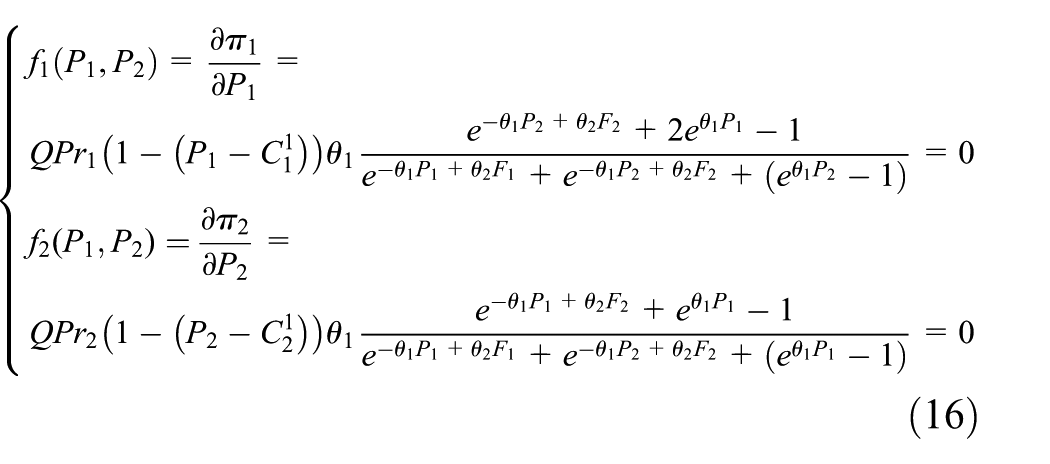
Use the Newton iteration to find a numerical solution for the equation set above:
Step 1. Set the initial estimate value of the equation set as
Step 2. Expand the function

Step 3. If the coefficient matrix determinant

Step 4. Using the same method to expand the function
In conclusion, when the equilibrium charge rate
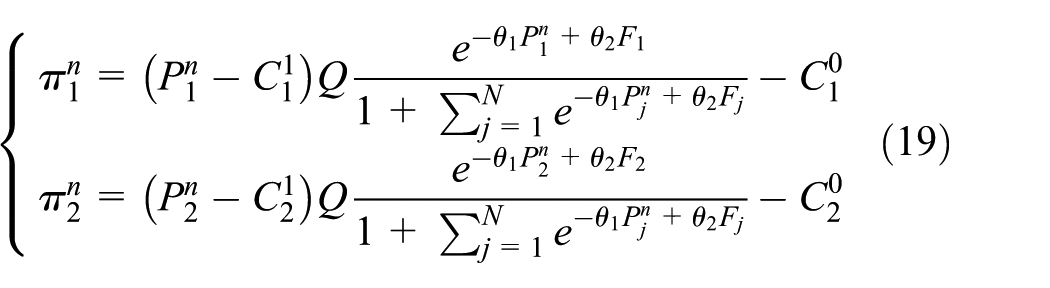
Cooperation model
The construction of the cooperation model
The competition model is based on the noncooperation condition. In the noncooperation condition, both the railway transportation enterprise and the freight insurance company are chasing their own maximum revenue; thus, the charge rate is always in a state of fluctuation.
Both value-guaranteed transportation and freight insurance are value-added services in the railway system. Additionally, both are affected by the volume of railway transportation. Currently, value-guaranteed transportation and freight insurance remain duopolies; however, the fierce competition always leads to an internecine result. Therefore, an inner motive force exists for value-guaranteed transportation and freight insurance to develop a cooperative relationship to benefit both sides.
When value-guaranteed transportation and freight insurance cooperate with each other, their strategy is to maximize the total revenue. On the assumption that the variable costs remain unchanged while fixed costs are reduced, the total revenue of the cooperation model can be expressed as follows

where
In the total revenue model, the total revenue is affected by the charge rate of both value-guaranteed transportation and freight insurance.
Solving the cooperation model
According to the properties of the basic elementary functions, the total revenue function is a continuous and piecewise differentiable function. According to the properties of a continuous and piecewise differentiable function, the extremum of the function may appear at a subsection point or a zero point. Therefore, the maximum revenue appears where the charge rates are the same or the partial derivative equals zero
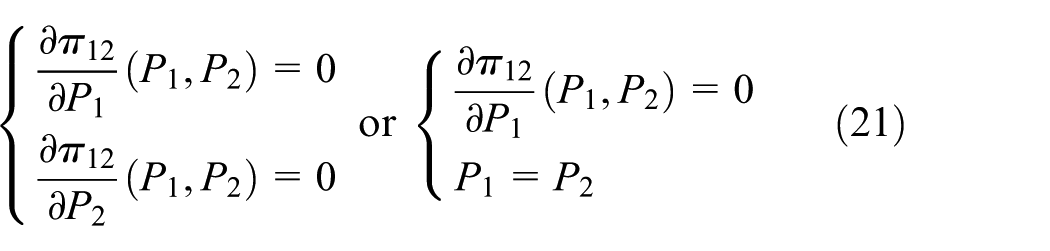
Situation 1. The charge rates of value-guaranteed transportation and freight insurance are the same. The maximum revenue appears where the charge rates of value-guaranteed transportation and freight insurance are the same, that is, the derivative function of the cooperation model equals zero.
Set

Additionally, the partial derivative of the revenue function with respect to P is

where
When other factors remain unchanged,
According to the property of the function, the partial derivative function of the revenue of the cooperation model with respect to P is a continuous function when
Set

Because
Situation 2. The charge rates of value-guaranteed transportation and freight insurance are different. The revenue function is sectionally derivable. Therefore, the inequality of the optimal charge rate combination is as follows

Referring to the method and the solution of the competition model, we can calculate the optimal charge rate of the revenue function in the same manner. Assume that the answer is
When
When
Case analysis
Parameter estimation
Due to the diversity of goods, this article only uses “parcel transportation” as an example to study the charge rate.
Assume the charge rate of value-guaranteed
The scores of the four service level indexes (safety
We use the expert scoring method to grade the four indexes (safety

Consistency check is as follows

According to the analysis, the result of the consistency check is within the range of tolerance. Therefore, the feature vector can be used as the weight vector. After calculation and normalization, the weight coefficient of the indexes is as follows

According to the above data, the service level of value-guaranteed transportation and freight insurance can be determined

where
The generalized cost

where
The market share of value-guaranteed transportation and freight insurance is as follows

where
Solving the equations yields values of
Analysis of the competition model
Assume the fixed cost of freight insurance is 1 unit, and plug the price parameter and the service level parameter into the revenue functions of value-guaranteed transportation and freight insurance, respectively
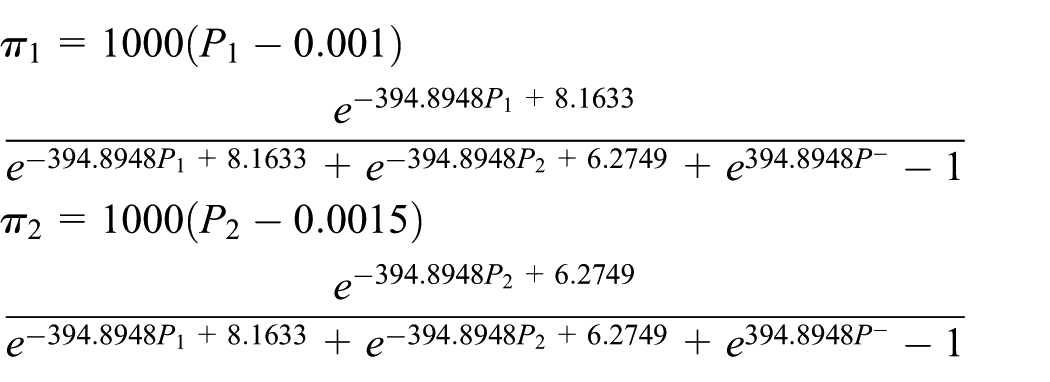
When the charge rate systems of value-guaranteed transportation and freight insurance remain unchanged, the revenues of value-guaranteed transportation and freight insurance are
According to the revenue function, when the charge rate exceeds 0.015, the market share and revenue decline rapidly; when the charge rate varies within [0, 0.015], the variation of total revenue is as shown in Figures (1) and (2):

The trend of the revenue of value-guaranteed transportation changes with the charge rates of value-guaranteed transportation and freight insurance.

The trend of the revenue of freight insurance changes with the charge rates of value-guaranteed transportation and freight insurance.
As shown in Figures (1) and (2), when the charge rate of the freight insurance has a fixed value, the maximum revenue of value-guaranteed transportation is within [0, 0.015]. When the charge rate of value-guaranteed transportation has a fixed value, the freight insurance revenue first increases and then decreases, and the maximum revenue also appears within [0, 0.015].
With the application of modern algorithms and MATLAB, the equilibrium solution [0.0081, 0.0051] can be obtained. The value-guaranteed transportation and freight insurance revenues can both achieve the maximum when the charge rate of value-guaranteed transportation equals 0.0081, and the charge rate of freight insurance equals 0.0051.
As shown in Figure (3), the iteration and convergence speed of both value-guaranteed transportation and freight insurance are relatively fast. Additionally, the changing trends of the two curves are basically consistent. The charge rate of value-guaranteed transportation decreased from the original rate of 0.01 to the equilibrium rate of 0.0081. The charge rate of freight insurance decreased from the original rate of 0.008 to the equilibrium rate of 0.0051.
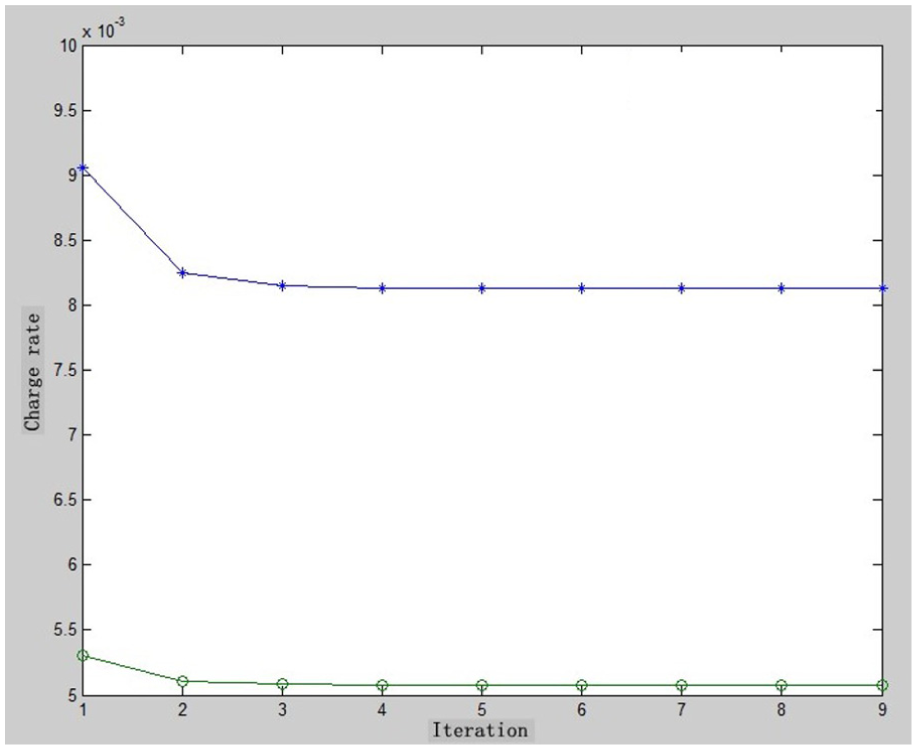
The fluctuation of the charge rate of value-guaranteed transportation (blue line) and freight insurance (green line).
In conclusion, with the development of market competition, the safety of railway freight transportation has been improving, the loss and damage of consigned goods has been reduced, and the charge rate of value-guaranteed transportation and freight insurance can be expected to decline.
As shown in Figures (4) and (5), the total revenue changes with the charge rate combination, which fluctuates first and then stabilizes at a certain level.

The fluctuation of the revenue of value-guaranteed transportation (blue line) and freight insurance (green line).

The fluctuation of the total revenue of value-guaranteed transportation revenue and freight insurance.
We calculate the revenue of value-guaranteed transportation and freight insurance at their equilibrium charge rates, respectively, as follows

From the previous calculation, with the aggravation of market competition, the revenue of value-guaranteed transportation and freight insurance exhibits different degrees of decline. The value-guaranteed transportation revenue decreases from 4.3400 to 3.5982 (decline ratio is 17.3%). The freight insurance revenue decreases from the original 3000 to 0.1657 (decline ratio is 44.8%). Compared with value-guaranteed transportation revenue, the freight insurance revenue declines more sharply.
Analysis of the cooperation model
The analysis suggests that the revenues for both value-guaranteed transportation and the freight insurance showed downward trends in the competition model. Additionally, the total revenue of value-guaranteed transportation and freight insurance decreased rapidly, which indicates the possibility of cooperation. As shown in Figure (4), the reduction range of freight insurance revenue is greater, which encourages the insurance company to consider cooperation with value-guaranteed transportation. Furthermore, value-guaranteed transportation has the potential to employ cooperation to increase revenue.
Assuming that the variable cost of value-guaranteed transportation and freight insurance in the cooperation model are 0.001 and 0.0015, respectively, and the fixed cost decreases to 1.5, the total revenue of value-guaranteed transportation and freight insurance is

We calculate the fluctuation of the total revenue of value-guaranteed transportation and freight insurance when their charge rates fluctuate within [0, 0.015].
As shown in Figure (6), the revenue gap between value-guaranteed transportation and freight insurance is large. Additionally, the total revenue of the cooperation model is more affected by value-guaranteed transportation. When the charge rate of value-guaranteed transportation is less than the charge rate of freight insurance, the total revenue shows a similar trend as the revenue curve of value-guaranteed transportation. When the charge rate of value-guaranteed transportation is more than the charge rate of freight insurance, the total revenue changes greatly.

The total revenue of the cooperation model.
The equilibrium charge rate and total revenue based on cooperation is calculated as follows
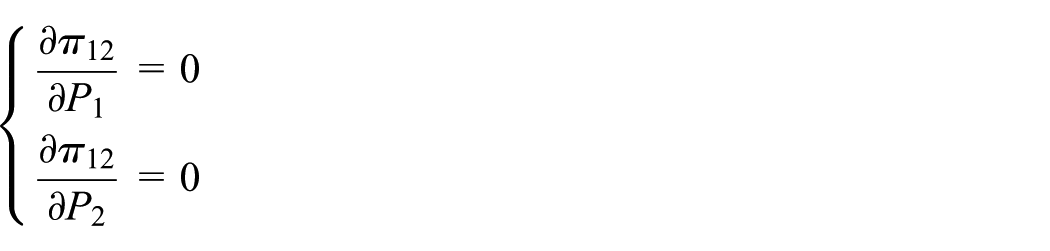
The result is
On the assumption that the fixed cost saved by the cooperation model is 0.25, the revenues of value-guaranteed transportation and freight insurance are
Because the charge rate of value-guaranteed transportation has been maintained for 24 years, since 1992, raising the price may be difficult. Therefore, the market situation should be considered before raising the charge rate of value-guaranteed transportation.
On the assumption that the charge rate of value-guaranteed transportation should be no more than 0.01, the optimal charge rate combination and maximum revenue is calculated as follows
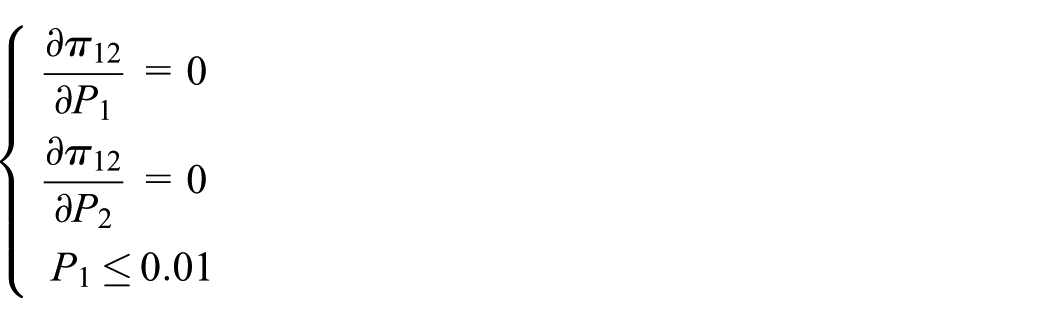
The result is
Therefore, when maintaining the charge rate of value-guaranteed transportation, the charge rate of freight insurance can be reduced to 0.0072 to maximize the total revenue. At this point, the revenue of value-guaranteed transportation and freight insurance is
The analysis shows that the growth of freight insurance under the cooperation scenario is much greater than the growth of value-guaranteed transportation. Therefore, the railway transportation enterprise can take actions, such as raising the agent fees of freight insurance, to share the benefit acquired by the insurance company.
Conclusion
The generalized cost function of railway value–guaranteed transportation and freight insurance was defined in this article. Additionally, the market share based on the logit model was studied.
Through the analysis of the market conditions under both competition and cooperation scenarios, the corresponding revenue function of both value-guaranteed transportation and freight insurance was formulated. Additionally, the optimal pricing strategy under both the competition and the cooperation models was determined based on a detailed calculation.
The feasibility of both the competition and the cooperation models was verified by the case analysis. Compared with the competition model, the revenues of both value-guaranteed transportation and freight insurance have increased greatly under the cooperation scenario. This finding proves that a cooperation strategy is beneficial for both railway value–guaranteed transportation and railway freight insurance.
Footnotes
Handling Editor: Xiaobei Jiang
Declaration of conflicting interests
The author(s) declared no potential conflicts of interest with respect to the research, authorship, and/or publication of this article.
Funding
The author(s) disclosed receipt of the following financial support for the research, authorship, and/or publication of this article: This research is supported by the Science and Technology Research Development Program of China Railway (grant no. 2015F024).