




Abstract
The biomimetic superhydrophobic surface derived from lotus effect is one of the hotspot issues in recent years and also a specific application case of biomimetic in modern industry. Based on the excellent characteristics of bionic superhydrophobic surface, such as self-cleaning, anti-icing, drag reduction, and anti-corrosion, it has great application value in the fields of industry, military, and biomedicine. Based on the effect of water contact angle and water sliding angle of superhydrophobic surface on the hydrophobicity, we discussed the wetting behavior of biomimetic superhydrophobic surface, the important properties of biomimetic superhydrophobic surface were reviewed in detail, and we provided the necessary theoretical basis for the application of superhydrophobic surface. The methods of fabrication of biomimetic superhydrophobic surface were summarized and elaborated three kinds of low-cost and simple methods of spraying, chemical etching, and flame treatment, and the development trend of biomimetic superhydrophobic surface was also prospected.
Introduction
Due to a high water contact angle (CA) and a very low water sliding angle, biomimetic superhydrophobic surfaces show excellent repellency. Superhydrophobic surfaces were initially observed on the surface of some animals and plants, and the most well-known example is the lotus leaf, and Barthlott and Neinhuis 1 studied on the microstructural of lotus leaf surface and found that it was the nanoscale hydrophobic epicuticular wax crystals of lotus leaf surface that made the lotus leaf have a self-cleaning property, and this phenomenon is called of lotus effect. Lu et al. 2 studied on the peach skin effect and found that it was due to the special coexisting water droplets of both Wenzel and Cassie states that created the strong interaction between the water droplet and surface, to make the surface of peach the quasi-superhydrophobic state with high adhesive force. Hu et al. 3 studied on the water strider body structure and determined that the unique hemispherical vortex shedding of the leg made the water strider have nonwetting property to walk on water. Gao et al. 4 studied on the microstructure of mosquito eyes and found that it was the miniature hemisphere composite structure which formed air cushion to prevent mosquito eyes from being wet. In addition, studies5–7 determined that there are examples of biomimetic superhydrophobic surfaces in rice leaves, butterfly wings, and gecko feet.
Through the research of the microstructure of superhydrophobic surfaces of flora and fauna, it has been determined that the superhydrophobic surface has many practical properties, such as self-cleaning, anti-fouling, and anti-corrosion, so the superhydrophobic surface has been widely used in various fields. For example, for the function of anti-fouling and anti-corrosion, it is practical to coat on the surface of the hull with superhydrophobic materials and fabricate superhydrophobic surface on pipeline inner wall. 8 The application of superhydrophobic surfaces in transportation, such as aircraft and ship surfaces, can effectively prevent icing accidents. 9 Modeled on the lotus leaf self-cleaning property, the superhydrophobic surfaces applied to clothing, packaging, and glass can make it have self-cleaning property to prevent dirt adhesion. 10 In recent years, many studies have explored the role of superhydrophobic surfaces in biomedicine, providing a new direction for the development of superhydrophobic surfaces.
Due to the excellent properties and wide applications, the fabrication of superhydrophobic surfaces has been the focus of research. Plasma treatment is an advanced superhydrophobic surface fabrication technology. Chen et al. 11 processed the Al surface by plasma treatment to be superhydrophobic surface. Compared with other methods, electrochemical method is not restricted by substrate sharpness and size. Darmanin et al. 12 synthesized pyrrole monomers with semifluorinated liquid crystalline segments to fabricate superhydrophobic polymer films. In recent years, many researchers have explored a lot of simpler and cheaper methods to fabricate biomimetic superhydrophobic materials. Yu and Li 13 fabricated nanosilica/polyurethane (PU) micro-nanocomposite coating with spraying method, due to the greater content of organosilicon and the surface micro-nanostructure similar to lotus leaf surface, and the coating had superhydrophobic property.
According to the thriving biomimetic superhydrophobic surface technology, a brief overview of the excellent properties of biomimetic superhydrophobic surface, a summary of low-cost and simple methods of fabrication methods in recent years, and a summary of applications of superhydrophobic surface were given, to provide a summary of recent research of superhydrophobic surface and pointed out the trend and direction of the development of superhydrophobic surface technology.
Theories and properties of superhydrophobic surfaces
Wetting behavior
Wetting is the phenomenon that a liquid expands along a solid surface when it is in contact with a solid. The CA is usually used to describe the degree of wetting. Young’s equation describes the state of a droplet at rest on an ideal, smooth surface, as shown in equation (1)

where

Young’s equation.
For the description of the state of the droplet on rough surfaces, there are two theories: Wenzel model and Cassie–Baxter model. The Wenzel model describes that the droplet is in uniform contact with the rough surface, as shown in equation (2) and Figure 2(a)

where θW is the Wenzel CA and Rf is the roughness factor.
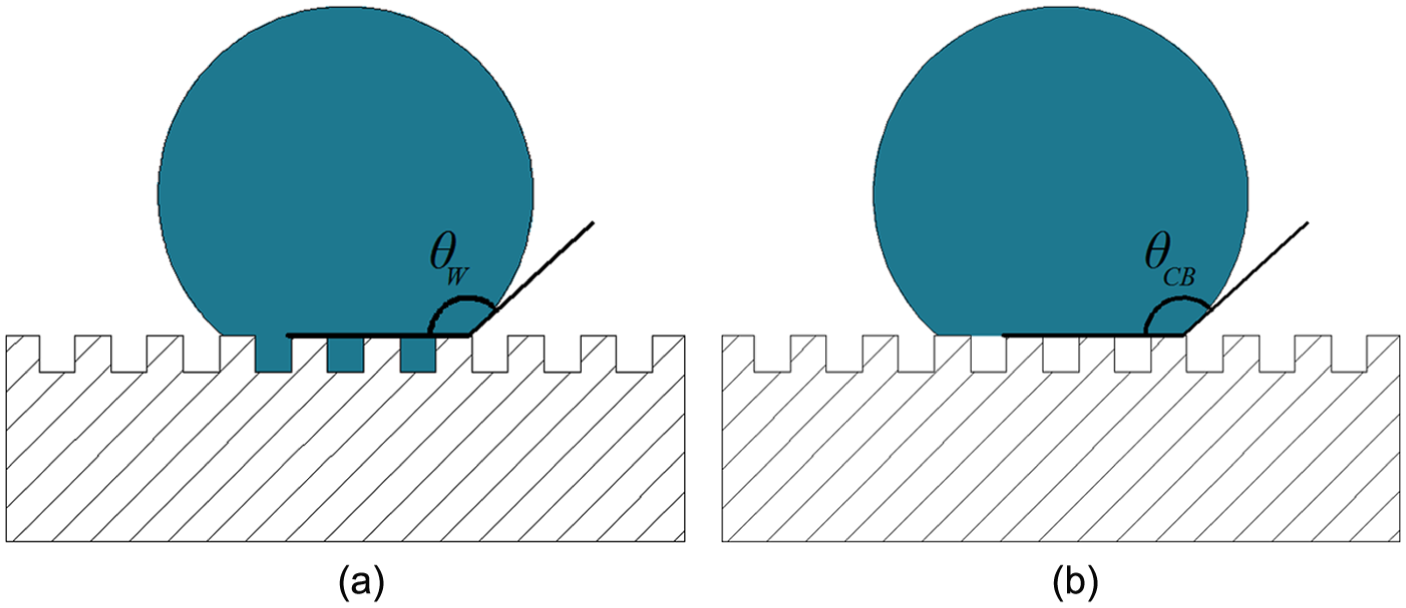
(a) Wenzel model and (b) Cassie–Baxter model.
Cassie–Baxter model describes the heterogeneous wetting. The droplets contact only the rough surface of the peaks, and the valleys of the droplets and the rough surface is filled with air, as shown in equation (3) and Figure 2(b)

where f1 is the area fraction of the solid surface in contact with the liquid droplet, θCB is the CA of the liquid droplet, and θ1 is the CA of component 1.
The solid surface can be called as superhydrophobicity surface when the CA is greater than 150° and the sliding angle less than 10°; in this case, the droplet does not completely infiltrate the rough surface, leaving the air in the groove, blocking the contact between the droplet and the solid surface. The superhydrophobic surfaces were initially discovered in some plants and animals, such as lotus leaf, water strider, and so on, as shown in Figure 3. The superhydrophobic surface has many excellent properties, which makes the study of superhydrophobic surface a hotspot all the time. Then, several important properties of superhydrophobic surfaces are briefly introduced.

Examples of superhydrophobic surfaces in nature: 14 (a) superhydrophobic surface microstructure of lotus leaf and (b) superhydrophobic surface microstructure of water strider.
Properties of repellency, anti-icing, and anti-corrosion
In the case of water droplets on steady superhydrophobic surface, the CA is greater than 150°, and the sliding angle is less than 10°. The high CA means that the contact area of water droplet on solid surface is relatively small, and the low slide angle means that as long as the surface is slightly tilted, water droplets will fall from the solid surface, so the droplets on superhydrophobic surface will not penetrate into the interior; it means that the corrosive medium will not penetrate into the internal to lead to formation of solid surface corrosion damage, and water will not stay and freeze on the solid surface at low temperatures, so the superhydrophobic surface has excellent properties of repellency, anti-icing, and anti-corrosion. The research of Fang et al. 15 on butterfly wing determined that butterfly wing displayed a multidimensional micro/nano superhydrophobic structure, as shown in Figure 4. The butterfly wing surface showed obvious anisotropy; the greater longitudinal ridge spacing would enhance the hydrophobic of butterfly wing surface, so the butterfly wing in flight could be exempted from wet with dew and frozen wing caused by low temperature. The study of the butterfly wing promotes the exploration of the mechanism of the wetting behavior of organism surface, and the butterfly wing becomes the biomimetic prototype to fabricate smart biomimetic superhydrophobic surfaces and multifunctional materials.

Butterfly wing surface showed multidimensional micro/nano superhydrophobic structure: SEM images of primary structures of (a) rectangular scale, (b) elliptic scale, (c) parallelogrammic scale; SEM images of (d) nano longitudinal ridges, lateral bridges and nano stripes, (e) cross section of longitudinal ridge, and (f) illustration of the structural parameters of scales. 15
Self-cleaning
If the CA is greater than 150°, and the sliding angle is less than 10°, the contact area of water droplets on superhydrophobic surface is relatively small, and water droplets will fall when the surface is slightly tilted. The special structure of superhydrophobic surface reduces the adhesion of dirt, and a small tilt can make the droplets move relative to the solid surface and remove the dirt and keep the surface clean. In daily life, the droplets of car window and glass surface slide to take away the dirt, but with the evaporation of droplets, the dirt will remain on the surface. To solve this problem, Zheng et al. 16 found that compared with droplets on the flat surface that could only remove the dirt by sliding, due to the microstructure of superhydrophobic surface, droplets could roll to remove dirt and sediment with a small tilt, and self-cleaning property and efficiency were much better, as shown in Figure 5, namely, the self-cleaning property of rolling droplets was better than that of sliding droplets. Richard and Quere 17 determined that when the CA was greater than 170°, even the more viscous droplets could roll on the solid surface and could not slide, this means the larger the CA, the better the self-cleaning property. While the research of superhydrophobic surface becomes more and more mature, the self-cleaning property of superhydrophobic surface has been widely used in various fields, such as high-rise building glasses.

Sliding and rolling droplets remove dirt on different hydrophobic surfaces. 16
At the same time, increasing the roughness of surface was significant to get larger CA. Figure 6 showed CAs of various surfaces, so adopted more complex topology to get larger CA.
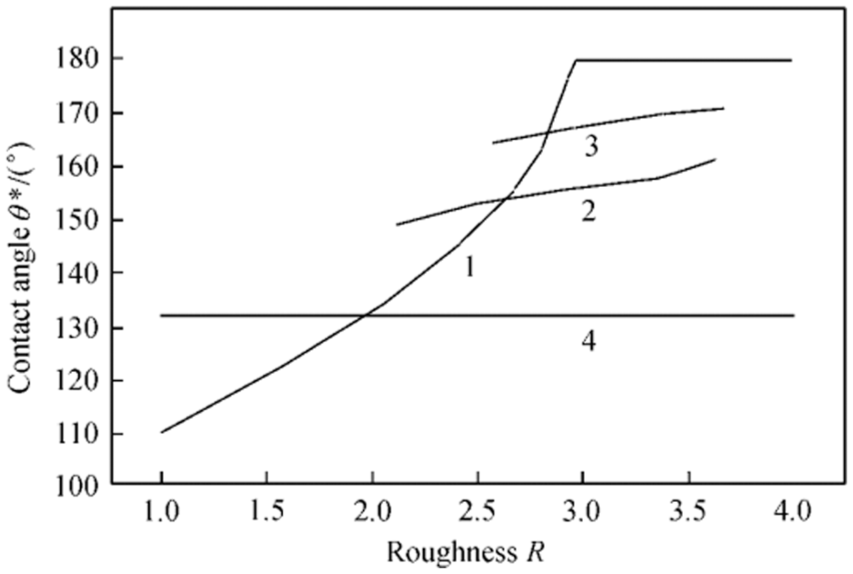
Contact angle of different roughness of surfaces: curve 1 represented the full wetting, and curves 2–4 were corresponding to composite contact of 1D sinusoidal, 2D sinusoidal, and vertical columns, respectively. 16
Drag reduction
As shown in Cassie–Baxter model, superhydrophobic surfaces have much convex microstructure, which keeps a lot of air in the groove between solid surface, that is, the actual contact surface between the liquid and the superhydrophobic surface is composed of two interfaces: liquid–solid interface and liquid–gas interface. On a superhydrophobic surface, the droplet can only contact with the separated convex microstructure, greatly reducing the contact area of water and solid surface, and the friction coefficient of liquid–gas interface is much less than that of liquid–solid interface, so the superhydrophobic surface will achieve the purpose of reducing the fluid resistance. Ke et al. 18 determined that the static CA had little influence on the drag reduction, and the dynamic CA was an important factor to reduce fluid resistance. The application of superhydrophobic surface in water pipe and oil pipeline can reduce the friction resistance of the conveying medium in the pipeline, so as to reduce the cost of pipeline transportation. And the fabrication of superhydrophobic surface on ship surface can reduce the fluid resistance of the ship, save energy, and reduce consumption.
Fabrication methods of superhydrophobic surface
In recent years, there are many methods to fabricate superhydrophobic surfaces, such as lithography, templating, femtosecond laser pulsing, and etching. Although there are a lot of fabrication of superhydrophobic surface technology, some of the methods have their limitation, such as lithography and femtosecond laser pulsing are expensive and difficult to be applied to large structures; although the templating has great potential for large-scale production, it is often used only in soft polymers. 19 Therefore, simple, practical, and low-cost methods of superhydrophobic surfaces will be briefly introduced, such as spraying, etching, and flame treatment.
Spraying and physical method
Spraying is a simple and low-cost method for the fabrication of biomimetic superhydrophobic surface, and it can be used to repair the mechanical surface damage by local spraying. 20 While this method relies heavily on the adhesion of the coating to achieve stability. Dessouky et al. 21 adopted different concentrations of functionalized silica (FS) nanoparticles and different polymers (i.e. epoxy, PU, polystyrene (PS), or poly(ethylene-co-vinyl acetate) (EVA)) to achieve one-step low-cost spraying method to fabricate uniform superhydrophobic coating without special equipment. By comparison of scanning electron microscopy (SEM) of copper surface treated by different concentrations of FS and epoxy (as shown in Figures 7 and 8), the results showed that when FS concentration was 2.5 wt% and no polymer was added, the maximum CA was 162° and the sliding angle of water was less than 5°. At the same time, the roughness of substrate bare copper surface increased from 240 to 1600 nm at 1 wt% FS and 600 nm at 2.5 wt% FS. And results of electrochemical impedance spectroscopy showed the transfer resistance of the corrosion process of superhydrophobic surface was 5.05 kΩ, much higher than the original material surface (0.091 kΩ). Therefore, this composite coating showed great potential and could be used for various industrial substrates such as glass, plastic, and metal.

SEM images of coated copper surface of different concentration of FS and epoxy: (a) 1 wt% silica with 1% epoxy, (b) the corresponding high magnification, (c) 2.5 wt% silica with 2% epoxy, and (d) the corresponding high magnification. 21

SEM images of coated copper surface of different concentration of FS without epoxy: (a) 1 wt% silica, (b) the corresponding high magnification, (c) 2.5 wt% silica, and (d) the corresponding high magnification. 21
By the ability that dopamine (DA) can polymerize spontaneously in alkaline aqueous solution, Xue et al. 22 attached lotus-inspired coating to polyethylene terephthalate (PET) fibers by adhesion of the mussel membrane, to form superhydrophobic surface. The SEM of PET fiber treated by different concentrations of DA is shown in Figure 9; the maximal CA was 160.26° ± 1.12°, and it was obtained by the treatment with DA of 2 mg/mL and 20 h processing time. This treatment method totally changed the original smooth and clear surfaces of PET fibers, because of the rough fibers of this coating, and it was beneficial to the hydrophobicity of textiles, and due to the high adhesion of catechol derivatives, this method could be extended to a variety of substrates.

SEM images of PET fibers treated with various concentrations of DA: (a)1 g/L, (b)2 g/L, (c)3 g/L, (d)4 g/L, (e)5 g/L, and (f) CA changes of treating time of 20 h. 22
Li et al. 23 fabricated a new kind of superhydrophobic and oleophilic porous polymer membrane by spraying fluorinated polyarylester polydimethylsiloxane block copolymer (PAR-b-PDMS) solution. The method was simple and just included three steps: spraying coating, drying, and peeling, but the PAR-b-PDMS membrane displayed high oil/water separation efficiency, recyclability and durability, and good mechanical properties, so this method can be used for a large-scale fabrication of superhydrophobic oleophilic polymer membranes. In addition, the layer structure of PAR-b-PDMS membrane surface could be controlled by adjusting the concentration of copolymer solution, as shown in Figure 10; the maximum CA could reach 163° ± 2.3°. The PAR-b-PDMS membrane could selectively adsorb the oil in water, and had excellent lipophilicity and hydrophobicity to effectively separate the oil/water mixture, and the separation efficiency reached 99%.

SEM of the PAR-b-PDMS membranes of different copolymer solution concentrations: (a) 1 wt%, (c) 5 wt%, and (e) 10 wt% and (b, d, and f) the corresponding high magnification. 23
Feng et al. 24 fabricated superhydrophobic surface by physical method scraping, bonding, and peeling; this method was very simple and did not require any expensive chemical reagents and equipment, as shown in Figure 11. The polyolefin superhydrophobic surface could be manufactured by abrasion machines and also could be applied to other hydrophobic polymer materials to realize superhydrophobic property. Because of its usability and low cost, this method will have widely practical application.

Fabrication of superhydrophobic surface by physical method. 24
Chemical etching
Chemical etching is a cheap and easy-controlling method, because the reaction conditions require specific temperature and immersion duration; this method is usually used in the fabrication of superhydrophobic surface on metal substrates. Yin et al. 25 put forward a method combined of chemical etching and oxidation technology to fabricate steel plate superhydrophobic surface in low concentration acidic solution; the process contained hydrochloric acid and potassium chloride in oxygen-enriched environment, to prepare superhydrophobic surface on steel substrates. When the CA of the superhydrophobic surface was 166° ± 2°, and the sliding angle was less than 2°, it showed excellent hydrophobicity; in addition, the superhydrophobic surface had long-term chemical stability. These properties are favorable for the potential applications of steel materials for drag reduction field.
Liu et al. 26 developed a simple efficient and low-cost method to fabricate biomimetic superhydrophobic surface, and the stainless steel substrates SS304 sheets were treated by FHH solution (FeCl3 + HCl + H2O2, 15:1:1, vol%) for 20 min, to change SS surface from shiny silver appearance to black and create nanoscale roughness; the CA was 158.3° ± 2.8°. In addition, the prepared superhydrophobic surface had excellent frost resistance, when in the environment of 60% humidity and −22°C for 90 s, the plain SS surface had almost completely frosted over, while the superhydrophobic surface just frosted in a few areas, as shown in Figure 12. This efficient and low-cost method is still a good method for the fabrication of superhydrophobic surfaces even in wet conditions.

Plain SS surface (left) and superhydrophobic SS surface (right) in the environment of 60% humidity and −22°C for 90 s. 26
Flame treatment
Flame treatment is a special and simple method to fabricate superhydrophobic surface. Based on the difference in the thermal properties of organic and inorganic materials, the micro/nanostructure and morphology of biomimetic superhydrophobic surfaces were fabricated. Li et al. 27 used an organic–inorganic composite consisting of polydimethylsiloxane (PDMS) and SiO2 particles with strong hydrophobicity as the base; in this composite, these two components showed different thermal responses in the flame treatment process and then constructed the expected micro/nano superhydrophobic structure. The roughness of superhydrophobic surface could be controlled by changing the flame treatment time, to achieve ultra-low sliding angle reaching a limiting value of 1° and greatly suppress the anisotropic wettability, as shown in Figure 13. Compared with other conventional methods, this method has the advantages of simplicity, high efficiency, and low cost. These characteristics will give it broad application prospects.
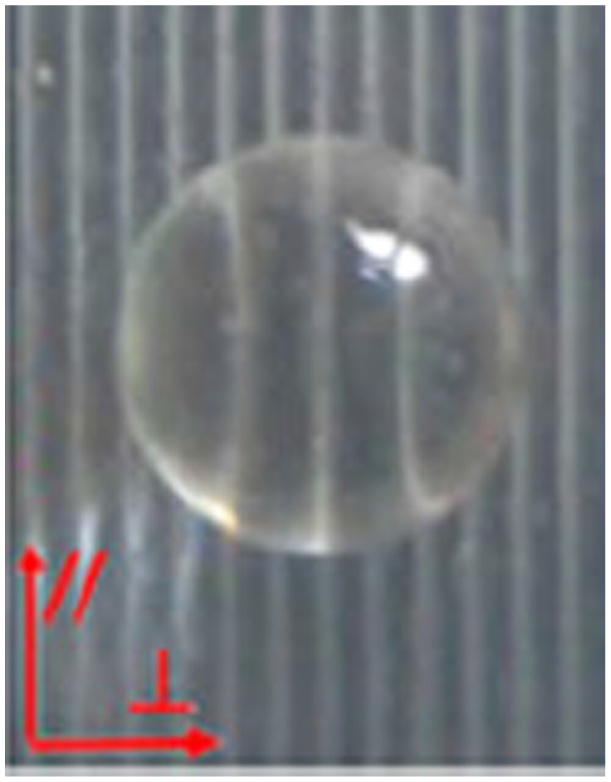
The flame-treated PET-R surface. 27
Function and application
In recent years, the superhydrophobic surface has been widely used in all aspects of daily life because of its excellent properties, such as self-cleaning, anti-icing, and anti-corrosion. The development of these superhydrophobic surface materials has important theoretical and practical value in many fields and is widely used in industry and military. In addition, the application of biomimetic superhydrophobic surface in biomedicine is gradually expanding, as is the inherent characteristics of implanted biological material, such as implanted biomaterials, materials that exhibit specific interactions with organisms or used in vitro.
Industry
Superhydrophobic surface is widely used in industry, such as superhydrophobic coating, oil/water separation membrane, self-cleaning surface, and other fields. Fan et al. 28 sprayed the micro/nano dual-scale structure polytetrafluoroethylene (PTEE) superhydrophobic surface to other materials, to achieve property of self-healing and excellent superamphiphobicity with both hot and cool liquids under the condition of low cost. Li et al. 29 used one-step spraying method to fabricate superhydrophobic attapulgite (APT) mesh membrane to separate oil and water. Gu et al. 30 fabricated carbon nanotubes superhydrophobic composite membrane, by attaching 1H, 1H, 2H, 2H-perfluorodecyltriethoxysilane (PFDTS) to –OH functionalized carbon nanotubes, to obtain stable superhydrophobic and high efficiency oil/water separation under extreme conditions. Based on the anti-icing property of superhydrophobic surface, Xu et al. 31 fabricated ZnO/PDMS composite material coating superhydrophobic surface on an Al substrate; this type of coating has the effect of reducing ice accumulation, so it is widely used in particle/polymer composite systems.
Military
The potential applications of superhydrophobic surface are valuable in the military equipment, especially in surface ships, submarines, torpedoes, and other naval equipment surface treatment. Contact area of superhydrophobic surface ships and marine actually consists of solid–liquid interface and liquid–gas interface, and the friction coefficient of liquid–gas interface is far less than that of solid–liquid interface, so as to reduce water resistance. Superhydrophobic surface treatment of ships is an efficient way to reduce the friction resistance in low-speed sailing, although there are many limit conditions of superhydrophobic surface drag reduction, such as low speed, shallow water, and short time, but it is still a simple and efficient underwater drag reduction way; once these issues are solved, it will be used in a large scale.
Under the ocean environment, the metal is prone to oxidation corrosion; naval surface ships, submarines, and even coastal or island land settings are threatened by oxidation corrosion. At present, the cost of measures of anti-corrosion of metal, such as sacrificial anode, external power to change the potential distribution of metals, antirust paint, and others is high and can only delay corrosion and cannot fundamentally solve the problem. The superhydrophobic surface has the property of water resistance, which can block the contact between the water and the metal material to relieve the oxidation corrosion problem, 32 as shown in Figure 14.

SEM images of (a) EE coated on CRS and (b) SEE coated on CRS. 32
The surface ships on the low-latitude sea are easy to freeze after the waves on the deck and, finally, the ice covers on the surface of the ship. Ice cover is a long-standing problem in the Navy, but so far, the method of deicing is still manual deicing, which consumes a lot of manpower and is low efficiency. The superhydrophobic surface can enhance the anti-icing property of the surface of the ship, which has important significance for the ships sailing in the low-latitude cold area, as shown in Figure 15. 33 The US Navy has announced that it will begin to cover surface ships with a protective coating layer, which is made of superhydrophobic material. This coating will protect the ship’s sensors, weapons systems, and other exposed equipment to avoid salt fog corrosion but also can save the time and money spent on maintenance due to corrosion.

Anti-icing of superhydrophobic surface. 33
Biomedicine
Designing innovative materials to improve the quality of life of patients is a matter of concerned by clinicians, engineers, and scientists. Superhydrophobic surface has been proved to be able to modulate the interfacial reactions of the biological entities and the surfaces of the materials. In addition to influencing protein adsorption and eukaryotic cell attachment and proliferation, wettability can also affect platelet adhesion/activation, blood coagulation, and bacteria adhesion. 34 In addition to directly apply to the body, superhydrophobic surface can also be used for other biomedical applications; micro/nanostructure of superhydrophobic surface has broad application prospects in the field of diagnostic tools, sensors, medical textiles, and production of biological material. For example, microfluidic devices based on superhydrophobic surfaces have been used for several biomedical applications such as cell culture equipment, medical diagnostics (e.g. biosensors), and particle production.35–37 Compared with traditional procedures, microfluidic devices can effectively control the molecular concentration using the characteristics of microfluid. The wettability of the microfluidic channel is very important for the flow of the liquid; the superhydrophobic surface can reduce the resistance of the microfluidic channel and produce microvalves. However, the use of selective hydrophobic/hydrophilic surface to control liquid flow is an efficient control method. In this case, the micro/nanostructure roughness of the microchannel can determine the liquid flow in a predetermined path,38–42 as shown in Figure 16.
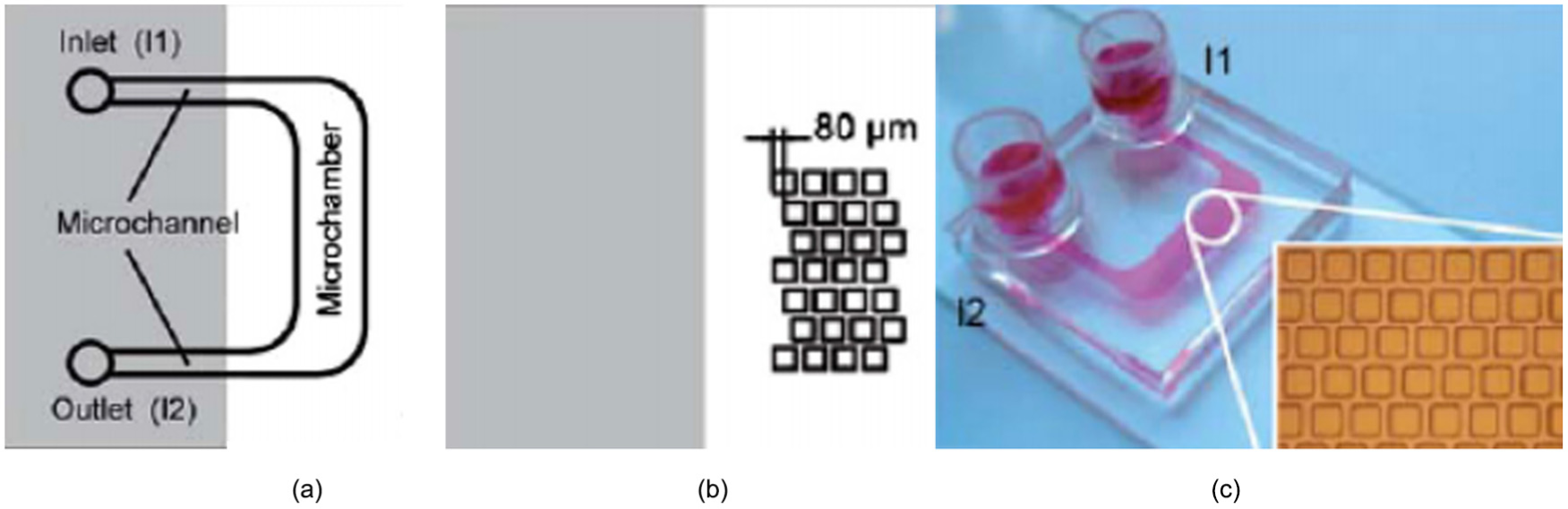
The two PDMS layers of microfluidic device: 43 (a) the upper microchannel layer and (b) the lower microchannel layer and (c) microfluidic device.
Summary and outlook
Biomimetic superhydrophobic surface is a typical interdisciplinary field, and it is a fast developing research field in the use of bionics in modern industry. Since the lotus effect caused a lot of study on biomimetic superhydrophobic surface, Wenzel model and Cassie–Baxter model explain the hydrophobic mechanism of superhydrophobic surface, explore the influence of CA and sliding angle on the hydrophobicity, and provide a theoretical basis for the application of superhydrophobic surface in modern industry. The technology of superhydrophobic surface fabrication, such as spraying, etching, templating, and electrochemical methods, is becoming more and more mature, and some simple and low-cost methods also gradually rise. Due to the properties of self-cleaning, anti-corrosion, anti-icing, and other excellent properties, superhydrophobic surfaces have been widely used in the manufacturing of superhydrophobic material, fabric, and oil–water separation membrane; at the same time, superhydrophobic surfaces have been used to prevent the corrosion of underwater equipment and the surface of ships. In recent years, the application of superhydrophobic surfaces in biomedicine has been rapidly developed, from microfluidic devices to superhydrophobic textiles in biomedicine, and the study of biomimetic superhydrophobic surface in biomedical field will be the development trend and hotspot.
Footnotes
Handling Editor: Michal Kuciej
Declaration of conflicting interests
The author(s) declared no potential conflicts of interest with respect to the research, authorship, and/or publication of this article.
Funding
The author(s) disclosed receipt of the following financial support for the research, authorship, and/or publication of this article: This work was supported by the Zhejiang Provincial Natural Science Foundation of China (grant no. LQ15E050005), the National Natural Science Foundation of China (grant nos 51779226, 20140251), the China Postdoctoral Science Foundation (2016M601736), the Postdoctoral Research Funding Plan in Jiangsu Province (1601028C), and the Public Welfare Technology Application Projects of Zhejiang Province (2017C31025).