



Abstract
The generalized Reynolds equation of dynamically loaded sleeve bearing is established based on mass conservation boundary condition and wall-slip effect. The cavitation migration and flow velocity of spiral oil wedge bearing for different times are computed, using the finite difference method by solving the Reynolds equation of four slip states with cavitation effect. The results show that the cavitation area with cavitation effect and wall slip decreases compared to the cavitation area without regard to cavitation effect and wall slip. As time goes, the slip location at the surface of axis and sleeve moves generally along the rotation direction of axis, and the region of slip changes.
Keywords
Introduction
With the development of high-speed and precision spindle systems, there is a higher demand for the characteristics of sleeve bearing. Sleeve bearing produces an important effect to the performance of entire bearing rotor system, especially in the dynamical loading and high-frequency vibration of machine tool. In order to better understand the physical mechanism of lubrication process, it is necessary to study the characteristics of dynamically loaded sleeve bearing. Wang et al. 1 investigated numerically the effects of non-Newtonian lubricant on elliptically shaped journal bearings subjected to transient loads based on mass-conserving cavitation model. Paranjpe 2 analyzed the non-Newtonian effects of multigrade engine oils in dynamically loaded crankshaft bearings using mass-conserving cavitation algorithm. Sawicki 3 studied the dynamics of a plain cylindrical journal bearing and four multi-lobe bearings considering the fluid flow in both full film and cavitation regions, and presented a transient analysis of submerged journal bearing incorporating the mechanism of shear. Shao et al. 4 investigated the performance of engine main bearings under hydrodynamic loads in a six-cylinder in-line diesel engine, and estimated the orbit movement, minimum oil film thickness, and power loss of the bearing. Michaud et al. 5 studied the three-dimensional transient thermohydrodynamic behavior of bearings under dynamic loading on the basis of the JFO (Jakobsson–Floberg–Olsson) model, and the JFO model automatically predicted oil film rupture and reformation in the bearings. Pai and Pai 6 studied theoretically the non-linear transient analysis of four- and six-axial grooved water-lubricated journal bearings using the JFO boundary conditions for unidirectional constant load, unidirectional periodic load, and variable rotating load. Zhang et al. 7 analyzed a transient performance of dynamically loaded finite journal bearings in mixed lubrication including mass-conserving cavitation. Dang et al. 8 investigated theoretically the influence of load direction on the characteristics of a five-pad tilting-pad journal bearing and showed that load direction had considerable effects on the static and dynamic characteristics of bearing. Adatepe et al. 9 studied the tribological performances of non-grooved and micro-grooved journal bearings under dynamic loading. Khatri and Childs 10 provided the static and dynamic performance test results for three-lobe bearing in many radial static-pad orientations. Su et al. 11 predicted the history moving of cavitation using mass-conserving cavitation algorithm and showed that the incompressible cavitation algorithm can predict the history moving of cavitation and the pressure value in the cavitation had great effect on the results. Brito et al. 12 compared the role of single and twin groove bearings under variable loading direction using the thermohydrodynamic approach. Rao and Sawicki 13 analyzed the stability characteristics of the herringbone grooved journal bearings considering cavitation of the fluid flow under steady and perturbed states, generated the results for different eccentricity ratios and groove angles, and validated the use of bearing at very higher operating speeds in rotating machinery. Zadorozhnaya 14 calculated the thermohydrodynamic characteristics of complex-loaded sliding bearings allowing for the non-Newtonian behavior of fluid and heat transfer. Using Reynolds equation and three-dimensional Navier–Stokes equations, Christiansen et al. 15 studied the journal orbit of dynamically loaded journal bearing. For better understanding the lubrication characteristics of sleeve bearing in dynamical loading, cavitation migration and slip velocity of spiral oil wedge sleeve bearing are studied based on mass conservation boundary condition and wall-slip effect.
Theoretical model
Wall-slip theory
The classical Reynolds equation assumes that liquid molecules adjacent to the solid are stationary relative to solid. The interaction of molecules cannot afford infinite shear stress, and wall slip can occur if shear stress is high enough. Critical shear stress model assumes that wall slip occurs when shear stress exceeds the critical shear stress at the solid–liquid interface, and the Reynolds equations of four slip states are gained.
When the slip region occurs on axis surface, the boundary conditions at the axis surface (y = 0) and the sleeve surface (y = h) are as follows
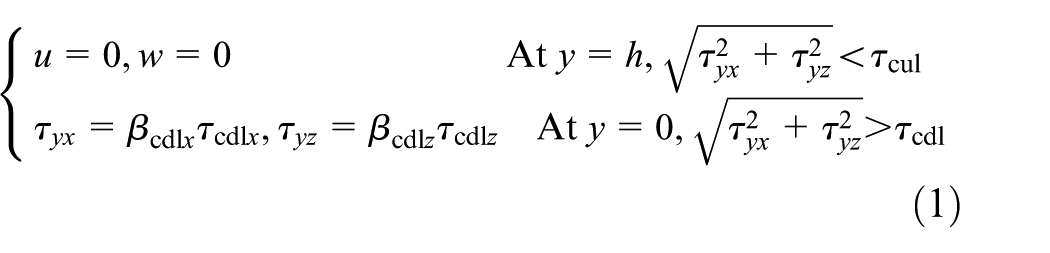
where τcdlx and τcdlz are the critical shear stress in the x and z directions at journal surface, βcdlx and βcdlz are the sign function, βcdlx and βcdlz are 1 if τyx and τyz are greater than 0, βcdlx and βcdlz are −1 if τyx and τyz are less than 0, τyx is shear stress in x direction, τyz is shear stress in z direction, h is the oil film thickness, y is the radial coordinates, z is the axial coordinates, τcul and τcdl are the critical shear stress for slip at sleeve and journal surface,
Substituting equation (1) into simplified Navier–Stokes equation, we get
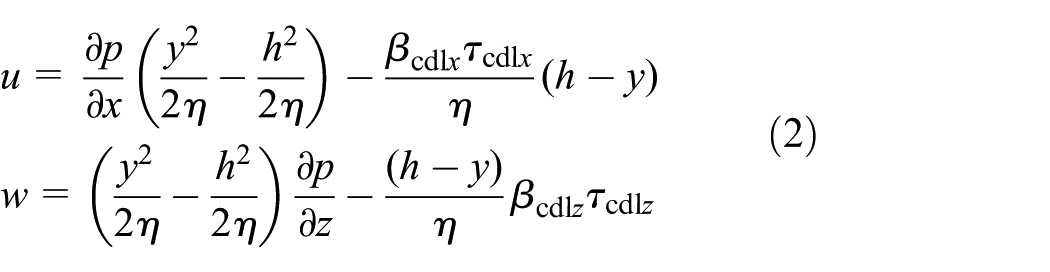
The volumetric flow rate through per unit width is solved by equation (2), and it is substituted into continuity of flow; the new Reynolds equation accounting for the wall slip of axis surface is established as follows

Cavitation theory
Mass-conserving boundary condition (JFO boundary condition) considers mass conservation in oil film rupture and reformation location. Similar to Elrod algorithm, 16 the cavitation algorithm inherited a switch function to modify the Reynolds equation in cavitation location. Through the bulk modulus, the density was related to the oil film pressure. Elrod introduced a switch function into the pressure–density relationship, which reflected that the pressure was constant and pressure gradient was zero in the cavitation region 16

where αρ is the ratio of lubricant density to the cavitation density,
Integrating equation (4) and using the Taylor series expansion, the expression of pressure can be gained, which will simplify calculation

For gaining the dimensionless generalized Reynolds equation considering wall slip of axis surface, substituting

where
The similar expression can be derived for the Reynolds equation considering the wall slip of sleeve surface, the wall slip of sleeve and axis surface, and no slip.
Modified Reynolds equation with cavitation effect and wall slip under dynamic loading
The structure of spiral oil wedge sleeve bearing is shown in Figure 1; it has three tilted arc oil grooves on whole circumference and has oil feed holes and oil return holes at both ends of each groove. On the circumference, it is the same as the conventional three oil wedge bearing, but the structure in the axial direction has great difference. In the condition of dynamic loading, axis center O2 (


Structural diagram of spiral oil wedge sleeve bearing.
Substituting

Substituting equation (8) into equation (6), the modified Reynolds equation with cavitation effect and wall slip under dynamic loading can be gained.
Numerical computation
The computed parameters of spiral oil wedge sleeve bearing are given as follows: arc recess depth h0 is 0.12 mm, bearing diameter is 100 mm, bearing width is 110 mm, bearing radius clearance c is 0.25 mm, spiral angle β is 0.6, oil recess width is 90 mm, wrap angle of oil recess is 80°, rotational speed N is 3000 r/min, dynamic eccentricity εd is 0.3, and cavitation pressure pcav is −72139.79 Pa.
11
According to the equation of critical shear stress τcul = τcu + kcup
17
and τcdl = τcd + kcdp, dimensionless initial critical shear stress
Wall slip can occur on sleeve surface and axis surface, so the Reynolds equations of four slip states are gained. The detailed computed process is shown in Figure 2. Region 1 is no slip, shear stress of axial surface τa is less than critical shear stress of axial surface τcdl, and shear stress of bearing surface τb is less than critical shear stress of sleeve surface τcul. Region 2 is the wall slip of sleeve surface,
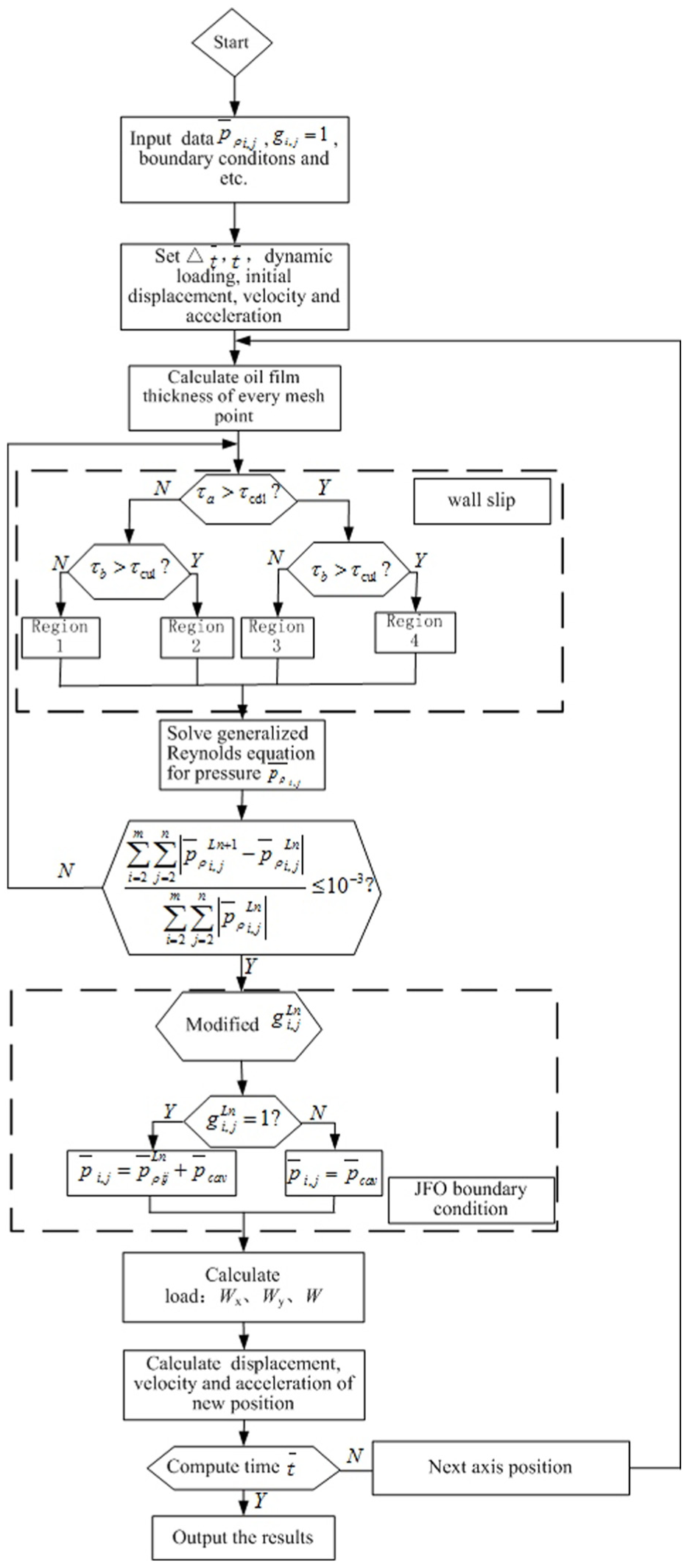
Flow chart.
Results and analysis
Verification of calculation method
When the dynamic loading is not considered (
When the dynamic loading is considered, the carrying capacity and friction drag of spiral oil wedge sleeve bearing vary periodically as time goes, which is consistent with the change of cavitation location in the following results.
Cavitation migration
In Figure 3, black area is the full oil film region, blank area is the cavitation region, and 1, 2, and 3 is the location of oil groove 1, 2, and 3, respectively. Cavitation locations vary periodically as time goes. The reasons are as follows: as shown in Figure 4, according to
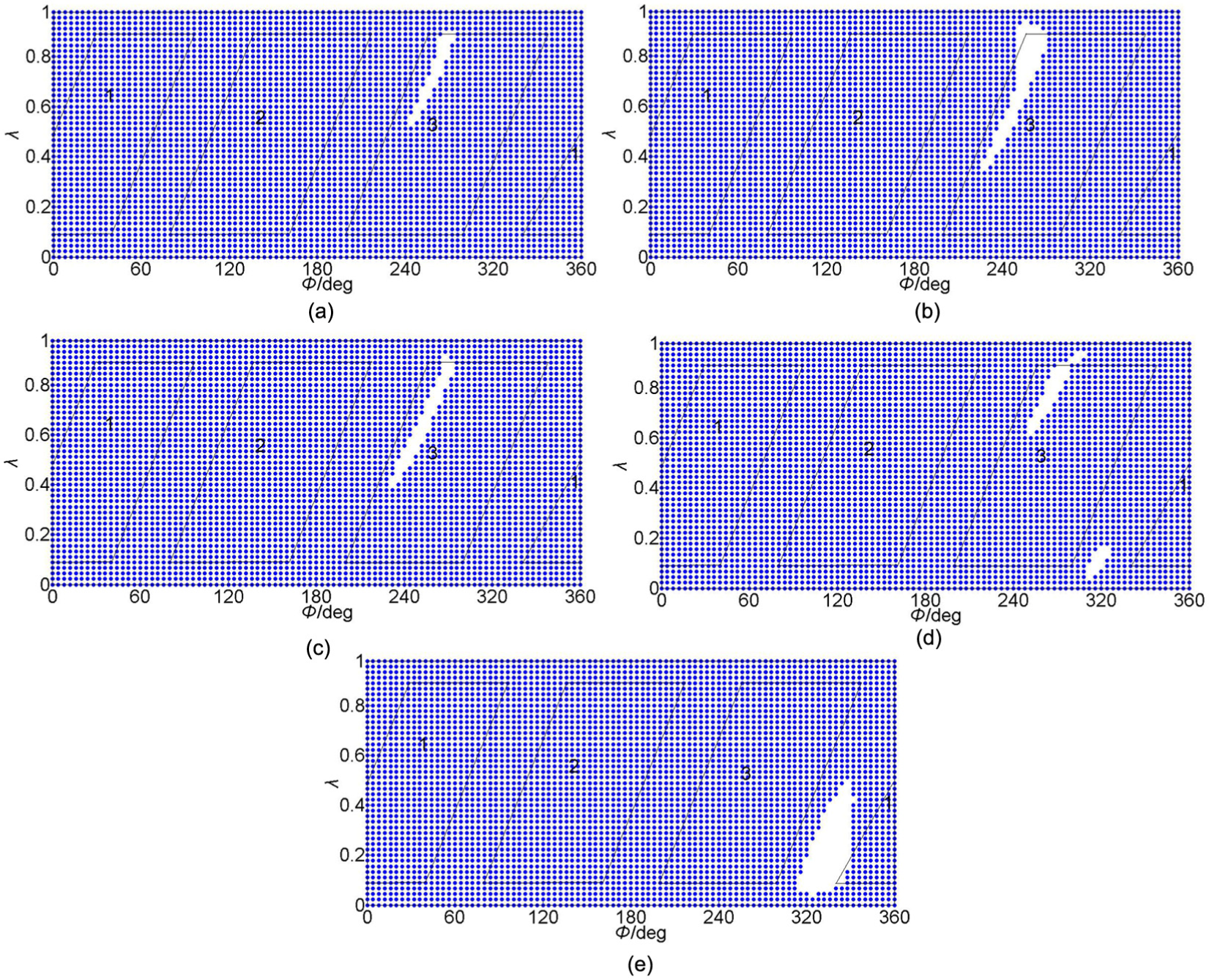
Cavitation migration of different times: (a)

Oil film thickness at different times.
The cavitation area with cavitation effect and wall slip decreases compared to the cavitation area without regard to cavitation effect and wall slip, which is consistent with the plain sleeve bearing. This is because that the oil film can support negative pressure considering cavitation effect, the oil film rupture region decreases generally. Every position of spiral oil wedge sleeve bearing occurs almost in cavitation region without regard to cavitation effect and wall slip, but only oil groove 3 and envelope surface occur in the cavitation considering cavitation effect and wall slip, which is consistent with the measure results of experiment that the cavitation is the earliest and easiest to occur in oil wedge 3. 18 Therefore, the wall-slip and cavitation effects need to be considered in numerical computation of bearing performance.
Slip velocity
Figure 5 shows the slip velocity of sleeve surface (the first figure at every time) and axis surface (the second figure at every time) at different times; it can be seen from the figures that every time, the slip velocity is about circumferential in most positions. The axial slip velocity is more obvious in some positions, the end axial slip velocity is obvious and outward, so the end leakage produces. The slip area of both ends is smaller in the total slip area. As time goes, the slip location at the surface of axis and sleeve moves generally along the rotation direction of axis. The region of slip velocity at sleeve surface shows a trend of decrease and then increase. Wall slip cannot occur in every region of sleeve surface; slip does not occur in the oil wedge 1 and oil wedge 2; and slip mainly occurs in oil wedge 3 and envelope surface. The reason is the same with the static load, and wall slip occurs first in small clearance and high pressure. The region of slip velocity at axis surface shows a trend of decrease and wall slip occurs every time. The slip position and area affect each other on the sleeve and axis surface.

Slip velocity of different times: (a)
Conclusion
Based on the wall-slip theory, cavitation theory, and the condition of dynamic loading, the cavitation migration and slip velocity with the change of time are studied. The conclusions can be summarized as follows:
In the condition of dynamic loading, the generalized Reynolds equation of four slip states and the velocity equation of spiral oil wedge sleeve bearing are established based on mass conservation boundary condition and wall-slip effect. As time goes, cavitation locations of oil film vary periodically, cavitation locations move along the rotation direction of axis, and the size of cavitation shows a trend of increase and then decrease.
Every position of spiral oil wedge sleeve bearing occurs almost in cavitation region without regard to cavitation effect and wall slip. The cavitation only occurs in the oil groove 3 considering cavitation effect and wall slip, and the cavitation area decreases compared to the cavitation area without regard to cavitation effect and wall slip.
The slip location at the surface of axis and sleeve moves generally along the rotation direction of axis as time progresses. The region of slip velocity at sleeve surface shows a trend of decrease and then increase, wall slip cannot occur in every region of sleeve surface, and the region of slip velocity at axis surface shows a trend of decrease.
Footnotes
Appendix 1
Handling Editor: Pietro Scandura
Declaration of conflicting interests
The author(s) declared no potential conflicts of interest with respect to the research, authorship, and/or publication of this article.
Funding
The author(s) disclosed receipt of the following financial support for the research, authorship, and/or publication of this article: This work was supported by the grant from China Postdoctoral Science Foundation funded project (no. 2017M612304), SDUST Research Fund (no. 2015JQJH104), and the National Natural Science Foundation of China (no. 51305242).