The problem of robust ℋ∞ filtering design for Takagi–Sugeno fuzzy systems with time-varying delay via delta operator approach is investigated. The time-varying delay and parameter uncertainties are assumed to be of an internal-like type and a structured linear fractional form, respectively. Based on a Lyapunov–Krasovskii functional in delta domain, robust ℋ∞ filter scheme is proposed. Then, a sufficient condition is established for the existence of the desired filter in terms of linear-matrix inequalities. A numerical example is provided to illustrate the design procedure of the present method.
Takagi–Sugeno (T-S) fuzzy model has been well recognized as an effective approach to model and control nonlinear systems. Thus, significant research efforts have been devoted to investigate T-S fuzzy systems over the past two decades.1–8 Recently, amount of attention have been focused on the stability analysis and controller design of networked control system (NCS) due to its great advantages, such as low cost, simple installation and maintenance, reduced weight, and power requirements.9 Since time delay is frequently encountered in NCSs, it usually results in poor performance or instability in practical applications.10–13 Therefore, time delay must be taken into account in networked T-S fuzzy systems. In addition, among various estimator schemes, the Kalman filter, and ℋ∞ filter are the two main methods. Compared with the Kalman filter, the ℋ∞ filtering method is to minimize signal estimation error for bounded disturbances or/and worse noises. Thus, the ℋ∞ filtering method is more robust than the Kalman one. Moreover, the ℋ∞ filter does not require the exact information for the statistics in the external noises, and it is of insensitivity to the exogenous statistics.14,15 The advantages guarantee that the ℋ∞ filter is very appropriate to many practical applications. As a result, robust ℋ∞ filtering approach has been extensively investigated for T-S fuzzy systems with time delay.16–19
On the other hand, with today’s exponentially growing computation power, in modern engineering applications, high-speed digital processing technology has became increasingly importance, such as flight control, nuclear reactor monitoring, and the integrated services digital network, which require a sampling rate at or above 1 MHz. Therefore, it is important for T-S fuzzy discrete-time systems with time delay to take high sampling rates into account. However, most of the research efforts for T-S fuzzy discrete-time models are focused on the shift operator method, which is of inherently ill-conditioned when datum is taken at high sampling rates.20 The delta operator model can be applied as a useful method for analyzing discrete-time systems and continuous-time systems into a consistent framework under high sampling rates.21–24 As a result, the analysis and synthesis problems for T-S fuzzy discrete-time systems with time varying via delta operator approach are of important theoretical interest and practical value. More recently, the problem of robust ℋ∞ control for T-S fuzzy systems with time delays via delta operator approach is reported in Yang et al.25 The work in Zhong et al.26 studied the problem of stability analysis and stabilization for T-S fuzzy delta operator systems with time-varying delays. Using delta operator approach, the problem of fault detection for T-S fuzzy systems with time-varying delays was considered in Li et al.27 The work in Xia et al.28 was devoted to robust sliding-mode control for time-delay systems with mismatched parametric uncertainties by delta operator method. To the best of our knowledge, there have been few results on the robust ℋ∞ filtering design for T-S fuzzy discrete-time systems using delta operator approach, which motivates us to make an effort in this article.
In this article, we aims at studying robust ℋ∞ filtering design for a class of uncertain T-S fuzzy systems with time-varying delay via delta operator approach. The state delay is considered as time varying and interval-like forms, so the available time-varying delay is of both the lower and upper bounds. The uncertainties are assumed to be of a structured linear fractional form. Based on a Lyapunov–Krasovskii functional (LKF), a sufficient condition for robust ℋ∞ performance analysis is first established. Then, the ℋ∞ filter gains can be obtained by solving a set of LMIs. Finally, a numerical example is given to illustrate the effectiveness and feasibility of our method.
This rest of this article is organized as follows. Section “Model description and problem formulation” gives the model description and problem formulation. Section “Robust fuzzy ℋ∞ filtering analysis” is devoted to present the robust ℋ∞ performance analysis. The robust ℋ∞ filtering design scheme is proposed in section “Robust fuzzy ℋ∞ filter design.” The simulation example is given in section “Simulation examples” to validate the advantage of the proposed method. Finally, conclusions are summarized in section “Conclusion.”
Notations: and represent the n-dimensional Euclidean space and matrices, respectively. and denote that the matrix P is positive and semi-positive definite, respectively. and denotes the inverse and transpose of the matrix A, respectively. represents an identity matrix with dimension n. and denote that the matrix are positive and semi-positive definite, respectively. is a block diagonal matrix. The symbol “*” in a matrix stands for the transposed elements in the symmetric positions. refers to the space of square-integrable vector functions over .
Model description and problem formulation
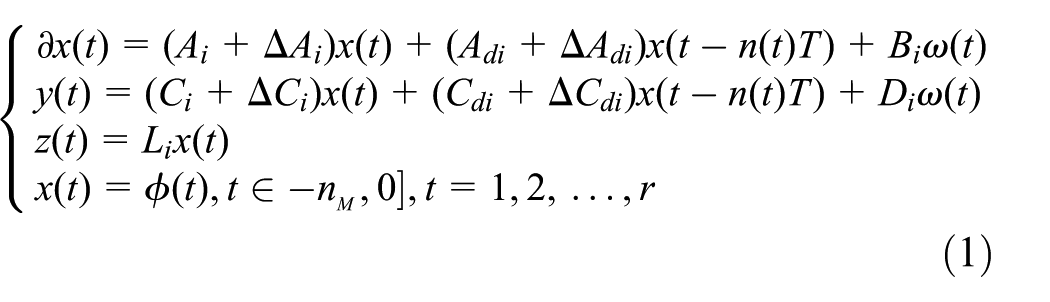
In the following, we consider a class of T-S fuzzy discrete-time systems in delta domain, which is represented by the following T-S fuzzy model.
Plant Rulei: IF is and is and … and is , THEN
where denotes the system state vector, is the disturbance input vector belonging to , is the measurement output vector, stands for the estimated signal vector, is the fuzzy set, r is the number of fuzzy rules, are the premise variables which do not depend on the disturbance and the control variables, and T is a sampling period, is a positive integer function, which represents the time-varying sample rates of the system (equation (1)) and satisfying the assumption as follows
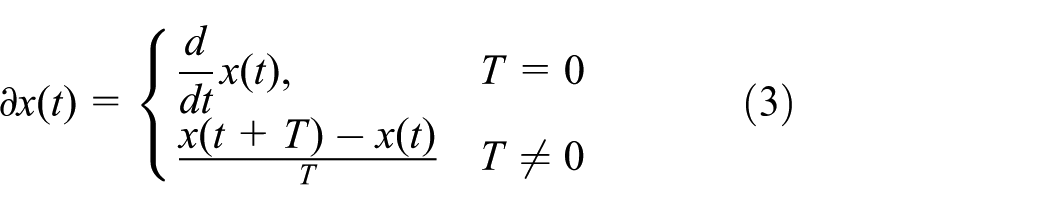
where and are two positive integers delegating the minimum and maximum sampling rates, respectively. is an initial value belonging to . is the delta operator of , which is given by
Remark 1
For a linear system , it yields using the conventional q-operator approach. In that case, it is easy to see that becomes an identity matrix when the sampling period T tends to zero. When using the δ-operator one, it has . It can be directly obtain the property when the sampling period T tends to zero.29
Remark 2
It is easy to see that the equation holds when , and the condition is equivalent the one using the q-operator approach.30
In addition, , and are known system matrices; the uncertain matrices , and are of the form
where , and are known matrices with appropriate dimensions, and is an unknown real-time-varying matrix, which satisfies
and
where J is known matrix and is an unknown and time-varying matrix satisfying
Remark 3
It is noted that of equation (2) presents the randomly sampling rates of out of . Multiplying equation (2) by a sampling period T, and represent the lower and upper boundaries for the considered time-varying delay, respectively. In such a way, is named an interval time-varying delay, which represents the state delay with time varying.31,32
Remark 4
It is also noted that the class of parametric uncertainties is said to be admissible if equations (4)–(7) hold. It possesses a linear fractional representation. For the special case , the linear fractional form uncertainty reduces to the norm-bounded one.33
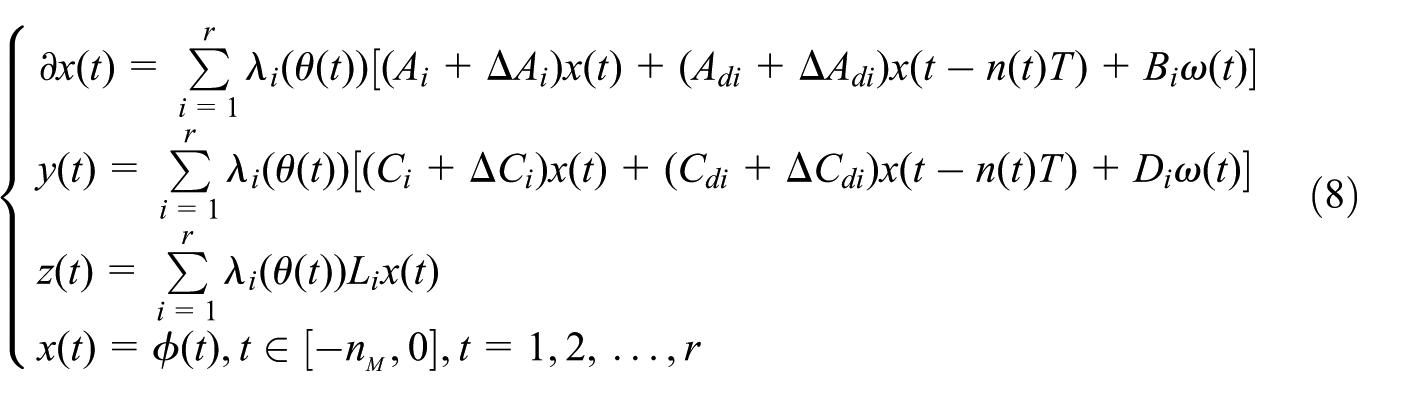
The following global T-S fuzzy delta operator system can be obtained
where , , and with represent the grade of membership of in .
Given the T-S fuzzy delta operator system in equation (8), we are interesting in designing the robust fuzzy ℋ∞ filter as follows.
Filter Rulei: IF is and is and … and is , THEN
where is the filter state vector and are the filter output vector. The matrices , and are appropriately dimensioned filter gains to be designed. The overall fuzzy filter system can be expressed as
Remark 5
It is noted that the fuzzy filter with synchronous premise variables is given in equation (10). However, in network-based perspective, some imperfect conditions, such as the sampling data control, time delays, and packet dropout, will induce the asynchronous premise variables between the system and the filter. It is also noted that when the asynchronous information is unavailable, the condition generally leads to a linear filter instead of a fuzzy one, which induces the design conservatism.34
Defining , we obtain the filtering error system as follows
where
The uncertain matrices and are of the form
where
Then, the robust ℋ∞ filtering problem to be addressed in this article is stated as follows.
Robust ℋ∞ filter design problem: Given the fuzzy delta operator system (equation (8)), the objective is to design a fuzzy filter of the form (equation (10)), which satisfies the following two requirements simultaneously:
The filtering error system (equation (11)) with is asymptotically stable.
The ℋ∞ performance is validated for all nonzero and for a given under zero initial condition
Before moving on, we introduce the following lemmas, which are used to prove the main results proposed in this article.
Lemma 1
The property of delta operator: for any time function and , it holds that35
where T denotes the sampled period.
Lemma 2
Given constant matrices , , and with and , then if and only if33
Lemma 3
Given matrices , and of appropriate dimensions, where Q is symmetrical, then33
for all satisfying the inequality if and only if there exists a positive scalar such that
Lemma 4
For any positive semi-definite symmetric matrix W, two positive integers r and satisfying the inequality , then it has36
Robust fuzzy ℋ∞ filtering analysis
In this section, based on an LKF in delta operator domain, a sufficient condition for the existence of an asymptotically stable filter with ℋ∞ performance for the filtering error system in equation (11) is established as follows.
Lemma 5
Consider the system (equation (8)) and filter (equation (10)). Given a prescribed ℋ∞ performance level , integer scalars , and a positive scalar . If there exist matrix , , such that the following matrix inequality holds
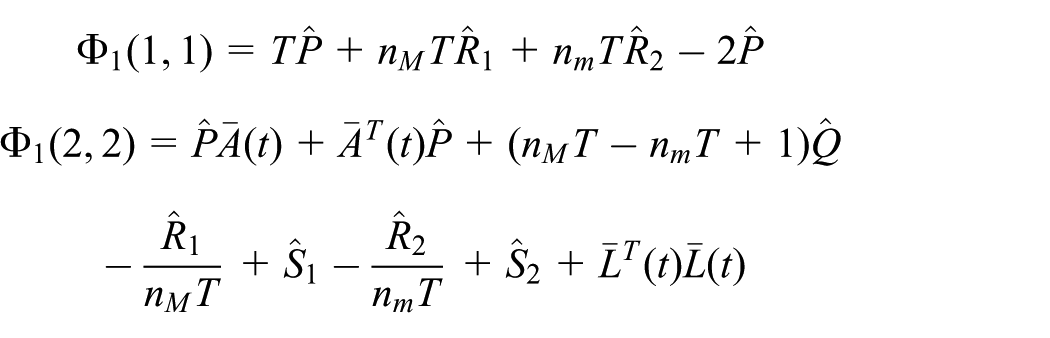
where
then the filtering error system (equation (11)) is asymptotically stable with ℋ∞ performance
Proof
Choose the following LKF
where
and , so that and hold.
Using the delta operator manipulations of along the trajectory of system (equation (11)) and using Lemma 1, it has
Similarly, we have
Based on the delta operator manipulation of and using Lemma 4, we have
Define the matrix , we have the following equation from (equation (11))
Applying the Schur complement and S-procedure (Lemmas 2 and 3), it shows that equation (16) is equivalent to ; thus, we obtain . Obviously, , which implies that (equation (15)) holds, such that ℋ∞ performance is verified.
In addition, it is easy to see from equation (16) that the delta operator manipulations of along the solution of equation (11) with guarantees , which shows the asymptotic stability of system (equation (11)) with The proof is completed.
Robust fuzzy ℋ∞ filter design
Lemma 5 provides a sufficient condition for existing an asymptotically stable filter with ℋ∞ performance . However, there exist some coupling matrix variables in Lemma 5. In this section, motivated by Yang et al.,37 we will use decoupling technique. In this way, we give the following results.
Theorem 1
Consider the system (equation (8)) and filter (equation (10)). Given a prescribed ℋ∞ performance index and integer scalars The filtering error system (11) is asymptotically stable with ℋ∞ performance if there exist matrices , , of appropriate dimensions, and a positive scalar , such that the following LMIs hold
and
and
where
In this case, the admissible robust ℋ∞ filtering parameters in (equation (10)) are given by
where S and W are two nonsingular matrices satisfying
Then, from , it implies that is nonsingular. Hence, we partition and as38
From , we have
Now, let us define
Pre- and post-multiplying of equation (35) by and respectively, yields equation (30) with changes of variables as
Then, following the similar line of above process and , which are similar to , yields equation (31). The proof is completed.
Remark 6
Theorem 1 obtains the robust ℋ∞ filtering design by solving a set of LMIs. For the system (equation (8)) with , the corresponding robust ℋ∞ filtering design result is readily obtained by removing the terms with parameter uncertainties from Theorem 1.
Corollary 1
Consider the system (equation (8)) with and filter (equation (10)). Given a prescribed ℋ∞ performance level and integer scalars . The filtering error system (equation (11)) is asymptotically stable with ℋ∞ performance if there exist matrices , of appropriate dimensions, such that the following LMIs hold
and
and
where
In this case, the admissible robust ℋ∞ filtering parameters in equation (10) are given by
where S and W are two nonsingular matrices satisfying
Simulation examples
This section provides a simulation example to validate the robust ℋ∞ filter design approach developed in the previous sections.
Consider a mass–spring–damper mechanical system, the system equations are given by
where denotes the relative position of the mass and is the external force.
In this simulation, the mass is chosen as ; the stiffness of the springs is ; the input coefficients are . We choose two local models, that is, by linearizing the mass–spring–damper mechanical system around the origin, and . Then, by discretization of the T-S fuzzy system with sampling period T = 0.01 s, we obtain the T-S fuzzy delta operator model as follows.
Plant Rulei: IF is and is and … and is , THEN
where the system parameters are as follows:
and a sampling period .
The parameter uncertainties are assumed to satisfy equations (4)–(6) with the parameters as follows
The membership functions are given as follows
and
The disturbance input vector is assumed to satisfy
Now, our aim is to design a robust fuzzy filter of the form (equation (8)), which guarantees the stability of the filtering error system (equation (10)) and ℋ∞ performance index Given matrix
and assume that the sampling rates with time-varying satisfy (equation (2)) with and . The minimum performance level can be obtained by applying Theorem 1. The desired robust ℋ∞ filter parameters are computed as follows
With the above solution, given the initial conditions and , the randomly sampling rates with time varying are shown in Figure 1, and simulation results of the state responses of and the responses of , , and , and the filtering error signal are shown in Figures 2, 3, and 4, respectively. Figure 5 shows the response of the ℋ∞ performance under zero initial conditions; it can be seen that is less than 0.4, which is less than the prescribed performance index obtained from Theorem 1. Therefore, the proposed robust fuzzy ℋ∞ filter is satisfactory.
The randomly sampling rates .
State responses of and .
Responses of , , and .
Error response of .
Response of the ℋ∞ performance .
Conclusion
This article investigated the problem of robust ℋ∞ filtering design for T-S fuzzy systems with interval time-varying delay using delta operator approach. Based on a LKF in delta domain, one ℋ∞ filtering design scheme was proposed. A numerical example was used to validate the effectiveness of the theoretical results obtained.
Footnotes
Acknowledgements
The authors wish to thank the Editor-in-Chief, the Associate Editor, and anonymous reviewers for their helpful comments that have improved this article and to thank Dr. Zhixiong Zhong from Xiamen University of Technology for his help in the work.
Handling Editor: Choon Ki Ahn
Declaration of conflicting interests
The author(s) declared no potential conflicts of interest with respect to the research, authorship, and/or publication of this article.
Funding
The author(s) disclosed receipt of the following financial support for the research, authorship, and/or publication of this article: The work was supported in part by the Natural Science Foundation of Fujian Province, China under grant no. 2017J01781; the Open Fund Project of Fujian Provincial Key Laboratory of Information Processing and Intelligent Control (Minjiang University) (grant no. MJUKF201731).
References
1.
SugenoM.Industrial applications of fuzzy control. New York: Elsevier, 1985.
2.
AhnC.T-S ℋ∞ fuzzy synchronization for chaotic systems via delayed output feedback control. Nonlinear Dynam2010; 59: 535–543.
3.
ZhaoXZhangLShiPet al. Novel stability criteria for T-S fuzzy systems. IEEE T Fuzzy Syst2014; 22: 313–323.
4.
YingH.Comparison of necessary conditions for typical Takagi-Sugeno and Mamdani fuzzy systems as universal approximators. IEEE T Fuzzy Syst1999; 29: 508–514.
5.
ChadliMKarimiH.Robust observer design for unknown inputs Takagi-Sugeno models. IEEE T Fuzzy Syst2013; 21: 158–164.
6.
QiuJFengGGaoHet al. Nonsynchronized-state estimation of multichannel networked nonlinear systems with multiple packet dropouts via T-S fuzzy-affine dynamic models. IEEE T Fuzzy Syst2011; 19: 75–90.
7.
ZhongZZhuY.Observer-based output-feedback control of large-scale networked fuzzy systems with two-channel event-triggering. J Frankl Inst2017; 354: 5398–5420.
8.
ZhongZZhuYYangTet al. Robust decentralized static output-feedback control design for large-scale nonlinear systems using Takagi-Sugeno fuzzy models. IEEE Access2016; 4: 8250–8263.
9.
WuZKarimiHShiPet al. Dissipativity-based small-gain theorems for stochastic network systems. IEEE T Automat Contr2016; 61: 2065–2078.
AhnC.Delay-dependent state estimation for TS fuzzy delayed Hopfield neural networks. Nonlinear Dynam2010; 61: 483–489.
12.
AhnCShiPWuLet al. Receding horizon stabilization and disturbance attenuation for Neural networks with time-varying delay. IEEE T Cybernetics2015; 45: 2680–2692.
13.
KarimiHJabedarMLohmannBet al. ℋ∞ control of parameter-dependent state-delayed systems using polynomial parameter-dependent quadratic functions. Int J Control2005; 78: 254–263.
14.
AhnCZhaoSShmaliyYet al. Frequency-efficient receding horizon ℋ∞ FIR filtering in discrete-time state-space. IEEE T Circuits: I2007; 52: 328–334.
15.
ZhuYZhangLZhengWet al. Distributed ℋ∞ filtering for a class of discrete-time Markov jump Lur’e systems with redundant channels. IEEE T Ind Electron2016; 63: 1876–1885.
16.
QiuJFengGYangJet al. A new design of delay-dependent robust ℋ∞ filtering for discrete-time T-S fuzzy systems with time-varying delay. IEEE T Fuzzy Syst2009; 17: 1044–1058.
17.
SuYChenMChenBet al. Fuzzy ℋ∞ filter design for nonlinear discrete-time systems with time-varying delays. Int J Innov Comput I2010; 6: 4335–4346.
18.
TianHQiuJGaoHet al. New results on robust filtering design for continuous-time nonlinear systems via T-S fuzzy affine dynamic models. In: Proceedings of the 2012 international conference on control automation robotics, Guangzhou, China, 5–7 December 2012, pp.1220–1225. New York: IEEE.
19.
SuYChenMLinCet al. A new fuzzy ℋ∞ filter design for nonlinear continuous-time dynamic systems with time-varying delays. Fuzzy Set Syst2009; 160: 3539–3549.
20.
MiddletonRGoodwinG.Improved finite word length characteristics in digital control using delta operators. IEEE T Automat Contr1986; 31: 1015–1021.
21.
GarneroMThomasGCaronBet al. Pseudocontinuous identification application to adaptive pole placement control using the delta-operator. Autom Control Prod Syst (Rairo-Automatique-Productique Informatique Industrielle)1992; 26: 147–166.
22.
LiGGeversM.Comparative-study of finite word-length effects in shift and delta-operator parameterizations. IEEE T Automat Contr1993; 38: 803–807.
23.
NeumanC.Transformations between delta and forward shift operator transfer-function models. IEEE T Syst Man Cyb1993; 23: 295–296.
24.
PremaratneKSalviRHabibNet al. Delta-operator formulated discrete-time approximations of continuous-time systems. IEEE T Automat Contr1994; 39: 581–585.
25.
YangHShiPZhangJet al. Robust ℋ∞ control for a class of discrete time fuzzy systems via delta operator approach. Inform Sciences2012; 184: 230–245.
26.
ZhongZSunGKarimiHet al. Stability analysis and stabilization of T-S fuzzy delta operator systems with time-varying delay via an input-output approach. Math Probl Eng2013; 2013: 913234.
27.
LiHGaoYWuLet al. Fault detection for T-S fuzzy time-delay systems: delta operator and input-output methods. IEEE T Cybernetics2015; 45: 229–241.
28.
XiaYFuMYangHet al. Robust sliding-mode control for uncertain time-delay systems based on delta operator. IEEE T Ind Electron2009; 56: 3646–3655.
29.
LiD.TS fuzzy realization of chaotic Lü system. Phys Lett A2006; 356: 51–58.
30.
YangHXiaYShiPet al. A novel delta operator Kalman filter design and convergence analysis. IEEE T Circuits Syst2011; 58: 2458–2468.
31.
GaoHChenT.New results on stability of discrete-time systems with time-varying state delay. IEEE T Automat Contr2007; 52: 328–334.
32.
QiuJFengGYangJet al. Improved delay-dependent ℋ∞ filtering design for discrete-time polytopic linear delay systems. IEEE T Circuit: II2008; 55: 178–182.
33.
XieL.Output feedback ℋ∞ control of systems with parameter uncertainty. Int J Control1996; 63: 741–750.
34.
ZhongZLinCShaoZet al. Decentralized event-triggered control for large-scale networked fuzzy systems. IEEE T Fuzzy Syst. Epub ahead of print 1 December 2016. DOI: 10.1109/TFUZZ.2016.2634090.
35.
QiuJXiaYYangHet al. Robust stabilisation for a class of discrete-time systems with time-varying delays via delta operators. IET Control Theory A2008; 2: 87–93.
36.
JiangXHanQLYuXet al. Stability criteria for linear discrete-time systems with interval-like time-varying delay. In: Proceedings of the 2005 American control conference, Portland, OR, 8–10 June 2005, pp.2817–2822. New York: IEEE.
37.
YangHXiaYQiuJet al. Filtering for a class of discrete-time systems with time-delays via delta operator approach. Int J Syst Sci2010; 41: 423–433.
38.
SouzaCBarbosaKFuMet al. Robust filtering for uncertain linear discrete-time descriptor systems. Automatica2008; 44: 792–798.