




Abstract
When conducting damage assessment by cross modal strain energy method, two very different approaches can be employed to solve cross modal strain energy equations. However, there are no performance comparison between these two approaches on their efficiency and effectiveness, especially under noise-polluted situations. In this article, cross modal strain energy method together with these two solving approaches, locality and wholeness approaches, is summarized, and their intrinsic features are extensively discussed. A new methodology for damage assessment is developed by combining these two approaches, in which the wholeness approach is first utilized for roughly localizing the potentially damaged members, and the final damage locations and associated extents are exactly estimated with the locality approach in the second step. To effectively investigate and compare the behavior of cross modal strain energy method, two factors, one measuring the recognition ability of damage location and the other measuring the precision of severity estimation, are introduced. A numerical simulation is conducted for a three-dimensional offshore platform structure. Both single- and multiple-damage cases, with and without noise effects, are considered. The numerical results indicate that the new methodology outperforms either approach in damage localization and severity estimation.
Introduction
Large civil engineering structures, such as suspension bridges, towers, and offshore platforms, are exposed to random actions and environmental influences continuously, which might lead to a structural deterioration or even failure. The significance of structural health monitoring (SHM) to avoid structural failure is thus evident. 1 Current SHM systems are integrated with a multitude of damage detection methods. The method based on structural vibration seems most promising.2,3 Normally, structural damages occurring in a form of stiffness loss will change the structural vibration behaviors and modal features, such as natural frequencies, mode shapes, and damping. In return, the measured modes could be used to detect the positions and severities of structural damages. Recently, a number of studies have demonstrated that damping has good sensitivity for characterizing damage. Cao et al. 4 provided a comprehensive survey of applying modal damping in structural damage detection. Several methods to estimate damping in different domains were reviewed and the application of damping to different structures were investigated. Salawu 5 reviewed several methods proposed for detecting damages via natural frequencies, and he proposed that natural frequencies were not only easy to detect but also sensitive indicators of structural integrity. Thus, an analysis of periodical frequency measurements can be utilized to monitor the structural condition. 6
Even with much goodness, the measurement and analysis of modal damping is pretty complex, which hinders the development of the relevant methods. In addition, the modal frequencies are not efficient spatial indicators and difficult to be used to identify the damage positions. To overcome this drawback, mode shapes and their derivatives, modal strain energy (MSE), for example, have been extensively adopted for damage detection. The MSE algorithm,7,8 developed from the product of stiffness matrix and second power of mode shape, has been successfully applied to the data from I-40 bridge 7 and found the most effective algorithm compared with several other investigated algorithms. 9 Moreover, in order to further enhance the performance of MSE, Li et al. 10 proposed modal strain energy decomposition (MSED) algorithm to determine damage locations, and the numerical results had demonstrated that this method was much capable of identifying the damaged locations, especially for a three-dimensional structure. Brehm et al. 11 enhanced the purely mathematical modal assurance criterion by additional physical information from the numerical model in terms of modal strain energies. Numerical and experimental results showed that the proposed energy-based criterion sufficiently reduced uncertainties about mode shapes particularly when limited spatial information was available. Srinivas et al. 12 proposed a multi-stage approach to detect structural damage using MSE and genetic algorithm (GA)-based optimization technique. The method was successfully applied to a simply supported beam and a plane truss. Cha and Buyukozturk 13 also proposed a hybrid multi-objective optimization algorithm based on MSE to detect damages in various three-dimensional (3D) steel structures. This damage detection method using hybrid multi-objective NS2-IRR GA shows significantly good performance in detecting multiple minor damages. For more information relevant to the MSE algorithms, the readers can refer to the literature. 14
It will be more attractive if a damage detection method could be employed to locate and quantify the structural damages simultaneously. Unfortunately, most of MSE algorithms above are only effective for damage localization, but unable to achieve a precise severity estimation for damaged members. An improved damage detection method that can tackle this issue effectively is cross modal strain energy (CMSE) method. Hu et al. 15 demonstrated that CMSE method could precisely estimate the damage extents after the damaged members were identified. However, if the damage locations are unknown previously, it is a great trouble to solve CMSE equations with two sets of unknown parameters, namely, damage positions and severities. One way to address this problem is to use another damage localization method. Of course, extending CMSE method to locate the damages and quantify the severities simultaneously is more promising. Based on this consideration, two typical hypotheses and their derivative approaches have been proposed so far. The first approach proposed by Li et al. 16 is based on the hypothesis that only a few selected local members are damaged. That is to say, one must first prejudge the number of true-damaged members. Accordingly, every possible combination of the damage members needs to be verified by a residual analysis, and the residuals produced in the process are considered as the feasible indicator to determine the credible damage positions and the corresponding damage severities. For simplicity, this approach is named locality approach. The second approach proposed by Wang et al. 17 is based on wholeness hypothesis that all structural members have been damaged in a form of stiffness loss. The value of damage severity of each structural member could serve as a major indicator of damage information. More specifically, the estimated value at the true-damaged location is prone to be larger than others are and always close to zero at the false damage locations. Therefore, the suspected members corresponding to the relatively larger values are believed to be damaged indeed. Although the effectiveness of these two hypotheses to identify the structural damages have been proven individually, most of these studies were merely conducted with noise-free measurements. Besides, there are no published articles conducting a direct comparison of the pertinent features.
Faced with this problem, the effectiveness of these two approaches are deeply investigated and compared in this paper to provide a new methodology for the better application of CMSE. To achieve this objective, the remainder of this article is organized as follows. In section “CMSE method,” a review of CMSE method together with two solving approaches is given in detail. Section “Numerical study” describes the simulated finite element method (FEM) modal and damage cases. In sections “Damage diagnosis with noise-free measurements” and “Damage diagnosis with noise-polluted measurements,” numerical simulations are conducted to figure out the effectiveness of two solving approaches, respectively, with and without noise effects. Based on the results, the new methodology is proposed and verified in section “New methodology.” Finally, the conclusions drawn from this work are presented in section “Conclusion.”
CMSE method
Using superscript “∗” to indicate the parameters of the damaged structure, and superscript “T” as a transpose operator, one has 15

where

where

The structural and elemental CMSE between the ith mode of the intact structure and the jth mode of the damaged structure can be defined as


After introducing a new index m to replace

Equation (3) can be simplified as

According to equation (7), if we have got

where

The above derivation procedure is on the premise that the damage locations have been known in advance. If not, there are two logical hypotheses-based approaches to solve this problem. One is proposed by Li et al., 16 in which a few local members are assumed to be damaged. For simplicity, this approach is named as locality approach. The other approach, proposed by Wang et al., 17 is based on the assumption that all structural members are potentially damaged. And this approach is referred as wholeness approach.
Locality hypothesis–based approach
When using this approach for damage localization and severity estimation, one first needs to assume the total number of possible damaged elements (

The normalized residual for each combination then is calculated by

Let

here,
Wholeness hypothesis–based approach
Unlike the locality hypothesis, the wholeness hypothesis assumes that all structural members are potentially damaged, thus one has

In equation (8), hence, only the damage severity vector
Preliminary comparison
The CMSE solving approaches based on these two hypotheses are both able to locate and quantify the structural damages simultaneously, which are huge supplements to the traditional approaches. 15 With the hope of better understanding and applying these two approaches, several comparisons are conducted as follows.
Mode selection strategies
Proper modal data sets must be selected in case of false detection results, such as false-positives or false-negatives. Usually, the modes, which are largely affected by the structural damages, are likely to contribute more instructions about the damage information. 18 Nevertheless, the sensitive modes are hard to decide lacking in true-damaged locations. Therefore, taking into account the situation that one could commonly acquire a few low measured modes (in general, first three or five modes at most) of large-scale civil engineering structures by the natural excitation technique, 19 it is suggested to use all measured modes for both approaches. 20 On the contrary, the selection of analytical modes is more skillful. In order to ensure that equation (8) has a unique solution, it is the most basic requirement that the number of cross modes is greater than or equal to the assumptive damaged members, that is

Moreover, one has
Computational efficiency
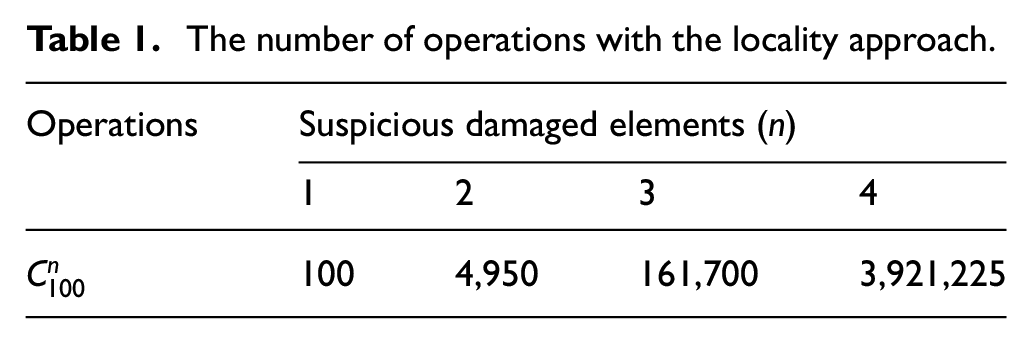
While using the locality approach, though it is an innovative idea to identify the structural damages with a separate residual analysis, an efficiency issue follows. Since the true-damage information is not known a priori, it is necessary to prejudge the number of damage members. For a large-scale civil engineering structure with
The number of operations with the locality approach.
Decision method
For the locality approach, prejudging the number of damaged members is an indispensable process before performing the residual analysis. However, it might be a fatal mistake if the prejudgment misses the correct damage members. For instance, if two elements are damaged but one just assumes one damaged location, the situation of false-negative is inevitable. Actually, with lack of valuable localization indicators, it is difficult to prejudge the correct number of damaged members, especially for a complex and unknown structure. As a result, it is always necessary for the locality approach to perform repeated prejudgments and trial calculations. Also, some realistic bases must be adopted to exclude the non-performing results. The wholeness approach, by comparison, circumvents the problem of prejudging the number of damaged members without any useful instructions. Based on the hypothesis that all structural members have been damaged, this approach conducts damage diagnosis and obtains damage indicators first. After that, accordingly, the number of damaged members is decided. Hence, the wholeness approach is more credible and well-founded intuitively.
Numerical study
Description of the structure
The structure adopted in this numerical study is a similar model of offshore platform structure introduced by Wang. 18 As shown in Figure 1, the main structural subsystems of the model consists of 36 3D frame elements, which comprise 12 jacket leg members, 12 horizontal brace members, and 12 diagonal brace members. Values for the essential geometrical and material properties are as follows. All leg members have uniform pipe-section of 20 cm outer diameter and 1 cm pipe thickness, and all horizontal and diagonal members have uniform pipe-section of 15, 0.8 cm and 12, 0.6 cm, respectively. The height of each story is 9, 9, and 4.5 m from below, and the side lengths of the bottom and top stories are 12 m × 11 m and 8.88 m × 7.88 m, respectively. For all members, Young’s modulus E =2.06 × 10¹¹ N/m2, mass density ρ = 7850 kg/m3, and Poisson’s ratio ν = 0.3.
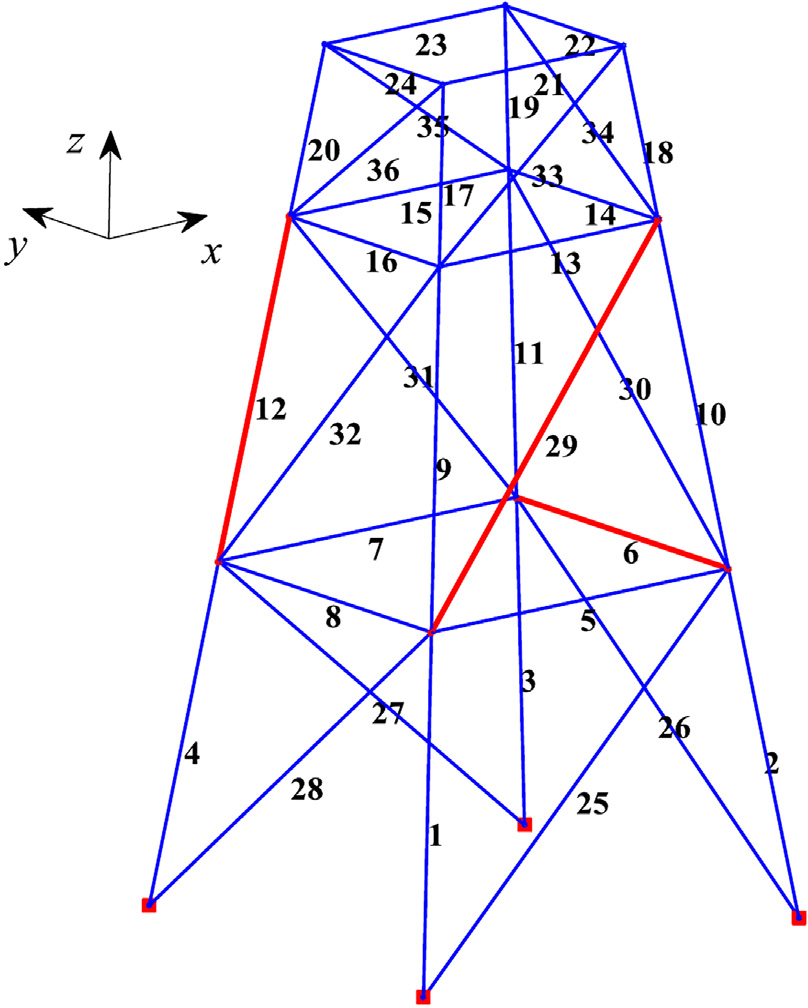
The sketch of the offshore platform structure.
Performing the Eigen analysis, one obtains the first three modal frequencies of 9.592, 9.773, and 12.102 Hz, respectively. The first three mode shapes are exhibited in Figure 2, where the first and the second modes vibrate dominantly in the y-direction and x-direction, respectively. Besides, the third mode vibrates dominantly around z-direction.

The first three mode shapes of the offshore platform structure.
Simulations of damage cases
This article addresses only the problem of linear damage detection. 21 The change in the stiffness due to damage is modeled by a reduction in the modulus of elasticity of the section. Thus, the equivalent modulus of elasticity corresponding to nth damaged element can be obtained from

where
Three damage cases are investigated with damaged locations at (A) Member 6—a short-span horizontal brace member oriented in the y-direction (named y-beam), (B) Member 12—a vertical leg member, and (C) a combination of Members 6 and 29 (a long-span slanted brace member oriented in the x-direction, for simplicity named x-brace). The simulated damage cases and the corresponding natural frequencies are listed in Table 2 for clarity.
Simulated damage cases in this numerical study.

In the next investigation, to compare the feature and ability for damage localization and severity estimation between the locality and wholeness approaches, damage cases with noise-free and noise-polluted measurements are both investigated. Additionally, to facilitate the implementation of the locality approach, the number of true-damaged members has been roughly known by default. According to the mode selection strategies introduced in section “Preliminary comparison,” two modal data sets are to be utilized for all damage cases; that is, the first five analytical modes and the first five measured modes for the locality approach, denoted as i = {1−5} and j = {1−5}; similarly, i = {1−25} and j = {1–5} for the wholeness approach.
Damage diagnosis with noise-free measurements
Though it is practically an over-idealization, the damage diagnosis researches with noise-free measurements also contribute a lot to the theoretical development. In this section, all damage cases employed to illustrate the pertinent features are without noise interference.
Single-damage scenarios
In this subsection, the modes i = {1–5} and j = {1–5} are chosen for the locality approach, and i = {1–25} and j = {1–5} for the wholeness approach as the explanation above. For the damage case A, one first supposes that exactly one element has been damaged. Depicted in Figure 3 is the damage localization indicator calculated from the locality approach, and the maximum value of indicator

The damage localization indicator of damage case A, using locality approach with noise-free measurements.
Additionally, Figure 4 shows the estimated damage severity of wholeness approach. One knows that the severity of element 6 is 30%, while others are all zero. Therefore, it can be concluded that element 6 is damaged and the damage severity is 30%. Repeating the same work for the damage case B also yields excellent results. In conclusion, with noise-free measurements, the damage assessment for single-damage scenarios is perfectly correct both with locality and with wholeness approaches.

The damage severity of damage case A, using wholeness approach with noise-free measurements.
Multiple-damage scenarios
Damage case C is a double-damage scenario where members 6 and 29 are both with 30% stiffness loss. First, one would like to investigate the effectiveness of the locality approach when the number of potential damaged elements is known a priori. If exactly two elements are assumed damaged, performing damage localization for damage case C with locality approach, one obtained the damage localization indicator, as shown in Figure 5. It can be clearly observed that the indicator
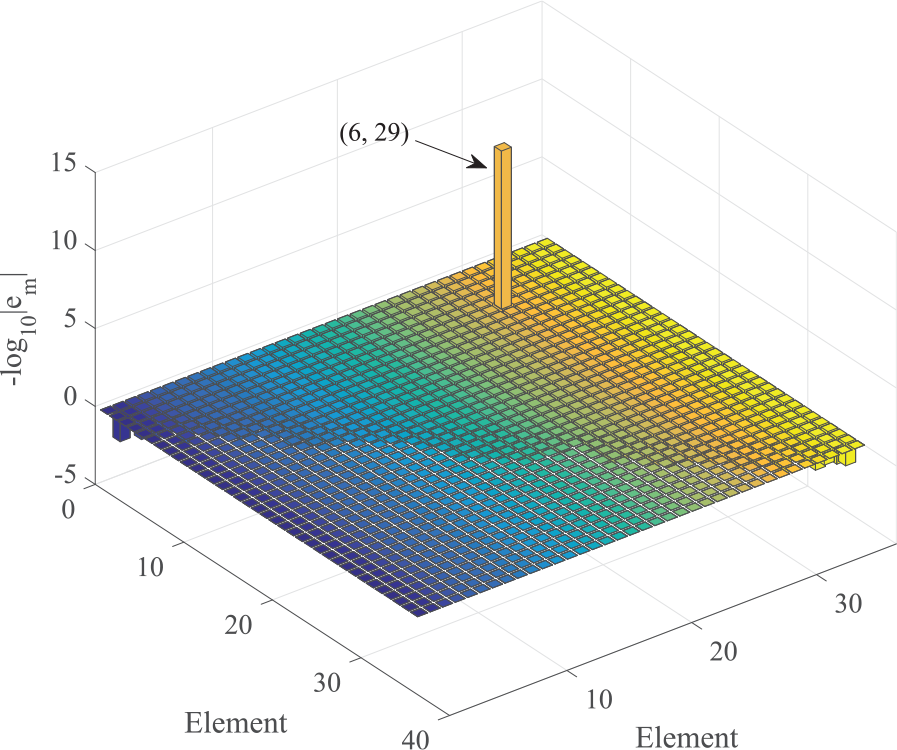
The damage localization indicator of damage case C, using locality approach with noise-free measurements.
Furthermore, the wholeness approach is implemented for damage localization and severity estimation, where all 36 elements are assumed potentially damaged. The results are illustrated in Figure 6. One knows that the severities of elements 6 and 29 are both 30%, while others are 0%, which shows that the wholeness approach is capable of handling double-damage scenarios as well.

The damage severity of damage case C, using wholeness approach with noise-free measurements.
False prejudgment scenarios
It is worthy to mention that the effectiveness of the locality approach is based on the prerequisite that the predicted number of damaged elements is perfectly correct. However, it is always difficult to prejudge the correct number of damaged members during actual operation. Thus, one considers the scenarios where less and more suspicious damage locations are assumed than the true-damaged locations. Table 3 lists the damage diagnosis results with the false number of prejudgments for damage cases A and C.
Damage diagnosis results with the false number of prejudgments.

For damage case A, the true-damaged location is element 6. If two elements are assumed to be damaged, conducting the locality approach yields two damaged elements at Nos 6 and 36, with the damage severities 30% and zero, respectively. That is to say, only element 6 is damaged, which is exactly the true-damage case. Similarly, for multiple-damage case C, the true-damaged elements are Nos 6 and 29, with both 30% stiffness loss. If three damaged elements are assumed when conducting the locality approach, damage severity at elements 6 and 29 are both 30%, and is equal to zero at element 26, which exactly matches the true-damage case. Thus, it is reasonable to believe that if the suspicious members are more than the true-damaged members, the locality approach can detect the structural damage effectively, rather than producing misunderstanding or false-positives.
In contrast, if the suspicious members are less than the true-damaged members, the situation of false-negative is inevitable. Consequence that is more serious is that neither true-damaged elements can be detected. For instance, if only one single-damage element is assumed when conducting the locality approach for case C, one sees from Table 3 that a false element is detected at element 24 with an abnormal damage severity. To sum up, while applying the locality approach, it is recommended to assume more damaged members in order to avoid fatal errors. Of course, it is very difficult to figure out the possibly correct damaged numbers since the true-damaged locations have not been known for the practical engineering.
In addition, one can see that no matter how many elements have been damaged, the CMSE solving approach with wholeness hypothesis just need one single operation. However, the locality approach is time-consuming with too many suspicious combinations. For this structure with 36 elements, there are 36, 630, and 7140 combinations that must be examined when assuming 1, 2, and 3 damaged elements, respectively. Some realistic bases, thus, must be adopted to exclude the redundant damage combinations.
Damage diagnosis with noise-polluted measurements
In practice, measured modal parameters are inevitably contaminated by noise and uncertainty, especially for offshore platforms working in hostile environments.22,23 The basic goal of this section is to figure out the sensitiveness of two CMSE solving approaches to noise. We meet this goal by investigating the same damage cases introduced in section “Simulations of damage cases,” but considering various levels of random noise.
The measurement of the polluted jth mode of the damaged structure at the kth degree of freedom (DOF), denoted by

where n denotes a modal noise level, quantified in percentage and varying from 0% to 2.5% throughout the section;
Generally, the effectiveness of the damage diagnosis is judged at least through two aspects: (1) statistical accuracy on damage localization and (2) statistical precision on damage estimation. In this article, the localization accuracy is measured by a factor called correct detection probability, denoted by

where

where
Damage localization
In this section, the correct detection probability of these two approaches was investigated to compare the capacity to identify damage for single-damage scenarios. For the locality approach, if one element is assumed damaged, the operating situation is named “locality_1”. Likewise, the operating situations associated with two and three suspicious damaged elements are named “locality_2” and “locality_3”, respectively, for convenience.
Figure 7 shows the correct detection probability versus the noise level for damage case A. As expected, all

The correct detection probability of damage case A versus the noise level.
Similar conclusion has been drawn for damage case B. Thus, one just compared the results between the operating situation locality_3 and the wholeness for all single-damage cases in the following research. The detailed results of the locality and wholeness approaches (denoted as loc. and who., respectively) are listed in Table 4.
The correct detection probability (%) of single-damage scenario using different approaches.
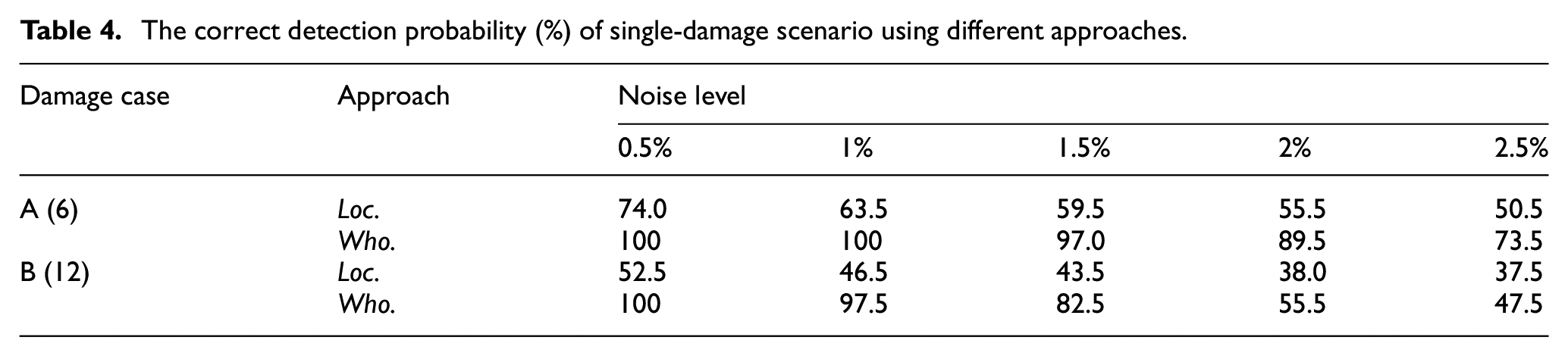
As shown in Table 4, the
Damage severity estimation
As mentioned earlier, CMSE is a method that utilizes the indicators that are directly or indirectly established with estimated damage severity to determine true-damaged members. Thus, when the damage members have not been known, an accurate estimation for damage severity is able to help damage localization. Shown in Figure 8 is
In spite of various noise interference, the averages of the severity estimate for each situation are all stable at 30%. That is to say, the based percentage precisions are all approximately 100%. In addition, the maximum of standard deviations (using the wholeness approach at noise level 2.5%) is less than 4%, which means the estimated damage severities existing in [26%, 34%] account for about 68.27%. Thus, both approaches could succeed in assessing the true-damage severity precisely.
As expected, all

where

where

The estimated severity of damage case A versus the noise level.
Then, damage severity estimation for damage case B was conducted, and the estimated severity versus the noise level is shown in Figure 9. It is observed that the averages of the estimated damage severity with locality approach are all remarkably accurate, while the averages with wholeness approach are somewhat smaller. Additionally, the standard deviations of wholeness approach are always larger than the others are. This indicates the simulated samples of damage severity spread out over a wider range. Contrariwise, the samples of the locality approach tend to be close to the expected value (20%). Therefore, the locality approach is more precise and stable to assess the damage severity.

The estimated severity of damage case B versus the noise level.
New methodology
In section “Damage diagnosis with noise-polluted measurements,” one has caught sight of some momentous characteristics of the locality and wholeness approaches from two single-damage cases. For one thing, with regard to damage localization, the wholeness approach holds larger correct detection probability. That is to say, it is more likely to identify the true damages using this approach. Besides, the wholeness approach does not require the prejudgment of the exact number of damaged members. Therefore, the fatal mistake in damage localization will not be produced because of assuming less damaged elements. For another, in terms of damage severity estimation, one has proved that estimated values of the wholeness approach are lower than the expected value, which might cause over-optimistic evaluation to structural integrity. Conversely, the locality approach is more precise and stable.
From this point of view, every individual approach does not yield absolutely excellent results, but complements each other perfectly. Thus, in practical operation, it is recommended to localize the damages using the wholeness approach first. The obtained localization indicators are expected to be employed for the locality approach as a prejudgment of the exact number of damage members. Second, carry out the locality approach to yield new localization indicators and damage severities. Third, compare the localization indicators in the first and second steps to pick out the ultimately damaged locations and corresponding damage severities. A flowchart to give visual assistance to understand and implement the new methodology or fusion approach is shown in Figure 10.

The flowchart to implement the proposed new methodology.
Another issue which needs further clarity is that one set of modal parameters (

where
In the following subsections, damage assessments were carried out with 1000 MC simulations (
Single-damage cases
First, following the flowchart, one performed damage localization for damage case A using the wholeness approach. The obtained

The damage severity of damage case A, using wholeness approach under 2.5% level of noise.
Furthermore, a comparison can be conducted between the single approach and the fusion approach. When only using the wholeness approach, one notices from Figure 7 that the
For damage case B, excellent results were also yeiled similar to those of damage case A. Thus, the fusion approach is highly effective for single-damage cases.
Double-damage cases
Damage case C is a double-damage scenario where elements 6 and 29 are both with 30% stiffness loss. Performing damage localization for damage case C with the wholeness approach, one obtains the damage localization indicators under different levels of noise. The average of damage severity under 2.5% level of noise is shown in Figure 12. Visibly, the damages are most likely to occur in elements 6 and 29. Accordingly, assuming two damaged elements for the locality method, one obtained the corresponding damage severities of elements 6 and 29.

The damage severity of damage case C, using wholeness approach under 2.5% level of noise.
Table 5 lists the correct detection probability of double-damage case C using different approaches. It can be seen from Table 5 that the
The correct detection probability (%) of double damage scenario using different approaches.

Table 6 shows partial results of damage severity estimation for double-damage case C. It is observed that using the fusion approach (equal to that of the locality approach with two suspicious elements), the damage severity assessments for elements 6 and 29 are still quite precise. In detail, for element 6, the averages of estimated damage severity under 0.5%, 1.5%, and 2.5% levels of modal noise are
The statistical precision of damage severity estimation (%) for double damage case C.
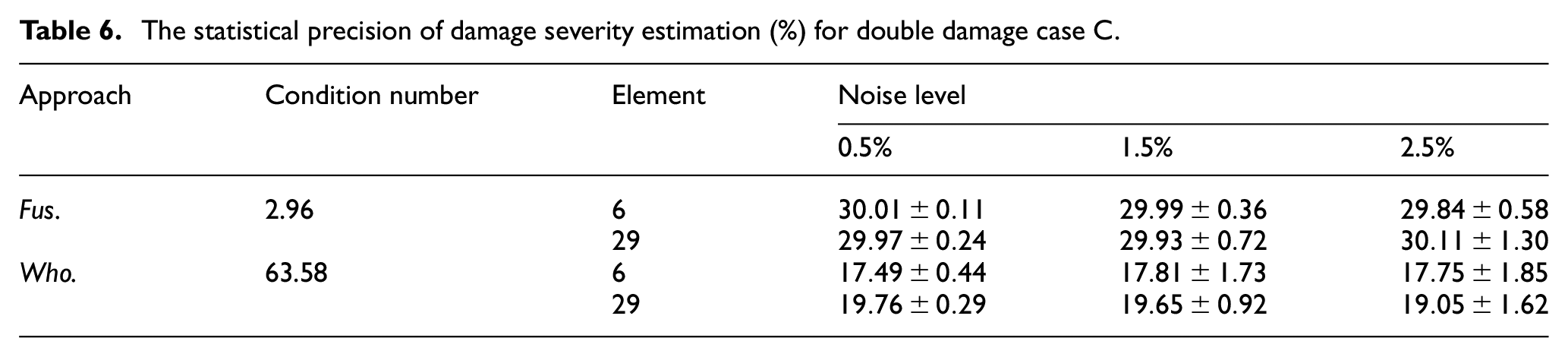
Differently, the damage severity estimation of the wholeness approach seems much lower than the expected value. For element 6, the assessed averages under different noise level are all between 17% and 18%, and for element 29, are between 19% and 20%. There are clearly big deviations away from the true-damage severity. One also obtains that the standard deviations of the wholeness approach are 0.44%, 1.73%, and 1.85%, while those of the locality approach are 0.11%, 0.36%, and 0.58%. Examining the condition numbers from Table 6, one finds that the
Conclusion
This article comprehensively investigates the noise robustness between two CMSE solving approaches, namely, locality and wholeness approaches. The intrinsic features of these two approaches, especially in practical application, are extensively discussed. Besides, two factors are introduced to measure the effectiveness on damage localization and qualification, respectively, and a new methodology integrating these two approaches is provided based on the numerical results to apply CMSE method better. The following conclusions can be drawn:
Both solving approaches of CMSE method are effective to locate damages and estimate severities under noise-free measurement.
When using the locality approach, if the suspicious members are less than true-damaged members, the situation of false-negative is inevitable. Consequence that is more serious is that neither true-damaged elements can be detected. Thus, for arriving at a better damage identification result, it is suggested to assume more damaged members.
Under noised measurements, the wholeness approach holds a higher correct detection probability in damage localization, but the locality approach is more qualified for damage severity estimation.
Compared with using the locality approach, correct detection probability is improved using the new methodology. Similarly, statistical precision in damage estimation with the new methodology is improved in comparison to that of using the wholeness approach.
The effectiveness of CMSE method relies on changes of modal parameters to locate the damage and assess the severity. In practical applications, if these changes cannot be detected, one is not able to utilize this kind of method for damage assessment. However, with the development of data collection technology and modal identification technique, the applicability of CMSE method would certainly be improved.
This article has focused on the theoretical development of the damage detection methodology and is limited to numerical investigation using an offshore platform structure. Verifying the methodology with experimental data represents a future work.
Footnotes
Acknowledgements
The valuable comments from the anonymous reviewer are highly appreciated.
Handling Editor: Francesco Massi
Declaration of conflicting interests
The author(s) declared no potential conflicts of interest with respect to the research, authorship, and/or publication of this article.
Funding
The author(s) disclosed receipt of the following financial support for the research, authorship, and/or publication of this article: This work was supported by the National Natural Science Foundation of China (51379196), the National Science Fund for Distinguished Young Scholars (51625902), and the Taishan Scholars Program of Shandong Province (TS201511016).