



Abstract
Spectral switches have been widely studied, and many related applications and phenomena were proposed or verified. However, the conditions under which spectral switches can be found are not completely specified. In the past, the zero-intensity components or phase singularities are used as the sufficient conditions for spectral switches. Some kind of oscillatory behavior in the modifier function is also proposed to be the necessary condition for it. In this work, we suggest that the necessary and sufficient condition can be reduced to a simple condition: a strictly concave modifier with a minimum. An example with this condition is given using the reflectance of aluminum in the visible to near-infrared range. This result clarifies the conditions for spectral switches and helps identifying it under different circumstances in the future. The related spectral shift amplification and polarization–controlled spectral shift effect are also presented.
Keywords
Introduction
The problem of spectra invariance during propagation has been studied since 1980. It is found that contrary to previous thoughts, spectral changes occur unless the scaling law is satisfied, which is called the Wolf effect. 1 This law requires that the complex degree of spectral coherence is a function of the product of wave number and relative position vector. After that, many studies investigate other mechanisms leading to spectral changes, including aperture diffractions,2–4 spectral correlation, 5 material interactions, and scattering.6–8 Also, many interesting phenomena or applications have been found, such as the singular optics, 9 spatial coherence spectroscopy, 5 lattice spectroscopy, 10 Talbot spectra, 11 and the spectral switches (SSW).3,12,13 The SSW are first proposed by Pu et al. 4 and are verified experimentally. 14 SSW are generally referred as a phenomenon in which the spectral shift of diffracted or modified polychromatic light experiences a discontinuous jump, like a switch, when one of the variables (e.g. the aperture size, the detected distance, the central wavelength, or the bandwidth of the light source) varies continuously. Many related interesting effects are found, such as the spectral shift amplification 15 polarization-controlled spectral shifts, 16 data transmission, 17 tunable SSW, 18 and surface plasmon effect. 19 It was first named by the observation that when polychromatic light passes a circular aperture, the detected spectral in the near field is modified, and the shift of the spectrum maximum goes through a discontinuous jump, just like a switch. Later, Foley and Wolf 20 illustrated that those points are actually the positions of phase singularities, with features that the field amplitude at central wavelength is zero and the phase increases from 0 to 2π for an infinite small loop around the singular points. The light field is undetermined at those singular points. Consequently, the singular points in the modifier function (explained later) are used as the sufficient condition for the SSW. In 2009, Han 21 gave a SSW example without singular points and illustrated that the necessary condition may be some kind of oscillatory behavior in modifier. In this work, this issue is investigated further. We suggest that a simple but important condition is necessary and sufficient for the existence of SSW; that is, the modifier is a strictly concave function with a minimum in some range of variables, as long as the original spectrum distribution is a convex function with a maximum. An example is given to illustrate this condition with the reflectivity of aluminum in visible near-infrared (NIR) range. This article is organized as the follows. The first section introduces the background of the spectral changes by different mechanisms and the reviews of conditions for the appearance of SSW. In the second section, we present the definition of a strictly convex/concave function with a maximum/minimum. For the first time, SSW is successfully made with such a simple concave modifier with a minimum, utilizing the reflectance of aluminum metal as the illustration. The discussion of such a necessary and sufficient condition and some conclusions from this result are made in the final section.
Theory and calculations
The SSW have been studied satisfactorily within the frame of scalar wave optics. For a fully spatially coherent polychromatic light, the standard Gaussian form of the spectrum can be written as 3

where the superscript

where
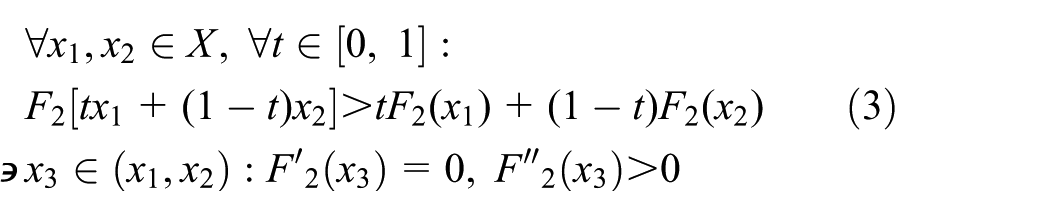

(a) The distribution of a Gaussian spectrum, (b) the plot of a strictly convex function with a maximum, and (c) the plot of a concave function with a minimum.
A strictly concave function with a minimum is shown in Figure 1(c), which has the function values lie below the straight line within the specific interval. It simply looks like a valley shape with a single bottom.
As mentioned in the “Introduction” section, the detected spectrum can be altered by different mechanisms, such as propagation, aperture diffraction, and interactions with matters. The resultant spectrum is usually written as 20

where
For example, the modifier on the axis for near-field circular aperture diffraction is

(a) The configuration for light diffraction through a circular aperture and (b) the distribution of
Later, the authors for the first time used a modifier without zero intensities and phase singularities to make SSW.
21
The geometry is shown in Figure 3(a) and (b), which is a right triangle aperture with an adjustable hypotenuse slope; the modifier is

(a) Schematic diagram of the configuration and illustration of notation. An incoming light wave from left is incident on a right triangle aperture and diffracted toward the observation plane. (b) Dimension and structure of the triangle which has an adjustable hypotenuse’s slope m. (c) The distribution of
Then, Han and Tseng
23
use the oscillatory behavior of spectral reflectance of silver metal to study the SSW and the spectral shift amplification effect. Figure 4 shows the reflectance of three metals: silver (Ag), gold (Au), and aluminum (Al).
24
It is found that there is a sharp dip in the silver’s reflectance near 0.3 µm (indicated by the red oval) and its blowup is depicted on the left-hand side. From the blowup, we see that this dip actually contains two minima and again some kind of oscillatory behavior, similar to Figures 2(b) and 3(c), is observed. Han and Tseng
23
successfully produce SSW with these two minima and oscillating property as shown in Figures 5 and 6. The dip of silver metal is caused by bound electrons resonant absorption and by free electron plasma, and it has higher reflectance at the dip than that of pure water by 10 times (the dielectrics containing only bound charges). Even so, the reflectance at the minimum is only 7.2%, which does not benefit the reflection spectrum. In this work, we want to show that the necessary and sufficient condition can be reduced from an oscillatory modifier to a simple strictly concave modifier with only one minimum. The former usually contains more than one dip and one peak, while the latter simply has one minimum. The example being given uses the reflectance of the aluminum in the NIR, as shown in the green oval in Figure 4 and its blowup inside the figure. It is easy to identify that it is a simple concave function with only one minimum and without oscillations in the interested wavelength range, consistent with the definition and the behavior in Figure 1(c). Another advantage of using Al metal is obvious by observing that the minimum of the reflectance is over 85% as shown in Figure 4, which is much larger than that of the Ag and benefits the reflection spectrum detection. To facilitate numerical calculations and illustrations, some parameters are set. The convex Gaussian spectrum in equation (1) with

The reflectance of Ag, Au, and Al. The blowup on the left-hand side is the dip of the Ag at 0.32 µm and the other blowup inside the figure is the concave reflectance of Al in the range from 0.5 to 1.1 µm.

The incident Gaussian spectrum is normally incident on the aluminum and the reflected spectrum is altered by the reflectance of Al.
The reflected spectrum

where

where

(a) The refraction index n of Al versus wavelength and (b) the extinction coefficient k of Al versus wavelength. 22
Spectral shift amplification
Figure 7(a)–(c) shows the normalized spectrum of

The normalized spectrum of
Polarization-controlled method
Another application for using the material reflectance as the modifier is its polarization dependence. It has been proposed by Han and Tseng
23
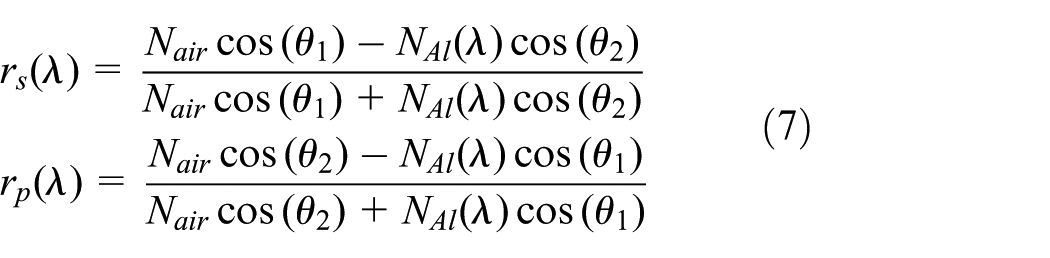
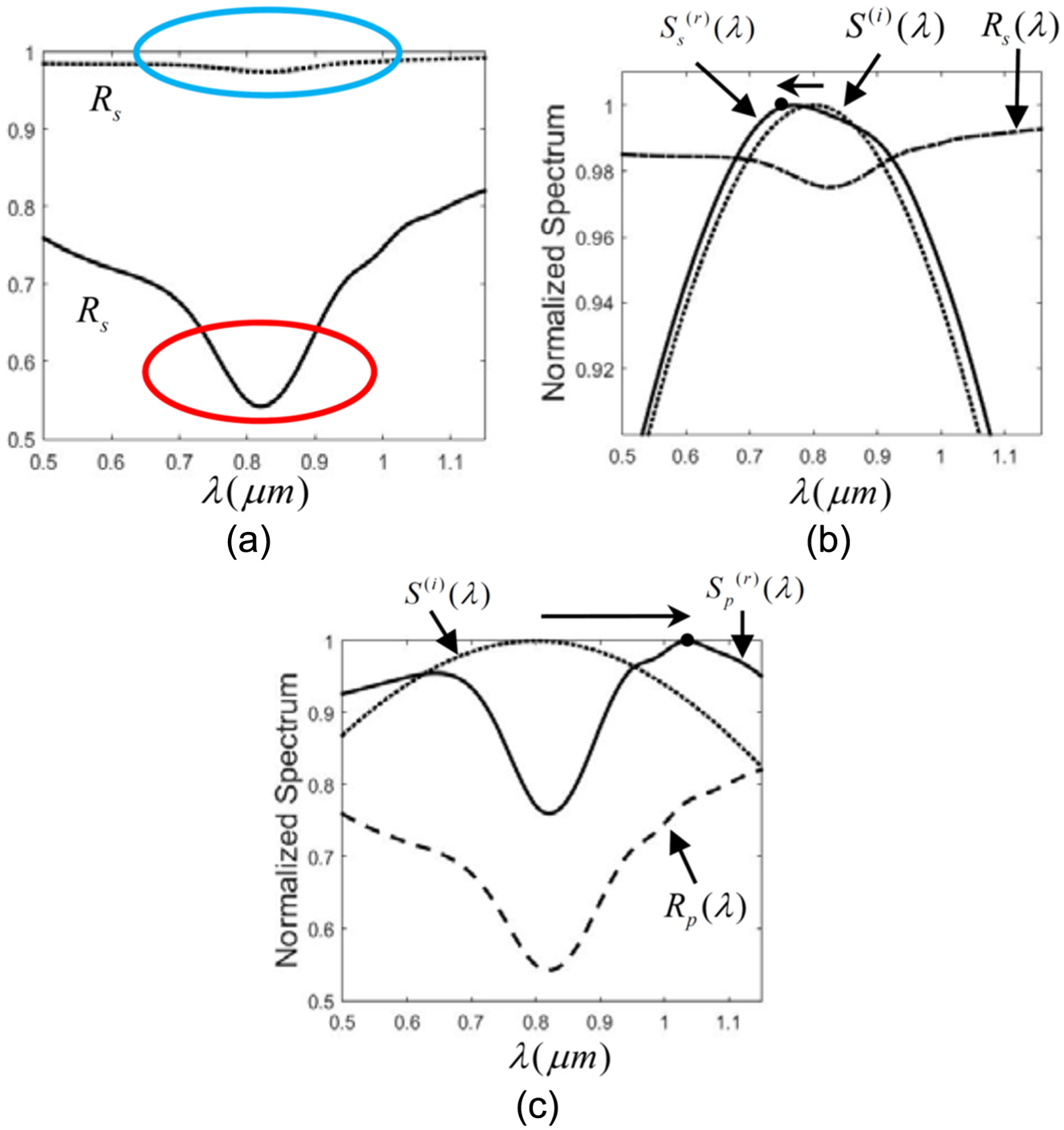
and used as a data transmission tool through polarization control. Similar effects can also be found here. It is known that the reflectance is polarization dependent when the incident angle is not normal. For oblique incidence with incidence angle
where

where
(a) The reflectance of
Discussion and conclusion
In this study, we illustrate that the spectral switch can still be found for a simple strictly concave modifier with only one valley or minimum. An example using the aluminum’s reflectance is given to show that such a simple condition still leads to SSW; and as found from Figures 4 and 1(c), the behavior of the aluminum’s reflectance meets the strictly concave function. This condition is obviously simpler than the oscillatory modifiers or modifiers with zero points or phase singularities, as we compare Figure 4 for Al with Figures 2(b) and 3(c). The authors claim that this should be the necessary and sufficient condition for SSW for the following reasons. Referring to Figure 7, it shows that the most critical feature making a spectral switch is the splitting of the original spectrum into two peaks, which occurs when the minimum of the concave modifier locates approximately on the maximum of the convex original spectrum. Without this concave behavior in modifier, the splitting cannot be made (a necessary condition); with it, the splitting can always be made under proper choice of the central wavelength and bandwidth (a sufficient condition). For example, a monotonic increasing or decreasing modifier, like the form
Finally, in this work, we proposed that the simplest necessary and sufficient condition for SSW should be a strictly concave modifier with a minimum for a typical convex original spectrum with a maximum. The reflectance of aluminum metal with concave shape and only one minimum is used as the example to illustrate the proposition, with the extra advantage over silver that much higher reflectance can be utilized. Also, the spectral shift amplification effect and polarization-controlled spectral shift are presented. Although this proposition is not rigorously mathematically proved, it is still valuable to serve as a general guide to discover SSW. It also helps clarifying the conditions for appearance of a spectral switch and facilitates finding next SSW under other situations in the future.
Footnotes
Acknowledgements
Pin Han suggested the idea, wrote the paper, and contributed in all activities. Cheng-Mu Tsai proposed the mathematical form of SSW conditions and took part in the discussion. Hung-Bin Lee performed the numerical works and analyzed the results.
Handling Editor: Stephen D Prior
Declaration of conflicting interests
The author(s) declared no potential conflicts of interest with respect to the research, authorship, and/or publication of this article.
Funding
The author(s) disclosed receipt of the following financial support for the research, authorship, and/or publication of this article: This work was supported by National Chung Hsing University, Taiwan, by the Ministry of Science and Technology (MOST) of Taiwan under Contract Nos 104-2221-E-005-069-MY3 and MOST 104-2622-E-005-019-CC3.