




Abstract
In recent years, the proportion of fuel costs in the total shipping costs grows up with the increase in international crude oil price. The rising cost seriously restricts the development of shipping enterprises. Many researches and cases show that reducing the ship’s fuel consumption by cautiously and reasonably decelerating the ship is the most simple and effective mean to control the shipping cost. However, the transportation time is longer when the speed is reduced. In other words, shipper would have to pay more for per unit transportation time. When the increase in transit time exceeds a certain range, liner companies are likely to lose customers. This article aims to maximize the profit of a liner company, which consisted of the variety of fuel cost, fixed cost, operating cost, and other related factors. And at the same time, the change in the shipper’s transport time cost and freight cost is considered. Then, a speed–freight optimization model based on the bat algorithm is established using MATLAB toolbox, in which the liner line is segmented. Finally, this article uses the model to optimize the route of the Far East to North America. The results show that the model can guarantee the quality of transport and reduce transport cost by adjusting speed at the same time.
Introduction
Requirement of shipping is derived from the demand of international trade; liner ship has the task of undertaking Chinese international trade transportation. In addition to tremendous initial building and purchasing cost, liner ships have to pay huge fuel oil expenses in the sequence of voyages in everyday operation. Compared with other costs (such as maintenance cost, tax, and insurance), fuel oil cost takes an important part in shipping cost, reaching 40% and seeming to be total of other tax. 1 Under such severe condition, a number of owners of the vessel take action of lowering speed; as a result, they acquire obvious effects. How to set the speed of vessel in operation, supply superior service for clients, and decrease operation cost have already become one of the important decisions in liner ship. In addition, to achieve sustainable development in Chinese economic, China comes up with energy conservation and emission reduction in transportation. Ships consume lots of energy; fuel consumption takes up 30% in world consumption. On one hand, high fuel consumption brings tremendous pollution. On the other hand, it also brings high operation cost. So, how to reduce the pollution of the transportation industry becomes the most important component of Chinese energy conservation and emission reduction strategy. Lower speed of ship saves a large number of fuel oil cost for liner ship. However, to the owner of cargo, time of transportation prolongs yet. If liner ships only pay close attention to its own cost and ignore the profit of the owner of cargo, they may lose valuable client resource. Therefore, lowering speed and energy conservation, reducing waste resource, and maximizing the profit of the owner of cargo and liner ship have become an important study issue.
At present, most studies on optimization of liner shipping services have assumed that ships sail at a given speed.2–9 With the study and development of new type engine and fuel, ships can use one or more types of fuels. 10 And because new types of engines have higher hot ratio than diesel engine, ships mainly adopt diesel engine currently. Hu et al. 11 considered that sailing in constant speed was an important regular pattern for the energy conservation of shipping. Kakoi et al. 12 systematically analyzed lower speed in economic and the influence when it changes. Christiansen et al. 2 analyzed that the nonlinearity effects brought by changes in ship’s speed led to changes in planning decision of fleet and deduced mathematic relation among ship’s speed, ship arrive and depart time, cost of the sequence of voyages or flights, and number of ships in ship route and established mixed integer nonlinearity fleet programming model. Wang and Meng 6 investigated the optimal sailing speed of container ships on each leg of each ship route in a liner shipping network while considering transshipment and container routing and proposed an efficient outer-approximation method to an optimal solution with a predetermined optimality tolerance level. Wang and Meng 7 first calibrated the bunker consumption—sailing speed relation for container ships using historical operating data from a global liner shipping company. Chang et al. 13 proposed an ant colony optimization algorithm to solve the traffic counting location problem by explicitly generating the Pareto solutions. By introducing additional suitable intensification mechanisms, the nondominated solutions can be attained with significantly fewer iterations and ants, which consequently indicate the effectiveness of the system and further verifies the modeling capability of ant colony optimization. Korsvik et al. 14 used the control variable method to study the effects of fluctuations of fuel prices and variation of the fixed costs on the average daily earning of each voyage, and the optimization model of tramp vessel speed was constructed with the object of average daily earnings maximization. Norstad et al. 15 presented the tramp ship routing and scheduling problem with speed optimization, where speed on each sailing leg was introduced as a decision variable, and they presented a multi-start local search heuristic to solve this problem.
On the basis of finishing sailing, we come up with a model about optimizing liner ship speed, which can save the cost as well as guarantee the quality of transportation. This article’s main work is in several aspects as follows:
Analyzing the reason and superior of lower speed.
Analyzing the relationship between speed and Bunker adjustment factor (BAF), the relationship between speed and number of ships, and the relationship between speed and operation cost, so that we can measure the liner operators’ profit.
Analyzing the time value of owner of cargo, we reach the acceptable boundary to owner of cargo bonding cost.
Combining with above-mentioned analysis, we set up optimized speed model of liner ship, solving by bat algorithm (BA) and proceeding instance analysis with the United States and China the container liner routes.
There are two main contributions in this article. On one hand, we consider that the speed is different in the different segments, which is different from most speed optimization problems with single speed in the whole shipping routes. On the other hand, heuristic algorithm is a feasible way of solving problems in practical problems, and BA is one of the new heuristic algorithms. At present, BA is mainly applied in vehicle routing problem, scheduling problem, and so on. We explored the application of BA in the field of maritime transport for the parameter optimization in the maritime problems.
The objectives of this study are to achieve the maximum profit in condition of lowering speed. Thus, this article is structured as follows: section “Speed–cost optimization model” provides brief introduction on speed–cost optimization model which includes problem description, model assuming, and speed–cost optimization model; section “BAs” provides the introduction of BA and the method to solve the model; section “Case studies” provides the case study to check the effect in condition of lowering speed; and section “Conclusion” provides the conclusion.
Speed–cost optimization model
Problem description
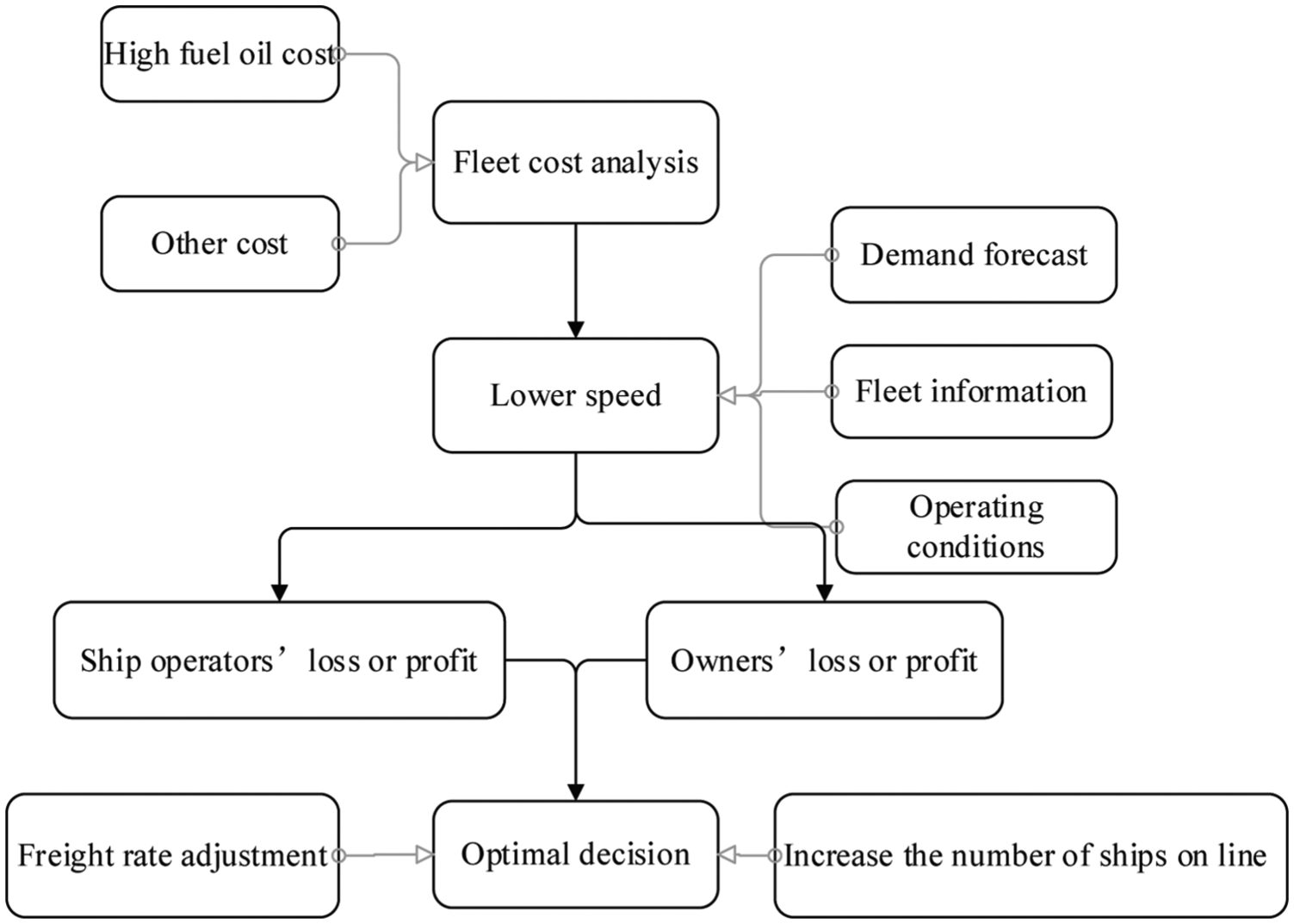
The object that we choose to study is the fleet under the condition of high fuel oil cost. According to the information and forecast of transportation needs in the future, we lower the speed to make the liner voyage profit maximization. However, the market competition may be influenced when reducing speed cautiously and reasonably. 16 Thus, we adjust ratio of freight and add ships to current lines at the same time, so that we can guarantee the level of service and reserve clients, as shown in Figure 1.
The level of service and reserve clients.
In Figure 1, first we analyze the component of fleet cost that contains the high fuel oil cost and other cost (e.g. fixed cost and variable cost). Then, the lower speed can be determined by some factors such as demand forecast, fleet information, and operating condition. So, we can figure out the loss or profit of the ship operators’ and owners’, respectively. Finally, the optimal decision about freight adjustment or increase the number of ships on line can be provided for the decision makers.
This article establishes math model to make the best decision against problem as follows:
Number of ships in shipping routes;
Either purchasing new liner or not;
The optimal speed of liner in each segment;
Either adjust the freight ratio in each segment or not and the adjustment extent.
Model assuming
To make the model approach the fact of liner operation, we set several hypothesizes before setting up model:
1 Type of ship is the same, age of ship is near, and the effect of different ages on shipping cost can be ignored in the whole shipping routes;
Study period is in years, starting at first year and terminating at year t. Behavior of buying occurs at the beginning of a year and expenses of operation cost occurs at the end of this year. Funds are discounted at the beginning of this year, and the discount ratio is e;
Ships bought before study period is ships which have been purchased, and decisions have no influence on these ships in the study period. Cost of buying these ships is ignored in the model;
Liner companies keep the schedule frequency to retain clients after lowering the speed;
Time of loading, unloading, and waiting is invariable in each port after lowering the speed;
Shipping routes is long, and natural condition is different in different segments. Some natural condition may affect speed, such as flow speed. Thus, we divide the shipping routes into n segments;
Freight ratio is related to the kind of cargo; thus, we divide the cargo into K types;
When the ship’s speed changes, various factors change at the same time, so this article mainly catches the changes in fuel oil cost, operating cost, and number of ships and analyzes profit and loss;
In terms of shipper, lower speed can prolong transport time, and in terms of liner shipping, most of the shippers are not sensitive to transport time. But if the speed was too low, shipper might choose other liner companies, so we assume that the lowest is 13 knot in this article;
After lowering the speed, liner companies adjust freight ratio to retain clients. We assume that the ratio of shippers’ transport cost is no more than 10% in every segment;
When lowering the speed, we adjust the ratio of freight and add ships to current lines. Thus, assuming that the market of liner shipping company is unchanged and is reasonable.
Speed–cost optimization model
Decision variables are
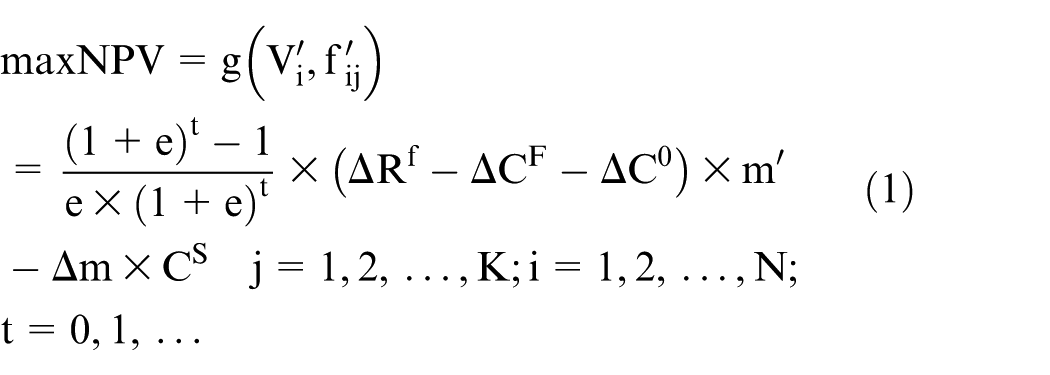
Solving of

where
The operating cost increases as the voyage time increases

where
When the speed of ships decreases from

where
Transportation revenue reduces with the reducing turnover rate after lowering the speed

where
Constraint

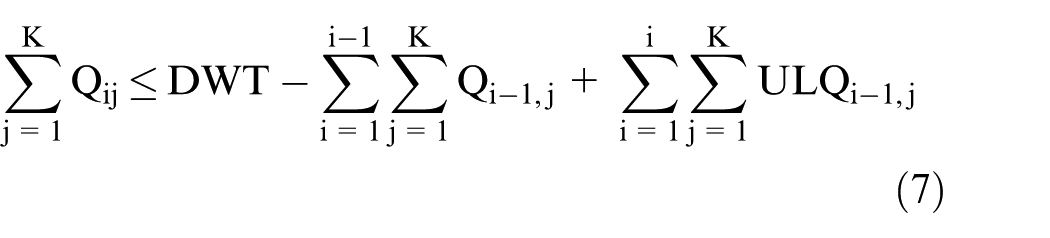



where
Equation (1) is the objective function of liner companies, and in the condition of high price of fuel oil, liner companies adjust speed and increase the number of ships in shipping routes, to acquire the highest net present value (NPV) in condition of guaranteeing the rate of voyage. The residual ones are constraints: equation (6) is constraint of cost, requiring that every ship’s income must be higher than cost; equation (7) is constraint of load, requiring that weight of cargo which is loaded in port must be less than the difference of total DWT and existing cargo’s DWT; equation (8) is constraint of rate of transport cost, requiring that the sum ratio of transport time cost and freight cost is no more than 10%; equation (9) is constraint of speed, requiring that speed should be higher than 13 knot and less than maximum speed after lowering the speed; and equation (10) is the constraint of frequency of voyage, requiring that liner companies keep the frequency by increasing the number of ships after lowering the speed.
BAs
The above model is a nonlinear programming problem, which contains two continuous variables, and objective function and constraints are nonlinear; against these feature of this model, this article improves the BAs, solving the model with MATLAB.
Many literatures suggested that heuristic algorithms were good choice to solve this kind of problems.17–20 The BA is a heuristic algorithm proposed by Yang 21 and Cheng, 22 which has been widely used in the literature.23,24 The algorithm is a kind of effective method to search the global optimal solution based on iterative optimization technique. First, it was initialized to a group of random solutions and then through the iterative search for the optimal solution. Next, the optimal solution improves the local search by random flight around local data processing. Compared with other algorithms, BA is far superior to other algorithms in terms of accuracy and effectiveness and not many parameters to adjust.
This heuristic algorithm is inspired by the echolocation behavior. Bats emit a very loud sound pulse and listen for the echo that returns from objects. Bats fly randomly with frequency, velocity, and position when searching for prey. The BA is formulated to imitate the process of bats to find their prey. In BA, each bat represents a solution in the population. The frequency, velocity, and position of each bat are changed for further movement. The changing frequency provides the diversity of the solutions. For using the variation of frequency, BA can be considered as a frequency tuning algorithm to provide a balanced combination of exploration and exploitation during the search process. The BA considers many simplification and idealization rules of bat behaviors by Yang 21 and Cheng. 22 The algorithm involves a series of iterations. A set of solutions changes in these iterations. If the new solution is accepted, the loudness and pulse rate are changed. The frequency, velocity, and position of the solutions are formulated as in equations (11)–(13)


where

The value of
The loudness decreases and the pulse rate increases when a bat finds its prey. It means that the loudness and the pulse are changed in each iteration. The loudness and the pulse are changed based on the following equations


where
Variable coding
The decision variables are

The problem is multivariable; two variables are encoded, and lengths are
Population initialization
Initial population is the starting point of BAs. To guarantee the feasibility and diversity of individual in group, randomly generated initial individuals based on constraints has been used to make the initial population generate feasibly.25,26
Fitness function
In standard BA, the value of fitness function is nonnegative, and it requires that the optimization problem is transformed into a maximization problem. The objective function is the sake of great value in the form of conversion in application time and mapping nonnegative fitness function. We chose objective
The pseudo code of the BA
To run the BA, the main steps are as follows (Figure 2):
Step 1. Initialize the bat population or their position
Step 2. Generate new solutions by adjusting frequency and update velocities and positions using equations (11)–(13);
Step 3. If (rand > ri), select a solution among the best solutions. Generate a local solution around the selected best solution;
Step 4. Else generate a new solution by flying randomly;
Step 5. If
Step 6. Rank the bats and find the current best position;
Step 7. While (iteration < maximum number of iterations n), the BA stops until the stop condition is met or meets the evolution algebra.

The bat algorithm flowchart.
To run the BA, first is to initialize the bat population, which is their position
Case studies
This article selects a traditional China–USA container route, Far East to US East, operating with nine ships which are 4250 TEU. The anchored order is Ningbo, Shanghai, Bhushan, Panama Canal, New York, Wilmington, SaiFenna, Panama Canal, and Bhushan. Shipping route is shown in Figure 3. We divide the shipping route into nine segments, as shown in Table 1.

Shipping routes.
Partition of shipping route.

Schedule and turnaround time are shown in Tables 2 and 3, respectively. In Table 2, Eta represents the arrival time of each port, and Etd represents the departure time of each port. The date in Table 2 is matched with sailing time in Table 4. First, we find the shipping line distance of each port with sea chart; then we obtain the average speed in each segment from logbook; then we collect parameter of shipping line and ship in Clarkson; and, finally, we substitute the data into speed optimized model and achieve optimized speed and adjusted freight with BA and genetic algorithm (GA). As shown in Table 4, the optimized speed is lower than the actual speed, and the BA optimized speed is lower than GA optimized speed. The performance of BA is better than GA in speed optimized model.
Far East–North America line arrival time table of liner.

Far East–North America schedules.

Far East–North America line optimized speed–freight.

GA: genetic algorithm; BA: bat algorithm.
In this article, VC++.NET 2003 is used to achieve two algorithms, and operating environment is the Pentium IV 2.93-GHz processor and 3 GB for the Windows platform. A large number of experiments to determine the parameters are set as follows:
From the optimized data, we can see that it can guarantee the quality of service and reduce the fuel oil cost at the same time, and the reduction of fuel oil cost is obvious (Table 5). From Table 5, it can reduce more than 20% cost in some segments (numbers 3, 4, and 8) optimized by BA. It can also be attained that the solutions by the improved BA are better than the GA solutions. And the solutions optimized by BA and Tabu algorithm are close. The solutions of BA are better than Tabu algorithm in segment numbers 2, 4, and 8. The optimized solutions of freight are shown in Figure 7. It is obvious that the freight is lower than before in some voyages, and the BA and Tabu optimized freights are lower than GA optimized freight, which can guarantee the quality of service better (Table 6).
The fuel oil cost of Far East–North America optimized line.

GA: genetic algorithm; BA: bat algorithm.
The freight of Far East–North America optimized line.
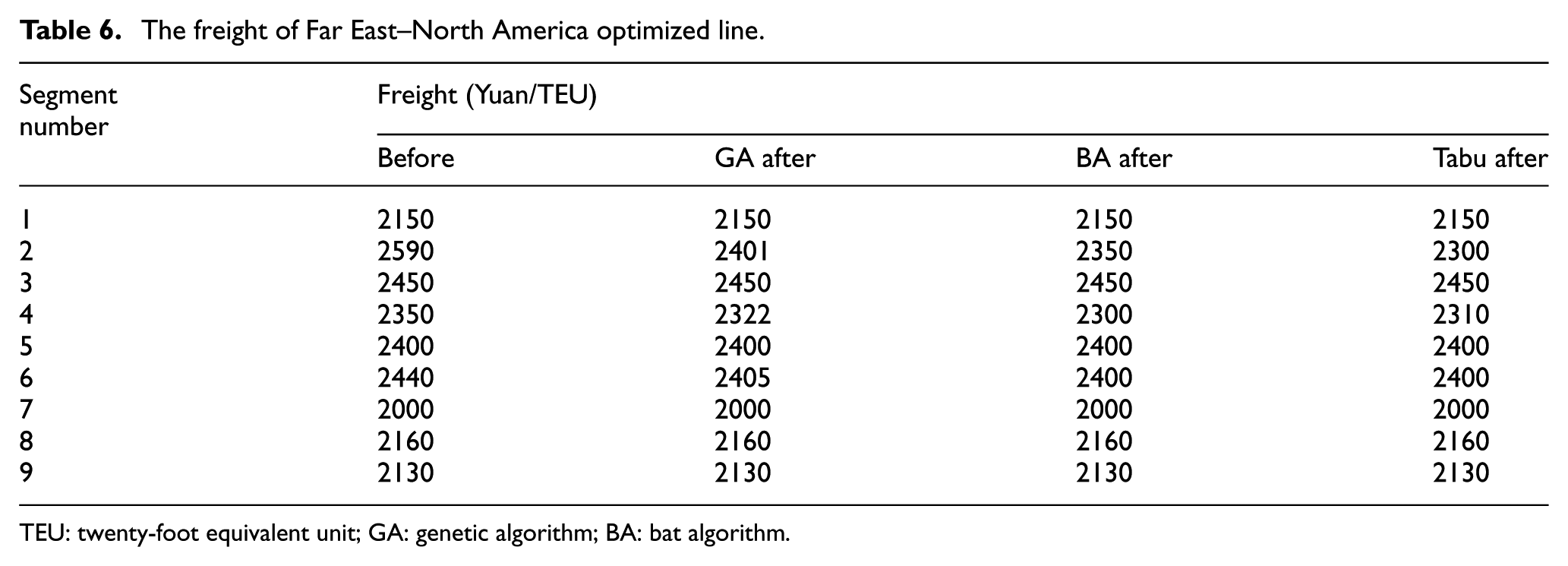
TEU: twenty-foot equivalent unit; GA: genetic algorithm; BA: bat algorithm.
To obtain the performance of the method in this article, the fuel oil cost and freight, which are achieved by BA, are shown in Figures 4 and 5, respectively. From Figure 4, we can see that the fuel oil cost of segments 3 and 8 is obviously decreased than before. In each segment, the solutions by the BA are smaller than actual fuel oil cost. From Figure 5, the freight of segment 2 is obviously decreased than before. The improved BA seems to be a powerful method for the speed–freight optimization model.
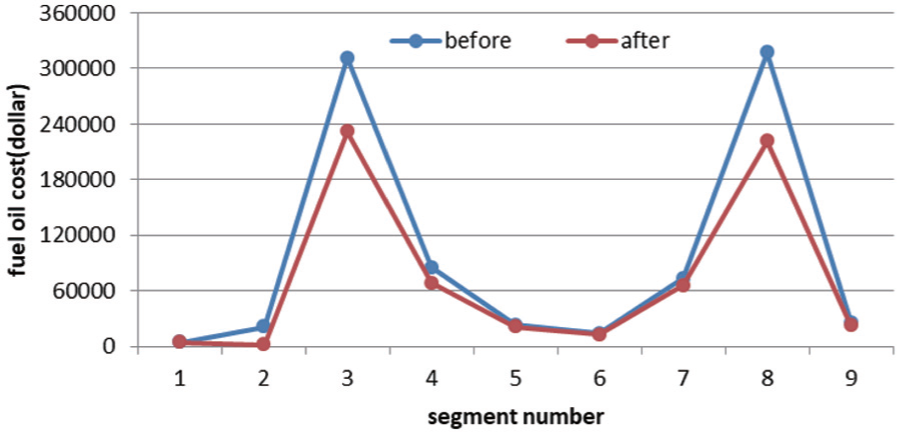
The fuel oil cost before and after optimization.
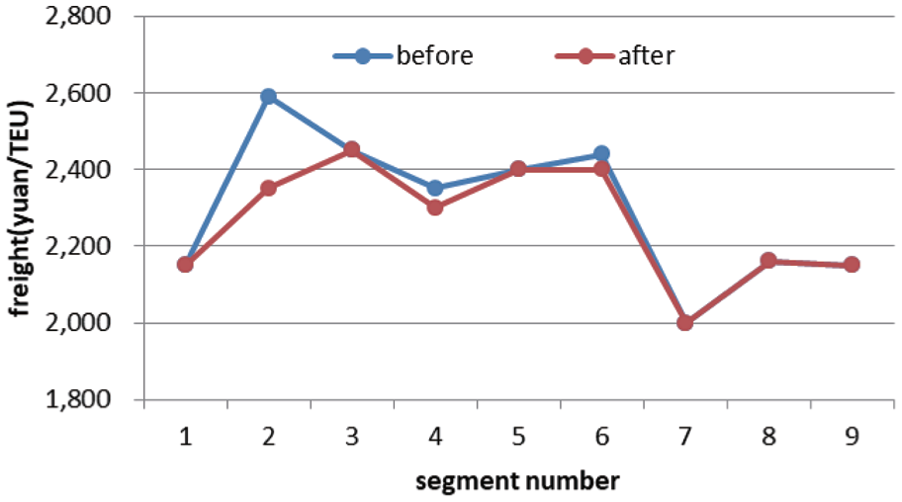
The freight before and after optimization.
To analyze the stability of the BA, we discuss the convergence of BA. Figure 6 shows its convergence of 10 experiments. We found that the target value of each experiment is almost stable eventually, and the optimal values of these 10 experiments are nearly the same, which are about 2,560,000 Yuan. Also, we can see that to obtain the best solution, BA used only 30 iterations, which is very effective. Thus, solving the problem by BA is reasonable and powerful. Furthermore, we compared BA, GA, and Tabu in Figure 7. There are 10 experiments for each algorithm. As can be seen from Figure 7, the volatility of Tabu is slightly larger, but the best solution of all experiments is found by the optimization of Tabu. And the volatilities of BA and GA are smaller, but the solutions of GA are a little worse than two others. The average value of BA solutions is almost the same as Tabu, but BA has a stronger stability than Tabu. Therefore, BA is one of the good choices to solve this problem, and the solution optimized by BA is credible and effective.

Convergence of BA.

Comparisons of BA, GA, and Tabu.
Conclusion
In the article, a speed–freight optimizing model based on BAs is established in the angle of liner companies. The model is used to optimize the speed of liner fleet and adjusts freight. When the shipping speed is reduced, the total cost of ship owners would decrease. But to the shippers the transportation time would become longer than before. To guarantee the profit of the shippers, who is possible to choose other liner companies that do not reduce the speed, this article proposed that adjusting the freight rate could help to keep customers after decelerating. Then, an improved BA is used to solve the model using MATLAB toolbox. We found that BA is more effective than GA and Tabu algorithm. In the end, we optimize and solve the example of a traditional China–USA container route, and the results show that the model can guarantee the quality of transport and reduce transport cost by adjusting the speed at the same time.
In the angle of liner companies, we set up the speed–freight optimizing model to analyze liner ships’ economic profit condition of lower speed, and lower speed can contribute to decrease operating cost. Well, as we know that the bulk fleet operating cost is in the condition with liner fleet in operating cost. We consider that the speed–freight optimizing model can also make a contribution to bulk fleet, but at the same time, we do not consider the influence of different ages in shipping costs and some other factors that could influence the optimizing results. These problems are looking for the further study.
Footnotes
Handling Editor: Gang Chen
Declaration of conflicting interests
The author(s) declared no potential conflicts of interest with respect to the research, authorship, and/or publication of this article.
Funding
The author(s) disclosed receipt of the following financial support for the research, authorship, and/or publication of this article: This research was supported by Social Sciences Planning Project of Liaoning Province (L14BJY015), Humanity and Social Science Youth foundation of Ministry of Education of China (13YJCZH042), and Specialized Research Fund for the Doctoral Program of Higher Education of China (20120041120018).