




Abstract
In this article, the approximate analytical solution of the time-fractional Cahn–Hilliard equation with quadratic form of the source/sink term is obtained using the powerful homotopy analysis method, which permits us to select a convergence control parameter that minimizes residual errors. The concerned method is more general in theory and widely valid in practice to solve nonlinear problems even for fractional order systems as it provides a convenient way to guarantee the convergence of the approximate series. The results have been given to show the effect of the reaction term on the solution profile in both fractional and standard order cases for different particular cases. The main feature of this study is the authentication that only a few iterations are required to obtain the accurate approximate solution of the present mathematical model. This is justified through error analysis for both fractional and standard order cases. This striking feature of savings in time is exhibited through graphical presentations of the numerical values when the system passes from standard order to fractional order in the presence or absence of the reaction term.
Keywords
Introduction
Interactions between convection and diffusion and also between diffusion and reaction cause many physical phenomena. From a physical perspective, the convection–diffusion and the reaction–diffusion processes describe a wide variety of problems arising in many branches of science and engineering. During the modelling of such processes, the nonlinear partial differential equations (PDEs) obtained provide new ideas regarding interactions of nonlinearity and diffusion. The importance of the analytical and numerical solutions of such nonlinear diffusion problems with reaction in mathematical physics can be found in soliton theory.
The theory of fractional calculus is an old mathematical subject with a history as long as integer order calculus. Fractional differential equation has recently proved to be an important tool for the modelling of many phenomena. Comparing integer and fractional orders, fractional order gives us a wonderful instrument for the description of memory and hereditary properties of various materials and processes. There are many methods, namely, Adomian decomposition method, 1 modified decomposition method,2,3 homotopy perturbation method,4,5 variational iteration method,6–8 differential transformation method,9,10 collocation methods11–13 and Galerkin finite element method 14 for the analytical or numerical solution of fractional differential equations. One of the strongest analytical methods for solving nonlinear problems is the homotopy analysis method (HAM), which was first introduced by the Chinese mathematician S. J. Liao using the basic ideas of homotopy in topology. Later, he improved the method greatly in stages and finally it has become an important and efficient tool for solving nonlinear problems. The advantage of the concerned method over the other existing analytical methods is that it provides us great flexibility to choose the auxiliary operator and initial guess. The main advantage of the method is that the convergence control parameter used provides a convenient way to guarantee the convergence of the approximate series solution.
In 1958, the classical Cahn–Hilliard equation (C-H equation) introduced by American scientists JW Cahn and J Hilliard
15
is one of the most studied models of mathematical physics. The equation is related to a number of physical phenomena like the spinodal decomposition, phase separation and phase ordering dynamics. This equation of mathematical physics describes the process of phase separation by which the two components of a binary fluid are spontaneously separated. The essential property of the equation is that the interface between two phases is not sharp but has a finite thickness in which the composition changes gradually. Thus, it is said that the equation describes the temporal evolution of conserved fields. A generalization of the mathematical model capable of describing a phase separation in the C-H theory can be found in Berti and Bochicchio
16
where this is achieved without loss of generality by taking the potential function as

where
Fick’s first law states that the flux of particles in a system is proportional to the gradient of the chemical potential and thus

where
The energy changes when particles change position, that is, the chemical potential of the system is given by

Now, the flux must obey a continuity equation

Finally, we get

The mathematical model gave a near accurate description of system dynamics during initial time range and provided an acceptable physical interpretation of system behaviour in intermediate time duration. The physical behaviour of the system in long time duration is studied because of its slow nature of evolution. Since the phenomena of downhill and uphill diffusion have their mathematical roots in C-H equation, it needs to be considered while development of models for binary mixtures. The equation stems from diverse phenomena like phase transition and moving process of river basin and finds applications in a variety of fields ranging from soft matter to complex fields. Recently, a few researchers have been involved in coupling the phase separation part of the equation to the Navier–Stokes equation of fluid flow. If

where the second term of the right-hand part is known as advection term and the last term is the reaction term. Modelling of nonlinear systems has gained tremendous popularity among scientists and engineers during the last few years as the nonlinearity phenomena are exhibited by most of the systems in nature. Moreover, if the models are of fractional order nonlinear problems, they are in a different dimension due to their stochastic nature. After the advent of powerful computers, various computational techniques and approximate methods or numerical methods employing effective software are used during the investigation of such types of problems. Generally, fractional order diffusion equations are obtained from the classical diffusion equations by replacing the first-order time derivative by a fractional order
Taking into account of the above facts, here we want to introduce and study the nonlocal fractional order C-H equations with advection and reaction terms, which is described as

In the next phase, an endeavour has been taken to solve this model with initial condition
Basics of fractional calculus
The definitions and properties related to fractional calculus given by B Riemann and J Liouville and also by M Caputo are as follows.27–31
Definition 1
The Riemann–Liouville fractional integral operator of order

Definition 2
The Riemann–Liouville fractional derivative operator of order

where
Definition 3
The Caputo order fractional derivative of a function

where

Solution of the problem by homotopy analysis method
To solve the C-H equation by HAM,34–40 we choose the auxiliary linear operator

Let us construct the zeroth order deformation equation as

where
Now expanding the function

where

If the auxiliary linear operator, the initial guess and the convergence control parameter are properly chosen, the above series converges for

which must be one of the solutions of the original equation as proved in Liao. 38
Differentiating equation (9) n times with respect to the embedding parameter

with initial condition
where

Here,

Taking

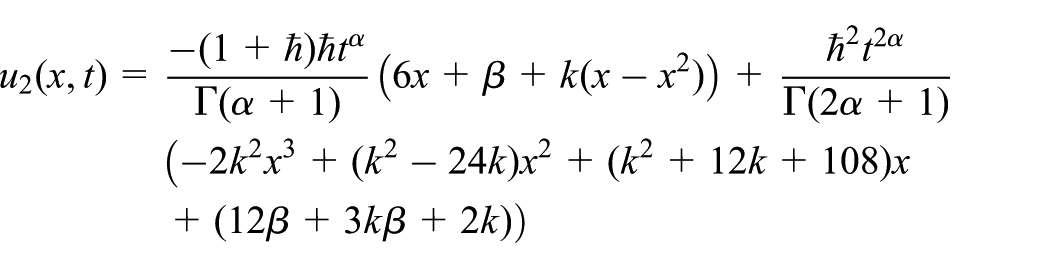

Proceeding in the similar manner, we can find

where
Choosing the values of the auxiliary parameter

To evaluate the effective region of

The convergence of series (16) can be obtained using those values of
Results and discussion
In this section, numerical values of the field variable

Plots of

Plots of

Plots of

Plots of Em versus
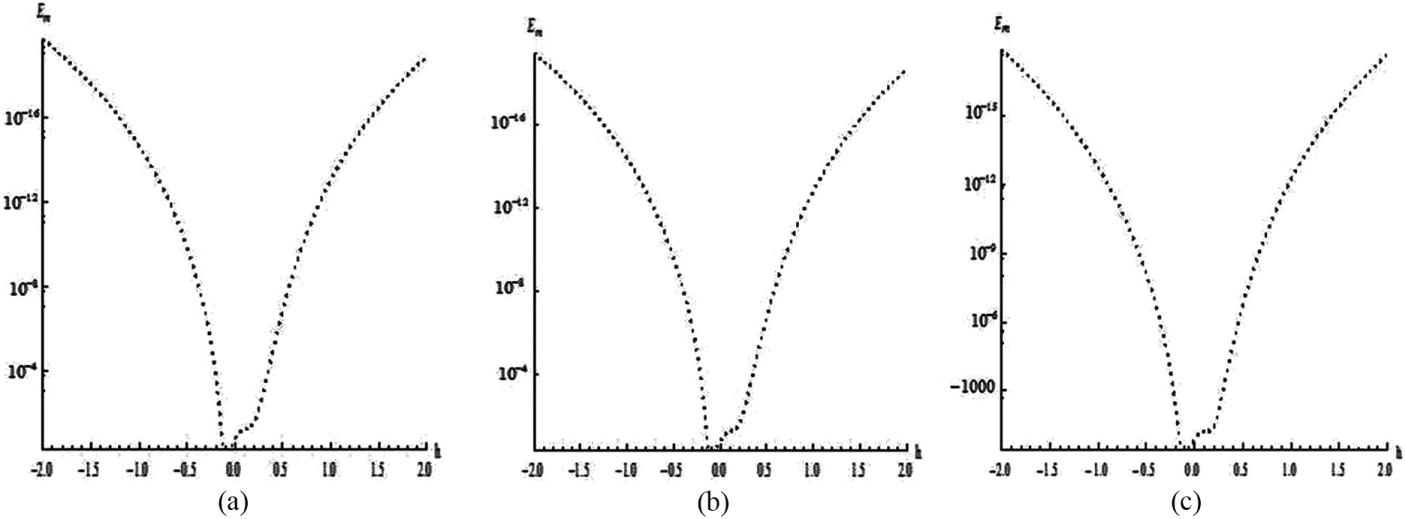
Plots of Em versus
Conclusion
Three goals have been achieved through this study. The first one is the demonstration of damping of the field variable
Footnotes
Acknowledgements
The authors express their heartfelt thanks to the revered reviewers for their valuable suggestions towards improvement of the manuscript.
Handling Editor: Xiao-Jun Yang
Declaration of conflicting interests
The author(s) declared no potential conflicts of interest with respect to the research, authorship, and/or publication of this article.
Funding
The author(s) disclosed receipt of the following financial support for the research, authorship, and/or publication of this article: This research work was carried out with the financial support provided by Science & Engineering Research Board (SERB), Government of India (vide their letter no. SB/S4/MS:840/13 dated 07.05.2015).