



Abstract
In this article, a simple model of aluminized explosive products under strong constraint is established. The analytical model incorporates the minimum details necessary to capture the contribution of the Al oxidation in the detonation products. In order to solve the flow field of aluminized explosive products analytically, some assumptions are necessary. It is assumed that Al particles are inert during the detonation reaction and do not affect the flow before oxidation of Al particles. To solve the flow field behind the detonation front analytically, the expansion process of detonation products is divided into several time ranges. In each short time range, it is assumed that the process is approximately isentropic. The metal plate test was conducted, and the motion of the metal plate was obtained. The comparison of calculation and test results was conducted. The quasi-analytic model can describe the contribution of Al reaction in the detonation products correctly, and the calculation results are in good agreement with test results.
Keywords
Introduction
The addition of aluminum to condensed explosives to increase the total energy release of the explosive is a common practice. Aluminum in its powdered form generally does not react quickly enough to contribute to the detonation front itself; 1 they can react with the detonation products of the high explosive, significantly contributing to the strength and acceleration of the blast wave. The acceleration ability of aluminum explosive relates to the concentration of aluminum and the degree of Al oxidation.
Often, multi-phase computational fluid dynamic (CFD) model has been used2–9 to analyze the conditions of Al particles with the detonation products. Mesoscale modeling with hydrocodes is also widely used.6,10–12 Although these models can, in principle, describe plenty of details about the phenomena mentioned above about aluminized explosive, developing an analytic model that captures the key elements of the problem in a way that makes the dominant features easily discernible would be preferred. For example, the classical Seshadri formulation analytically describes the structure of premixed flames propagating in a uniform cloud of fuel particles. However, it is not suitable to analyze the combustion of Al and detonation products under high pressure and temperature.
In this article, we developed a new model based on the classical theory for ideal explosive that incorporates the reaction of Al with the products, allowing us to analytically investigate the contribution of Al oxidation in the detonation products. To analytically solve the flow behind the detonation front of the aluminized explosive, we propose an assumption called local isentropic process, which enables the conclusion that the flow field behind the detonation front of aluminized explosive is only a function of the reacted aluminum mass fraction at each time. A metal plate test under strong constraint was conducted to obtain the velocity of the plate and, indirectly, the mass fraction of reacted aluminum powder. We then compared the test result with the results calculated by our analytic model and found the calculation results are in good agreement with the test results.
The assumption of the model
The flow of detonation products of aluminized explosive is more complex than ideal explosive due to the reaction of Al particles with detonation products. To analytically describe the contribution of Al oxidation in the detonation products, we simplified the problem and proposed some assumptions.
To simplify the problem, consider the detonation of aluminized explosive contained in a rigid tube and the motion is confined to one dimension. Based on the classical one-dimensional model for ideal explosive, the state equation of detonation products is
The reaction mechanism of aluminized explosive
It is assumed that none of the aluminum particles reacted during the detonation, and the Al oxidation occurs in the products behind the detonation front.15,16 For detonation of aluminized explosives, the duration for energy release of the reaction of explosive components is generally less than 0.1 µs, while the energy release for Al oxidation is in the order of microseconds to several milliseconds. 17 Therefore, the reaction rate of explosive components is much quicker than the rate of Al oxidation. So, the assumption mentioned above is valid for aluminized explosive.
The state of aluminum powder in detonation products
It is assumed that Al particles in the flow field do not affect the flow before oxidation of Al particles. This assumption is valid for the small particles loading in the high explosive (Rudinger 18 for example). The small particles could be viewed as small perturbation to the flow field of detonation products.
The afterburning of the aluminum is modeled following the work of K Balakrishnan et al., 19 which was originally applied to the combustion of aluminum in a gas phase. We adapted the Noble–Abel equation to determine the equation of state (EOS) of gas-phase aluminum. 20
The assumption of local isentropic process
The flow behind the detonation front of aluminized explosive cannot be treated as an isentropic process approximately due to the chemical reaction of Al particles in the detonation products. We propose an assumption of local isentropic process to analyze the non-isentropic flow behind the detonation front of aluminized explosive. The rate of aluminum oxidation is relatively slow, so we divided the products’ expansion process into many small ranges along the time axis. In each short time range, we assume that the process is approximately isentropic (the mass fraction of reacted aluminum is approximately constant). Using this method simplifies the flow behind the detonation front of aluminized explosive and enables analytical evaluation. We call this assumption as local isentropic process.
Note that the detonation of aluminized explosive is extremely violent and fast, and it is difficult to obtain detailed quantitative data related to this phenomenon directly. In this article, the metal plate acceleration test was conducted to obtain the velocity of metal plate driven by different kinds of explosive and the reaction degree of Al powder in the detonation products indirectly. The comparison of test results and calculation results was conducted. The model correctly described the contribution of Al oxidation in the detonation products of aluminized explosive. The assumption of local isentropic process is indirectly validated by this result.
Model of aluminized explosive products
The model of high-explosive detonation products
As was mentioned in section “The assumption of the model,” the high-explosive detonation products are treated as a perfect gas and Al particles do not affect the flow of the detonation products. The expansion of the detonation products is confined by rigid tube to one dimension. Based on the method of characteristics line for one-dimensional isentropic flow, the Riemann invariant along a right-running characteristic line can be obtained

When γ = 3, μ + c = constant. Therefore, the slope of characteristic line of right-running wave is constant

The same can be shown for left-running wave. This flow is shown by the sketch in Figure 1.

Sketch of expansion of a planar detonation with γ = 3.
The model of aluminized explosive detonation products
As was mentioned in section “The assumption of the model,” it is assumed that the Al particles exist in gas phase in the products. To determine the EOS of gas-phase aluminum, we adapted the Noble–Abel equation of the form 20

where R denotes the gas constant,
Based on the state equation of mixture of aluminum powder and perfect gas, we can obtain the state equation of detonation products of aluminized explosive by isentropic transformation. The state equation of perfect gas is

where

As was mentioned in section “The assumption of local isentropic process,” the process of product expanding is composed of several small processes which are isentropic. The state equation of detonation products of aluminized explosive can be represented by the following equation

where
The equations which represent the conservation of mass and momentum behind the detonation front of the aluminized explosive are


Based on the method of characteristics line for one-dimensional isentropic flow, the Riemann invariant along a right-running characteristic line can be obtained

When

The same can be shown for left-running wave.
Initial conditions in each time range
According to the content in section “The model of aluminized explosive detonation products,” the characteristics of ideal and aluminized explosive can be obtained, as shown in Figure 2. There is no reaction in the flow of detonation products of ideal explosive. So, the characteristics of ideal explosive are straight lines. Based on the assumption of local isentropic process, the characteristic of the flow of detonation products of aluminized explosive is divided into several segments along time axis. Due to the reaction of Al particles with detonation products, it can be obtained that S1 ≠ S2 ≠ S3 ≠ S4 ≠ S5 ≠ S6 which is depicted in Figure 2. Therefore, the characteristics of detonation products of aluminized explosive will not be straight lines. Consider that the rate of Al oxidation is relatively slow, in each time range, the fraction of reacted aluminum particle is constant approximately and the expansion of detonation products is isentropic. However, the total flow behind the detonation front is non-isentropic.
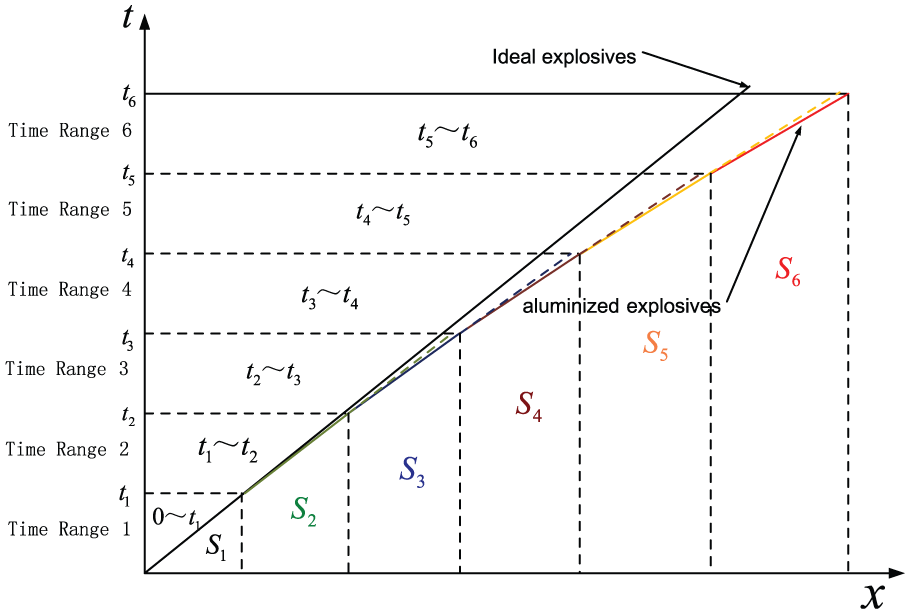
Sketch of characteristics for aluminized explosives and ideal explosives.
The relationship between time range i and time range i + 1 is necessary to solve the non-isentropic flow of the detonation products analytically. The parameters (such as u, c, ρ, and p) are along the characteristic line, in each time range, in relation to the fraction of the reacted aluminum. The energy which is released during the Al oxidation mainly increases the internal energy of the products. So, the pressure and temperature of products will increase, and the density and velocity of particles remain unchanged. The parameters of products in the time range i + 1 can be calculated as




where
The metal plate acceleration test and results
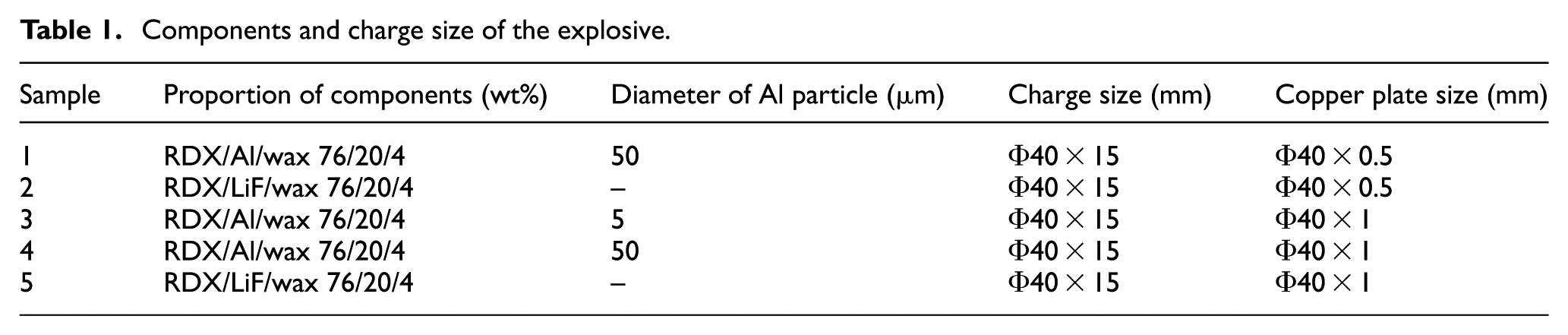
In this article, the metal plate acceleration test under strong constraint was conducted to verify the quasi-analytical model. In order to highlight the contribution of reacted aluminum to the acceleration, the aluminized explosive that contain 20% aluminum powder was selected. (Note that the degree of reaction of aluminum powder in the detonation products is highest when the mass fraction of aluminums in the aluminized explosive is 20%–25%.) Two kinds of aluminum powder in diameter were selected to analyze the influence of reaction degree of aluminum powder on calculation results. (Note that the reaction degree of aluminum powder in the detonation products varies with the diameter of aluminum powder.) The explosives and charge size are shown in Table 1.
Components and charge size of the explosive.
The schematic diagram of the metal plate acceleration test is shown in Figure 3.

Schematic diagram of the metal plate acceleration test.
The test results of Φ40 mm × 0.5 mm metal plate accelerated by RDX/Al/wax (50 μm Al) and RDX/LiF/wax
The test results are shown in Figure 4. The motion of the metal plates driven by two kinds of explosive is almost same within 1.2 μs. Consider the LiF is inert in the detonation products and the physical property of LiF is similar to Al, we can obtain that aluminum powder in the detonation products is also inert within 1.2 μs. The reaction of aluminum powder begins to contribute to the motion of metal plate after 1.2 μs, and the velocity of metal plate driven by RDX/Al/wax is higher than RDX/LiF/wax.

The velocity of metal plate (Φ40 mm × 0.5 mm) accelerated by RDX/Al/wax and RDX/LiF/wax.
The test results of Φ40 mm × 1 mm metal plate accelerated by RDX/Al/wax (5 and 50 μm Al) and RDX/LiF/wax
The test results are shown in Figure 5. In this test, the metal plates are thicker than the one given in section “The test results of Φ40 mm × 0.5 mm metal plate accelerated by RDX/Al/wax (50 μm Al) and RDX/LiF/wax.” The stress wave in the metal plates causes the test results to be oscillatory. The oscillation of test curves does not affect the analysis. The motion of the metal plates driven by three kinds of explosive is almost same within 1.3 μs. The aluminum powder in the detonation products is inert within 1.3 μs in this test. After 1.3 μs, the velocity of metal plate driven by RDX/Al/wax is higher than RDX/LiF/wax and the acceleration ability of 5-μm Al aluminized explosive is greater than the 50-μm Al one.

The velocity of metal plate (Φ40 mm × 1 mm) accelerated by RDX/Al/wax and RDX/LiF/wax.
The reaction degree of aluminum powder in the detonation products
Unlike Al powder, LiF always remain inert. The difference in kinetic energy of metal plate is the contribution of Al oxidation to the motion of metal plate. Thus

where
The reactions of Al with detonation products mainly contain three parts

The chemical enthalpy of formation of aluminum powder in the detonation products is calculated and QAl = 20 kJ/g. The efficiency of reaction heat of aluminum powder for the metal plate test is 0.18. 21 Note that the efficiency of reaction heat of aluminum powder for the metal plate test is obtained from a large number of experiments, and it is an empirical parameter. In this article, the aluminized explosive and experimental conditions are similar to Chen et al., 21 so the parameter is valid in this test.
The reaction degree of aluminum powder in the detonation products can be calculated and is shown in Figures 6 and 7. Note that the acceleration time of aluminized explosive under strong constraint is 0–5 μs. After 5 μs, the shell deformation is large, and the rarefaction wave has a great influence on the acceleration of metal plate. So, the reaction degree was obtained just from 0 to 5 μs.
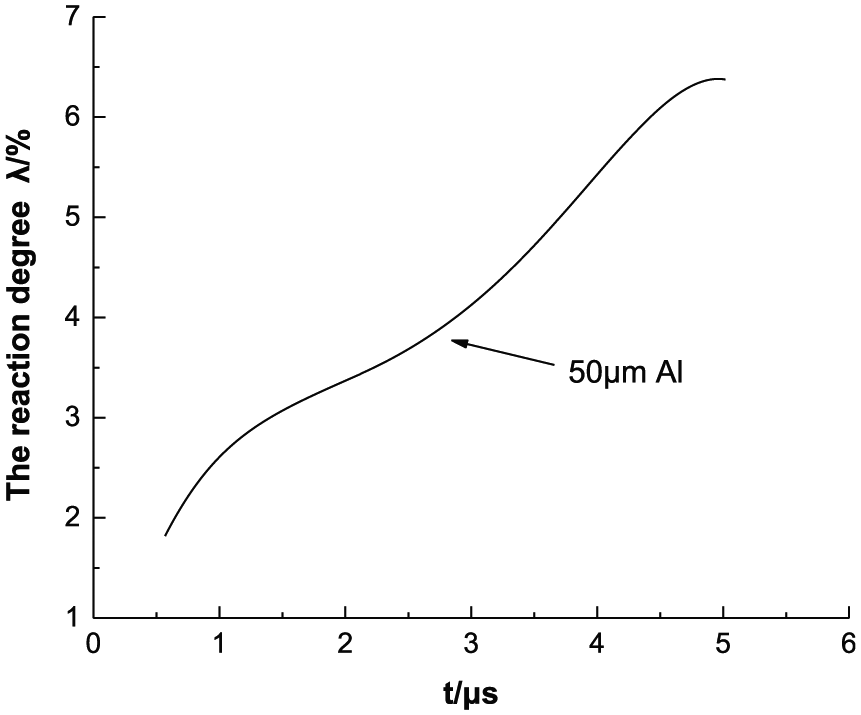
The reaction degree in the test that driven Φ40 mm × 0.5 mm metal plate.

The reaction degree in the test that driven Φ40 mm × 1 mm metal plate.
As shown in Figures 6 and 7, the reaction degree of aluminum powder in the detonation products is affected by the experimental conditions and the particle size of the aluminum powder.
The theoretical analysis of the motion of metal plate under strong constraint
When the detonation front arrives the metal plate, there will be a reflected compression wave propagating into the products. It is non-simple wave region behind the reflected compression wave, and the non-simple wave region can be represented by the following equations


where the subscript
For the motion of metal plate, the equation of conservation of momentum is

where M is the mass of the metal plate,

where
Inserting equation (19) in (18), we can obtain

When the compression waves arrive the metal plate, the velocity of detonation products change from

The derivation of equation (16) is

Inserting equation (20) in (22), we can obtain

where
In this study,

In the time range 1, the initial conditions are


When the first compression wave arrives the metal plate, the boundary conditions are



where
Inserting the boundary conditions in equation (24), we can obtain

where
Inserting equation (30) in (24), we can obtain

where
Inserting equation (31) in (20) and integrating

We can obtain the initial condition and boundary condition of the time range

where
The initial condition in each time range is given in Appendix 1.
The application of the analytic model and sensitivity analysis
The comparison of calculation and experimental results
In this section, we will apply the analytic model to calculate the motion of metal plate. The characteristics of the explosive which are obtained in test are shown in Table 2.
Characteristics of explosive and charge size.

The initial conditions are calculated according to the method in section “Initial conditions in each time range,” and the boundary conditions are obtained according to the method in section “The theoretical analysis of the motion of metal plate under strong constraint.” The calculation results are shown in Table 3.
The initial condition and boundary condition in the time range 1.

The comparison of calculation and experimental results that Φ40 mm × 0.5 mm metal plate driven by RDX/Al/wax (50 μm Al) and RDX/LiF/wax is shown in Figure 8.

The comparison of the calculation results with test results that Φ40 mm × 0.5 mm metal plate driven by RDX/Al/wax (50 μm Al) and RDX/LiF/wax.
In Figure 8, the calculation results are in good agreement with the experimental results within 0–5 μs. The calculated result indicates that the finial velocity of metal plate driven by RDX/Al/wax is 6.5% higher than RDX/LiF/wax. The test result indicates that the finial velocity of metal plate driven by RDX/Al/wax is 6.1% higher than RDX/LiF/wax. Note that the model describes the flow of aluminized explosive products under strong constraint. After 5 μs, the strongly constrained shell failure and the detonation products are greatly affected by the coefficient wave. So, the calculation results are larger than the experimental results after 5 μs.
The comparison of calculation and experimental results that Φ40 mm × 1 mm metal plate driven by RDX/Al/wax and RDX/LiF/wax is shown in Figure 9.

The comparison of the calculation results with test results that Φ40 mm × 1 mm metal plate driven by RDX/Al/wax and RDX/LiF/wax.
The comparison of calculation and test results is shown in Figure 9. The metal plates (Φ40 mm × 1 mm) are driven by RDX/Al/wax (5 μm Al), RDX/Al/wax (50 μm Al), and RDX/LiF/wax. The quasi-analytical model describes the contribution of the reaction of aluminum powder in the detonation products and the influence of particle size of aluminum powder on the work capacity of explosive correctly. The final velocity of metal plate driven by RDX/Al/wax (5 μm Al) is 2.2% higher than RDX/Al/wax (50 μm Al) and is 8.6% higher than RDX/LiF/wax. In test, the final velocity of metal plate driven by RDX/Al/wax (5 μm Al) is 2.1% higher than RDX/Al/wax (50 μm Al) and is 9.1% higher than RDX/LiF/wax. Note that the stress wave in the metal plates causes the test results to be oscillatory. The test results’ oscillation of Φ40 mm × 1 mm metal plates is more severe than the thin ones. The influence of stress wave in the metal plate is not considered in the quasi-analytical model, so there is some difference between the calculation results and the experimental results.
The objective of this study is to adopt an alternative approach to develop a highly simplified analytical model. The analytical model captures the contribution of Al oxidation in the detonation products and the motion of metal plate driven by aluminized explosive. Based on the analytic model, the flow of the aluminum explosive products behind the metal plate can be solved. This work will be done in the future.
Sensitivity analysis of the model
The parameters of quasi-analytical model consist of three parts: initial condition, boundary condition, and the reaction degree of aluminum powder. The initial conditions are only related to the property of the aluminized explosive and are calculated according to the method in section “Initial conditions in each time range.” Under the strong constraint, the boundaries of metal plate test driven by aluminized explosive are related to the detonation velocity of aluminized explosive and can be obtained according to the method in section “The theoretical analysis of the motion of metal plate under strong constraint.” The reaction degree of aluminum powder in the detonation products is the key parameter to describe the contribution of aluminum powder in detonation products correctly. The reaction degree of aluminum powder in the detonation products is related to the test constraint, density of aluminized explosive, mass fraction of aluminum powder in the explosive, and particle size of aluminum powder. The reaction time of explosion is in the order of a microsecond, making it difficult to obtain detailed quantitative data of the reaction degree of aluminum powder by experimental method directly. In section “The reaction degree of aluminum powder in the detonation products,” the reaction degree of aluminum powder is calculated indirectly.
The interval of time range is a factor that affects the calculation results. The model will produce large error when the interval of time range is divided too largely. We divided the process of detonation products expanding into 10, 15, 20, 25, and 35 time ranges averagely and calculated the metal plate velocity, respectively. When the process is divided into 20, 25, and 35 time ranges averagely, the velocities of metal plate are almost the same. But the results on 10 and 15 time ranges are not good. If each time range is too large, the mass fraction of reacted aluminum cannot be treated as constant approximately and the result calculated by our model will produce large error.
Conclusion
In this study, a simple model for aluminized explosive products has been constructed. To solve the complicated problem analytically, some assumptions are proposed to simplify the problem. The assumptions consist of three parts: the reaction mechanism of aluminized explosive, the state of aluminum powder in detonation products, and local isentropic process. Based on the assumptions and the classical theory for ideal explosive, a quasi-analytical method is established to analyze the contribution of Al oxidation in the detonation products and acceleration of metal plate driven by aluminized explosive under strong constraint.
To verify the model, the metal plate acceleration test is conducted. In the test, we obtain the acceleration ability of five kinds of explosive and the reaction degree of aluminum powder in the detonation products. The comparison of calculation and test results is conducted, and the calculation results are in good agreement with test results. The sensitivity analysis of the quasi-analytical model is conducted in section “Sensitivity analysis of the model.” The sensitivity analysis consists of parameters and interval of time range. The reaction degree of aluminum powder and interval of time range are the major factors affecting the calculation results.
The model captures the contribution of the Al oxidation in the products to acceleration ability with simple method. Moreover, the flow of the aluminized explosive products behind the metal plate can be solved based on the model. The analytic model is useful for understanding the flow of the aluminized explosive products.
Footnotes
Appendix 1
Handling Editor: Pietro Scandura
Declaration of conflicting interests
The author(s) declared no potential conflicts of interest with respect to the research, authorship, and/or publication of this article.
Funding
The author(s) received no financial support for the research, authorship, and/or publication of this article.