




Abstract
Large eddy simulation was performed for forced homogeneous isotropic turbulence with/without polymer additives. Wavelet transform in one dimension and two dimensions were performed to investigate the multi-resolution features of coherent structures and intermittency in forced homogeneous isotropic turbulence based on large eddy simulation database. Using wavelet decomposition in one dimension and two dimension, it is found that polymer additives behave inhibitive effect on the intermittent pulse and the amount of coherent structures in forced homogeneous isotropic turbulence. The reconstructions of velocity waveform for coherent structures with strongest intermittence were surveyed at the scale
Keywords
Introduction
In 1948, Toms discovered that adding a minute amount of flexible long-chain polymers to water flow can induce significant turbulent drag reduction (DR; named Toms’ effect thereafter). 1 It is repeatedly obtained that there exists dramatic frictional DR in pipe or channel turbulent flows of polymer or surfactant solution.2–7 The DR rate can reach to even more than 80% at some situations. 8 The dramatic turbulent DR has attracted many researchers to investigate the characteristics of turbulent drag-reducing flow and mechanism of DR since this technique is of great significance in decreasing energy consumption, protecting environment, and so on. However, in order to study the mechanisms of DR, there are yet robust theories or numerical simulation tools (at high Reynolds number) currently.
So far, there have been many numerical studies on the characteristics and mechanism of turbulent DR, most of which are direct numerical simulation (DNS), some of which are Reynolds-averaged Navier–Stokes (RANS) model, and very few of which are large eddy simulation (LES). Sureshkumar et al.
9
first used DNS to simulate turbulent drag-reducing flow with the finitely extensible nonlinear elastic in the Peterlin approximation (FENE-P) model based on pseudospectral method. Following that, more and more DNS works have been carried out to resolve the detailed characteristics of turbulent drag-reducing flows and investigate the mechanism of DR.10–19 Due to the constraint of computer hardware, the performed DNSs had to be limited to most flows with moderate Reynolds number. Regarding RANS method, several researchers paid attention to the proposition of RANS models for viscoelastic fluid flow and the inquiry on the overall characteristics of polymer solution flows.20–22 Cruz et al.
22
proposed a two-equation
The above-mentioned works on CSs and intermittency in polymer solution flows are all focused on mean features estimated with the partial derivatives of velocity fluctuation. However, the detailed features of CSs and intermittency should be explored at different scales, since turbulence can be seen as the superposition of vortex structures at different scales and the strongest vortex structure is the so-called CS which exists not only at large scale but also at small scale. To this end, the wavelet transform (WT) method has been utilized because WT can translate turbulent velocity fluctuation signals into local vortex structures and thus make the vortex structures at different regions and scales be easily and clearly observed. Farge and Rabreau 28 first used WT to demonstrate the intermittency of small-scale vorticity filed and the relations between CSs and intermittency in homogeneous turbulent flows. After that, WT has been widely used in examining the characteristics of turbulence, such as turbulent fractal features, CSs, and the intermittency. Bacry et al. 29 obtained negative local scaling index of turbulence by WT, reflecting the singularity of turbulence. For uniform grid turbulence and turbulent jet flow, Camussi and Guj 30 found that there exists connection between small-scale signals with strong intermittency and CSs based on orthonormal WT. Farge et al. 31 proposed a numerical method for extracting CSs with wavelet decomposition of vorticity field. By inquiring fully developed turbulent channel flow data, Onorato et al. 32 put forward a turbulent signal decomposition technique by WT. All the above discussions about the applications of WT were for the characteristics of Newtonian fluid turbulent flows. For viscoelastic fluid turbulent flows, WT method is yet rarely utilized in analyzing the characteristics of modified CSs and the intermittency in drag-reduced turbulence. In Wang et al. 33 and Wu et al., 34 which are almost the only two reported examples, WT method was used to analyze the flow structures in turbulent drag–reducing channel flow based on DNS data.
In this article, wavelet analysis was performed for a database of velocity filed in forced homogeneous isotropic turbulence (FHIT) with drag-reducing polymer additives. The velocity field database of this drag-reduced FHIT was obtained by LES using our newly proposed Mixed SGS model based on Coherent structures and Temporal approximate deconvolution (MCT). 35 The purpose of this study was to investigate the variation in CSs and intermittency influenced by polymer additives in turbulent drag-reducing flows at different scales. In this study, Daubechies wavelet 36 with three-order vanishing moments (db3) was used for one-dimensional (1D) and two-dimensional (2D) WT since db3 has suitable scaling and wavelet function with a certain smoothness and relatively small computation cost. Then, the wavelet decomposition, reconstruction of velocity waveform, flatness factors, and local intermittence measure (LIM) are deeply analyzed for the drag-reduced FHIT with polymer additives in detail.
Numerical models and mathematical method
As mentioned previously, the reported numerical simulation studies on turbulent drag-reducing flows of viscoelastic fluid using LES were very few. We have then proposed a new SGS model particularly for LES of viscoelastic fluid flows named MCT, 35 which has been successfully used to simulate FHIT with polymer additives and turbulent drag-reducing channel flow of surfactant solution. In this section, the LES procedures based on MCT are briefed at first. The WT procedures are then introduced in detail.
LES of FHIT with polymer additives based on MCT SGS model
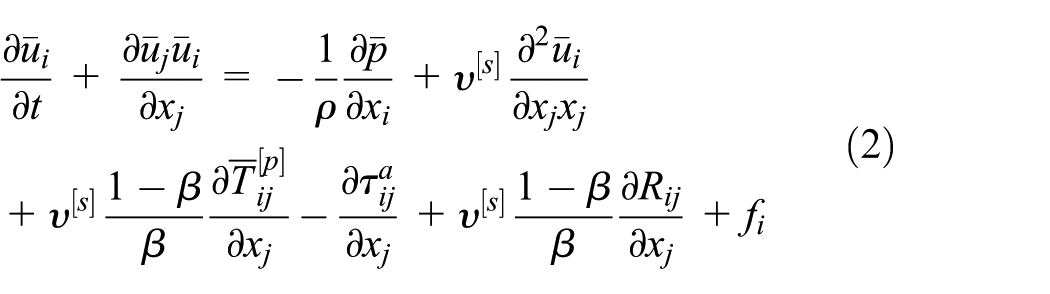
The MCT SGS model is established through the following procedures. The continuity and modified momentum equations for LES based on spatial filtering in turbulent drag-reducing polymer solution flows are expressed as follows

where
The concept of coherent-structure Smagorinsky model (CSM)40–42 is adopted to calculate the SGS stress tensor

where C is the model parameter,

with


where

However, the spatial filtering method described above is not suitable for the conformation tensor transport equation. Therefore, the concept of temporal filtering used in TADM is adopted to filter the conformation tensor of polymers35,37

where
The principle of TADM is to take advantage of values at current and earlier time steps to calculate the deconvolved values which approximate the unfiltered values. The deconvolved velocity

In this study,
The subfilter terms


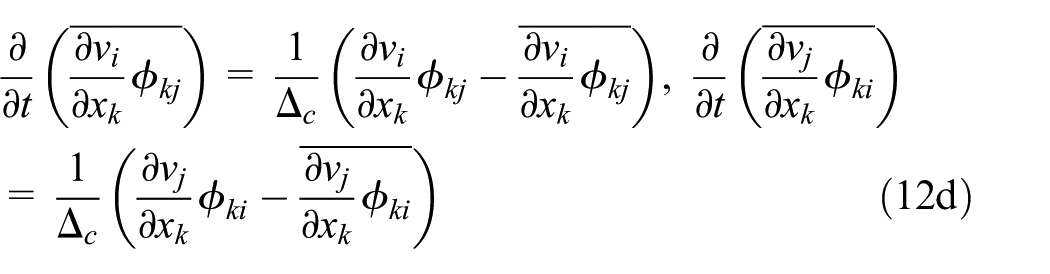
Then, filterings of the above variables are based on time-domain26,35,37


where
In this study, a periodic cubic

where
WT
WT is a multi-scale analysis method for fluctuating functions or signals by scale and translation. Compared with Fourier transform, WT is a kind of local transformation on both time domain and frequency domain, which can obtain more effective information. WT can be classified into continuous WT (CWT) and discrete WT (DWT). For CWT, the wavelet function


where

In order to make WT adapt the non-stationary of signal by changing the time and frequency resolutions, the scale and translation must be adjusted for DWT. If the scale is binary discrete and the translation is continuous, the binary wavelet as a kind of DWT is formed. In binary wavelet,


From the above description, it can be known that the translation invariant for a signal on the time domain is not damaged in binary wavelet. And
For the 2D signal


In this article, db3 as a kind of binary wavelet in 1D and 2D WT is applied. For 1D WT, the time-varying velocity fields obtained by LES between
Results and discussions
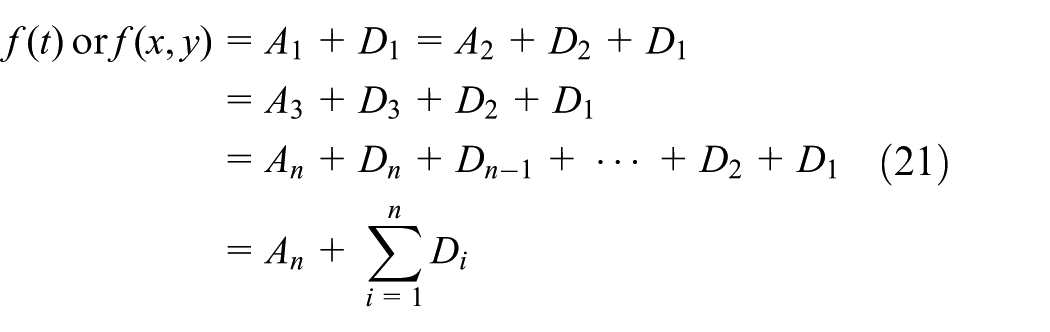
In WT, the most distinctive characteristic is the wavelet decompositions: the original 1D signal
where

Wavelet decompositions of the streamwise velocity fluctuation time series for the Newtonian fluid case.

Wavelet decompositions of the streamwise velocity fluctuation time series for the polymer solution case.

FFTs of the detailed components of the signal for (a) the Newtonian fluid case and (b) polymer solution case.
As we know, the isoline or isosurface of velocity fluctuations can extract vortex structure. For 2D WT, the detailed components in equation (21) can image the relatively small-scale CSs.
45
The wavelet decompositions of velocity fluctuations in the

Wavelet decompositions of the velocity fluctuations in
As is known, WT is an effective tool to detect CSs that have strongest energy locally and play essential role in turbulence. One feature of WT is the energy conservation, as expressed in the following

According to the content of energy density, the following equation satisfies

Coupling equations (22) and (23), the wavelet energy for WT at each scale is obtained as

In order to extract CSs, the maximum wavelet energy must be determined. In this study, the maximum energy criterion proposed by Liandrat and Moret-Bailly 46 was adopted and its expression is as follows

where

The distribution of the energy fluctuations with scale: (a) the Newtonian fluid case and (b) the polymer solution case.

Velocity waveform reconstruction for CS: (a) the Newtonian fluid case and (b) the polymer solution case.

FFTs of velocity wavelet reconstruction for (a) the Newtonian fluid case and (b) polymer solution case.
Turbulence is a nonlinear phenomenon and possesses CSs leading to intermittency in the space and time domains. The detections of vortex structures by wavelet decomposition can indirectly represent the intermittency characteristics. A typical quantity, the flatness factor, characterizing intermittency in both the Newtonian fluid and viscoelastic fluid flows is quantitatively analyzed with WT. The definition of the flatness factor in DWT is as follows 47

where

Flatness factor for fluctuation velocity in streamwise direction.
Generally speaking, intermittency is caused by CSs in turbulence. In order to quantitatively detect the contribution of local CSs to the intermittency in turbulence, Farge 48 defined an LIM which can reflect the ratio of local wavelet energy spectrum to the whole-wavelet energy spectrum as follows

It is defined that the locations at which
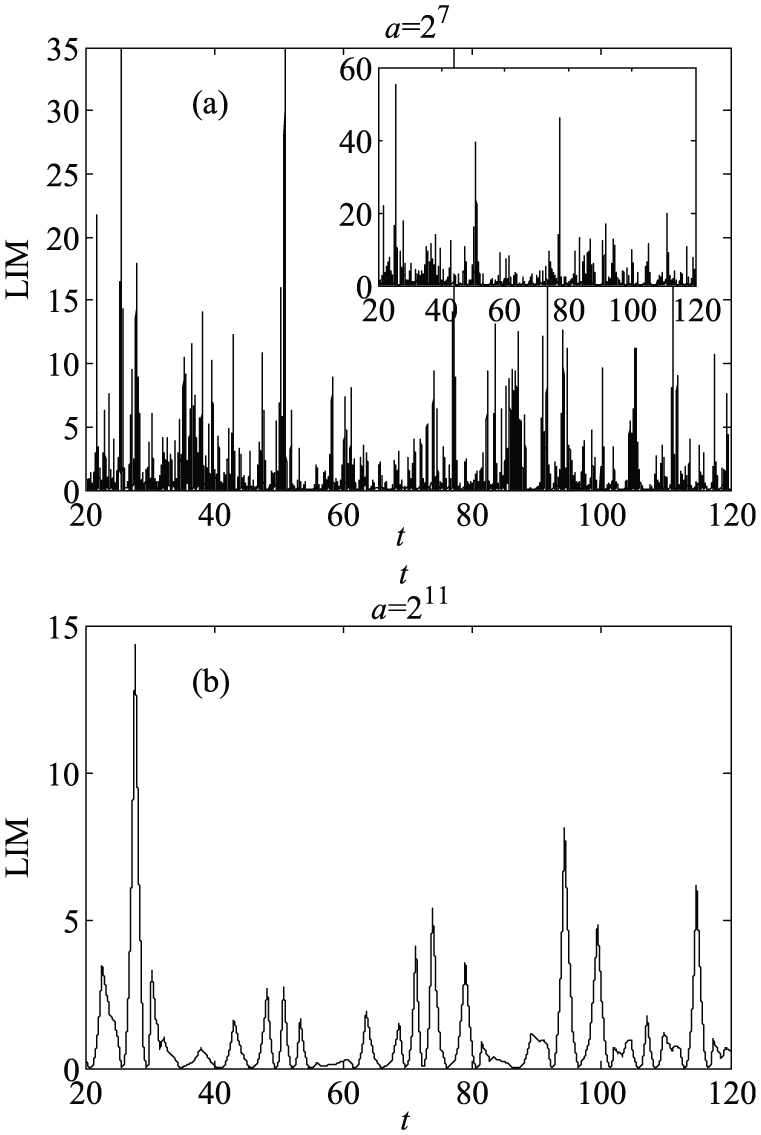
LIM by 1D WT for the Newtonian fluid at scale (a)

LIM by 1D WT for the polymer solution flow at scale (a)
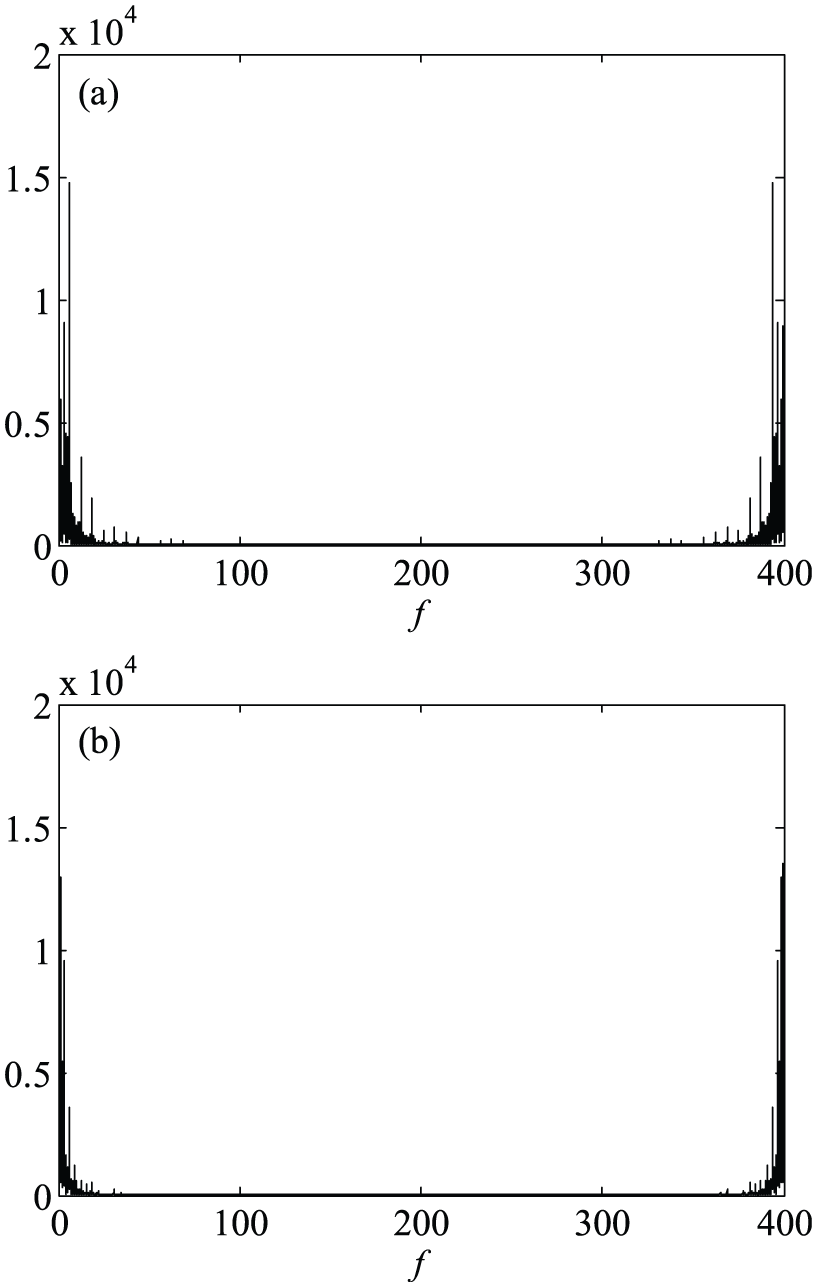
FFTs of LIM for (a) the Newtonian fluid case and (b) polymer solution case at scale
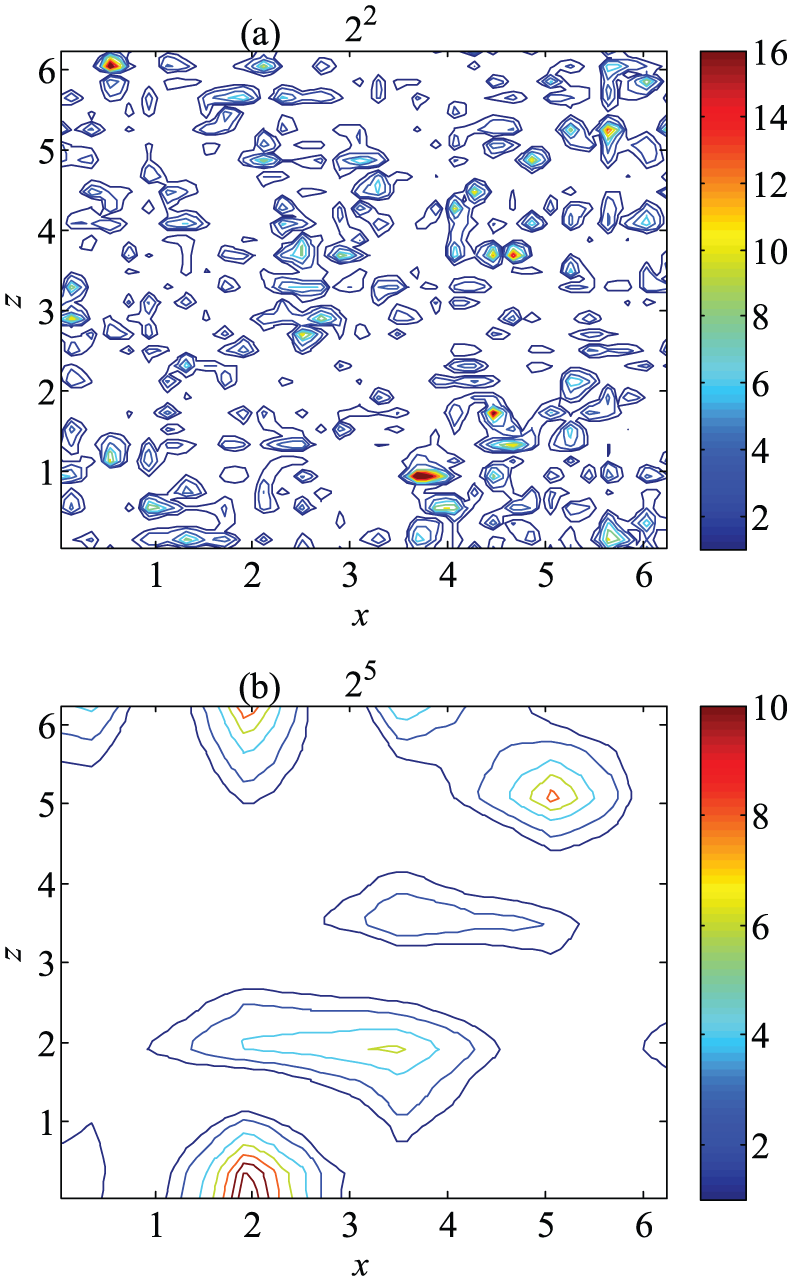
LIM by 2D WT for the Newtonian fluid at scale (a)
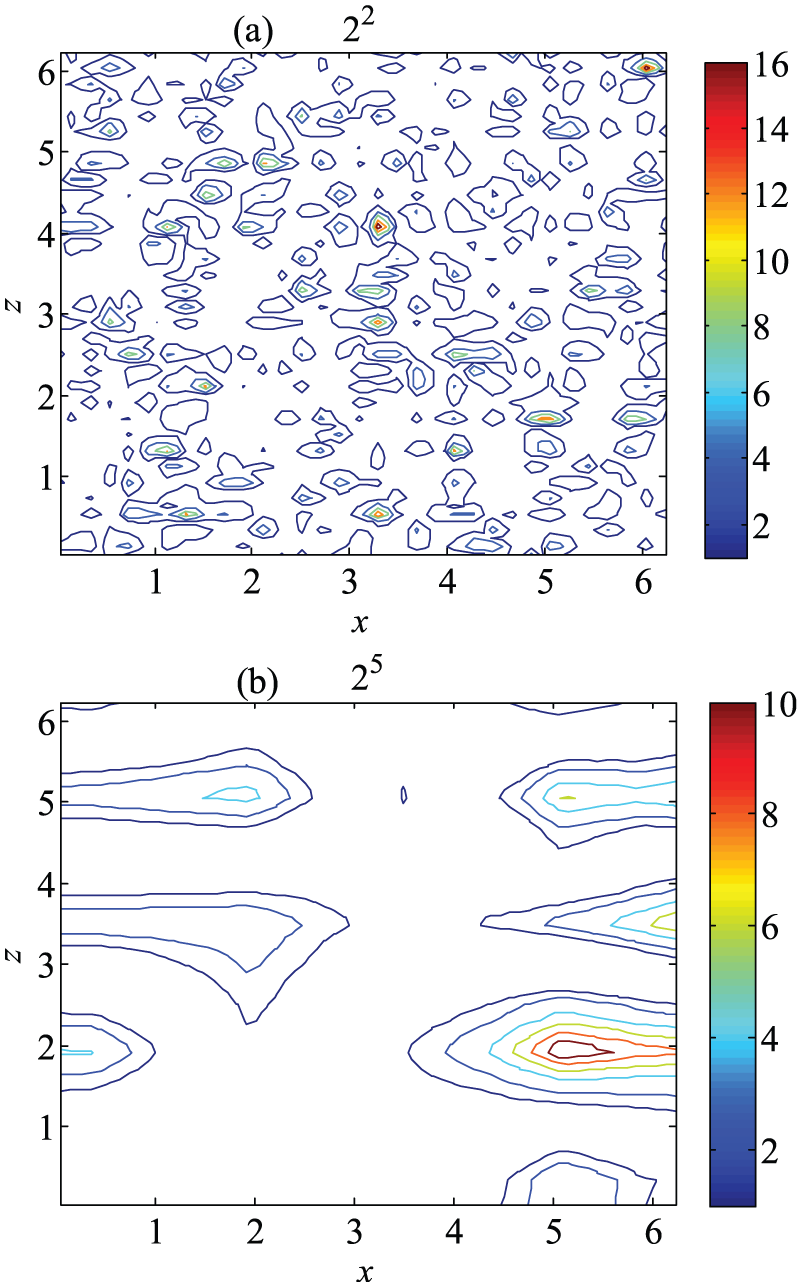
LIM by 2D WT for the polymer solution flow at scale (a)

PDFs of LIM for the Newtonian fluid and polymer solution at scale
Conclusion
The drag-reducing effect on the CSs and intermittency in FHIT with polymer additives has been investigated by means of 1D and 2D WT analyses of LES database. Through discussing the wavelet decompositions for the Newtonian fluid and polymer solution flows in 1D and 2D WT, it is found that the intermittent pulse and relatively small-scale vortex structures exist in both the Newtonian fluid and polymer solution flows. Nevertheless, the intermittency and the quantity of CSs in polymer solution flows are both obviously inhibited. Through the detection of CSs in turbulence by maximum energy criterion, the velocity waveforms for CSs are reconstructed at scale
Footnotes
Acknowledgements
We are very grateful for the editors and the valuable suggestions of the reviewers and thank the great help from all members in Complex Flow and Heat Transfer Lab of Harbin Institute of Technology.
Handling Editor: Kai Bao
Declaration of conflicting interests
The author(s) declared no potential conflicts of interest with respect to the research, authorship, and/or publication of this article.
Funding
The author(s) disclosed receipt of the following financial support for the research, authorship, and/or publication of this article: The project was supported by National Natural Science Foundation of China (Grant Nos 51206033, 51276046, and 51706050) and the Fundamental Research Funds for the Central Universities (Grant No. HEUCFJ160207).