




Abstract
There are so many paper shredder products available in the market, and the decision to select a ‘right shredder’ usually involves a number of criteria. For organizations, complexity arises when the procurement function is to purchase a massive amount of shredders of the same type. This study initiated the idea to use the analytic hierarchy process with graph theory and matrix approach for solving the problem. The proposed model determines the best shredder from a pool of alternatives, given the buyer-side decision-maker’s preference settings. With the expert questionnaire polled and the heterogeneous real data collected, the model is applied to a reduced data set. The size of the decision problem is defined as 8 alternatives are filtered among 26, while the 7 justification attributes considered are fully kept for not losing the experimental meaning. The result shows the effectiveness and applicability of the approach to manage the encountered decision scientifically. As this also implies that not only buyers but also the manufacturers can use this model to analyse ‘something’, it is confident to conduct more future studies. The R script which implements the dynamic programming concept to calculate the assessed index scores for graph theory and matrix approach is perhaps another contribution of this study.
Keywords
Introduction
Paper shredder is an electromechanical facility which can be found in every office, while the home-use of it is also popular. A main function of paper shredder is to destroy sensitive or private documents before disposal or recycling, as to prevent from the disclosure risk of confidential information. The other function of it is to destroy too dated but still archived physical paper files, some of which might have been converted and saved in the digital repository.
However, when it is to choose ‘a suitable shredder’, one becomes a confounding decision-maker (DM). In the market, there are brands, types of shredder, each of which is advertising and boosting its own ‘special advanced features’. Such information simply makes the justification criteria blur, and this has made the DM difficult to choose one among so many shredder alternatives.
When one is going to buy a home-use shredder, which is used on occasion, a compact, easily taking-in and stylish shredder with a smaller bottom can is usually preferred.1,2 According to the statistics, over 80% of people who considered to own a shredder for the first time have purchased one with a ≤15 L can. And the main reason is about compactness: it is portable even from home to the office. 1
For ‘office uses’, paper shredder becomes a business machine that is accessed frequently. More robust functions, such as batch shredding (several papers a time), are required, while how fine the paper can be cut through as to achieve the claimed ‘security level’ and how silent the shredder is when it is in operation are other important matters (and measures). Sometimes, advanced functions like efficient and effective credit card or compact disc shredding functions are also expected. As is seen, roughly, the problem to select a suitable shredder for uses in the office should address a different set of criteria, compared with using at home. This study is mainly focused on the shredder-selection problem in the former context.
However, in any of a middle-large company or institution, purchasing one shredder a time upon some emergent demand seems an impossible practice. Instead, batch procurement should be a usual situation. Since here ‘batch’ implies ‘a number of shredders of the same type’ (which is perhaps tens of, hundreds of or even ‘thousands of’) for price bargaining or maintenance contractual convenience, the decision should be handled very carefully because as can be imagined, any wrong action taken based on the decision might lead to irrecoverable consequences!
To the author’s knowledge (as reviewed in the next section), such a shredder-procuring decision has not yet been systematically and scientifically studied, modelled and supported, let alone to have a decision support system (DSS). The main purpose of this study is to fill this gap. In this study, a hybrid multi-attribute decision-making (MADM) model, which takes analytic hierarchy process (AHP) to obtain the pairwise comparison information and assess the priority weights of the considered criteria and then graph theory and matrix approach (GTMA) to assist the shredder ranking/selection process, is established. Works about the identification of relevant selection criteria were done according to the reviews. The priority weights of criteria are determined by the first stage of AHP based on the pairwise comparison data collected from a DM who is to launch a procurement process. The shredder alternatives considered, together with their attributes, are sourced from the Internet, the brochures and the price quotations issued by the different shredder brands.
As for how come this study uses both AHP and GTMA and has identified a suitable integrated AHP-GTMA approach to solve the encountered decision problem, the motivation can be sorted out here. According to the recent concept of data-driven decision-making, a business decision cannot be made solely based on either the judgements in human mind or the existing data sets. Instead, by following the concept of human–computer interaction (HCI), at the data age, the concept of decision can be shifted to human–data interaction (HDI), which means during the decision, relevant information from both the DM’s mind and the existing data sets should be collected, sourced and considered together, as to have the cogent ‘informed decision’ (if spoken from the knowledge discovery aspect). Since AHP has been a well-known method for mining the DM’s mind, we use it to mine the DM’s mind, as to have the pairwise comparison opinions as well as the priority of criteria. And, since GTMA is a recent popular method for decision-making, we use it to mine the data sets (the pairwise comparison matrix and the source data for the alternatives), as to have the priority of alternatives. By taking the AHP-GTMA approach, this work not only utilizes data from ‘data mining’, but also from ‘mind mining’, and, as will be shown later in the case modelling section, both of these two mining processes are required to complete the encountered decision. In other words, this realizes ‘HDI’ during decision-making.
The above paragraph illustrates ‘how come it is to link and use the two methods’, which is the main methodological motivation of this study. In the next section, questions about ‘what is the ground to link these two methods’ and more fundamentally ‘what is the individual application ground of each method’ will be examined. The fact that the studied problem has not yet been systematically supported and scientifically managed is also confirmed. This is the main problem-solving motivation of this study. Section ‘Decision case modelling and the results’ applies the AHP-GTMA approach to a real decision case, wherein a DM is to select one most preferred shredder, among 8 (filtered among 26 and with names blinded for case anonymity), in consideration of 7 criteria of interest. Section ‘Discussion’ gives the concluding remark.
Methods: a literature study
In this section, we review the recent developments and the application scenarios of AHP, GTMA and the AHP-GTMA approach, postulating that the shredder-selection problem lacks a systematical scientific decision support and that AHP-GTMA should be a suitable approach for solving the encountered problem.
Govindan et al. 3 use GTMA to quantify the adverse impact of barriers on green supply chain management implementation. Fathi et al. 4 apply GTMA with fuzzy AHP (FAHP) for equipment selection. Chaghooshi et al. 5 integrate fuzzy GTMA (FGTMA) with FAHP to select the location for the installations of gas pressure reducing stations. Darvish et al. 6 rank the contractors using GTMA. To achieve total quality management (TQM) in India, Kulkarni 7 applies GTMA for the performance evaluation problem in the context. Singh and Rao 8 name the approach which involves the application of GTMA with AHP as ‘the hybrid MADM method’ (i.e. ‘AHGTMA’, or alternatively ‘AHP-GTMA’ here). This study takes the way to integrate GTMA with AHP as revealed by Singh and Rao. 8 Lanjewar et al. 9 assess the alternative fuel energies for transportation using a ‘hybrid graph theory and AHP’ method, which can be viewed as the application of AHP-GTMA. Later, in 2017, Rao et al. 10 introduce the utility concept and use GTMA to improve the overall performance of machining. Jain and Raj 11 compare the results from using methods such as interpretive structural modelling (ISM), structural equation modelling (SEM) and GTMA, when these are taken to model the variables in a flexible manufacturing system (FMS). Chou and Ongkowijoyo 12 use a ‘stochastic graphical matrix model’ to support the risk-based group decision scenario to decide among renewable energy schemes.
The above review to the recent articles shows some key points: (1) GTMA has been a mature method in supporting a wide range of decision applications in many fields and (2) GTMA has, already, been applied with AHP (or FAHP) or other MADM methods, and such kind of a ‘hybrid’ should be effective, as demonstrated by many applications. The later point supports the methodology taken by this study.
As for AHP, it has been, and still is, an effective approach in MADM, since proposed by Saaty 13 in 1977. Yazdani-Chamzini and Yakhchali 14 apply it to resolve the Tunnel Boring Machine (TBM) selection problem. Using FAHP to form the structure of the TBM selection problem as to determine weights of the evaluation criteria, the fuzzy Technique for Order Preference by Similarity to an Ideal Solution (TOPSIS) method is utilized to obtain the final ranking of the TBM alternatives. Akaa et al. 15 select the appropriate fire protection to steel structures using the grouped-decision-based AHP decision analysis. Recently, Erdogan et al. 16 introduce AHP and the expert choice decision-making approach to the field of construction management.
Dweiri et al. 17 design an AHP-based DSS for supplier selection in the automotive industry. In Paraguay, Szulecka and Zalazar 18 apply the concept of the ‘SWOT + AHP’ framework for forest plantations. Bian et al. 19 adopt AHP to identify the most influential nodes in a complex network. Sindhu et al. 20 conduct the feasibility study of solar farms development using a hybrid MADM approach of ‘AHP + TOPSIS’. To evaluate the in-flight service quality, Li et al. 21 propose to develop a hybrid method combining FAHP and the ‘2-tuple fuzzy linguistic method’. Kokangül et al. 22 integrate AHP with the ‘Fine Kinney methodologies’ for risk assessment in the safety science field. Samuel et al. 23 synergize FAHP and artificial neural networks (ANNs) and design a DSS for heart failure risk prediction. Dong and Cooper 24 develop a supply chain risk assessment framework based on AHP and names the framework as ‘orders-of-magnitude AHP’ (OM-AHP). Hillerman et al. 25 present a model for the analysis of suspicious claims data from healthcare providers with the use of different clustering algorithms, while AHP is applied as a MADM method for prioritizing the identified suspect entities for subsequent auditing. The work by Taylan et al. 26 is focused on applying the ‘FAHP + FTOPSIS’ method as to assess the risks of and select a suitable one among the construction projects. Pandey and Kumar’s work 27 integrates AHP with the other fuzzy DEMATEL method, as to evaluate the criteria for human resource for science and technology (HRST).
The above review to the recent developments and applications of AHP reveals that (1) AHP is an effective yet mature method which has been applied for a long time; (2) DSSs that implement AHP are popular now and (3) AHP is now integrated with more and more, and not limited to MADM, methods while appropriate, given the requirement in the decision-making context. This supports the methodological thought of this study, which is to apply the hybrid AHP + GTMA method for solving the paper shredder-selection problem.
A supplement but notable point here is that AHP remains a popular method that is receiving attention from many fields and it continues to be irrigated by many applications. This is justified based on the recency of the articles reviewed above, despite that AHP is categorized as one of the MADM models with which the rank reversal problem might occur.28–30 Since ‘there is neither a strong reason to reject a particular school of multiple-criteria decision-making (MCDM) nor a convincing argument to give general preference to one of the many methods’, 31 ‘identifying the best MADM method is considered to be a paradox’28,32 and many other frequently used MADM methods also suffer from the rank reversal problem, 33 AHP is chosen here because of its popularity to the fact that the initial problem-solving motivation of this study was to give an experiment as to see whether or not the encountered decision problem can be scientifically and systematically managed by MADM modelling.
A final note here is that from the above review works (and more extensively, the broadly defined MADM application area), neither AHP nor GTMA has been applied to the shredder-selection decision problem as faced with by this study, let alone the AHP-GTMA approach. However, for the encountered problem, solely using AHP with pairwise comparisons for both the selection criteria weight determination phase and the alternative prioritizing/scoring phase should be unsuitable here because as discussed previously in section ‘Introduction’, for ‘office use’, it usually involves ‘selecting one best type of shredder’ and then ‘buying many of the same type’ among a considerable number of alternatives in the market. While the number of alternatives may grow large (e.g. more than 8, as in the case studied), the DM is therefore hard to justify the relative importance of a shredder alternative over the other under any one specific criterion (attribute) (i.e. it is the agreed limit of human to perform pairwise comparison). Therefore, for the given problem, in this study, it is suggested that the second phase of AHP (which is alternative prioritizing/scoring based on pairwise comparisons) can be replaced with GTMA. Such an experiment should not only be a reasonable trial to manage the shredder-selection decision problem scientifically, but also widen the application range of the AHP-GTMA approach.
Decision case modelling and the results
Decision case description
The decision problem involves 8 shredder alternatives, filtered from 26, to be considered. The filtering process is extensively described in Appendix A. A2, A5 and A8 are different types of the same brand. A3 and A4 are of the same brand. So, the 8 alternatives are from 5 brands, as shown in Table 1. Note that Table 1 also describes the performance of the alternatives when justified based on the 7 common criteria (i.e. the column titles) summarized and detailed below the table. These data for the ‘decision matrix’, D, are from heterogeneous data sources, such as brochures, Internet or price quotations.
Source data for the alternatives (decision matrix D).

Acronym for the attributes: c1: security level (as defined by DIN 32757 standard), TMTB; c2: width of output strip or segment, in millimetre, TLTB; c3: Paper can size (basket volume), in litre, TMTB; c4: Neatness, measured in terms of the total volume of the shredder set, in mm3, TLTB; c5: Noise level, in dB, TLTB; c6: Number of supported material types, that is, paper, CD, credit card, TMTB; c7: Price, in USD, TLTB.
As can be roughly seen, this decision involves three the more the better (TMTB) criteria attributes and four the less the better (TLTB) ones. Every alternative renders its own ‘advantage’ on a different set of attributes. Each attribute is measured differently with a different unit. This simply implies the complexity of the decision to select a most suitable 1 from the 8.
Obtaining the criteria weight vector using AHP
This subsection investigates the DM’s preference structure over the 7 considered criteria by using AHP, while the final result is presented in terms of a criteria weight vector (CWV). A DM from the procurement department of a company which is to purchase a mass amount of paper shredders was interviewed, for the pairwise comparisons data revealing his preference on one of the criteria over another. This pairwise comparison matrix is shown in Table 2. Note that first, during the investigation, the ratio levels which involve even numbers are not used here. Also note that only the upper triangle of Table 2 is from the interview data, while the lower is the reciprocal. These are because the comparisons are, in fact, too complicated because the number of criteria has reached 7, which should be around the suggested upper bound for any AHP survey, while the psychological limit of human brain exists for simultaneous comparisons of 7 ± 2 items.34,35Table 2 is named as matrix B for subsequent processes.
Pairwise comparison matrix sourced from the DM (matrix B).

A short break is required here to illustrate the format of and the meaning of the numbers presented in Table 2. Table 2 is a typical pairwise comparison matrix, while each element is presented in a format that ‘how important a row-indexed criterion is in compared with the other column-indexed criterion’, that is, the ‘intensity of importance’ as defined by Saaty 36 since AHP was proposed. It is the most important quantitative tool to mine the real thoughts about the qualitative justification of criteria priority that is buried in the DM’s mind. For example, for the criterions c1 and c2, the interviewed DM made the qualitative answer that ‘the security level criterion (c1) has very strong or demonstrated importance than width of output strip or segment (c2)’. Therefore, the (c1, c2) cell in the pairwise comparison was recorded a value of 7, according to the ‘scale of relative importance’ table. 36 For the other example, the value of the (c1, c4) cell, which is 3, means that ‘the security level criterion (c1) has moderate importance than neatness (c4)’ when considering among the shredders.
After summing the columns of Table 2, dividing the matrix elements by them, the CWV of the 7 considered criteria can be obtained, as

The process of the consistency check performed for matrix B by the consistency ratio (CR) method will be detailed further in subsection ‘The consistency analysis’.
Calculating the normalized decision matrix
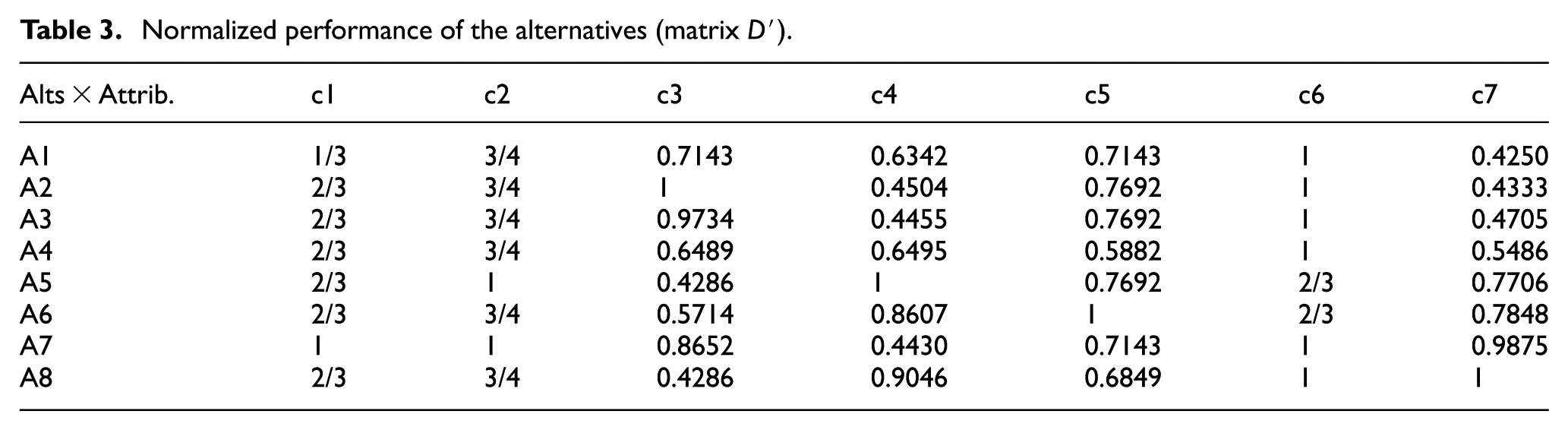
Normalizing the decision matrix (D in Table 1) using the maximal value of a column as the pivot for a TMTB attribute and using the minimal value as the pivot for a TLTB attribute, the normalized decision matrix, D′, is obtained, as shown in Table 3.
Normalized performance of the alternatives (matrix D′).
Calculating the alternative selection attribute matrices using GTMA
For every alternative (i.e. A i , i = 1.8), by replacing the diagonal axis of B (the 1 s) with its normalized attribute values from D′ (i.e. the elements in the ith row of D′), we obtain the alternative selection attribute matrix (ASAM), Ci, for this alternative. By calculating the permanent value of square matrix Ci, the ‘index score’ for this alternative is obtained. By computing this for every alternative i, all the index scores can be obtained so that the final rank order can be obtained on a ‘higher score is preferred’ basis. For example, Table 4 shows the values in square matrix C1 and its permanent value. The calculations for the rest 7 ASAMs are omitted here for space reason.
Alternative selection attribute matrix for alternative A1 (matrix C1).
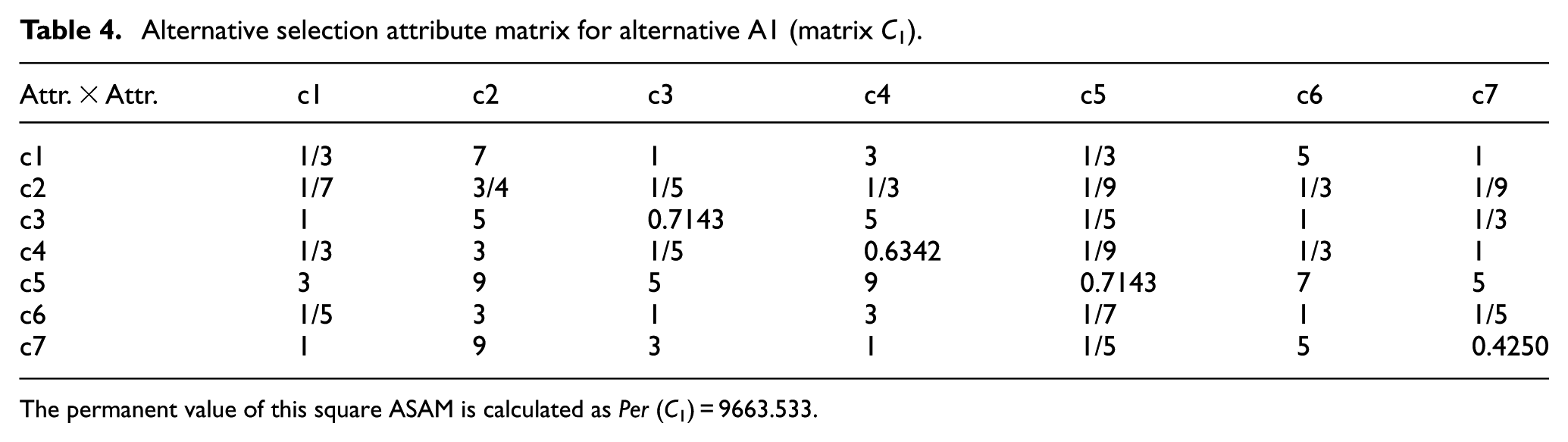
The permanent value of this square ASAM is calculated as Per (C1) = 9663.533.
An extension discussion about the abovementioned ‘permanent value’ is present here. The permanent value of a square matrix is defined as the sum of products of (all) sets of matrix elements that appear in distinct rows and columns. For example, all elements appear in the diagonal axis of a matrix is one of the ‘sets’. For clarify, it is neither the ‘determinant value’ nor the ‘permutation matrix’. The latter is ‘a matrix’ in the intrinsic and thus not ‘a value’, while the former is a value but the calculation of it involves + and − sign flip-flops of the product terms to be summed, and the sign of a product term of a set depends on the parity of the set. For example, the permanent value of a 3 × 3 square matrix, K, is calculated intuitively as follows

where there are 6 such sets and 6 product terms to be summed.
The above scenario can be generalized to any square matrix. However, as can be imagined, for a square matrix with a higher degree, enumerating all the sets should be a cumbersome work, and therefore it is required to decompose the permanent value determination problem into smaller pieces, conquer the sub-problems and aggregate the results from solving the sub-problems. Fortunately, the decomposition method used to develop a determinant of a square matrix along a row or a column is also valid for calculating the permanent value. Taking the above square matrix K as an example, this decomposition method may apply along the first column of K as follows
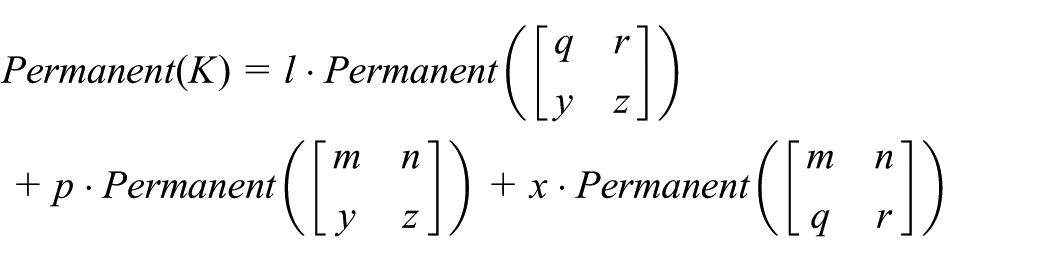
This form of calculation is exactly the ‘dynamic programming like’ implementation taken by this study to calculate the permanent values for the ASAMs.
For our case, calculations to obtain the permanent values are done with R with self-written codes because in R, unlike to calculate the determinant value for a square matrix where the sign matters, the calculation of permanent value is not supported by the default packages. The R program is written in a ‘dynamic programming like’ manner. That is, an R function, named as per3(), to obtain the permanent value of a 3 × 3 matrix is written at first. Then, this function is used as the basic block of the per4() function, which calculates the permanent value of a 4 × 4 matrix. These can support the permanent value functions for higher dimensional matrices, for example, per5(), per6() and per7(). The above logic can be illustrated by the following R logic
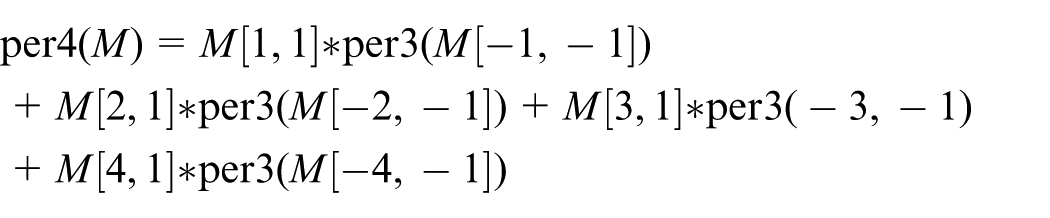
where M is a 4 × 4 numerical matrix and per3() is an existing function.
Ranking the alternatives according to the permanent values of the ASAMs
In the former phase, the index score for each alternative is assessed by calculating the permanent value of the alternative’s ASAM. Given these permanent values (Per(Ci), for i = 1.8), the priority rank of the alternatives is determined.
In the studied case, since every alternative’s ASAM has a dimension of 7 × 7, per7() is called, and the square matrices C1, C2, C3, …, C7, one by one, serves as the function parameter M. According to these calculations, the index scores for the 8 assessed paper shredder alternatives are obtained. These scores, together with the alternatives, are ranked in Table 5.
The index scores assessed for the alternatives.
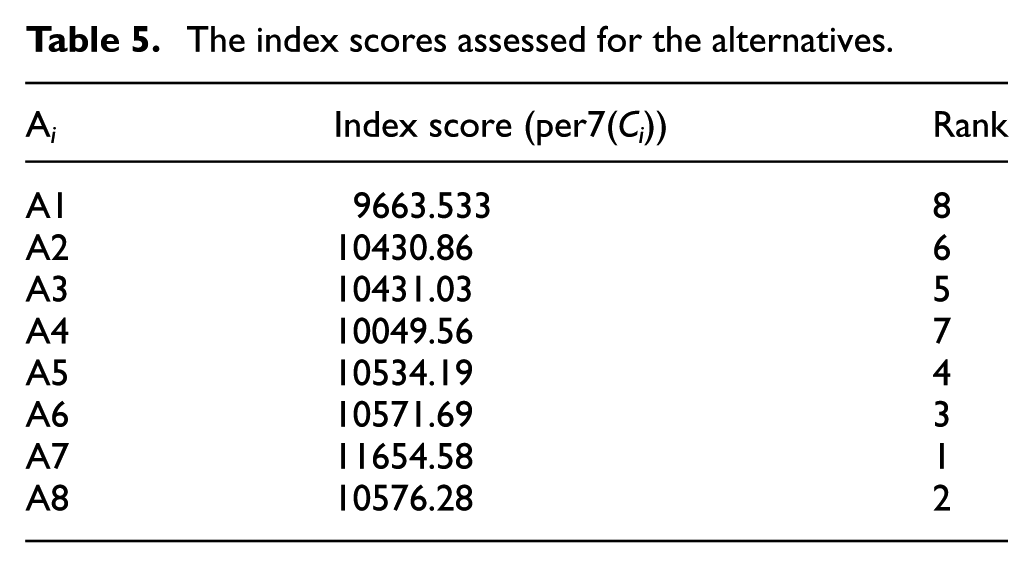
Such an outcome reveals that the preferential order justified based on synergizing both the data profiles for the 8 alternatives from the heterogeneous data sources and the priority weights for the 7 criteria in the DM’s mind, is

The consistency analysis
Consistency analysis is an important part of AHP calculations which is to check whether the opinion in the expert questionnaire answered by the DM is consistent or not. The consistency of an expert questionnaire which has been surveyed can be checked through the transitive logic according to the following theoretical aspect of decision-making theory:
If the DM states that
For more theoretical details about consistency analysis, please refer previous studies.13,36,37 In this study, we follow the standard process (i.e. the eigenvector method) to check the consistency of matrix B in Table 2, as developed and proved by Prof. Saaty. 38 At first, we compute the consistency index (CI) of the pairwise comparison matrix. To do so, initially, a 1 × 7 column summation vector (CSV) is obtained by summing the columns in Table 2, whose value is as the following

Dividing back this vector to Table 2 column wisely using each associate element in CSV as the divisor, a temporary weight matrix T is obtained, as shown in Table 6.
Temporary weight matrix (matrix T) and the assessed criteria weight vector.

By summing the rows of T, the value of the CWV is assessed, which is shown in the rightist column of the table. Anyhow, the above process details the exact determination process of CWV as presented in subsection ‘Obtaining the criteria weight vector using AHP’.
Then, the step that follows is to identify the largest eigenvalue of matrix B (λmax). This can be done first by a column-wise multiplication, that is, by multiplying each column of B with the associated element in CWVtr (the transpose vector of CWV). For our case, this matrix, U, is obtained as shown in Table 7, with a row-sums vector obtained in the rightist column. This row-sums vector is sometimes called ‘weighted sum vector’ (WSV). The above process is as what one might have done using the simple-additive-weighting (SAW) method to score the alternatives. But here, the things to evaluate are the criteria.
Matrix U and the row-sums vector.

By dividing each row-summed values in the 7 × 1 WSV with the corresponding element in the 7 × 1 CWV, we can obtain a consistency vector (CV) as follows

By calculating the mean value of CV, the largest eigenvalue value for matrix B is obtained as λmax = 7.9050. And following this, since the problem size is N = 7 (#attributes), the CI of the matrix can be calculated according to the following formulae

Under the given problem size that N = 7, the random index (RI) is looked up as

Therefore, the CR of the pairwise comparison information carried by the given matrix B is determined as follows

The CR value computed here is acceptable to justify matrix B as consistent. This will be discussed at the beginning of the next section.
Discussion
In the experiment (section ‘The consistency analysis’), the pairwise comparison matrix for the involved criteria yields CR = 0.1117. As the value of CR is in fact an ‘inconsistent ratio’ that is to indicate how inconsistent the pairwise comparison matrix is away from the ideal status (where all pairs of comparison strictly followed transitivity and thus CR approaches 0) under the given matrix degree. This is because since the threshold to justify as consistent was 0.1 (as suggested by Saaty 38 ), but in some practical studies it was set as 0.2,37,39 the outcome here is ‘0.1 < CR < 0.2’ and the value of CR merely surpasses 0.1 slightly by 0.0117. Based on these facts, the consistency should be acceptable.
For the reason why the value of CR is slightly larger than 0.10 but in fact the DM have been interviewed twice, maybe this is because for humans (and the DM is human), it is (often) not easy to compare 7 items pair-wisely in a shot, as 7 have reached the range of ‘unlucky numbers’ (7 ± 2) of any AHP-style investigation.34,35 For this matter, some further studies can be conducted to solidify the results (e.g. to totally and strictly pass the CR check according to the threshold defined by Saaty, instead of ‘approximately passed’).
Another important finding of this study is about the assessed value of CWV, wherein as can be observed, the DM has paid considerable attention to the noise level of a shredder, which is more than two times than its price, the second important criterion. After a re-consultation with the DM, who serves at the middle-large connector manufacturer company in Taiwan, the answer becomes clear. The pairwise comparison data set presented in Table 2 was mined from her and sorted out from the AHP-style expert questionnaire data. According to the re-consultation, the main reason for her to address the importance of noise level was that (as expressed) all they want is a quiet environment in the office for quality working. In particular, she also addressed that this is very important to keep the occupational health of people who are working in the personnel, accounting/financing and the research/development departments. The shredders purchased previously were too noisy, or had become noisier as the days went by, to meet such a requirement. The procurement was to be launched to purchase a new batch of shredders, and the noise level should be put into consideration at the first place. Next, the reason for her to address more importance for noise level than price was that in most of their procurement cases, the annual total budget to upgrade the office facilities and accessories had been allocated. So for them, upgrading the paper shredders is a continuous improvement work year by year, and therefore, the unit price is not as important as the most important key function watched according to the employee complaints. However, as can be seen from the results, the unit price is just not as important as noise level. Relative to other five considered criteria, it is still the most important one. Anyhow, the abovementioned not only implies that the assessed CWV should be reflexive to the DM’s mind (in addition to its validity as inferred to by the consistency analysis), but also cannot violate with the context of any commercial decision, in which cost should be always one of the important issues, even it is justified merely as the second important factor as in the studied decision case.
According to the common logic of recursive implementations of dynamic programming problem (as it is also supported by R), theoretically, the algorithm for per4() in section ‘Calculating the ASAMs using GTMA’ can be extended as a recursive function: per(M,n), where n > 3 is the dimension of square matrix M, and the function should decompose M into n submatrices (while the order of each of which is (n − 1)) and call the per() function again to compute the permanent values for these submatrices individually. And, the algorithm should have a boundary condition to return when n = 3.
From the final results in section ‘Ranking the alternatives according to the permanent values of the ASAMs’, A7 should be the best paper shredder which the DM can suggest to launch the mass procurement process. However, the relatively small gap among the assessed index scores shown in Table 5 just reflected that ‘how confounded the DM is’ on making such a selection decision. The reasons for this can be summarized here:
There are too many available shredder products in the market, but for the company it is to choose one from these many, as to launch the mass procurement process;
There are so many conflicting criteria (attributes of the paper shredders) to be considered during the purchase, and more critically, some of which are TLTB, while others are TMTB;
Following (1), in the market the paper shredder alternatives are very competitive to each other, as shown by the small gap among the index scores assessed in Table 5;
More critically, Table 5 shows that two pairs of index scores are very close (i.e. the (A2, A3) and the (A6, A8) pairs, and the gaps are both <5/10,000), which means that they should be treated as indifferent in the final rank order and this further implies the unforeseen (and difficult) trade-offs in the decision.
Finally, it is worthwhile to mention something about decision case modelling itself. As discussed previously (in the first paragraph of this section), although the final CR just surpasses 0.1 a little, the DM has suffered from the problem of being hard to pairwise justify the relative importance between two criteria, given a total number of 7. Consider the case now that the DM is asked to pairwise compare the 8, rather than (and greater than) 7, alternatives in terms of some specified attribute, can he/she successfully compare them? The answer is still ‘probably yes’ but as can be imagined, several rounds of AHP-style re-investigation should be required to pass the CR check. Moreover, if the data set is not the reduced version (where in the example, the possible alternatives are reduced to 8 by a suitable data preprocessing), but the original data set which contains 26 shredders, can the DM still feel okay to compare them? The answer should be ‘definitely no’.
From this observation, for the decision case where the alternative dimension is high, it should be obvious that the second stage of traditional AHP (i.e. pairwise comparisons to justify the priority of the alternatives on each criterion) is not a suitable way. But as the usual purchase decision like the one supported by this study usually involves no more than 7 criteria, so the first stage of AHP (i.e. pairwise comparisons to justify the priority of the considered criteria) is still suitable because it better supports the ‘mind mining’ process. Because of the strong evidence that AHP has successfully supported the ‘mind mining’ processes for countless DMs during these decades, the first stage of AHP should be irreplaceable. However, one may raise the question that ‘what if the number of criteria is over 7 when assessing the CWV’? And in this case, should he/she remain using AHP? The answer should still be ‘yes’. In such a case, the more-than-7 criteria can be categorized into less-than-7 constructs and they can become subcriteria under which, and then the first stage of AHP still takes place but is performed more than once because the factors are re-organized as more than one layer. This is not similar to some other fields. In some fields, researchers do find that increasing factors is helpful for increasing prediction accuracy (such as the field of machine learning, theoretically), while in some fields researchers are always trying to eliminate unnecessary factors to make the model ‘more correct’ (such as the field of Statistics). However, in operational research (OR), the determination of the set of criteria (factors) always depends on the decision context that the DM is facing with. In other words, instead of increasing or decreasing the factors and then watching the results (as what is done in other fields), re-organizing the factors should be the main task, while appropriate.
Conclusion
This work applies the AHP-GTMA (AHGTMA) approach to support the decision pertaining to the selection of a single type of paper shredder, for the company to launch a mass procurement process. Real data of the shredders (alternatives), which are required by GTMA modelling, are collected from heterogeneous data sources, as to have the normalized performance vector of each alternative. Data about the considered criteria, which are also required by GTMA modelling, are polled using the first stage of AHP survey, as also to have the CWV. And the square pairwise comparison matrix, in itself, serves as the base matrix to generate the ASAMs for all the alternatives. In other words, by taking the AHP-GTMA approach, this MADM work not only utilizes data from ‘data mining’, but also from ‘mind mining’.
Paper has been, and still is (even in this big data age when the Internet is now abundant with digital data) a main information carrier all over the world since invented centuries ago, and the material engineering of it has never stopped. But apart from paper itself, issues about paper shredder, which is a main tool nowadays to recycle the papers, are worth of study. In this sense, this study not only widens the application scenario of the AHP-GTMA method, but also provides decision supports to the encountered practical paper shredder-selection problem, which should have not been systematically and scientifically supported yet. The R-based algorithm for implementing the latter stage of the method (i.e. implementing the Per() function to assess the index score for each alternative given its ASAM in terms of the dynamic programming concept) is perhaps another contributing work of this study.
Future works can be many folds. At first, enforcing using the second stage of AHP (for the studied case, let the DM do pairwise comparisons for the 8 alternatives based on each of the 7 criteria) should be a good trial, and the result should be interesting. Next, for the same decision problem, introducing other MADM methods which also incorporated AHP as their first stage process to obtain the CWV (e.g. AHP-TOPSIS, AHP-SAW, etc.) and comparing the results should be the other challenging but interesting task. Third, enhancing the implementation of the AHP-GTMA solving algorithm presented in this study (e.g. a general function for AHP-GTMA model solution) is another challenging issue, while a DSS software product can be further expected. Finally, as this study uses the procurement case on the buyer side and the results have also implied something for the industrial design of paper shredders, perhaps in the future the optimization model to assist the design process of shredders can be studied on the manufacturer side.
Footnotes
Appendix 1
The alternative reduction process is mainly based on the consideration of future maintenance convenience and an important data preprocessing concept in data analytics, which is the ‘complete case study’ method, whereby taking this method a case will be excluded from the statistical analysis if it has missing data for any of the variables. In our case, such a preprocess is tantamount to in the reduction process a shredder alternative should be excluded if it has missing data for any of the attributes, and here these ‘attributes’ should also include those which are not considered during the decision but are required to launch the mass procurement, for example, width of the paper feed (throat width) and the gross weight. Besides, it is required by the bid spec that there must be formal domestic agencies for the brand, and the purchased shredder can shred at least one extra material type in addition to paper. In the source data set, there is no local agency for 8 of the 26 shredders, and among the rest 18, 4 shredders lack of the gross weight data, 7 shredders do not show the ability to shred any other materials than paper, while 1 lack of the data of noise level. During the preprocess, the latter three missing-value filters had overlapped so there were totally 10 shredders removed from the rest 18. As a result, only 8 alternatives are kept in the list.
Acknowledgements
Prof. Dr Chih-Yung Chen proposed the research idea, conceived the experiments and sourced the data (of the alternatives); Dr Zheng-Yun Zhuang designed the experiment flow, performed the experiments and wrote the paper; Prof. Dr I-Jen Chiang evaluated the programming languages and directed the implementation process of the GTMA; Ph.D. Candidate Chia-Rong Su contributed in the AHP survey and its data preprocessing, and a part of the literature study works.
Handling Editor: Stephen D. Prior
Declaration of conflicting interests
The author(s) declared no potential conflicts of interest with respect to the research, authorship, and/or publication of this article.
Funding
The author(s) disclosed receipt of the following financial support for the research, authorship, and/or publication of this article: The funding supports of the study are disclosed as follows: TMU Research Project, Taipei Medical University: TMU105-AE1-B46 (received funds for covering the costs to publish in open access), Ministry of Science and Technology, Taiwan (ROC): MOST106-2410-H-038-001.