




Abstract
In engineering design, structural components with variable cross sections are extensively employed due to their excellent mechanical properties. From a strength and stiffness perspective, structural components with a uniform cross section are not always ideal. Therefore, to effectively utilize material, variable cross section structural components with excellent properties such as high strength and stiffness are employed in many practical engineering applications. As a multi-dimensional function is required to describe the state of a variable cross section structural component, determining the locations of its dangerous cross sections is very difficult. As a result, the development of a reliability-based design for a variable cross section structural component is a complex process. Therefore, strict theoretical derivations and reasonable quantitative research are required to understand the variation pattern of the reliability of the variable cross section structural component with the coordinates to determine the locations of its dangerous cross sections. This article presents a reliability sensitivity analysis with limited probabilistic information and a reliability-based robust design variable cross section structural component. Mathematical models for reliability sensitivity analysis and reliability-based robust design of variable cross section structural components with incomplete probabilistic information are established. Reliability sensitivity analysis and reliability-based robust design methods for variable cross section structural components with non-normally distributed parameters are proposed. The article provides the changing condition of the reliability with respect to the variable cross section, describes the change rule of reliability with respect to design parameters, and provides the multi-objective optimal design model based on reliability sensitivity. The reliability index obtained using the presented method is insensitive and therefore robust. Using a numerical example, the variation curves of the reliability index and reliability of a variable cross section structural component with coordinates of variable cross section are obtained. A reliability-based robust optimal design approach for variable cross section structural components for given design reliability index conditions is provided.
Keywords
Introduction
In engineering design, structural components with a variable cross section (VCS structural components) are extensively employed due to their excellent mechanical properties, for example, VCS beams, which are employed in large numbers in construction engineering applications (Figure 1), and VCS parts, which are extensively employed in mechanical equipment (Figure 2). VCS structural components are ubiquitous in everyday life and practical engineering applications. Lightweight, low-cost, and high-performance VCS structural components are employed in large numbers in fields such as aerospace, mechanical machinery, and civil engineering. An ideal structural component should have large cross sections at locations where large bending moments and deformation occur and small cross sections at locations where small bending moments and deformation occur. Consequently, an ideal structural component has a cross section that varies in size along with its length and excellent properties (e.g. high strength and stiffness). Thus, the use of VCS structural components can facilitate material saving, weight and cost reduction, and performance enhancement. Therefore, investigating reliability and reliability sensitivity problems concerning VCS structural components has application and academic values.
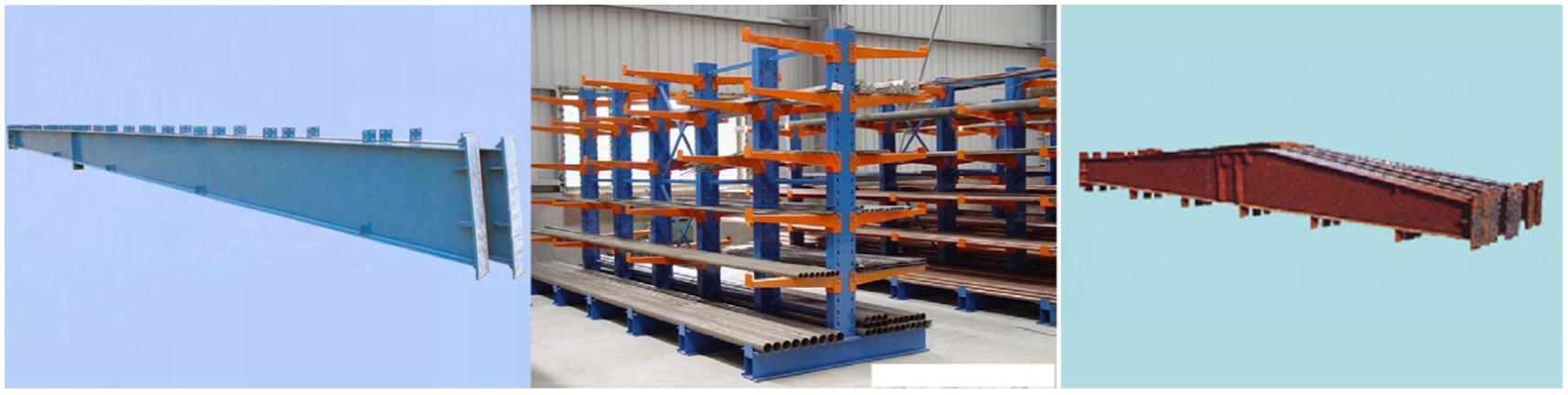
VCS steel beam.
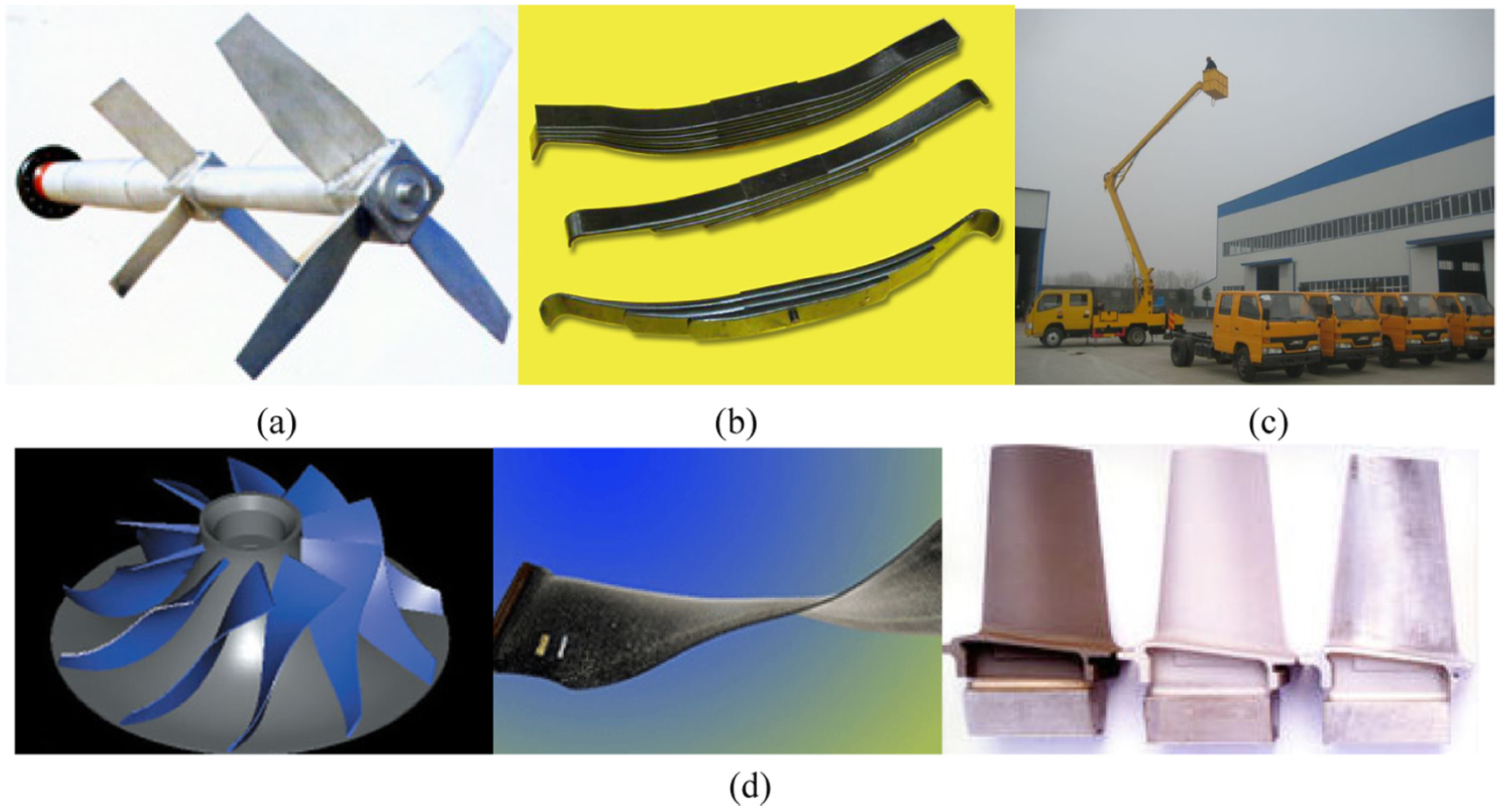
VCS parts: (a) VCS stirring blade, (b) VCS leaf spring, (c) VCS composite box beam, and (d) VCS blade.
Reliability, which is an important structure quality index, is garnering increasing attention from engineering industries. Of the three stages (design, production, and application), modern production practice demonstrates that design determines the reliability level of a structural component (i.e. inherent reliability of a structural component), and production and application ensure the realization of the reliability index β of the structural component. Numerous excellent results have been achieved using reliability analysis and reliability-based design methods based on probability and statistics.1–11
As different factors affect the reliability of a structural component to varying degrees, the reliability sensitivity of the structural component should be sufficiently analyzed. Using a reliability sensitivity analysis, the impact of the variations in the design parameters on the reliability of a structural component can be evaluated, which reveals the level of impact of each design parameter on the reliability of the structural component, that is, sensitivity.12–15
For a structural reliability-based robust design, reliability sensitivity is included in an optimal design model based on a reliability-based design, an optimal design, a sensitivity-based design, and a robust design, and the reliability-based robust design is converted to a multi-objective optimal design that satisfies the reliability requirements. As a low-cost, high-reliability design concept and method,16–22 Lagaros et al. 23 implemented a combined reliability-based robust design optimization (RRDO) formulation. Yadav et al. 24 established new and effective techniques and tools to ensure a robust and reliable product design. Wang et al. 25 proposed a unified framework for integrating reliability-based design and robust design. Wang et al. 26 attempts to integrate reliability, maintenance, and warranty during reliability-based design. Martowicz and Uhl 27 discussed the applicability of a reliability- and performance-based multi-criteria robust design optimization technique for micro-electromechanical systems. Yu et al. 28 proposed in their work a reliability-based robust design optimization framework dedicated to the tuned mass damper in passive vibration control. Paiva et al. 29 outlined an architecture for simultaneous analysis and calculation of robustness and reliability in aircraft wing design optimization. Wang et al. 30 presented a new approach to efficiently carry out dynamic reliability analysis for RRDO. Qui et al. 31 proposed a reliability-based robust design approach on the basis of axiomatic theory, aiming at actualizing a reliability-based robust design framework for mechanism motion.
Many researches based on VCS have been reported. Boiangiu et al. 32 provided differential equations for free bending vibrations of straight beams with VCS using Bessel’s functions. Kang et al. 33 investigated the methodology to enhance hydroformability of non-axisymmetric thin-wall tubular component with VCS. Li et al. 34 provided a transfer matrix method used to predict the transmission loss of apertures assuming that the cross-sectional dimensions are small compared to an acoustic wavelength. Jun et al. 35 studied a flexible extrusion process which involves extruding the materials via one fixed and one movable die.
Currently, most reliability analysis techniques for VCS structural components in mechanical equipment are developed based on accumulated experience or experiments. The failure mechanisms of VCS structural components have not been completely revealed, and reliability-based design models for VCS structural components have not been clearly established; consequently, the available reliability-based design models lack ideal accuracy and precision. Currently, research on reliability-based design of VCS structural components is in the early stage, and no research has been conducted on reliability sensitivity analysis and reliability-based robust design of VCS structural components.
In this study, based on preliminary theoretical research on structural reliability, a reliability sensitivity analysis is performed on VCS structural components, and a reliability-based robust design is developed with incomplete probabilistic information using theoretical methods such as structural reliability-based design, reliability sensitivity analysis, and reliability-based robust design. In addition, a reliability sensitivity analysis is performed on VCS structural components with non-normally distributed parameters, and a reliability-based robust design is developed for these structural components using modern mathematical and mechanical theories and methods, such as probability and statistics theory, stochastic perturbation technique, higher-order moment method, reliability-based design technique, sensitivity theory, and robust design method. Engineering reliability sensitivity analysis and reliability-based robust design methods for VCS structural components using limited probabilistic information are proposed. The problem of whether the reliability of VCS structural components is sensitive to the design parameters is discussed. For the condition in which the probabilistic characteristics of the basic random variables are known, information that relates to the reliability sensitivity analysis and reliability-based robust design of a VCS structural component can be rapidly and accurately obtained.
Reliability analysis method
One goal of structural reliability analysis is to determine the reliability of the system

where f

where r represents the strength of the material; Sz represents the stress of the VCS structural component that varies with z; and

The first four moments of gz(




where ⊗ represents the Kronecker product, and
When the first two moments of the basic random parameters of the structural component (

When

where Φ(·) represents a standard normal distribution function.
When


where
When the distribution of

Thus, the reliability of the structural component is obtained; in addition, a reliability analysis can be performed on the structural component and a reliability-based design can be developed.
Reliability sensitivity analysis
When the first four moments of


where

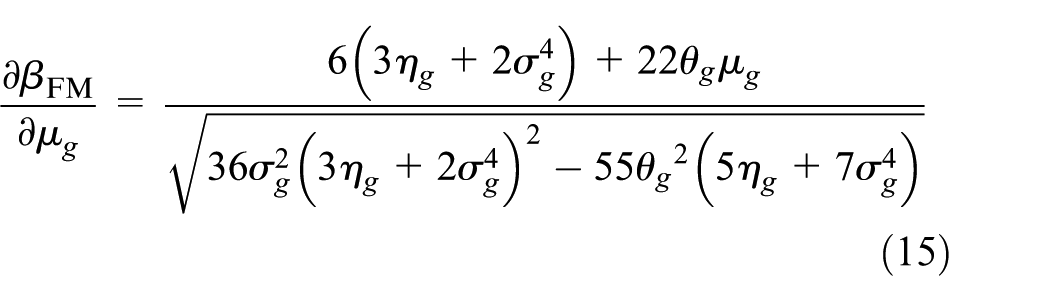


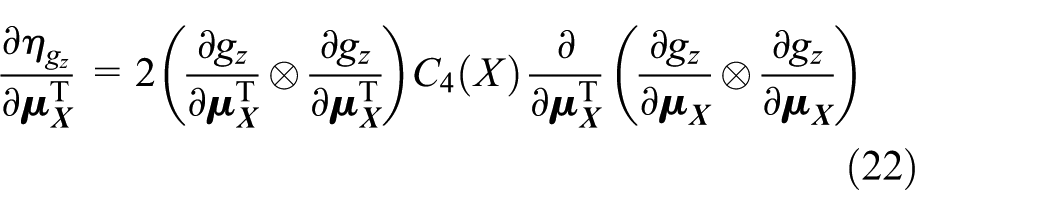
If the first-order mean value of the Taylor series expansion of g(


where φ(·) represents a standard normal probability density function. The known condition and the results of the calculation of relevant data and reliability are combined and substituted into the equations for the reliability sensitivity of a structural component (equations (12) and (13)). Thus, information that relates to the reliability sensitivity (i.e.
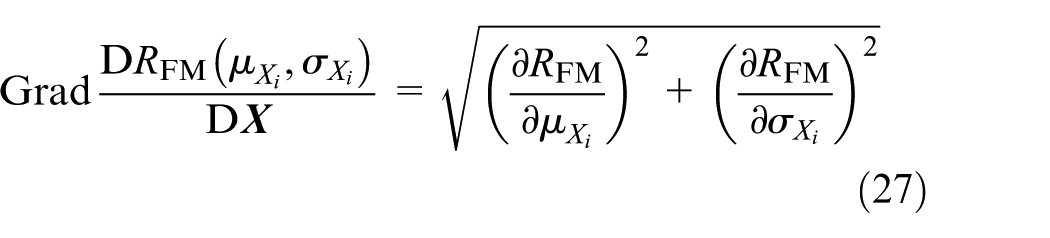
Reliability sensitivity is used to evaluate the level of impact of a certain factor on the reliability of a structural component. To uniformly describe the level of impact of various factors on the reliability of a structural component, the reliability variation gradient at the nominal point is generally selected as the sensitivity factor. Therefore, the reliability sensitivity gradient can be expressed as follows
Reliability-based robust design
Structural reliability-based robust optimal design can be expressed using the following mathematical model
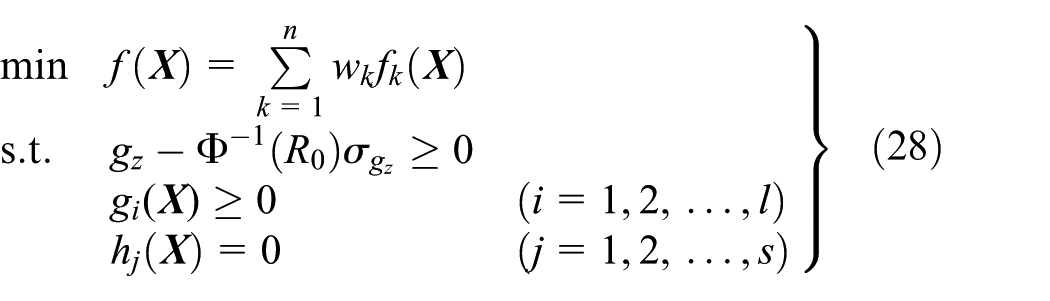
where R0 represents the reliability specified in the design requirements;

Numerical example
Figure 3 shows a tapered beam under a vertical pressure. Each geometric cross-sectional parameter can be considered to independently follow a normal distribution. The mean and variance of the tapered beam parameters are as follows: cross-sectional thickness b = (12, 0.06) mm; free-end height a = (18, 0.09) mm; slope of the tapered beam α = arctan(0.12, 0.006); and length of the tapered beam l = (500, 2.5) mm. The probability distributions of the load and the strength parameter are unknown; however, the first four moments of the load and the strength parameter are known. The first four moments of the load borne by the beam P = 3400 N, 170 N, 7.3756 × 10⁵ N3, 2.539 × 10⁹ N4 and the first four moments of the tensile strength of the material r = 221 MPa, 11.05 MPa, 2.0255 × 10² MPa3, 4.532 × 10⁴ MPa4. Here, a reliability sensitivity analysis is performed on this structural component, and a reliability-based robust design is developed for this structural component.

Actual structural and mechanical model of a cantilever bracket.
Reliability analysis of the tapered beam
Structural brackets and various types of bases are often involved in structural design. These structures are generally composed of shaped steel bars, plates, and some prefabricated structural components to satisfy the mechanical strength, stiffness, and appearance requirements. The bending stress of a tapered beam at any arbitrary cross section z is

Transversal force-caused bending is common in engineering structures. As the ratio of beam span and cross-sectional height is n ≥ 5, the shear stress resulting from the load is not considered. According to the stress–strength interference theory, the state equation expressed with the ultimate stress state is expressed as follows

where r represents the material strength of the tapered beam;
Volume (V) is one of the important reference values for the reliability-based design of a tapered beam and is a main target for a lightweight design. The selected tapered beam has a V of

The first four moments of the state function of the VCS structural component are determined by substituting the known condition and relevant data into the expressions of the first four moments of the state function of a VCS structural component (equations (4)–(7)). Then, a reliability analysis and calculation are performed by substituting the known condition and relevant data into the equations for βFM (equation (10)) and RFM (equation (11)). By substituting the known condition, βFM and RFM curves with respect to z are obtained by calculation, as shown in Figure 4.

Reliability curves of the tapered beam.
As demonstrated in Figure 4, the βFM and RFM curves of the tapered beam exhibit a parabolic shape. The βFM and RFM of the tapered beam vary with z. The minimum βFM and RFM occur near 0.345 m, that is, the cross section at z = 345 mm is a dangerous cross section. Thus, when developing a reliability-based design for a VCS structural component, balanced reliability should be effectively ensured based on the reliability analysis results.
Based on the equations for the βFM (equation (10)), RFM (equation (11)), and V (equation (32)) of a VCS structural component, the V, βFM, and RFM of the tapered beam at the dangerous cross section are
V 0 = 288 mm3
β FM = 1.36064
R FM = 0.91319
The reliability of the VCS structural component is also calculated by simulation using the Monte Carlo method, and the result, which is denoted by RMC, is
R MC = 0.90605
where RMC represents the reliability obtained from the numerical simulation based on 105 samples using the Monte Carlo method. The calculation results demonstrate that the results obtained using the proposed method are consistent with the results obtained from the numerical simulation using the Monte Carlo method.38–43
Reliability sensitivity analysis of the tapered beam
A reliability sensitivity analysis of the tapered beam is performed via calculation by substituting the known condition and relevant data into the expressions of the sensitivity of RFM of a structural component (equations (12) and (13)). The data in Table 1 list the values of the reliability sensitivity of the structural component with non-normally distributed parameters to
Reliability sensitivity to µX and σX before optimization.

The reliability sensitivity analysis demonstrates that the reliability sensitivity of the entire tapered beam to each
Reliability-based robust design for the tapered beam
A reliability-based robust optimal design that satisfies the design reliability requirement (R0 = 0.99) and minimizes the weight of the tapered VCS beam is developed.
Determining design variables
By analyzing the main parameters that affect the reliability of the tapered beam, three parameters, namely, a, b, and tanα, are selected as the design variables when developing a reliability-based robust optimal design model. Thus, the design variable vectors are x = [a b tanα]T.
Establishing objective functions
The weight of the tapered beam can be minimized by minimizing its V. Therefore, the first optimization objective of the reliability-based robust optimal design is

To eliminate the reliability sensitivity of the tapered beam to the design parameters (i.e. to enable the tapered beam to be robust), the sensitivity function of the reliability constraint to the design parameters is selected as the second optimization objective of the reliability-based robust optimal design, that is

Establishing constraint conditions
The tapered beam needs to satisfy certain reliability requirements. Thus, we have the following reliability constraint condition

The geometric dimensions of the tapered beam also need to satisfy certain design conditions. Thus, we have the following inequality constraint conditions



Reliability-based robust optimal design
The design values of the parameters are selected as the initial values for optimization: x = [a b tanα] = [0.019822, 0.010452, 0.14787]. The parameters obtained from reliability-based robust optimization are as follows
V = 293.36 mm3
a = 19.822 mm
b = 10.452 mm
tanα = 0.1479
The βFM and RFM of the tapered beam after optimization are
β FM = 3.4010
R FM = 0.99966
The calculation results are as follows. (1) RFM = 0.99966 satisfies the reliability-based robust optimal design requirement for the reliability of the tapered beam, that is, R0 = 0.99. (2) R0 is considerably higher than the initial reliability (RFM = 0.91319), and the V of the tapered beam is correspondingly increased by ΔV = V − V0 = 293.36 mm3 − 288 mm3 = 5.36 mm3. This finding demonstrates that the reliability-based robust design reaches the VCS structural component design goal—balanced reliability—and that the reliability theory and technique are effective and practical lightweight techniques.
Figure 5 shows the variation curve of the RFM of the tapered beam with z after optimization. Compared to the RFM shown in Figure 4, the RFM of the tapered beam is significantly higher after optimization.

βFM and RFM curves after optimization.
A comparison of RFM before and after the reliability-based robust optimal design indicates that the numerical value of RFM significantly increases, and the range within which RFM varies also significantly decreases after optimization, which demonstrates that the reliability-based robust optimal design method is effective and can produce a balanced result. Therefore, research on the reliability of a VCS structural component can ensure the reliability level, reflect the actual condition of the VCS structural component, and ensure that the design working performance of the VCS structural component is more consistent with its actual working performance. Research on the reliability of a VCS structural component can facilitate the development of a lightweight design, ensure that the working performance and parameters of the VCS structural component are optimal, and help reach design goals, such as weight reduction, efficiency enhancement, energy saving, environmental protection, performance enhancement, and a safe and reliable design.
The values of x = [a b tanα]T after the reliability-based robust design (a = 19.822 mm, b = 10.452 mm, and tanα = 0.1479) are selected for a reliability sensitivity analysis. Table 2 lists the values of the reliability sensitivity of the VCS structural component to
Reliability sensitivity to µX and σX after optimization.

The reliability sensitivity analysis results obtained before and after the reliability-based robust optimal design indicate that the numerical value of the reliability sensitivity significantly decreases after the reliability-based robust optimal design, which ensures stable reliability and eliminates the reliability sensitivity of the VCS structural component to the design parameters for interference factors, enhances the safety, reliability, and robustness of the VCS structural component, and attains the reliability-based robust design goals and effect.
The reliability sensitivity of the tapered beam at any arbitrary location can be calculated using equations (12) and (13). The RFM sensitivity gradient of the tapered beam at any arbitrary location can be calculated using the expression of the RFM sensitivity gradient of a structural component (equation (27)). Figure 6 shows the variation curves of the RFM sensitivity gradient of the VCS structural component with z plotted based on the variation patterns of the mean value and mean square error of the reliability sensitivity of the VCS structural component with z.

Variation curves of the RFM sensitivity gradient with z: (a) variation curve of the RFM sensitivity gradient before optimization and (b) variation curve of the RFM sensitivity gradient after optimization.
The previously mentioned calculation results demonstrate the following conclusions. (1) The higher the RFM of the VCS structural component RFM = Φ(βFM), the gentler the variation curve of RFM with z, and the smaller the numerical value of the RFM sensitivity gradient, that is, the lower the sensitivity of RFM of the VCS structural component to variations in the design parameters (the more robust the VCS structural component). (2) The numerical value of the RFM sensitivity gradient significantly decreases after the reliability-based robust optimal design. This finding demonstrates that the reliability-based robust optimal design yields notable results, and the reliability-based robust optimal design method is effective and practical.
Figure 7 shows the comparison of the reliability sensitivity to the mean values of

Reliability sensitivity to the mean value of x.
Figure 7 demonstrates the following results. (1) The RFM of the VCS structural component varies with the design parameters. A change in b will have the most significant impact on the RFM of the VCS structural component, followed by a and α. Therefore, variations in the sensitive parameters should be strictly controlled when designing the shape and dimensions of the VCS structural component. (2) The numerical values of the reliability sensitivity to
Conclusion
In structural design, the reliability-based robust optimal design method can be employed to ensure that the reliability of the design structure is stable when the design parameters undergo variations (i.e. eliminated reliability sensitivity of the structure to the design parameters). By doing so, the objectives of satisfying the reliability requirements and reducing cost can be achieved. In this article, the reliability-based design method is combined with the robust design theory, the function of reliability sensitivity is included in the objective function of the reliability-based optimal design model, and reliability-based robust optimal design is converted to a multi-objective optimization problem that satisfies the reliability requirements. Based on this idea, mathematical models for reliability sensitivity analysis and reliability-based robust optimal design of VCS structural components are established. Reliability sensitivity analysis and reliability-based robust optimal design theories and methods for VCS structural components are proposed. A case study is conducted to illustrate the proposed method. In the case study, an in-depth reliability sensitivity analysis is performed on a VCS tapered beam, and a reliability-based robust design is also developed for this tapered beam. Ideal analysis and design results are obtained, which forms a solid foundation for the reliability sensitivity analysis and reliability-based robust design of VCS structural components in practical engineering applications.
Footnotes
Handling Editor: Shun-Peng Zhu
Declaration of conflicting interests
The author(s) declared no potential conflicts of interest with respect to the research, authorship, and/or publication of this article.
Funding
The author(s) received no financial support for the research, authorship, and/or publication of this article.