




Abstract
In this study, the transport of Al2O3 nanoparticles in ethylene glycol conventional fluid over a linearly stretching cylinder is investigated. The current research employs a convective surface boundary condition for heat transfer exploration. Flux model proposed by Rosseland is employed to examine effect of thermal radiations. The governing flow problem comprises highly nonlinear ordinary differential equations. Similarity transformations are used to reduce the equations in similar forms, which are then solved by Runge–Kutta–Fehlberg fourth-fifth order numerical scheme with shooting algorithm in MATLAB software. In order to authenticate the accuracy of our results, we have contrasted results with those obtained by Ishak et al., Wang, and Pandey and Kumar and found that they are in better concord, as revealed in Table 2. The impact of numerous emerging parameters on velocity distribution and heat transfer distribution are argued in all aspects and depicted through graphs.
Introduction
The terminology of “nanofluid” invented by Choi and Eastman 1 describes engineered colloids incorporating a conventional liquid (e.g. air, water, oil and ethylene glycol (EG)) and nanoparticles. Later, Buongiorno 2 offered a new model to examine heat transfer properties of conventional fluid. In this model, impact of Brownian motion and thermophoretic are considered. Nanofluids typically employ metals, metal oxides, carbides, or carbon nanotubes nanoparticles, and the conventional fluid includes EG, kerosene oil, and water. To evaluate heat transfer enhancements, nanofluid usually contains nanoparticles (e.g. gold, copper, titanium and aluminum) volume fraction up to 5%. In the past few years, hydromagnetic transport of nanoparticles in base fluid has become an attractive area due to their extensive range of applications. Specifically, the magnetohydrodynamic (MHD) nanofluids have applications like optical modulators, transformer oil, and solar water heater. Nanofluids also play a vital role in biomedicine applications like sink float separation, cancer therapy, and magnetic cell separation. Some recent efforts related to this article can be revealed by the investigators3–8 and a number of references therein.
Sheikholeslami et al. 9 investigated MHD impacts on Cu-H2O nanofluid in an enclosure. They conclude that due to magnetic field, Nusselt number becomes smaller versus inclination angle. In another scientific exploration, Sheikholeslami and Ellahi 10 examined the impact of electrohydrodynamics on Fe3O4/EG nanofluid in a sinusoidal enclosure. Turkyilmazoglu 11 considered the flow problem of nanofluid past a rotating disk. In his research, water-based nanofluid comprising volume fraction of (Ag, Cu, CuO, Al2O3, TiO2) nanoparticles are considered in description. Ellahi et al. 12 used modified Darcy’s law flow modeling to study non-Newtonian nanofluid with coaxial cylinders. Mabood et al. 13 performed numerical analysis of MHD boundary layer flow due to a nonlinear stretching sheet. They found that due to magnetic number, Nusselt number falls in magnitude, while the skin friction coefficient rises. Rashidi et al. 14 in his research focused on MHD flow over porous disk immersed in an incompressible nanofluid incorporating three varieties of nanoparticles, Cu, Cuo, Al2O3, and water as base fluid. Hussain et al. 15 explored the problem of MHD flow of third-grade nanofluid with prescribed heat flux condition (PHF) and prescribed concentration flux conditions (PCF). In another computational work, Ellahi et al. 16 investigated the convective nanofluid flow over wedge including the influence of porous media. They employed Nimonic 80a metal particles of various shapes and sizes. Zeeshan et al. 17 studied the convective MHD nanofluid flow along with inverted cone. Makinde and Aziz 18 examined boundary layer nanofluid past a stretching sheet by employing convective surface condition for heat transfer explorations. Hayat et al. 19 analyzed the flow problem of MHD nanofluid in porous media by utilizing a convective surface heating condition. Rashidi et al. 20 theoretically assessed boundary layer nanofluid flow by applying differential transform method (DTM).
The literature survey reveals that there are only few articles related to hydromagnetic transport of nanoparticles over stretching cylinder with convective boundary conditions. Some authors investigated flow problems due to stretching surfaces.21–24 Mustafaa et al. 25 and Makinde and Aziz 18 studied the boundary layer flow of nanofluid over a stretching sheet with convective boundary conditions. Yao et al. 26 analyzed the heat transfer of a generalized stretching/shrinking wall problem with convective boundary conditions. Ramzan et al. 27 discussed the influence of homogeneous–heterogeneous reactions on MHD three-dimensional (3D) Maxwell fluid flow with Cattaneo–Christov heat flux and convective boundary condition. Recently, few authors made their contribution about this topic.19,28,29
The aim of the present problem is to examine the influence of thermal radiation and Ohmic heating on hydromagnetic transport of
Properties of ethylene glycol and Al2O3.

Comparison of numerous values of Nusselt number

Convective transport equations
In the current communication, an incompressible, steady, boundary layer flow of conducting viscous EG base fluid with Alumina Al2O3 nanoparticles over a linear stretching cylinder is considered. The x-axis and r-axis are considered along the cylinder axis and along the radial directions, respectively. The magnetic field

Schematic of flow.
From Maxwell’s equations,
When magnetic field is so weak then magnetic and electric field may obey Ohm’s law

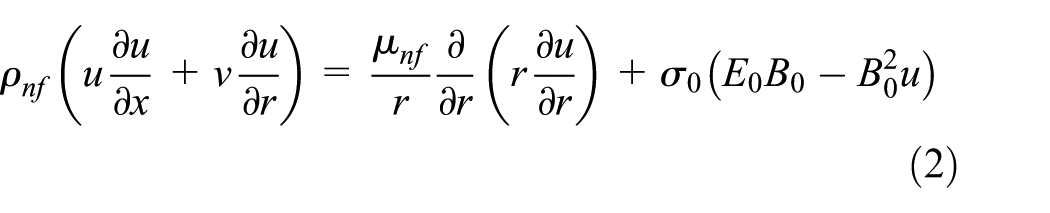
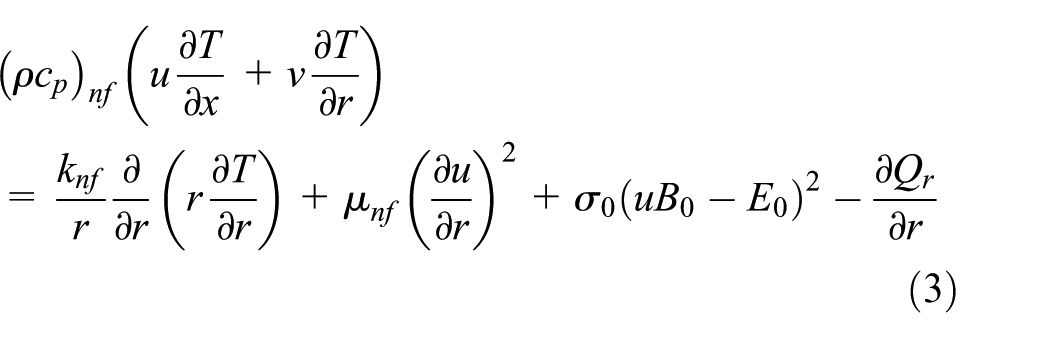
The applicable boundary conditions for above reflected problem are taken as


The radiation flux model proposed by Rosseland can be written as

By the Taylor series expansion of


The models for nanofluid density

The models for effective dynamic viscosity and thermal conductivity of nanofluid are proposed by Brinkman and Maxwell Grannet, respectively, which are given by

To transform the boundary value problem in self-similar form, the following similarity transformations are utilized

Using above-mentioned transformations, the problem in non-dimensional form can be presented as


The corresponding boundary conditions are


The constant terms in equations (12) and (13) are given as

Here,


Now in the dimensionless form, the expression for

Numerical solution
In this study, the resulting flow phenomenon is described by a system of nonlinear coupled ordinary differential equations (ODEs) (equations (12) and (13)) along with the boundary conditions (equations (14) and (15)). The system of equations (12) and (13) are first reduced into system of first-order ODEs, which are then solved by Runge–Kutta–Fehlberg numerical integration scheme with shooting algorithm. The selection of

The system of five simultaneous first-order equations can be written as follows

The boundary conditions are written as follows

Since
Discussion of results
In this article, the impact of thermal radiation and Ohmic heating on hydromagnetic transport of alumina nanoparticles in EG over linearly stretching cylinder is analyzed. The convective boundary condition is also employed for heat transfer effects. Differential equations (12) and (13) with boundary conditions (equations (14) and (15)) are solved by RKF45 with shooting algorithm in MATLAB software. Role of various involving parameters like magnetic field number
Figures 2 and 3 represent variations of momentum and thermal boundary layer versus
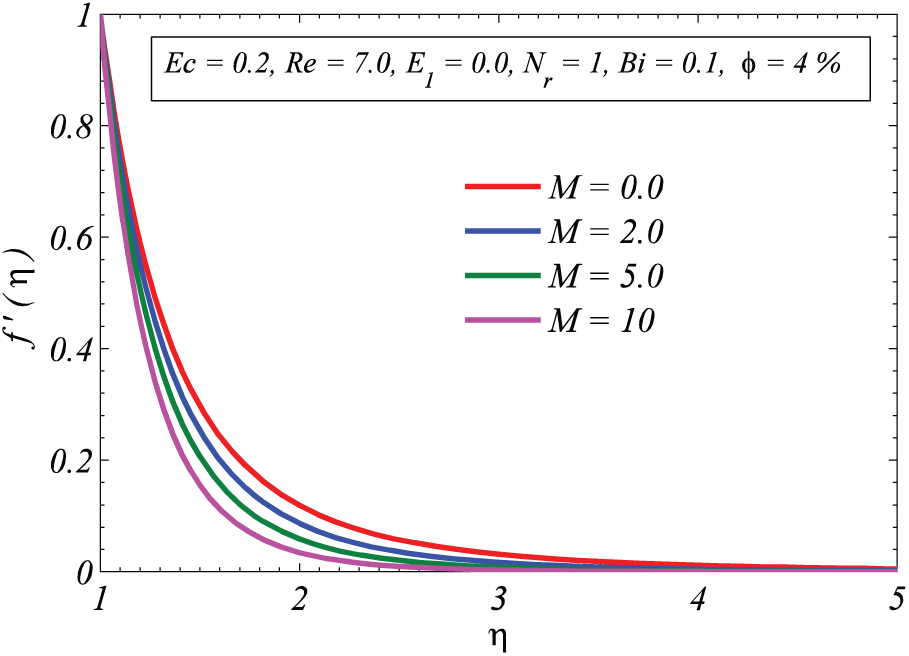
Impact of magnetic number M on velocity distribution
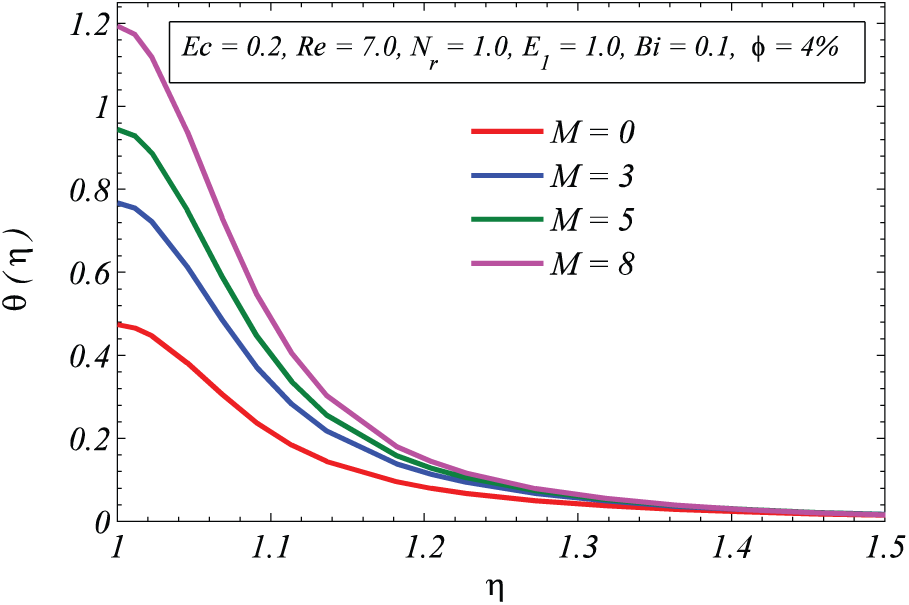
Impact of magnetic number M on temperature distribution

Impact of electric parameter

Impact of electric parameter

Impact of radiation number

Impact of Eckert number

Impact of electric parameter

Impact of Biot number

Impact of radiation parameter
Concluding remarks
The current investigation has many useful applications in various fields such as piping, wire drawing, metal spinning, flow meter design, solar collectors, casting systems, manufacturing of rubber sheets, crude oil refinement, electronics cooling, drilling operations, commercial refrigeration, geothermal power generation, cylindrical wires coating, and polymer fiber coating. In this study, the problem of hydromagnetic transport of
The velocity and temperature distributions depend on parameters as follows: Reynolds number
For extremely large Biot number
By increasing the Biot number
Skin friction coefficient enhanced as we increase electric parameter
With the increasing magnetic number
Both the flow and thermal profiles boosted with the increase in electric parameter
Footnotes
Appendix 1
Acknowledgements
The authors wish to express their sincere thanks to the anonymous reviewers for their essential suggestions and comments to enhance the superiority of this manuscript.
Handling Editor: Moran Wang
Declaration of conflicting interests
The author(s) declared no potential conflicts of interest with respect to the research, authorship, and/or publication of this article.
Funding
The author(s) received no financial support for the research, authorship, and/or publication of this article.