




Abstract
In this article, a mathematical model of hydrodynamic force was established to model the influence of wall in realizing the precise control and maneuverability of a complex-shaped underwater robot. A hydrodynamic model of a robot for use in a nuclear reaction pool was presented containing not only hydrodynamics coefficients but also a wall hydrodynamic force term, which was often ignored for robots used at sea. First, hydrodynamic coefficients in the model, including viscous and inertial coefficients, were solved by simulating steady-state and unsteady-state motion by computational fluid dynamics. Next, the wall hydrodynamic force was calculated by computational fluid dynamics for different velocities and distances from the wall, and the scope of influence of the wall was identified. Finally, hydrodynamic coefficients without the wall effect and with the wall hydrodynamic force under different conditions were measured experimentally in a circulating water tank. The result demonstrated the accuracy of hydrodynamic calculation by computational fluid dynamics and verified the reliability of the hydrodynamic mathematical model.
Keywords
Introduction
In recent years, nuclear energy industry was rapidly developed around the world. After the Fukushima nuclear accident in Japan, nuclear security issues were paid worldwide attention to.1,2 Many research institutes have devoted considerable effort to research on nuclear rescue robots.3,4 We have developed an underwater robot with a welding device that can weld a nuclear reaction pool in an emergency. The semi-autonomous underwater unmanned robot can not only be manually operated through an umbilical cable but also independently patrol near the operation target. The design of the robot’s controller and the analysis of its maneuverability are based on a dynamic model. In this approach, a mathematical model of hydrodynamic force 5 treated as a disturbance factor is a main component of the dynamics to improve control precision. Hence, the analysis of the hydrodynamic characteristics is significant. Additionally, when moving while attached to wall to weld or inspect, the hydrodynamic force will be altered due to the wall obstruction. 6 Therefore, the hydrodynamic model presented here includes not only hydrodynamic coefficients but also a hydrodynamic force term due to the blocking effect of the wall.
At present, there are three methods to calculate hydrodynamic coefficients: estimation of an empirical formula, testing a restraint model, and numerical simulation. 7 The empirical formula method simplifies the robot as a combination of various geometries. It is effective in solving the hydrodynamic force on a robot with a simple structure,8,9 but the calculated result is imprecise for a robot of complex structure, so this method is seldom used. The restraint model test method is suitable for solving hydrodynamic coefficients of all types of underwater robots. In recent years, many scholars have published much research.10–14 Although this method is most effective, it has failed to become widely popular because of its long test periods and high cost. With the development of computer technology and computational fluid dynamics (CFD) technology, numerical simulation15–17 with short cycles, low cost, and manpower savings has become a new method for determining hydrodynamic coefficients. Recently, this method has been widely used to achieve research results. Tyagi and Sen, 18 Cheng and Lau, 19 and Wu et al. 20 presented a method to determine the damping coefficients by an experiment to verify the theoretical model obtained from CFD. The added mass coefficients were solved by simulating the planar motion mechanism test and a free-decaying test in CFD from the literature.21–24 A method of solving the hydrodynamic coefficients of a complex-shaped robot was proposed, and the authenticity of the simulation was verified by an experiment in Tang et al. 25 With robot motion near a wall, the hydrodynamic force due to the blocking effect of a wall is called the wall hydrodynamic force. In previous research, there was not much research on the influence of wall effect for robots. Du et al. 26 analyzed the change in hydrodynamic force close to the sea bottom. Suzuki et al. 27 obtained a linear relationship between a vertical hydrodynamic force and the distance from the sea bottom with a model test. Zhu et al. 28 analyzed the relationship between resistance, lift coefficients, and the distance from the bottom when robot moved linearly. Zou and Larsson 29 presented a CFD method to calculate the effect of a bank on ship under different conditions.
Although these reports have worked out theoretical hydrodynamic models by solving hydrodynamic coefficients, the underwater robots are used in the sea, namely, the open water domain. In these scenarios and models, the blocking effect of a wall on an underwater robot is ignored. Recently, some literature discusses the effect of a wall on a robot by the numerical simulation, but only qualitatively; the effect has not been quantified until now. Moreover, there is no experiment designed to measure the wall hydrodynamic force to verify the accuracy of the simulation. In this work, to quantify and predict the effect of the hydrodynamic force on an underwater robot with a motion near the wall, the CFD method and a prototype test are used. First, a theoretical model of the hydrodynamic force resulting from the blocking effect of walls is presented in the horizontal and vertical planes. Then, the wall hydrodynamic force is solved by a method similar to a steady motion simulation by CFD. Finally, a hydrodynamic test is designed in a circulating water tank to verify the accuracy of the results of the wall hydrodynamic force obtained by CFD, and for difference flow velocities the influence scopes of the wall are obtained. The work conducted in this article establishes a precise mathematical model and is helpful for the control designer and maneuverability research.
This article is organized as follows. Section “Structure and function of robot” describes an underwater robot to weld and inspect the wall of a nuclear reaction pool. Section “Hydrodynamic model” presents a mathematical model of the hydrodynamic force with a robot motion near the wall in the horizontal and vertical planes. Section “Hydrodynamic coefficients solved by CFD” reports a steady and unsteady motion simulation in CFD to solve the viscous and inertial hydrodynamic coefficients in the model. Section “Wall hydrodynamic force solved by CFD” depicts a method of solving the wall hydrodynamic force by CFD. Section “Prototype test” describes a prototype test including a direct resistance test, an oblique towing test, a planar motion mechanism test, and a wall hydrodynamic test. Finally, some conclusions are drawn.
Structure and function of robot
In previous research, many underwater robots have been designed. Liu et al. 30 designed a new multi-functional and model-switched remotely operated vehicle for decontamination of underwater structures at sea. Miao and Pang 31 presented a small inspection-class underwater robot that carried a video camera for underwater inspection. Anwar et al. 32 designed a portable low-cost remotely operated underwater vehicle that can conduct surveys in shallow waters.
These previous robots were used only to observe in water; they could not perform complex tasks. In this section, the research object is an open-frame underwater robot equipped with a welding device and an observation device; it can weld the wall of a nuclear reaction vessel in an emergency and perform a daily inspection. The size of the framework of the robot (Figure 1), which is made of Teflon, is 1.06 m × 0.65 m × 0.66 m (length × width × height). The drainage volume of the body is ΔV = 0.21 m 3 , and its mass is = 117 kg. Pressurized cabins for power and control are arranged on the body. A welding torch and a camera are installed on a 3-degree-of-freedom (DOF) movement platform on the body. There are eight propellers on the body, which are the only power output devices equipped. The maximum thrust and power of every propeller are, respectively, 50 N and 300 W. The propellers are divided into two layers: four propellers on the top layout provide power for heave, roll, and adsorbing on the wall; the others on the bottom layout allow the body to surge, sway, and yaw.

A prototype of an underwater robot.
The body can roll 90° about its x-axis to address and patrol on a side wall, as the torch has a downward direction. Buoyancy material is installed on the bottom of the body to reduce the metacentric height, which can reduce restoring moment to enable the device to roll. The structure of the robot is symmetrical in x-axis and y-axis directions; hence, the distance between them is 8 mm in z-axis direction and 0 mm in x-axis and y-axis directions.
Hydrodynamic model
To facilitate describing the movement of the robot, a fixed coordinate frame E-ξηζ and a moving coordinate frame O-xyz are established as shown in Figure 2. The origin of the moving coordinate frame coincides with the center of mass of the robot. The linear velocities in the longitudinal, transverse, and vertical directions are, respectively, represented by

Fixed and moving coordinate systems of robot.
The blocking effect of the water against the robot’s movement is called as the hydrodynamic force. Hence, hydrodynamic force is a function of motion parameters. According to their origin, the hydrodynamic forces can be classified into inertial and viscous hydrodynamic forces. Additionally, a wall hydrodynamic force is presented due to the blocking effect of the wall when robot moves near the wall.
From the literature, 33 a hydrodynamic model of a robot moving in the horizontal plane is established in view of the impact of the wall as follows



Similarly, the hydrodynamic model when robot moves in the vertical plane is


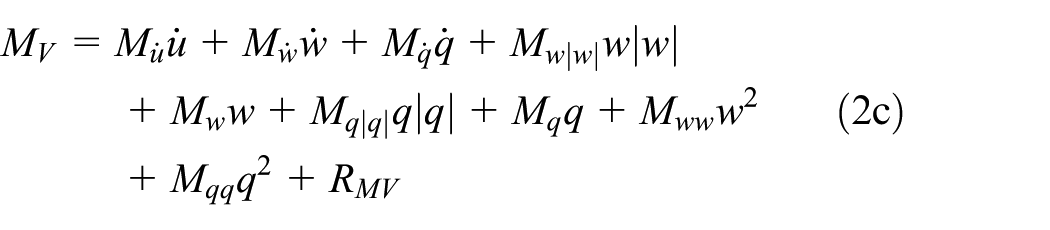
where inertial hydrodynamic coefficients are expressed as
The hydrodynamic coefficients in formulas (1) and (2) are dimensional, and their values are easily influenced by the model’s scale, and so on. To overcome these effects, the coefficients are re-defined as dimensionless according to the similarity principle. Therefore, the coefficients of forces proportional to the velocity are dimensionless by
Hydrodynamic coefficients solved by CFD
In this section, hydrodynamic coefficients in formulas (1) and (2) will be solved by numerical simulation and an estimating formula. 34 The numerical simulation can be divided into two types: an unsteady-state simulation and a steady-state simulation.
Before calculating CFD, a calculation domain divided into internal and external flow fields is established as shown in Figure 3. An external flow field of the domain was like a cube region, the size of which was 11L ×9L × 9L (L was the length of robot). The size of an internal flow field which was also cubic was 2L × L × L. The boundary of the internal flow field extending back a distance of 6L was the inlet boundary of the external flow field, and extending forward a distance of 3L was the outflow boundary of the external flow field, and extending to the left, right, top, and bottom a distance of 4L were other boundaries of the external flow field.

A computational domain in CFD.
The calculation domain was then meshed. Here, a multi-block meshing strategy was used due to the complex shape of the body, namely, an unstructured tetrahedron grid that can best adapt to the complex shape of the robot and for which it was easy to control the size of nodes and the grid density in the internal flow field; the external flow field used a structured hexahedral mesh to reduce the number of mesh points, which can improve calculation efficiency. The total mesh size of the computational domain was about 741,900.
The entrance of the external flow field was set as an inlet velocity condition, and the exit was set as an outlet pressure condition. The other boundaries of the external flow field were set as free-slip walls. The surface of the model was set as a no-slip wall.
In CFD, some parameters were set as following: the turbulence model was set as standard k-epsilon with standard wall function; SIMPLE algorithm was used to calculate pressure–velocity coupling; pressure discretization was the first-order upwind discrete mode; and momentum discretization, turbulent kinetic, and turbulent dissipation rate were the second-order upwind discrete mode. Under-relaxation factors of pressure, momentum, turbulent kinetic energy, turbulent dissipation rate, and turbulent viscosity were 0.5.
Unsteady motion simulation test
An unsteady motion simulation was conducted to solve for inertial hydrodynamic coefficients. The planar motion mechanism was simulated virtually by CFD, namely, the robot made motions such as pure heave motions, pure pitching motions, pure sway motions, and pure rolling motions, using user-defined functions (UDFs). The hydrodynamic force was solved with longitudinal flow acting on the body. The process of solving for the inertial hydrodynamic coefficients was described taking the simulation of the pure heave motion of the robot as an example.
In the computational domain, the pure heave motion equation of the robot was

where the amplitude of robot motion was a = 0.04 m; the vertical displacement was expressed as ζ; the vertical velocity and acceleration of the robot were, respectively,
The grid nodes in the internal flow field will experience sinusoidal movement according to formula (3) by UDF; the hydrodynamic forces were calculated under conditions in which the oscillation frequencies were set at f = 0.2, 0.25, 0.3125, 0.4, 0.5, and 0.625 Hz. A stable plot of dimensionless force versus time can be obtained after six to seven calculation cycles. A set of discrete points at time t was obtained, which can be written as a first-order Fourier series

namely

assuming
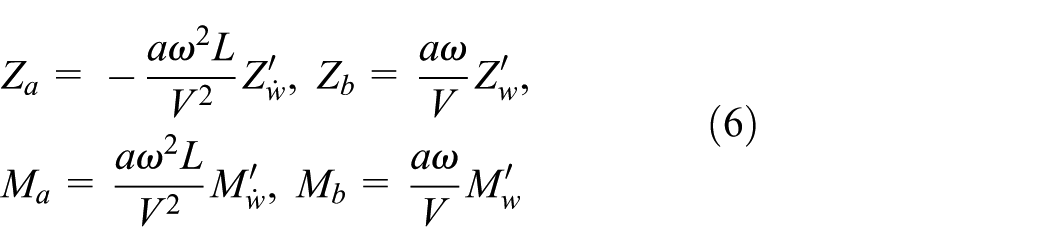
where L represents the characteristic length of the robot and
From formulas (4)–(6), the coefficients Za, Zb, Ma, and Mb were solved by the Fourier expansion method in MATLAB, followed by the hydrodynamic coefficients related to the pure heave motion.
Steady-state motion simulation
The simulation experiment of steady-state motion included a linear motion simulation and an oblique motion simulation.
The robot was placed in the calculation domain with no pitching and rolling angle when launching a linear motion simulation. The velocity of the robot was kept constant in a straight line under a rated speed that the robot reached after acceleration from rest at 0.1 m/s 2 by UDF. The resistance was calculated at different rated speeds. Here, the rated speed varied from 0.1 to 0.8 m/s in increments of 0.1 m/s.
The oblique motion simulation was developed in the vertical and horizontal planes. The calculation was illustrated taking the oblique test in the horizontal plane as an example. The flow velocity at the entrance to the computational domain was kept constant; the angle between the velocity direction and ξ-axis in fixed coordinates was an angle of drift that was positive if the rotation from the velocity direction to the ξ-axis was clockwise. Here, the hydrodynamic force and moment were calculated with the angle of drift varying from −10° to 10° in increments of 2°. The hydrodynamic coefficients related to an oblique motion in a horizontal plane were obtained by multiple linear regression. 35
Wall hydrodynamic force solved by CFD
To inspect and look for cracks in a nuclear reaction pool, a robot moves near the wall. During this motion, the robot is subjected not only to the longitudinal hydrodynamic force but is also influenced by the hydrodynamic force or moment in the other direction due to the blocking effect of the wall. In this section, the wall hydrodynamic force terms are calculated by CFD, and the method is illustrated with an example of robot motion in the horizontal plane.
The robot moved in a horizontal plane near the wall as shown in Figure 4. The distance from the wall to the robot was h. Here, the effect of wall produced the lateral hydrodynamic force

Robot motion in horizontal plane near the wall.
The method of calculation was similar to that of the longitudinal resistance of the robot by CFD, but there were some differences: the lower boundary of the flow domain was set as the wall, and the other three boundaries were set as velocity inlet (i.e.
The wall hydrodynamic force
Prototype test
To verify a proposed hydrodynamic model, a hydrodynamic test of the underwater robot can be conducted in a circulating water tank. This section describes a linear motion towing test, an oblique motion towing test, and a plane-motion mechanism test to verify calculated hydrodynamic coefficients without the wall effect; then, a hydrodynamic test including the wall effect is developed to verify the simulation results of the wall hydrodynamic force.
The size of the circulating water tank is 10 m × 3.5 m × 2 m (length × width × height). The hydrodynamic test system features a six-component force sensor, a connecting rod, a connecting frame, and so on. The hydrodynamic force to which the body is subjected by the water flow is measured by a six-dimensional force sensor of type ATI Mini45 TI, fixed on the top of the connecting rod; its measurement range is 0–150 N, with a maximum error of 0.5% of the measurement result. The schematic and physical images are shown in Figure 5.

The schematic and physical map of a hydrodynamic test.
In the direct resistance test, a test model was put in the circulating water tank, remaining stationary with the water moving. The flow velocity could be altered, over the velocity range of 0.1–0.8 m/s (0.1 m/s steps). Sensor data for the x-axis produced the results as shown in Figure 6.

Measurement results of resistance model test.
In the oblique towing test, the drift angle of the robot was varied from −10° to 10° in increments of 2°. When the robot was subjected to the flow, the lateral hydrodynamic force

Measurement results of oblique towing test.
The viscous hydrodynamic coefficients derived from a direct resistance test and an oblique towing test were obtained by CFD and a hydrodynamic experiment. The results and errors are shown in Table 1.
Viscous hydrodynamic coefficients obtained by CFD and experiment.

CFD: computational fluid dynamics.
To determine inertia hydrodynamic coefficients, a sinusoidal motion mechanism was designed similar to the planar motion mechanism: the mechanism was installed on the connection rod to generate sinusoidal motion of the model, as shown in Figure 8. The length of the oscillation rod was 0.6 m, the maximum frequency of oscillation was 1 Hz, and the maximum amplitude was 0.04 m.

Diagram of planar motion experiment mechanism.
The frequencies measured were f = 0.2, 0.25, 0.3125, 0.4, 0.5, and 0.625 Hz; for the hydrodynamic coefficients related to pure heave motion, the hydrodynamic force
Inertial hydrodynamic coefficients obtained by CFD and experiment.

CFD: computational fluid dynamics.
To measure the wall hydrodynamic force, the robot was placed near the wall of the circular water tank. The wall distances were, respectively, set as lw = 0.05, 0.1, 0.15, 0.175, 0.2, 0.25, 0.3, 0.35, 0.4, 0.45, and 0.5 m. Under the rated wall distance, the flow velocities were set at

Force results of wall hydrodynamic force test: (a) flow velocity

Moment results of wall hydrodynamic force test: (a) flow velocity
In Figure 9, the lateral hydrodynamic force
Conclusion
In this article, a semi-autonomous underwater robot was developed capable of welding the wall of a nuclear power pool in an emergency. To control the robot motion precisely, a hydrodynamic model was established, including hydrodynamic coefficients and a wall effect. Hydrodynamic coefficients in the theoretical model were found by developing a virtual hydrodynamic simulation test in CFD. The wall hydrodynamic force in the model was then quantified by CFD, and the influence scopes were, respectively, determined at different velocities by fitting functions. Finally, a prototype test was conducted in a circular water tank with and without the wall effect. The simulation results demonstrated that the wall hydrodynamic force, which was related to the wall distance and the robot velocity, was a main component of the model. By comparing the simulations with experimental results, the accuracy and authenticity of the simulation were verified, and the hydrodynamic model introduced was shown to be reasonable. In the near future, the wall hydrodynamic force will be calculated with the change in the wall distance when the robot moves vertically to the wall and a three-dimensional influent region of the wall on the robot can be obtained.
Footnotes
Handling Editor: Yangmin Li
Declaration of conflicting interests
The author(s) declared no potential conflicts of interest with respect to the research, authorship, and/or publication of this article.
Funding
The author(s) disclosed receipt of the following financial support for the research, authorship, and/or publication of this article: This work was support by the National Basic Research Program of China (2013CB035502). Special fund is National Natural Science foundation of China (61673138).