




Abstract
This article focuses on the missile integrated guidance and autopilot design in the end-game phase with control input saturation. First, the nonlinear integrated guidance and autopilot model is developed with third actuator dynamics, where the control surface deflection has magnitude constraint. Second, three nonlinear extended state observers are used to estimate the aerodynamics coefficients’ uncertainties and unmatched time-varying disturbances. Third, a command filtered controller is designed step by step with linear and nonlinear sliding surfaces to improve the terminal performance. In the process, different command filters are implemented to avoid the influences of disturbances and repetitive derivation and solve the problem of unknown control direction. The stability of closed-loop system is proved by Lyapunov theory, and the principles abided by the controller parameters are concluded through the proof. Finally, 6-degree-of-freedom numerical simulations are presented to show the feasibility and validity of the proposed controller.
Keywords
Introduction
Since 1980s, there have been lots of studies in the area of missile integrated guidance and control (IGC). In the conventional design, the missile guidance and control system is treated as two separated processes based on different operation frequencies. The outer guidance system creates acceleration or angle of attack (AOA) command, and the inner control system tracks it. When the two control loops are combined, the original performance objectives are lost and must be recovered. Thus, the resulting iterative design may not produce an optimal overall system. Additionally, under the condition of high speed, imprecisely known aerodynamics, complicated uncertainties, and external disturbances, the missile dynamics is obviously characterized by nonlinearities. The approaches which involve linearization about a set of equilibrium conditions or trim points within the flight envelop suffer from several disadvantages. Comparatively, the IGC design has provided better solutions in low-cost, modular growth, design flexibility, simple logistics and attracted great interest of researchers.
In Williams et al., 1 the scheme of tactical missile IGC system is designed, where the information produced by inertial sensors of guidance system are used for the attitude control system. Because the accuracy of sensors in guidance system is much greater than that of autopilot, the IGC can reduce cost and improve the entire guidance and control system performance. In Evers and Cloutier, 2 the discussion of IGC scheme goes a step further with three optimal control laws for a tactical missile. In Xin et al. 3 and Vaddi and Menon, 4 new optimal control methods are proposed to effectively design IGC system for missiles. However, the weighting matrices have too many elements, while the actuator dynamics is assumed to be sufficiently fast and is not modeled in the IGC development. In comparison, sliding mode control (SMC) is a robust method with not complicated structure for nonlinear control issues. It has been extensively used in IGC design. In Shima et al., 5 a brief review of SMC is made at first. A simple first-order actuator dynamics is considered in model development. Then, the missile IGC design is compared with two different separated designs. It is indicated that the inherent instability of decoupled guidance and control loops in terminal phase is postponed by the integrated design, so the interception accuracy is greatly improved. Besides, the control input chasing is depressed using zero-error-miss (ZEM) sliding surface. In Harl et al., 6 predicted-impact-point (PIP) heading error is used to make sliding surface, and terminal second-order SMC is designed to achieve the convergence in a finite time without chattering. In Shima et al. 7 and Tournes and Shtessel, 8 the IGC dynamics is built with two first-order actuators for dual-control missiles, and the controller complexity becomes staggering. Nevertheless, the true missile dynamics has high order for second- or third-order actuator dynamics. For high-order nonlinear system model in literatures,9–12 back-stepping technique is a useful tool, which is always combined with SMC and disturbance observer. In Huang et al., 9 the nonlinear disturbance observer is implemented to estimate the nonlinearities, uncertainties, and disturbances in the system dynamics, thus the decrease in undesired chattering in control is achieved and the robustness of closed-loop system is enhanced. In Guo et al., 10 the extended state observers (ESOs) are used to estimate indirectly measured states and various parametric uncertainties. The nonlinear ESO in Xia et al. 11 has better performance under complex uncertainties and measurement noises than linear ESO in Shao and Wang;12,13 however, it has more parameters to tune. In Sun et al., 14 velocity tracking error is used to design a composite-error-based ESO in a feedback form, which makes estimation and tracking errors smaller without high gains.
To simplify the implementation and cancel out the system noises, command filter is introduced. In Farrell et al., 15 command filtered back-stepping is proposed to offer a means to get the time derivatives of the pseudo control signals. In Huo and colleagues,16,17 low-pass filter is used to construct the derivative of pseudo control input. It solves the problem of “explosion of complexity” caused by the repeated differentiations of the pseudo control signals in dynamic surface control (DSC). In Pan et al., 18 the second-order command filters instead of the first-order filters are applied in DSC. With the help of command filters, the performance of back-stepping control scheme significantly improves in stability and steady-state tracking accuracy, while the analysis is made in detail in Pan and Yu. 19 In Pan and Yu, 20 the stability of commander filtered back-stepping control is further improved by composite learning. In Farrell et al. 21 and Xu et al., 22 a second-order command filter is designed to impose magnitude and rate limitation on the control input. In Chwa, 23 directly differentiating the pseudo control command with respect to time is avoided and the global uniform ultimate boundlessness of the tracking errors is guaranteed in the presence of the input constraints. In Erdos et al., 24 low-pass filters of the adaptive control scheme guarantee the fast adaptive performance and robustness of the missile integrated guidance and autopilot (IGA) system. Deep discussion about control input constraint, finite time convergence in IGC design arises rapidly in Wang and Wang25,26 and Shi et al. 27 In Wen et al., 28 first-order auxiliary dynamics is developed in addition to the system model to deal with the input constraints. In Chen et al.,29,30 Nussbaum function is introduced to compensate for the nonlinear term arising from input saturation and solve the problem of unknown control direction. In Chen et al., 30 a novel Nussbaum gain is proposed for multiple unknown actuator directions and time-varying nonlinearities.
In summary, IGC study should be more focused on the model development with actuator dynamics, coefficients’ uncertainties, and control input constraints. Then, the application is able to be studied and discussed more practically and effectively. Motivated by (1) the IGC design, (2) ESO-based disturbance estimate, and (3) command filtered back-stepping control in the presence of control input constraint, this work proposes a novel missile IGA scheme.
The article is organized as follows: in section “Introduction,” the integrated design and related control techniques are introduced. In section “Missile IGA model,” the missile flight dynamics in end-game phase with third-order actuator model is developed, and the control surface deflection has constraint of magnitude saturation. In section “ESO,” ESO is designed to synthetically estimate the uncertainty and time-varying disturbance, and three ESOs are used in different channels of the IGA model. In section “Command filtered controller,” the command filtered back-stepping technique is implemented based on the estimations of ESOs. Command filters are used to get the derivate of pseudo inputs produced by the sliding mode controllers, and Nussbaum function is introduced to solve the problem of unknown control direction when differentiating the saturated control input. In section “Stability analysis,” the stability proof of closed-loop system is given by Lyapunov theory, and the principles followed by the controller parameters are concluded. In section “Numerical simulation,” 6-degree-of-freedom (DOF) numerical simulations verify the proposed design with two scenarios, and Monte Carlo simulations are made to test the performance under initial flight states bias and measurement noises. Finally, section “Conclusion” concludes the article.
Missile IGA model
In this section, the missile IGA model in the end-game phase is developed. In Figure 1, the coordinate systems are built without considering the earth rotation. The aerodynamics is built in the velocity coordinate system. V is the velocity of mass center, R is the distance between the missile and the target, q is the angle between line of sight (LOS) and local horizon,

The planar geometry in end-game phase.
The state vector is chosen as



where


The lift force can be simplified as two parts:
The actuator dynamics is considered as a first-order inertial element with time constant

The state-space model of actuator can be depicted as follows



where
The nonlinear saturation characteristic of the actuator in equation (1c) can be modeled as

where

then
ESO
The disturbance estimation technique is particularly crucial for disturbance attenuation. To compensate the IGA system under uncertainties and unmatched disturbances, the technique of ESO is implemented. It is developed as follows:
First, considering the following system

The uncertain nonlinearity and time-varying disturbance are considered as a whole

where
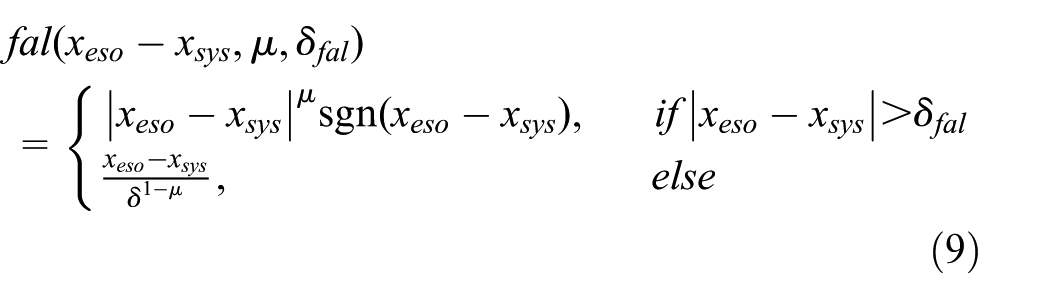
The estimator error of the whole disturbance
In the missile IGA design, three ESOs (ESO1, ESO2, and ESO3) are used to estimate the unmatched uncertain nonlinearities and time-varying disturbances
Command filtered controller
In this section, based on the estimate states by ESOs, the command filtered back-stepping sliding mode controller is designed to achieve LOS rate convergence:
Step 1: The first sliding surface is chosen as

If directly differentiating

In equation (11),
Step 2: Defining the second sliding surface

Another low-pass filter in the same form of equation (11) is used to avoid directly differentiating

Then the error produced by the low-pass filter can be expressed as
Step 3: In this step, there are two sub-steps to finish the design. First, the pseudo control input

The third low-pass filter is used to get the first-order derivative of

The error between
Second, if defining

where

Then the proportional reaching law with positive constant


The Nussbaum function is defined with the following properties


According to the properties, the following Nussbaum function is implemented

The parameter

At the end of Step 3, a third-order differentiator is also used as command filter to get first- and second-order derivatives of the pseudo control input
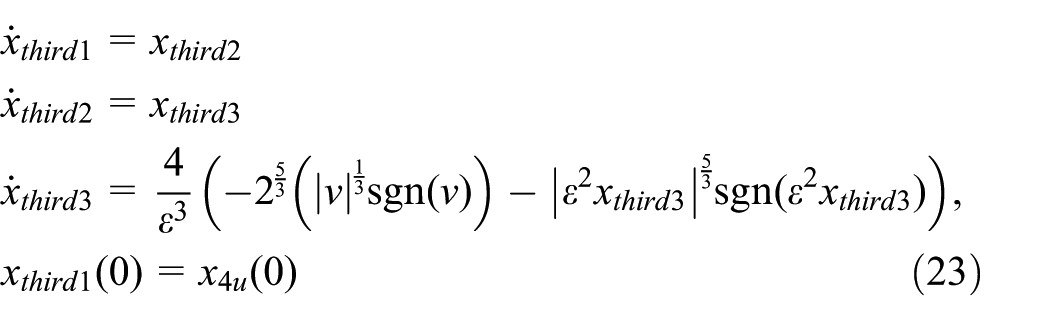
where
Step 4: The task of tracking


In equation (24b),

Defining vector

In equation (26),

where
Finally, the control input is designed as follows

Stability analysis
Defining




Besides, the following Lyapunov function is chosen

Differentiating part of equation (33) with respect to time

Because the differentiator is set appropriately such that

Through differentiating equation (33) and combining equation (34), we have
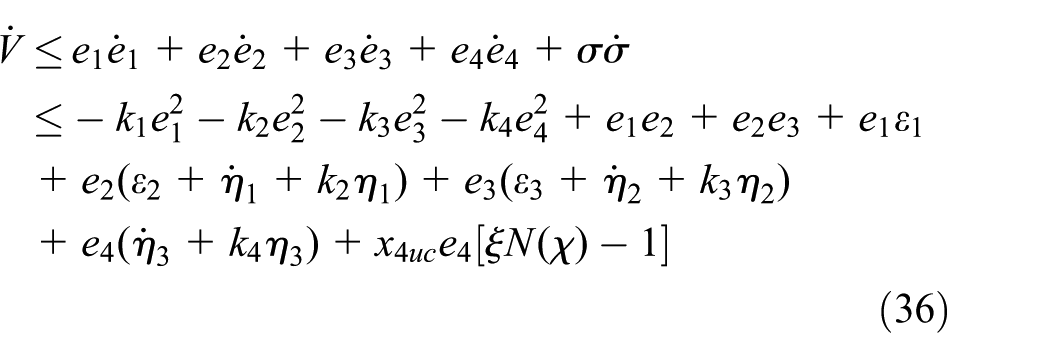
If defining the following bounds


According to Young’s inequality, equation (36) can be rewritten as follows

Remark
If choosing

Integrating equation (39) directly, then we have
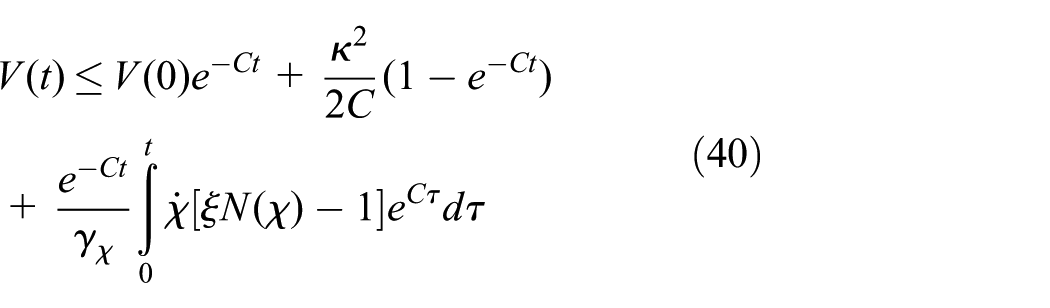
According to the proof in Wang and Wang,
26
Numerical simulation
In this section, 6-DOF nonlinear numerical simulations are provided to illustrate the control schemes proposed in the previous sections. First, the initial flight condition in end-game phase is set as follows

The IGA model is built in two scenarios with the following aerodynamics coefficients based on Table 1 in Appendix 1.
Scenario 1

Scenario 2

The third-order actuator dynamics is given by the following transfer function

The time-varying disturbances in different channels are given as follows

Second, the three ESOs are set with parameters as follows

Third, the first three one-order command filters have time constants

Finally, the terminal sliding surface in equation (26) is set with
Comparison simulating
The simulation results in Scenario 1 (S1) under saturated

Comparison with and without ESOs: (a) curves of
The performance of three nonlinear ESOs in Scenario 2 (S2) is shown in Figures 3–5 through comparison between estimate states and actual states, and estimate synthetical uncertainties and preset synthetical uncertainties. First of all, the tracking errors and estimation errors in the closed-loop control system are uniformly ultimately bounded. It can also be seen that all the ESOs estimate the nonlinearities and disturbances with good accuracy, so the system dynamics is well-compensated. As a result, the controller performs better with ESOs.

States’ comparison of ESO1: (a) comparison between

States’ comparison of ESO2: (a) comparison between

States’ comparison of ESO3: (a) comparison between
Two scenarios of S1 with equation 42(a) and S2 with equation 42(b) are set to test the performance under large aerodynamics coefficient uncertainties. In equation (42b),

Comparison between Scenario 1 and Scenario 2: (a) curves of
The results shown in Figure 7 are comparison simulation with different magnitude constraints of control surface deflection

Comparison with different
Simulating with initial distance, velocity, measurement noise
With the help of Monte Carlo theory, large number of numerical simulations under a wide dispersion range of velocity, initial distance, and measurement noise are made. The results are shown in Figures 8–10. Figure 8 presents the Monte Carlo simulation results under initial distance dispersion between 18 and 22 km. The mean value is 20 km. It can be seen that the corresponding flight states converge well; the main difference lies in the convergence time under initial distance dispersion.

Monte Carlo simulation under

Monte Carlo simulation under

Monte Carlo simulation under measurement noises: (a) curves of
In Figure 9, the simulation results under velocity dispersion between 1000 and 1400 m/s are presented. The mean value is 1200 m/s. It is seen that the parameters’ setting of the proposed controller can satisfy large variations in flight velocity. From Figures 8 and 9, the proposed scheme is able to achieve the control object under large dispersion of flight states.
The measurement noises are modeled as a first-order inertia transfer function with a time constant

In Figure 10, the Monte Carlo simulation results under measurement noises are presented. It can be concluded that the uncertain gain of sensor dynamics has a very limited effect on the proposed controller.
Conclusion
In this article, a novel composite IGC scheme combined with third-order actuator dynamics under control input saturation and ESO is developed to address hypersonic missile flight control with multiple uncertainties and control constraint. The nonlinearities and unmatched time-varying disturbances are well estimated by three ESOs. Four differentiators including a third-order hybrid nonlinear differentiator are used to calculate the derivatives of pseudo control input. Thus, the peaking phenomenon and chasing of back-stepping sliding mode controller are greatly depressed. Besides, the noteworthy feature of the proposed IGC approach is that the control surface deflection is constraint under saturation with Nussbaum gain. It is very important in practical application.
Footnotes
Appendix 1
The aerodynamics of NASA CAV-L in 1998 is shown in Table 1.
When the flight velocity is high, the lift coefficient can be simplified as
Take
Handling Editor: Yongping Pan
Declaration of conflicting interests
The author(s) declared no potential conflicts of interest with respect to the research, authorship, and/or publication of this article.
Funding
The author(s) received no financial support for the research, authorship, and/or publication of this article.