



Abstract
The increase in bearing capacity under the influence of consolidation is the main feature of a soft foundation on the stage of subgrade filling. The effects of consolidation, intermediate principal stress, earth pressure at rest, and presence of a crusty layer were all considered. Based on the unified strength theory, new theoretical formulas for critical edge load and critical load were deduced. The solution of the Mohr–Coulomb strength theory is a special case of the unified strength theory. The proposed formulas were analyzed and validated on a practical railway subgrade filling project in an area with soft soils. The calculated results showed good agreement with experimental results. The new formulas provide not only a theoretical basis for the calculation of the bearing capacity of a soft soil foundation but also a reference for calculating the safe height of subgrade filling in a soft soil area. Using the new formulas to calculate the bearing capacity of the soft soil foundation and the filling height of embankment under different degrees of consolidation, it is possible to understand the variation pattern of the bearing capacity of the foundation during construction of the embankment filling, which provides significant guidance for the safe filling of the embankment on a soft soil foundation.
Introduction
The distribution of soft soils in China is very extensive. The construction of road embankments, buildings, and other structures on soft soils as foundations often face serious safety and engineering quality issues. Inadequate subgrade-bearing capacities result in sliding failures and structural damages, leading to significant economic losses.
The studies of laboratory tests, in situ tests, and engineering practices show that soft soils as foundations undergo drainage consolidation under the load of overlying soils and that the shear strength of soft soils increases with continuous consolidation. These increases in strength are extremely important for soft soils that have low foundation-bearing capacities, as increases in the foundation strength of soft soils are beneficial for adequate utilization of the bearing capacity of soft soil foundations. This will subsequently lead to road construction methods with improved levels of cost-effectiveness.
The strength of soft soils is a critical factor for their stability as foundations. The continuous increase in strength due to drainage consolidation is an important engineering property of soft soils, especially for those with low subgrade-bearing capacities. Understanding the patterns of strength improvement for soft soils is the basis for the rational management of construction speeds for embankments, reduction of construction periods, and achievement of subgrade construction methods that are more scientific and cost-effective. 1
Scholars in China and rest of the world1–11 have conducted numerous studies on calculation methods for bearing capacities of soil foundation. However, those formulas were mostly derived from the Mohr–Coulomb strength theory, which does not consider the effects of intermediate principal stresses on soil strengths. After the proposal of the unified strength theory by Professor Yu Maohong, some scholars expanded the application of this theory and introduced it to the calculation of subgrade-bearing capacities of soils as foundations, taking into account the effects of intermediate principal stresses on the calculation results. For example, based on the unified strength theory, Fan et al.12,13 derived the formulas for critical load and ultimate bearing capacities for soils as foundations, whereas Wang et al. 14 derived the formula for the subgrade-bearing capacities of loaded strips.
Embankment height is a frequently encountered issue during the design, construction, and supervision of road works. This is because control over the deformation and stability of road foundations can only be achieved when the height of the fill is less than the critical height. The subgrade-bearing capacity of soft soils during road constructions is different from the load-bearing capacity of ordinary foundations, as the load distribution in the former is a trapezoidal gradient. As the consolidation of soft soils increases their shear strength and therefore their bearing capacity, the presence of a crusty layer above soft soils will consequently enhance the soft soils’ bearing capacity. Therefore, it would be pertinent to consider the aforementioned effects during the determination of soft soil–bearing capacities.
Considering the above, this study simplified the embankment load based on the equivalent load method and derived a calculation method for the bearing capacities of soft soils based on the unified strength theory to take into account the following: effects of consolidation of soft soils when these serve as foundations, intermediate principal stresses, earth pressure at rest, thickness of the crusty layer, and shear strength.
The calculation method was then validated through a practical railway subgrade filling project. The calculated results show good agreement with experimental results. These may be used as references for calculating the bearing capacities (and their increments) of soft soils as foundations, as well as projecting the safe height at different phases of an embankment construction project.
The bearing capacity formulas deduced in this article provide a practical and effective method to calculate the bearing capacity and growth of a soft soil foundation under an embankment and to calculate the safe height of the embankment filling.
Derivation of formulas
Simplification of embankment load and basic assumptions
Simplification of embankment load
An embankment is a linear structure with a certain compactness, built with soil or stone on the natural ground. The cross section of the subgrade is a trapezoidal structure (shown in Figure 1(a)). Its upper and lower bottom widths are B1 and B2, respectively. In general, the slope ratio of the subgrade slope is 1:1.5 (height: horizontal slope). The embankment is situated along the direction of traffic, appearing as a linear structure. Similar to the strip foundation, the form has a length much longer than its width.
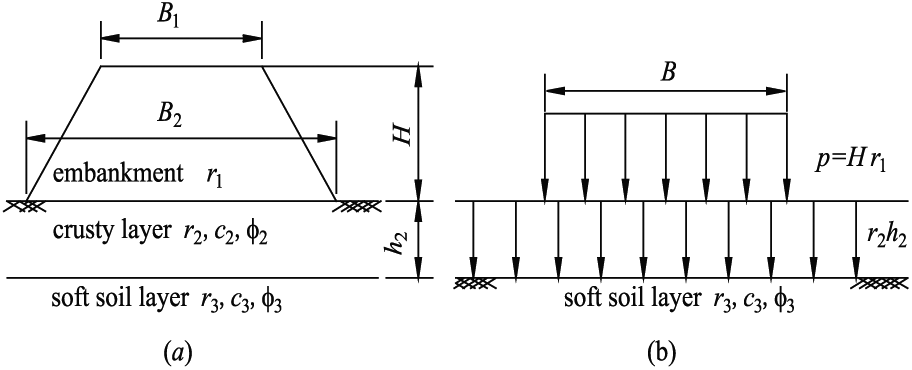
Simplification of embankment loading: (a) the prototype of embankment and (b) simplification model of embankment.
Based on the equivalent load method,
Basic assumptions
Compression deformation of the crusty layer was ignored; 10
The crusty layer was treated as a large area with uniform load r2h2 acting on top of the soft soils as foundation, as shown in Figure 1(b).
Total stress at random point M within the soft soil layer
Gravitational stress at random point M
As illustrated in Figure 2(a), the gravitational stress at point M is



where r2 is the gravity density, h2 is the thickness of the crusty layer, r3 is the gravity density of the soft soil layer, z is the distance between M and the top surface of the soft soil layer, K0 is the earth pressure at rest of the soft soil layer,

Stress calculation for soft soils as foundations: (a) the stress state and (b) the stress analysis.
Additional stress at random point M
It is known from the literature 15 that Flamant, the additional stress in the soils arising from the effects of a uniformly distributed linear load under the polar coordinates, can be explained as follows



where
For the polar coordinates shown in Figure 2(b), the angles formed between the lines that connect M to the edges of the load and two vertical lines at these edges are β1 and β2. Positive values are assigned to angles formed by rotating the vertical line MN around M in the clockwise direction, and the values of β1 and β2 in Figure 2(b) are both positive. By taking the width of each load element as dx, the geometric relationships in this figure imply

Substituting equation (7) into equations (4)–(6), the expression for additional stress at point M triggered by the uniformly distributed load p can be obtained from the cumulative points in the width of load distribution within range B as follows



where
Total stress at random point M
The total stress at point M can be derived from equations (1), (2), (3), (8), (9), and (10), and it can be expressed as follows


Effective principal stress at random point M within the soft soil layer
Principal stress at random point M
Based on material mechanics theory, the relationships between principal, normal, and shear stresses can be expressed as follows


The distribution pattern of additional stress in soils under a striped uniform load indicates that the greatest stress is on the center line of an embankment, which will be the first to be yielded and damaged. For ease of deduction, only the stress on soft soils as foundations under the center line of an embankment was calculated (i.e. conservative calculation). The symmetry and the geometric relationships in Figure 2(b) show that
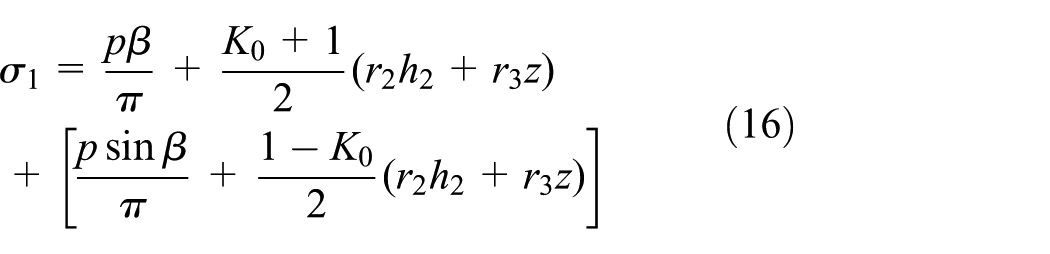
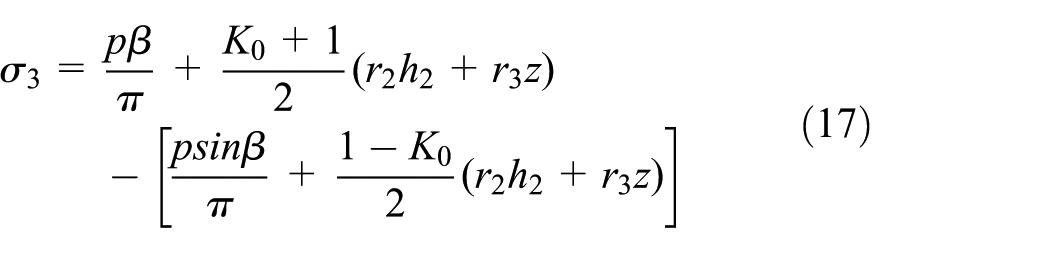
Effective principal stress at random point M

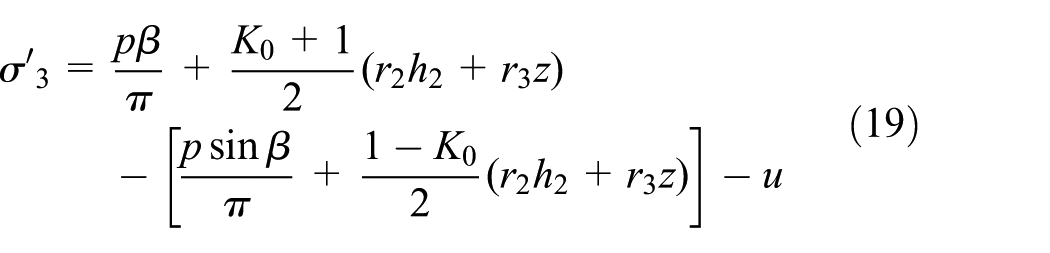
where u is the pore pressure.
Formulas for critical edge load and critical load
When the stress at point M reaches the limit equilibrium, based on the unified strength theory,12,16 the effective stress at that point satisfies the following conditions

where


in which b reflects the weight coefficient of the degree of destruction on the material caused by the intermediate principal shear and normal stresses from the corresponding surface; m represents the parameters of intermediate principal stress, which can be determined by theory and experiments
17
(when the soil is yielded, m → 1
12
); and c3, ϕ3, ct, and
The boundary equation for the critical edge can be obtained by substituting equations (18) and (19) into equation (20)

Equation (23) is the graphic formula for the critical edge when the uniformly distributed load p is a constant value, while both z and β are variables. The maximum depth zmax for the critical edge zone can be derived from β using equation (23). When the derivative is set as zero, then

Substituting equation (24) into equation (23), the expression for the maximum depth zmax in the critical edge zone can be obtained as follows

Theories on soil mechanics 15 indicate that the average pore pressure caused by additional stress p under the full consolidated thickness of the soils can be expressed as

where um is the average pore pressure, and U is the average consolidated thickness of the soils.
The following can be obtained by replacing u with um and substituting equation (26) into equation (25)

Rewriting equation (27), we obtain
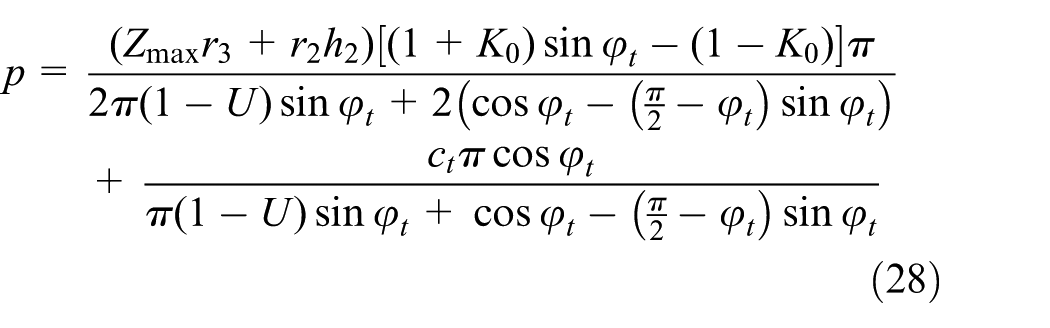
If zmax = 0 in equation (28), the expression for the critical edge load pcr is
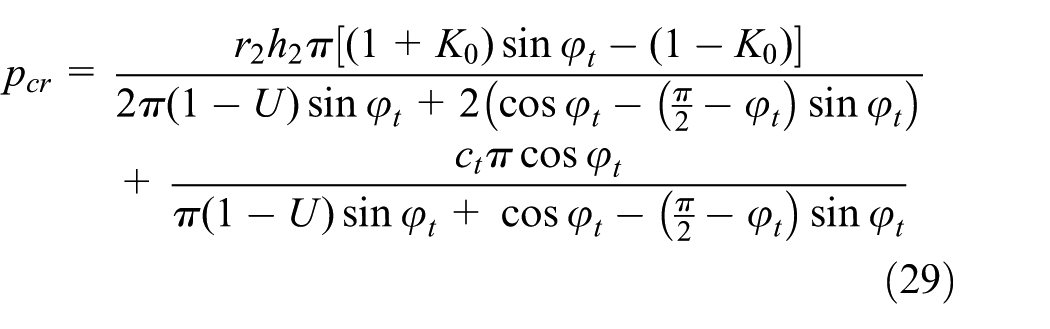
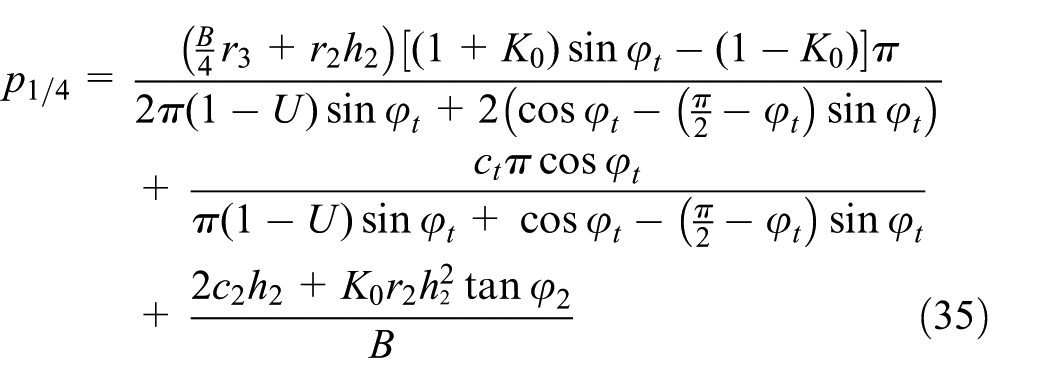
During the implementation of an engineering project, the appearance of a plastic deformation zone at a specified depth in the foundation soils is often used as a criterion for foundation damage.15,18 For this study, zmax = B/4 is used. The expression for critical load p1/4 can be derived as

Substituting h2 = 0, b = 0, K0 = 1, and U = 1 into equations (29) and (30), the expressions for critical edge load pcr and critical load p1/4 based on the Mohr–Coulomb strength theory as stated in the literature 14 can then be derived


Critical edge load and critical load equations that account for the effects of the crusty layer
The crusty layer is set as a piece of soil plate (Figure 3). When subjected to the effects of a uniform strip load, the crusty layer (with a width of B) will be affected by the shear effects of the AD and CE sliding surfaces as it slides downward.

Analysis of force transferred in surface crusty layer.
It is known from the literature10,18 that the crusty layer will transfer 2Q shear strength beyond width B through the sliding surfaces. Hence, the value

An expression for pcr that accounts for the effects of the crusty layer was obtained by combining equations (29) and (33)

Similarly, an expression for p1/4 that accounts for the effects of the crusty layer was obtained by combining equations (30) and (33)
Experimental validation
Case study
As can be seen in Figure 4, a slump occurs in a railway embankment project when the embankment is filled to a height of 5.3 m.
19
The cohesion of the crusty layer is

An example of an embankment engineering.
Calculation and analysis
For this study, it was already known that the level of ground water was approximately the same as the bottom level of the crusty layer. Hence, it is more appropriate to use
Calculation results for critical load and filling height of embankment base on different values of b and U.

Since the construction period for embankment filling is relatively short, the degree of consolidation in soft soils as foundations cannot exceed 20%. Based on the data in Table 1, the corresponding critical fill height for the embankment is 4.03–5.21 m, which is less than the slump height and satisfies the safety requirements of the project. The data in Table 1 also show that by maximizing the bearing capacities of foundations and providing appropriate considerations for the effects of principal stress, the fill height of embankments can be effectively raised.
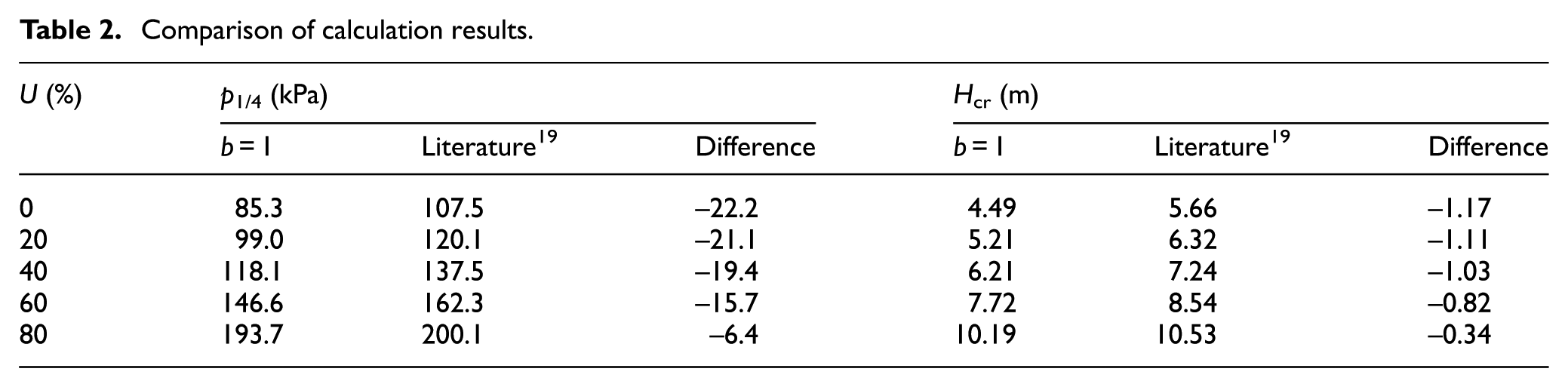
By comparing the data in Table 1 with that in the literature, 19 it was found that when b = 1, the calculation results for the bearing capacity of a soft soil foundation and the critical embankment height were consistent with those in the literature 19 (shown in Table 2). This confirms the reliability and practicability of the new formulas.
Comparison of calculation results.
Conclusion
Based on the unified strength theory, this study derived the formulas for critical edge load and critical load for soft soils as foundations. The following effects were taken into consideration when determining the bearing capacities of soft soils as foundations: consolidation of soft soils, intermediate principal stress, earth pressure at rest, thickness of the crusty layer, and shear strength. The formulas provide a new and effective method for calculating the bearing capacities (and their increments) of soft soils as foundations for embankments and for projecting the safe height of embankments at various phases.
The equations proposed in this work for calculating the bearing capacity can simultaneously compute the bearing capacity and embankment heights of soft soils with different levels of consolidation. These findings may then be used to help us understand the changes that occur in the bearing capacity of soft soil foundations during the construction of embankments and to control embankment filling times and heights, thus guiding construction work.
The accuracy of the theoretical formulas proposed in this study was validated through the construction project of an actual railway subgrade. Both indoor and outdoor experiments may be used to obtain the parameters for unified strength, which can then be applied to the formulas for calculating the bearing capacities of foundations. This will be beneficial for the adequate utilization of soft soil foundation–bearing capacities and for increasing embankment heights.
Footnotes
Handling Editor: Xiaotun Qiu
Declaration of conflicting interests
The author(s) declared no potential conflicts of interest with respect to the research, authorship, and/or publication of this article.
Funding
The author(s) disclosed receipt of the following financial support for the research, authorship, and/or publication of this article: This research is financially supported by the project of Education Department of Jilin Province (JJKH20170260KJ), project of Ministry of Housing and Urban-Rural Development in China (2017-K4-004), and the Plan Projects of Transportation Science and Technology in Jilin Province of China (2011103).