



Abstract
With the improvement of people’s living standard, car has become an indispensable means of transportation, and the specialized car service industry is developing rapidly. Therefore, for the car repair stores, it is the core issue to choose suitable location according to the characteristics of car owners and existing competition. This study puts forward a model aiming at the maximum profit rate considering choice preference of car owners, competition, consumption capacity of owners, and capital limit. Then, a genetic algorithm improved in four aspects is proposed to solve the proposed model. Finally, an example and a case study of Dalian expound the application of the proposed models and algorithms in practice. It proved to be effective to China’s national conditions through the analysis of the results.
Introduction
The number of cars in China is growing annually with the development of economy and the improvement of living standard. Along with the increasingly mature automobile industry, data show that the center of automobile industry value chain has gradually shifted from the automobile manufacture to the automobile post-market service. It is the core problem for the enterprises to keep the profit under the situation of increasing competition. And how to optimize the automobile service for enterprises according to China’s national conditions is important. At present, the automobile market in China is still in the early stages of adjustment and expansion. It is an opportunity for the enterprises in terms of huge market potential and rapid growth rate. And at the same time, it is also a challenge for the enterprises under multi-power competition.
There are mainly three types of stores for car repair, including 4S store, common car repair store and special car repair store. Through investigation, it can be seen that the 4S store is serving for a particular brand. It has obvious advantages in the service environment and service quality, but the price of repairing is high and opaque. The common car repair store is serving for most of the brands. Its typical characteristics are convenient and cheap, but the environment is not good. Compared to the 4S and common store, the special car repair store which is serving for a particular brand is more likely to be accepted by customers. On one hand, it is more professional and has a higher car technology level and ability than common store. On the other hand, it is more convenient than 4S store and has a unified service. Therefore, this article focuses on the analysis of the special car repair store and studies the location problem in its chain operation.
The study of the location problem has been paid attention to by many scholars and has obtained lots of achievements. There are many types of location problems, such as median location, multi-objective location,1–3 and competitive location. In the 17th century, Faltings 4 proposed a famous mathematical problem, that is, to find a point in the triangle making the minimum distance from the point to three vertices. In fact, this is a typical median location problem. In addition, there are many factors needed to be considered in location distribution problem, such as continuous location or discrete location,5–8 static location or dynamic location,9,10 certain demand location or uncertain demand location,11,12 and whether it is necessary to consider the capacity constraints.13,14 Li et al. 15 proposed improved approximation algorithms for the location problem. And then the improved algorithms for location problem were further studied.16–19 The location problem is not only complex but also important, which can influence the routing problem, 20 the network design, 21 and even the traffic flow distribution.22–24
Study on the competitive location problem was first proposed by Hotelling, 25 the core idea being that the customers choose the nearest facilities. That is to say, the attraction of all the facilities is the same. Then the idea of competition developed, considering both geographical position and characteristics of customers. And many laws appeared later, such as Reilly’s law, 26 Converse’s law, 27 central place theory, and Huff model. 28 The maximum market share model proposed by Revelle 29 in 1986 is a competitive location model which gets more attention. Drezner et al. developed Revelle’s idea and judged the probability of choosing a certain facility according to customer choice behavior. Eiselt 30 studied the distribution problem for several facilities, and the objective was to get the largest market share considering the influence of existing facilities. In 2011, T Iida and N Matsubayashi 31 studied the competitive location of two chain stores and discussed the problem considering cost limitation. MHF Zarandi et al. 32 combined the location problem with route optimization and established a fuzzy programming model based on reliability and time window. In addition, there are many other scholars who have studied the location problem in depth.33–37
The application of location problem is widely used. It generally focused on the minimum total cost for non-competitive location problem. As for competitive location problem, the profit margin is more concerned by the enterprises, such as supermarket and gas station. But the existing studies about car repair store are few. In brief, the existing studies about location problem are many, and competitive location problems are analyzed by scholars considering different conditions. Different from other studies, this article focuses on habitat characteristics of China. And based on the realities, an improved model and algorithm is proposed considering preference of the car owners. Thus, there are two main contributions of this article. On one hand, a systematic analysis of car repair store according to China’s conditions is presented. On the other hand, the improved model and genetic algorithm (GA) are both easy and effective to be applied in reality for the enterprises.
The remainder of the article is organized as follows. In section “The models,” the factors which would influence customer behavior are detailed explained, and a model for distribution is proposed. An improved GA is developed in section “The algorithm.” In section “The computational experiments and results analysis,” an experiment of Dalian in China is established, and the algorithm and model parameters are analyzed. Finally, the conclusion is presented in section “Conclusion” to provide some suggestions for enterprises.
The models
The location distribution of special car repair store is considered with competition and ability of enterprises. And there are two main reasons for customers to visit car repair store, one is to repair his car and the other is to maintain beauty. Thus, the profit of a certain store is linked to consumption capacity, probability, and construction cost.
Consumption capacity
Consumption capacity refers to the ability of consumers to spend money and the will to the store, and it is closely related to the characteristics of consumers. More exactly, consumption ability generally can be considered to be proportional to the population density of the area and the average shopping ability, which can be expressed as follows

In fact, consumption ability is related to car density directly. But it is hard to get data of car density because of privacy. It is reasonable to replace it by population density. And the shopping ability is replaced by housing price. As for the case of customers scattered and in a large number, in reality it is hard to calculate shopping ability of every customer. Thus, this study extends the individual to the region and collects the average data of this region. To make it more convincing, a community is regarded as an area.
Consumption probability
When multiple competition facilities already exist in a market, whether a consumer chooses a certain facility or not depends on the attraction of this facility to the consumer. And there are a number of factors which can affect the attraction of a facility. Therefore, utility value is used to evaluate the attraction of facilities. Whether a facility can be selected depends on the size of its utility value. And the customer will select the new facility when the new facility is more efficient than the other facilities. The utility function of special car repair store is established in equation (2)

The value of
When considering the locations of new store, all the utility factors are known apart from the distance between store k and the demand area. Thus, the probability of the customer choosing a new store can be expressed as a function of distance. And the expression for the probability that the customer chooses the car repair store k without choosing another repair store is as follows


The relationship between d and probability.
Drezner
38
expresses

The distribution optimization model
Many scholars have made great achievements in the field of site selection. In the study of the existing competitive location problem, whether the profit (or the market share) is maximized is a special concern to the investors. Thus, maximizing the market share of a facility can be regarded as an objective function of the location problem. And most of the location models are based primarily on Huff’s gravitational model and Drezner’s model of maximizing market share. The more a facility attracts the purchasing power, the more the market share obtained.
A major problem in reality is the weak capital of the enterprise to construct new stores. Therefore, an improved location distribution model is proposed referring to Huff and Drezner. The profitability is chosen as the location target







Equation (5) is the objective function to maximize the profitability. Equation (6) can guarantee the total probability of choosing all stores for each area does not exceed 1. And if store k is not chosen to construct, there is no probability to choose it as shown in equation (7). Equation (8) is a constraint of capital. Equations (9) and (10) are the constraints for variables. Equation (11) is the constraints to ensure that the company is profitable.
The algorithm
It is obvious that the problem of proposed model is an N-P hard problem. The calculating time will be longer as the scale of the problem grows. Thus, GA is applied to the developed model, which is a heuristic search algorithm based on natural selection and genetic mechanism. It searches solutions in all directions by keeping a population of potential solutions. The population search has the ability to jump out of the local optimal solution, leading the search solution space to the improved region. GA has been widely used with the advantages of high computational efficiency, good universality, and strong robustness. To avoid unnecessary inferior solutions, an improved GA is developed in this article, which limits the range of solutions and replaces the infeasible solution at any time in the process of generation. On the other hand, in order to get faster search speed, the crossover rate and mutation rate are defined as follows



In addition,
On the evolution of the process, it can adjust


The steps of GA are as follows:
Step 1: Initialization
The matrix is generated about the consumption ability and probability based on the market survey and calculation. The maximum number of iterations
It can reduce the probability of infeasible solution using the above method of the initial population. However, if the constraint condition is still not satisfied in the process of evolution, the method of randomly removing one candidate point (that is, one Code 1 in the chromosome will be changed to 0 randomly) is used to reduce the probability of the infeasible solution.
Step 2: Individual evaluation
The objective function is defined as the fitness function, and the fitness of each individual in the population is calculated.
Step 3: Selection operation
The selection operation is based on the fitness of each individual. The next generation is selected from the excellent individual of current population in accordance with the roulette method.
Step 4: Crossover operator
The crossover operator randomly assigns the selected population to pairs. For each pair of individuals, some genes are exchanged at a certain probability
Step 5: Mutation operation
The gene value for each individual in the population will be changed with the probability
Step 6: Judgment of constraints
If the infeasible solution is obtained by crossover and mutation operations, the method in Step 1 is adopted to convert it into feasible solution.
Step 7: Termination condition
If the number of iterations is
The computational experiments and results analysis
Case study 1
To test the improved GA, a case study about warehouse location problem 39 is shown in Table 1. VII and X cases are calculated for comparison. Cases of VII have 16 potential warehouse locations and 50 customers, and cases of X have 25 potential warehouse locations and 50 customers. The study adjusts the object of algorithm similar to the object of Lagrangian heuristics, and the best solution is obtained after running it 10 times. It can be seen from Table 1 that the optimal solution value by improved GA is close to the value by Lagrangian heuristics, and VII-4, X-1, and X-3 are the same as the solution by Lagrangian heuristics. And it proves that the algorithm proposed in the article is feasible and effective.
Comparison of improved GA and Lagrangian heuristics.

GA: genetic algorithm.
Case study 2
To analyze the practicality of the improved model and algorithm, an example of Dalian in China is cited. There are already 81 common car repair stores in urban areas at present. There are 40 candidate locations to build new special car repair store according to the location selection principle. The available capital is assumed to be 3 million Yuan. The data of population and housing price are shown in Figures 2 and 3, respectively.

Distribution of population density in Dalian City.
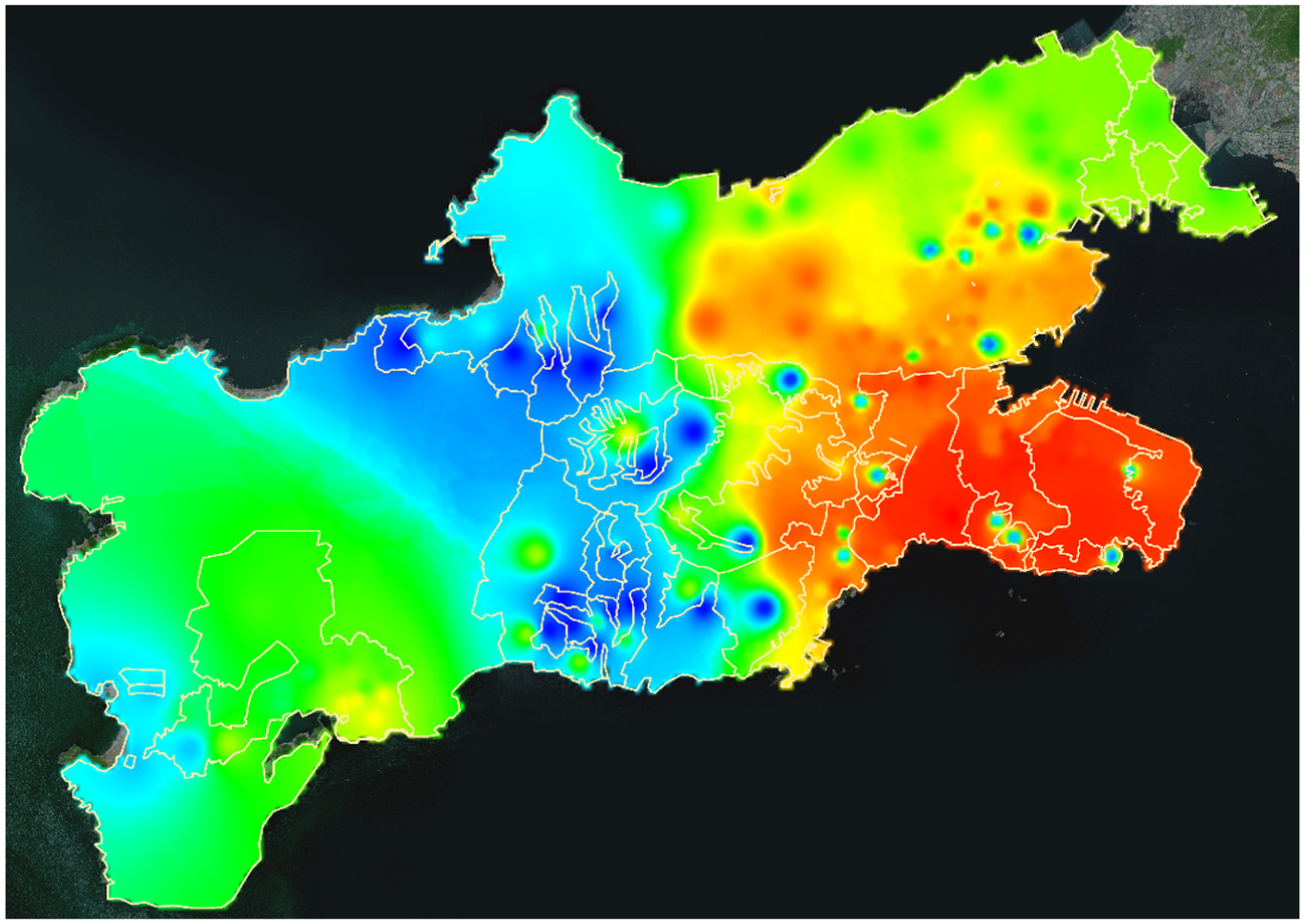
Distribution of housing prices in Dalian.
The area in Dalian is divided into 435 small areas according to the community. The distance between each small area and the store can be calculated using the center of each community instead of community area. The distributions of the community, existing stores, and candidate stores are shown in Figures 4 and 5.
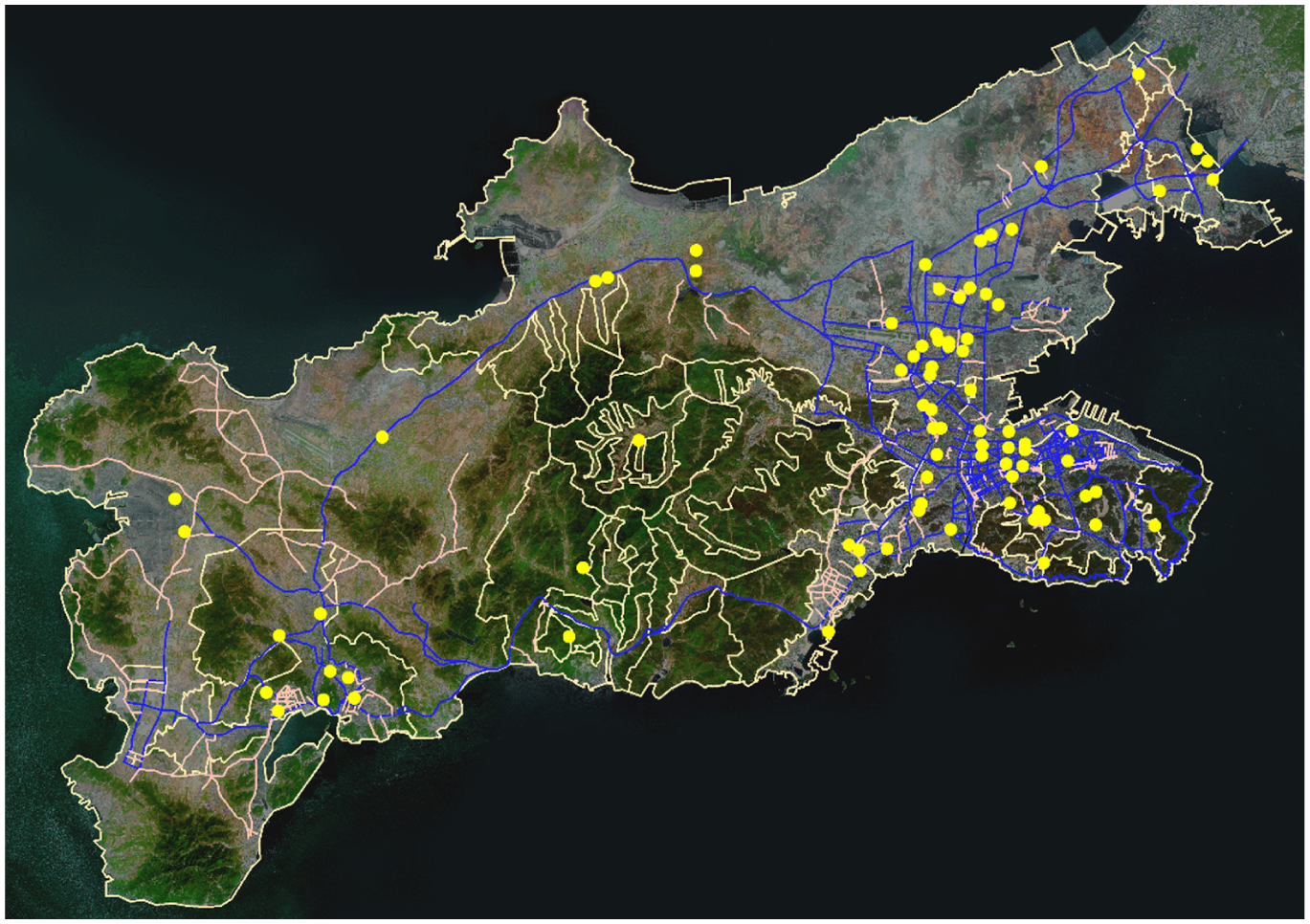
Distribution of community and existing stores.

Distribution of candidate stores.
According to the survey about customers, the study takes the average value of the valid questionnaires as the weight

Table 2 shows the utility of four factors according to the customers. Due to different preferences of each person, different consumers may have different views on the same factor of the same store. This article assumes that the consumer’s score for a utility impact factor is in accordance with the standard normal distribution function, and the standard deviation of the normal distribution function is 0.1.
The utility of some stores.

The solution is calculated by GA. Although the crossover and mutation rates would be optimized during evolution, the impact of the initial combination of crossover and mutation rates is also critical. In order to obtain better crossover and mutation parameters, a comparison of different combinations of crossover and mutation rates is done. Because the choice of mutation rate is usually not more than 0.3 and the selection of crossover rate should not be less than 0.5, this article presents 12 combinations of different crossover and mutation rates (shown in Table 3). Each combination runs 10 times for average; the convergence is shown in Figure 6.
Twelve combinations of different crossover and mutation rates.


The convergence of 12 combinations.
It can be seen from Figure 6 that combination of 7 and 11 converges faster at beginning, but the trend to be stationary is at a slower rate. Combination of 3 and 9 tends to be stable faster, but the convergence rate is very slow at the beginning. Comparatively speaking, combination 6 has a faster convergence speed and a stronger smoothness. Therefore, the crossover rate of 0.7 and mutation rate of 0.15 are used as initial parameters to solve problems.
The number of iteration is 1000 times, and the solution is shown in Figure 7.

The optimized solutions.
The blue points in Figure 7 are the special car repair stores chosen to build. There are seven candidate stores to be chosen as chain stores and the total profitability is 308.6. It is not difficult to find that 35 and 36 are relatively away from the existing repair stores. The consumption ability around points 37 and 38 is high. Thus, they are the best choice to establish chain store.
The location of the special store is affected not only by the existing repair stores and consumption ability but also by the total investment cost. The change in profitability is analyzed further because of the change in available capital as shown in Figure 8. The results show that the total profitability shows an increasing trend when the capital changes from 0.3 to 2.5 million Yuan. When the capital reaches 3 million Yuan, the total profitability will not increase. Thus, it is wrong to build stores as many as possible, which could affect its effectiveness. For the enterprise, it is a clever choice to put about 2.5 million Yuan, which can both ensure a reasonable arrangement of capital and get the largest market share.

The relationship between capital and profitability.
GA is a heuristic algorithm based on biological evolution. It is necessary to test the stability and effectiveness of the proposed algorithm. Figure 9 shows the GA’s results of 10 times running on MATLAB. It can be seen from the figure that the algorithm has a strong smoothness. It has become stable when the number of iterations reaches 60, and the convergence rate is fast.

Convergence graph of improved GA.
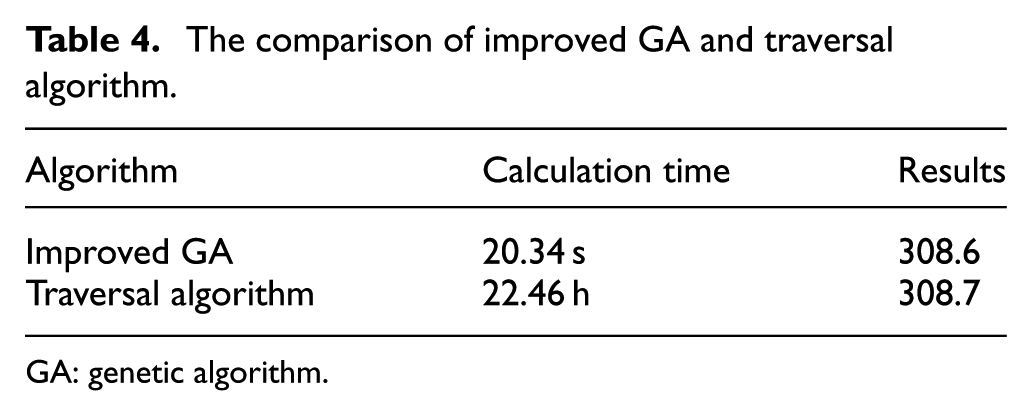
To prove the validity of the improved GA, the study compares it with traversal algorithm. Figure 10 shows the idea of traversal algorithm. According to the construction cost of candidate points and experience, the minimal and maximum numbers of points can be fixed. Table 4 shows the comparison of GA and traversal algorithm. It can be seen that GA has the advantage in the calculation time. The optimized results obtained by these two algorithms are almost the same. Therefore, GA is feasible and effective in solving the model proposed in this study.
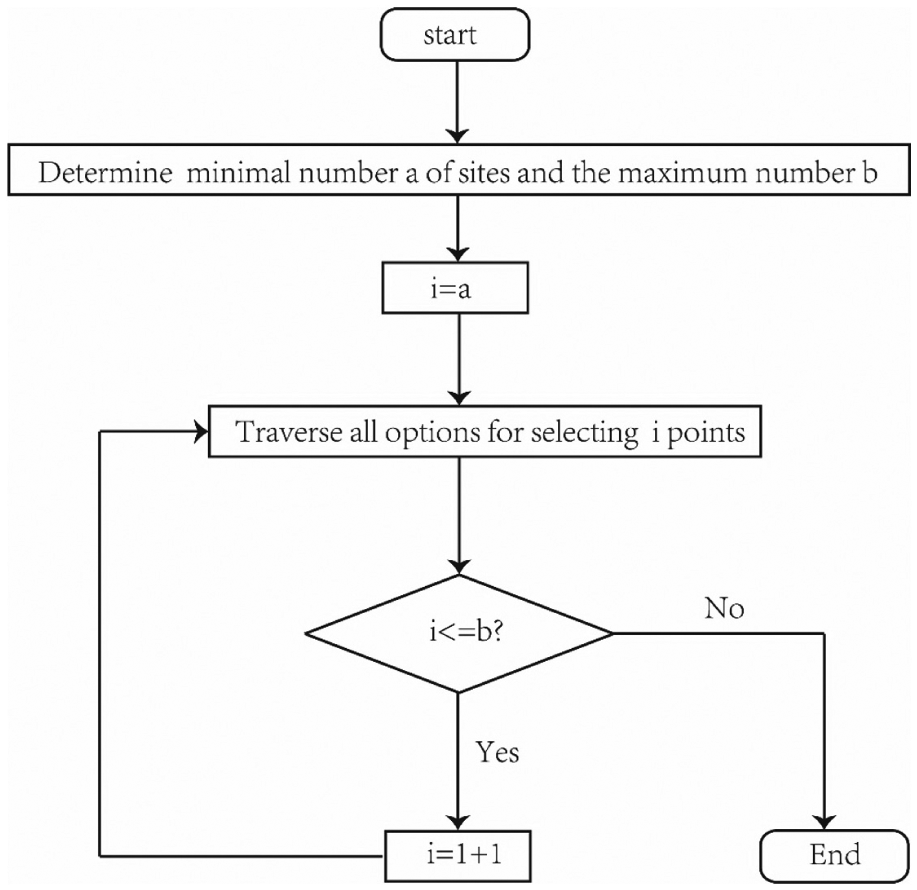
Flow chart of traversal algorithm.
The comparison of improved GA and traversal algorithm.
GA: genetic algorithm.
Conclusion
According to the analysis of the automobile post-market, it is a good choice to build special car repair stores facing fierce competition. Combined with the company’s capital limit in reality, a model with an objective of maximum profitability is set up to solve location distribution problem. Consumption capacity is measured by population density and house price. The probability of choosing each candidate point is determined by equation (4). In addition, an improved GA is proposed to get better solutions and stability. Finally, an example of Dalian in China is given, and a solution of location is shown through calculation and analysis. From the results, it can provide some reference for the enterprises on the capital. At the same time, the improved GA is proved to be stable and effective, and an optimal solution could be obtained in a relatively short period of time.
In addition, apart from taking the characteristics of the demand into account, operation mode of the chain stores can also be taken into account in the location distribution problem, on which further research can be done in the future.
Footnotes
Appendix 1
Academic Editor: Peter Nielsen
Declaration of conflicting interests
The author(s) declared no potential conflicts of interest with respect to the research, authorship, and/or publication of this article.
Funding
The author(s) disclosed receipt of the following financial support for the research, authorship, and/or publication of this article: This research was supported by National Natural Science Foundation of China (51578112), Humanity and Social Science Youth Foundation of Ministry of Education of China (13YJCZH042), Specialized Research Fund for the Doctoral Program of Higher Education of China (20120041120018), and Liaoning Excellent Talents in the Central Universities (DUT16YQ104).