




Abstract
The purpose of this article is to analyze various wind speed-forecasting methods, select the appropriate method for developing synthetic wind speed for 1-year period at Salem in Tamilnadu state in India, and use it for the structural and fatigue analysis of a small horizontal-axis wind turbine blade made of composite material. Various forecasting models such as Markov chain, Kalman filter, and autoregressive integrated moving average are evaluated, and a long-term wind speed pattern at Salem is developed using Markov chain. This wind pattern is used to create time-varying loads using the blade element momentum on blade sections. Then, the fatigue analysis of the blade is carried out using the stress life approach. The blade is found to have available life of about 20 years and the critical area for fatigue is found on the skin near the root of the blade. Various blade skin materials are also compared for fatigue performance. A cohesive zone model of the adhesively joined root joint is also developed and analyzed for fatigue at the metal–composite joint. Thus, an integrated methodology involving high-fidelity modeling of the blade, wind forecasting, and static and fatigue analysis is developed for horizontal-axis wind turbine blade for locations where historically wind speed measurements are available for short time.
Keywords
Introduction
The service life of wind turbine blades is highly influenced by the random and nonlinear nature of wind leading to unsteady aerodynamic effects, wind turbulence, and dynamic stall and causing fatigue loads as highlighted by many researchers such as Mo et al. 1 and Liu et al.2,3 Wind speed forecast is closely associated with power generation prediction, and high-precision wind speed prediction is needed for effective and safe wind energy utilization for small power systems as highlighted by Kaneko et al. 4 Accurate wind prediction also reduces operating costs and improves reliability of power generation system as highlighted by Smith et al. 5 Researchers therefore focus on wind profile analysis and forecasting to better predict the blade loads and fatigue and optimize the blade design for improving safety and reliability. With a focus on blade optimization study which depends on wind, rotor control strategy and generator type, Yi et al. 6 studied the effects of rotor control strategies such as combinations of fixed and variable speed and pitch algorithms on optimal blade shapes and rotor performance using optimized blade designs. They also evaluated the effects of environmental wind data and the optimization functions using the NREL HARP_Opt tool which uses WT_Perf code for performance evaluation based on blade element momentum (BEM). Some of the performance indices which the authors compared and are significant for this study were thrust, torque, and roof-flap moment forces. Ghasemi et al. 7 studied the aeroelastic stability aspects of composite blades of a 660 kW wind turbine blade under flutter, that is, coupling of bending and torsional vibrations. The blade section is made up of NACA 632-415. Analytical techniques were used to calculate flutter speed and safety factor, while finite element model (FEM) was used for static and modal analyses. In another study on blade optimization, Lee et al. 8 numerically analyzed effect of active load control devices such as trailing-edge flaps for reducing fatigue loading on wind turbine blades and found a 30%–50% reduction in the standard deviation of the root bending moment. The authors of this study have also used the blade model with trailing-edge stiffeners for the same purpose. Chen and Lee 9 have used an adaptive input estimation method which combines Kalman filter without input term and adaptive weighted recursive least square estimator to predict the wind load on a multilayer shearing stress system.
As pointed by Grujicic et al., 10 the main structural performance requirements for wind turbines are (1) flapwise bending strength to withstand extreme wind loads and (2) flapwise bending stiffness to ensure a minimum clearance between blade tip and the turbine tower. To meet these conditions, Hu et al. 11 developed a fatigue analysis procedure including random wind field simulation, aerodynamic analysis, FE stress analysis, and fatigue damage simulation. Probability density functions (PDFs) for 10-min mean wind speed and 10-min turbulence intensity were developed to simulate a 1-year wind field and calculated the accumulated fatigue damage, which could facilitate reliability analysis and reliability-based design optimization of composite wind turbine blades considering wind load uncertainty. Lecheb et al. 12 have analyzed fatigue life of a 25-m-long wind turbine blade made of glass/epoxy composite. They first carried out modal and static analyses to find out blade critical zone for stresses followed by crack growth study, experimental fatigue life determination, and fast fracture. In order to help meet needs such as carrying out risk analysis, reliability-based design optimization, and maintenance scheduling, An et al. 13 have used Bayesian technique to obtain a fatigue life prediction model for wind turbines. Their method makes use of available field data, noise, and bias in measurements on the distribution of fatigue life so that difference between designer’s predicted life and field observations can be reduced. They used Markov chain Monte Carlo technique to obtain the posterior distribution. Significant amount of simulation and experiments have been investigated on the life prediction of composite materials in literature; however, experimental validations of fatigue failure of composite wind turbine blades (made of composite materials) are often hampered due to lack of enough structural health monitoring data measured under realistic random wind loading in the field. Hence, this article focuses on accurate wind modeling for structural and fatigue analyses of composite wind turbine blades.
There are various methods available for wind modeling that could be classified as (1) physical models, (2) spatial correlation models, (3) artificial intelligence models, (4) stochastic statistical models, and (5) hybrid models.
Spatial correlation models take the spatial relationship of different sites’ wind speed into account for prediction. Spatial correlation models need site-specific local historic data for accurate prediction and are useful when the nonlinear relationship between these local variables is required to be modeled. However, these models may not be appropriate to be used when little historical information is available.
The use of artificial intelligence models such as artificial neural network (ANN) and fuzzy logic is increasing over the years. Barbounis and Theocharis 14 developed a locally feedback dynamic fuzzy neural network (LF-DFNN) for 15 min to 3 h ahead wind speed prediction with spatial correlation and having superior accuracy over other network models. Flores et al. 15 supplied a control algorithm based on ANN model using back-propagation method for wind speed prediction. Surveys on artificial intelligence models on wind speed prediction has been carried out in Lei et al., 16 which concludes that it is necessary to further study on artificial intelligence methods and improve their training algorithm aiming at more accurate results of wind speed prediction.
Stochastic statistical models consist of a mathematical model based on historical data, patterns, and wind parameters. Amezcua et al. 17 developed an algorithm using generalized random Fourier series to generate a real-time wind speed time series from data logger records containing the average, maximum, and minimum values of the wind speed in a fixed interval, as well as the standard deviation. They also incorporated extreme values using the concept of constrained simulation in post processing.
One typical group of stochastic statistical approaches includes autoregressive (AR) models, integrated models (I), and moving average (MA) models which depend linearly on the previous data. The combined methods such as autoregressive moving average (ARMA) described by Box and Jenkins 18 and autoregressive integrated moving average (ARIMA) models. A review of the literature by Jung and Broadwater 19 suggests that statistical models can be utilized for short-, medium-, and long-term predictions quite well. Cadenas and Rivera 20 applied ARIMA and the ANN methods and also compared the two techniques for wind speed prediction in Mexico. They found that both the models provided reasonable predictions, and seasonal ARIMA model has a better sensitivity to wind speed adjustment. They utilized mean absolute percentage error (MAPE) as a forecast error for comparison. Another commonly used stochastic statistical model for wind speed prediction is the Markov chain model. 21 Synthetic wind speed generation for a specific site using Markov transition matrix has been employed by various researchers such as Negra et al. 22 for short-term prediction. These models are easy and inexpensive to implement as compared to spatial correlation models which need large geospatial data of various sites as well as higher processing cost due to the multiple input variables representing physical properties of the sites such as temperature, pressure, humidity, and altitude to predict the wind speed. Thus, in this article, the wind speed simulation has been carried out by three stochastic statistical models such as ARIMA, Kalman filter, and first-order Markov chain, and the suitable model is selected for wind speed prediction and related structural fatigue analysis.
Hybrid models combine the benefits of individual models and overcome limitations of using a single model. They could be formed by combining physical and statistical models or statistical and spatial models.
Huang and Xu 23 have proposed a numerical simulation procedure for predicting directional typhoon design wind speeds and profiles for sites over complex terrain by integrating typhoon wind field model, Monte Carlo simulation technique, computational fluid dynamics (CFD) simulation, and ANNs. Ke et al. 24 utilized another hybrid forecast model called wavelet packet transform (WPT) for wind prediction based on daily average wind speed data from four wind farms in China. The hybrid model although is more time-consuming, and it has better accuracy than the individual models as indicated by the error criteria such as mean absolute error (MAE), mean square error (MSE), and MAPE.
The literature survey on wind modeling and wind turbine blade fatigue analysis shows that although there are various studies available on wind prediction methods and blade structural and fatigue analyses, very few are available for an integrated framework starting from forecasting of long-term wind to aerodynamic and structural analyses and to fatigue analysis of composite horizontal-axis wind turbine (HAWT) blades with limited or no raw wind data available for the site. Hence, this study focuses on developing an integrated procedure incorporating long-term wind forecasting methods into blade fatigue analysis.
The unique contribution of this study is that (1) it compares the various statistical wind forecasting models to select the one which is best suitable for fatigue analysis applications, (2) develops long-term wind profile prediction for sites which does not have enough historical wind measurement data to a good level of accuracy, (3) performs high-fidelity three-dimensional (3D) modeling and analysis for random wind loads for fatigue, and (4) extends the conventional fatigue analysis by comparing the cohesive zone modeling (CZM) approach for root joint of blade for fatigue. Thus, this study presents an end-to-end framework for wind turbine blade analysis.
For accurate structural analysis, a high-fidelity blade model is generated referring from the work by Perkins and Cromack. 25 The structural analysis results are compared with the published results so that the baseline model is available. The predicted long-term wind load is then applied to the fatigue analysis considering wind load variation at the selected location of Salem, Tamilnadu in India.
The blade analysis procedure consists of four steps as shown in Figure 1. First, a detailed computer-aided design (CAD) model for a wind turbine blade is developed in Catia V5R20 software based on the specifications. Pre-processing of the model is performed by applying material properties and boundary conditions and meshing the model. This is followed by natural frequency and static structural analysis of the model as per the loading specified in the reference and validating the baseline model. In the third step, the available monthly Weibull wind speed parameters at the selected site are fitted with a stochastic model. Weibull probability distribution method is commonly used for wind speed prediction on account of its accuracy as noted by various authors.26,27 A forecast of the long-term wind speeds is then carried out using stochastic wind-generation models, and the suitable model is selected as a basis for long-term load calculation. Finally, a software program based on BEM theory with consideration for tip and hub losses is developed to obtain the variable loads on the turbine cross sections for 1-year period. The static stresses obtained from the load amplitudes on cross sections along with the variable wind load spectrum are then used to predict the cumulative fatigue damage, life, and safety factor. The above-mentioned BEM method is one of the most commonly used methods to achieve rapid simulations for standard sets of aerodynamic calculation in both academia and industry. Ke et al. 24 developed a procedure to find the aerodynamic loads and aeroelastic responses of a 5-MW large wind turbine in yaw condition. They employed harmonic superposition method and modified BEM method to calculate aerodynamic loads while fully accounting for wind shear, tower shadow, tower-blade modal and aerodynamic interactions, and rotational effects. The authors also analyzed the yaw effect and aeroelastic effect on aerodynamic loads and wind-induced responses. In their earlier study, Ke et al. 28 developed an approach for predicting the wind models and wind effects of large wind turbines and the vibration effects due to wind on the 5 MW tower-blade-coupled wind turbine. They calculated the wind-induced static loads and responses considering resonance coupling of modes and background responses. Their study found that the resonant component plays a significant role on equivalent static wind loads and responses than background component at the middle-upper part of the tower and blades. The cross terms between background and resonant components affected the total fluctuation responses. Other notable work in this area includes those of Burton et al. 29 and Hansen. 30

Blade analysis procedure.
Structural and aerodynamic analysis of the wind turbine blades is studied by many researchers as the size of wind blades is increasing due to growing power demands. Tenguria et al. 31 analyzed a composite material HAWT blade subjected to flapwise loading. They utilized ANSYS software and focused on root section and transition section where the cross section changes to NACA 634-221. The current authors of this article also have performed structural analysis of a similar blade as a first step and used it as a base for fatigue analysis due to wind loads. Rafiee and Fakoor 32 analyzed a 23-m HAWT composite blade having a mixed airfoil geometry (NACA, FFA-W3, etc.) across its length for modal, aeroelastic, and aerodynamic analyses using FEM. The authors carried out structural analysis at startup, standby, power production, and shutdown events and optimized the geometry of the blade as per observed deformations. One of their important recommendations is to consider static aeroelasticity for blade design for fatigue since this phenomenon increases induced stresses in blade laminates. Vardar and Eker 33 analyzed six NACA profiles and found a general trend that blade area and volume are directly proportional to starting speed and inversely to the rotor performance. Spagnoli and Montanari 34 carried out time-domain along-wind dynamic analysis of upwind HAWT considering coupling effect of blades and tower. The wind speed field is considered with mean and fluctuating components. Their study brings out the importance of analyzing blade and tower as a coupled system and serves as a tool for preliminary design of wind turbine–tower systems.
This article is organized as follows: section “Blade modeling and structural analysis” presents the details of the blade model, structural analysis procedure, and comparison with the available reference solution. Section “Wind field modeling and forecasting” presents the wind field modeling and forecasting procedure. Section “Blade fatigue analysis” extends the procedure to fatigue analysis and presents the fatigue life, damage, and safety factor results for the blade. Section “CZM of blade root joint” discusses the CZM of the root joint of the blade. Finally, the conclusions and future work directions are provided.
Blade modeling and structural analysis
In this section, details of blade specifications, 3D modeling, and static and natural frequency analyses of the WF-1 blade are explained along with comparison to available results.
Blade specifications and modeling
The basic geometry of the blade used in this study is referred from the Technical Report by Perkins and Cromack 25 at University of Massachusetts Amherst. The blade called as WF-1 (Wind Furnace-1) belongs to a three-bladed prototype downwind wind turbine. The reason for selecting this blade is because this is a small HAWT blade which is the focus of this study. Furthermore, the blade geometry and modal and static analyses information are available for this blade which is helpful to create a baseline 3D model, and the study can be extended to carry out fatigue analysis due to wind loads.
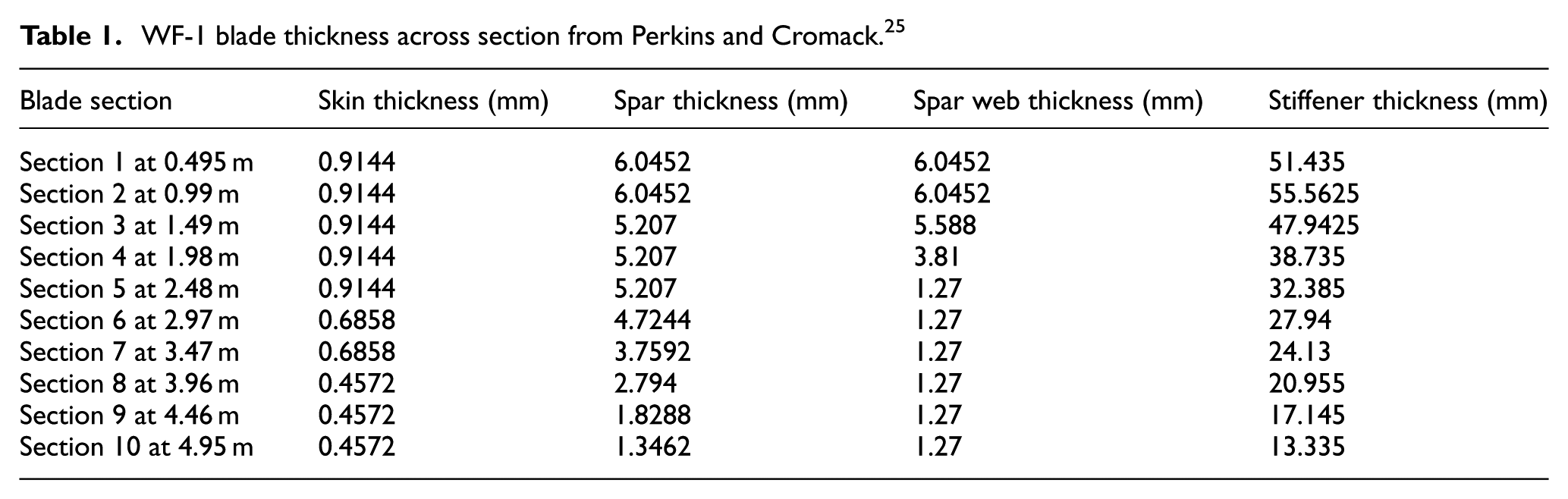
The blade section and planform are defined in Figures 2 and 3. The blade geometry details are shown in Tables 1 and 2, and material properties of blade parts are shown in Table 3.

A sample blade section at 0.495 m from root as defined by Perkins and Cromack. 25

Blade Planform as defined by Perkins and Cromack. 25
WF-1 blade thickness across section from Perkins and Cromack. 25
WF-1 blade specifications from Perkins and Cromack. 25

WF-1 blade material characteristics from Perkins and Cromack. 25

The blade is made up of four parts: skin, spar, spar web, and stock. The skin composition is of fiberglass epoxy matrix having low bending modulus. The spar and the web are made of high-modulus fiberglass epoxy matrix and the stock is surrounded by a steel sleeve. The purpose of spar and spar web is to provide reinforcements to the hollow interiors of the blade. A trailing-edge stiffener is provided to prevent the top and bottom faces from attaching to each other near the trailing edge in case of heavy loads.
In order to maintain the aerodynamic configuration as per the specification, a high-fidelity 3D CAD model of the blade airfoil section and the blade is created using CATIA V5 3D modeling software. The airfoil sections are drawn as per the chord lengths and span locations defined in Figure 1 and the twists were applied to them as specified. The airfoil sections were connected by spline curves and a surface model is created. Figure 4 shows the airfoil sections and assembly of the blade CAD model.

Details of blade model: (a) NACA 4415 profile for cross section, (b) blade surface, (c) wireframe, and (d) blade spar, web, and stiffener.
Blade structural analysis
FEM of the blade
The blade assembly is composed of four parts, which are the handle, skin, stiffener, and the shear web. These parts are assigned the thicknesses and material properties as defined in Table 2 and Figure 2, respectively. The FE model of the blade was created using the ANSYS software. The mesh was created using 71,212 elements and 141,385 nodes in the model. The root of the blade handle was fixed for all degrees of freedom (DOF) to create a fixed boundary condition for cantilever to simulate the root joint with turbine hub. Figure 5(a) and (b) shows blade’s 3D CAD and meshed model, respectively.

Blade model: (a) CAD model and (b) FE model.
Natural frequency analysis
In order to validate the correctness of the developed simulation model of the blade, the natural frequencies of the blade are calculated and compared with the reference solution by Perkins and Cromack. 25 The block Lanczos method is used to perform the modal analysis as it is widely used. The vibration modes of first three orders were extracted. Figure 6 shows the three modes and Table 4 shows the observed natural frequencies and comparison with the reference (experimental and numerical predictions). As shown in Figure 6 and Table 4, the most important top three modes of the developed blade match well with the reference blade.

Natural frequency and mode shapes: (a) mode I, (b) mode II, and (c) mode III.
Blade natural frequencies.

The difference between the observed natural frequencies with the reference numerical prediction can be attributed to uncertainty in the available geometry details such as trailing-edge region, stiffener thickness, and resin-steel sleeve at the handle. This uncertainty could have resulted in lesser flexibility in the model especially for the second mode. However, since flapwise bending is more critical for fatigue load, 10 the variation in edgewise mode can be accepted.
Static structural analysis
The blade is subjected to static loads to check whether the deflection and bending stresses on top and bottom surfaces are computed correctly as compared with reference solution by Perkins and Cromack. 25 The load applied is 68.95 N acting downward with blade in horizontal position (15 lbs and 8 Oz as per reference) at a location of 0.95R where R is the blade span radius. The results for the deflection of the free end and the maximum bending stresses on top and bottom surfaces at a section located at 0.475R along with comparison with reference is shown in Table 5. Figures 7 and 8 show these simulation results from ANSYS computer-aided engineering (CAE) software.
Blade deflections and maximum bending stress under applied reference load.


Deflections of blade free end: (a) vertical deflection and (b) horizontal deflection.

Bending stresses on (a) top and (b) bottom surfaces at 0.475R.
The variation in the bending stress on the top (suction) and bottom (pressure) surfaces of the blade across the chord length was found out at a specified location of 0.475R in the reference. Figure 9 shows a good agreement between the observed and the reference distribution.

Comparison of observed and reference Perkins and Cromack 25 bending stresses on top and bottom surfaces of the blade at a location of 0.475R.
Thus, the baseline model of the blade is established having structural response close to the reference. This blade model is further analyzed for transient and fatigue analysis in next section.
Wind field modeling and forecasting
For the Salem location, the information available for the mean wind speed and Weibull parameters for wind distribution for each month of the year is referred from the works of Sriram et al. 35 The parameters are based on the data taken every 4 h on Monday, Wednesday, and Friday during 2001 and 2002 time period. The Weibull distribution function is defined as

where K and C are shape and scale parameters, respectively, and V is the wind speed. These parameters for each month of the above-mentioned period are given in Table 6.
Average monthly wind speed and Weibull parameters.

As mentioned in section “Introduction,” the details of the three stochastic forecasting models—first-order Markov chain, ARIMA, and Kalman filter—and their comparison for the wind prediction are discussed in the following.
Markov chain
This is a discrete time model made of sequence of random variables

The set of possible states of

The probability distribution of transitions from one state to another can be represented into a transition matrix
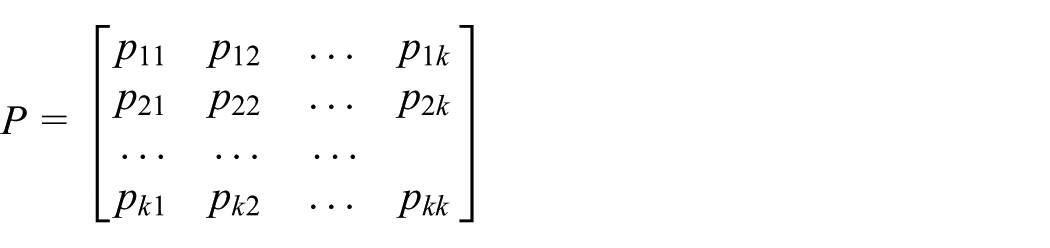
So, for a three-state chain, it can be represented as

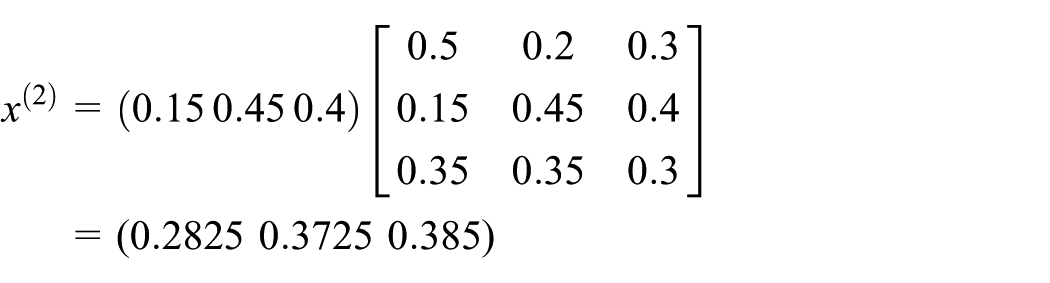
or let us say with an example

This means that p12 = 0.2 is the probability of system to go from state 1 to state 2, that is,

If all the states in the matrix communicate, that is,
The availability of Weibull parameters and mean wind speed for each month of the year as shown in Table 6 accounts for the seasonality of the wind. For each month of the year, the wind speed vectors are generated based on the mean wind speed (Table 6) and maximum wind speed for Salem which falls in zone 4. 36 These data are used to create a Weibull probability density for the vector values. The transition parobability matrix for each month is then defined using the procedure for simulating non-Gaussian wind speed time series. 37 This matrix relates each hourly wind speed value with previous hourly average based upon (1) desired probability density as per monthly Weibull parameters and (2) autocorrelation of wind speed. Hence, the transition matrix is modeled as a normalized product of a diagonal probability matrix for probability density and a suitable symmetric decay matrix for autocorrelation.
Validation of Markov approach with a reference wind measurement
The above method is first validated against a measured wind data,38,39 and the comparison for the predicted and the measured wind is shown in Table 7 in terms of root mean square error (RMSE), MAE error metrics, and the Weibull parameters. The measured wind data considered here are for the Iowa, USA location every 10 min from 1 January 2008 till 31 December 2008. There are 52,704 observations and the wind speed range is from 0.35 to 19.22 m/s. The RMSE is defined as

RMSE, MAE, and Weibull parameter comparison of Markov prediction with measured wind.

The benefit of using RMSE as metric for comparison is that it brings in more weightage on larger error terms due to the square of the difference term.
Another commonly used error metric called MAE is calculated. MAE is defined as

where
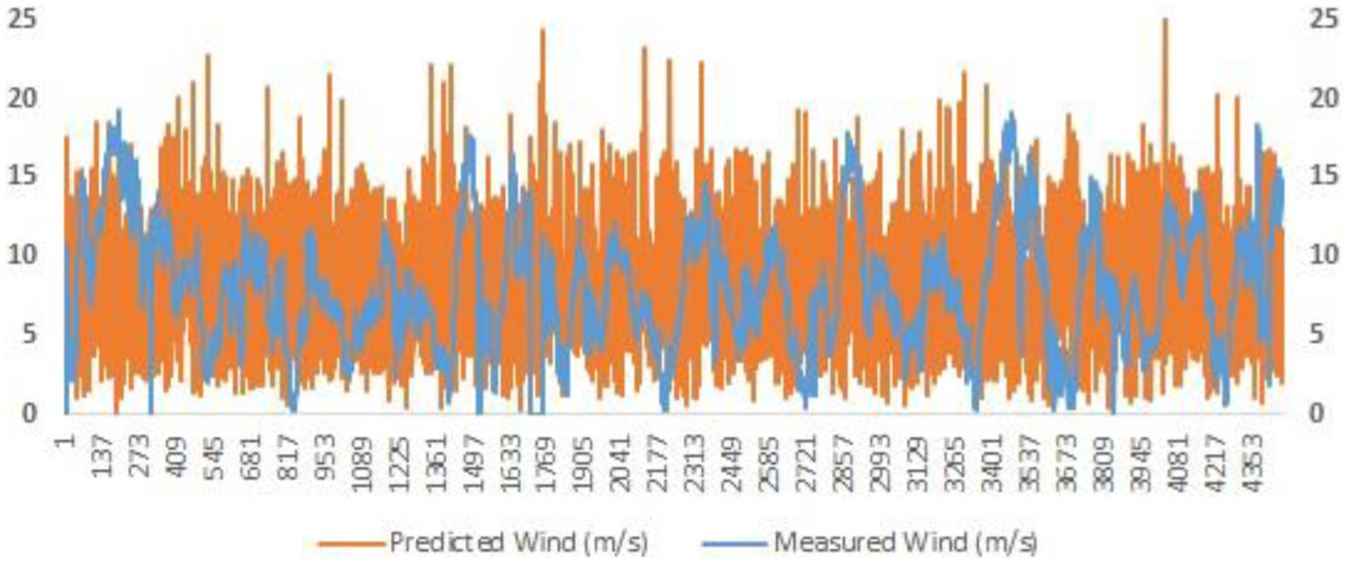
Comparison of observed and predicted wind for the month of March 2008.
Application of Markov method for Salem location
The Markov method which is tested with reference wind is now applied for the Salem city in India having the Weibull parameters and mean wind speed as defined in Table 6. The approach of including seasonality for long-term wind prediction where the actual measurements are limited is also used by researchers like Karatepe and Corscadden 41 with good results. The wind prediction using Markov and Kalman methods for months having maximum and minimum of mean wind speed is shown in Figure 11. Figure 12 shows the predicted wind speed for Salem for 1 year and its PDF is calculated using MATLAB.

Hourly wind prediction based on Markov chain and Kalman filter for Salem city for (a) May and (b) October months of the year which have maximum and minimum mean wind speed, respectively.

(a) Wind speed for 1 year generated by Markov chain and (b) Weibull probability distribution.
The transition probability matrix from Markov approach is shown in Tables 8 and 9 for November and April months, respectively, which have minimum and maximum mean speeds, respectively. This matrix is based on 12 bins for wind speed ranging from 0 to 12 m/s with 1 m/s interval.
Markov probability transition matrix for November having mean wind speed of 1.3 m/s.

Bold value shows the probability of wind speed staying in same bin/range.
Markov probability transition matrix for April having mean wind speed of 2.95 m/s.

Bold value shows the probability of wind speed staying in same bin/range.
ARIMA model
ARIMA is a type of statistical method for time series–based forecasting which combines the “autoregression” (AR), that is, modeling the linear dependence of the output on its past “p” values, and “moving average” (MA), that is, the linear dependence of the error/residual term on the current and past “q” values of stochastic error terms. ARIMA is a special case of the ARMA model where the non-stationary time series is differentiated “d” times to make it stationary. Thus, the general equation for ARIMA (p,d,q) model for a variable Y is constructed as follows.
If Y is the dth differential of Y such that


where
The process to generate the forecast data is to first estimate p, q, and d by differencing the data and iteratively checking autocorrelation function (ACF) plots for q and partial autocorrelation function (PACF) plots for p till stationary trend is obtained. Thus, the value of p is determined as the last lag after which the PAC cuts off and the value of q is determined from the last lag after which ACF cuts off. This identification phase is followed by finding
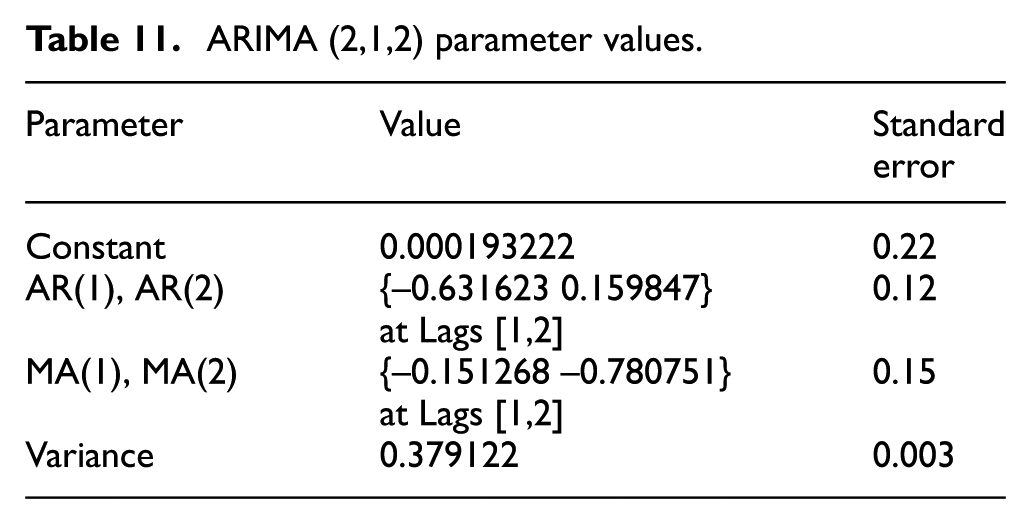
For wind prediction using ARIMA model, the wind generated using Markov Chain is used as training data. A software program is developed in MATLAB to find the autocorrelation and partial autocorrelation plots of the wind. Using the MATLAB functions “estimate,” the AR, MA, and integration parameters are found to be of ARIMA (2,1,2) series which has lowest Akaike information criterion (AIC) and Bayesian information criterion (BIC) values as seen from Table 10 when compared to some of the other trials. The AIC and BIC criteria are a standard criteria for ARIMA-based model selection. 42 The parameters of the ARIMA (2,1,2) model are given in Table 11 showing the goodness of the fit. The ARIMA prediction 1 month ahead wind speed is shown in Figure 13, and Figure 14 shows the ACF and PACF plots of the training input.
ARIMA models’ comparison.

ARIMA (2,1,2) parameter values.

Markov chain wind pattern and 1 month ahead ARIMA prediction.

Autocorrelation and partial autocorrelation plots for the Markov wind data.
Kalman filter
In this model, the unknown state vector

And the correlation between measured vector and unknown state vector is defined as

where
The wind spectrum based on Kalman filter proposed by Kalman 43 is expressed as

where U is the mean wind speed, z is the height above ground,
The standard deviation (

and the standard deviation is distributed equally among the real and imaginary parts, that is

Then, inverse Fourier transform is applied on the generated Fourier coefficients to get the series values in the time domain

Thus, looking at the accuracy of the Markov method to predict wind speed based on monthly Weibull wind speed characteristics (section “Validation of Markov approach with a reference wind measurement”) and the higher alternating wind speed prediction compared to Kalman and almost constant mean speed prediction by ARIMA model, Markov chain model is selected for wind speed forecast and blade fatigue load calculation.
Aerodynamic wind load calculation
The wind prediction obtained for 1 year using Markov chain method from previous section is used to calculate the aerodynamic forces on the blade section using the BEM method. A software program is developed in MATLAB which utilizes the varying wind speeds from Markov prediction and the flowchart in Figure 15 for calculating the hourly time-varying thrust and moment loads for the 10 blade sections for all the months of the year. Blade rotational speed is taken as 12 r/min. Thus, a duty cycle for 1 year is created. Figure 16 shows the loads and moments on some sections (1, 2, 5, 6, 9 and 10) for 1 month duration.

Flowchart for calculating induction factors and blade forces and moments.

Loads and moments on some blade sections for 1 month.
Comparison of static load calculation by BEM method with analytical method
The major loads on the wind turbine blade are due to wind itself along with gravitational force in horizontal position. The centrifugal forces are comparatively low due to low rotational speed. The lift and drag forces on the blade as given by Yahya 44 are


where

Lift and drag coefficients for NACA4415 45 at Re = 1E6.
The gravity force
Parameters for dynamic loading.


Aerodynamic forces on blade. 46
Thus, the BEM-based program calculation for static structural loads matches the analytical solution with acceptable tolerance as seen from Table 13. The resultant thrust loads closely match. Many authors such as D Salimi-Majd et al. 47 have used this approach to find approximate blade loads.
Static load comparison of BEM and analytical approaches.

BEM: blade element momentum.
Blade fatigue analysis
The time-varying wind loads and moments on blade calculated in section “Aerodynamic wind load calculation” are used as basis for the fatigue analysis. The load cycle is made of 1 year of loads with data point for each hour of a month for the selected site of Salem. Thus, there are 8760 load points in the cycle. In order to create the time-varying signal, first static analysis is carried out by taking the peak values of load and moment. Then, a non-dimensional signal is created by dividing actual loads by the peak loads used in the static analysis. The equivalent von Mises stress obtained from static analysis is used as a basis for fatigue analysis. Figure 19(a) shows the applied loads in static analysis and Figure 19(b) shows the Von Mises stress distribution.

(a) Loading, (b) equivalent von Mises stress, and (c) maximum principal stress for static analysis.
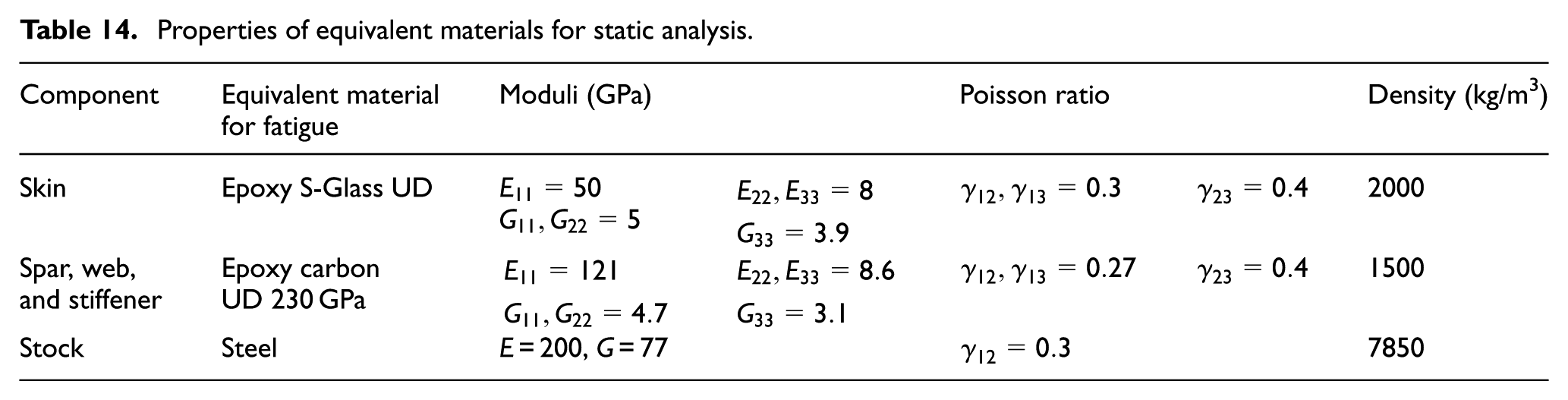
Since the reference material by Perkins and Cromack 25 does not contain enough information for fatigue analysis, equivalent materials for skin, spar, web, and stiffener are chosen as shown in Table 14 for carrying out static analysis as first step. The material properties for these materials are obtained from SNL/MSU/DOE Composite Material Fatigue Database. 48
Properties of equivalent materials for static analysis.
The S-N curves for skin and spar, web, and stiffener materials are shown in Figures 20 and 21, respectively, which are used for fatigue analysis. These S-N curves are generated from the constant life diagrams (CLDs) referred from Mandell et al. 49

S-N curve for skin material at stress ratio R = –1 (Epoxy S-Glass UD).
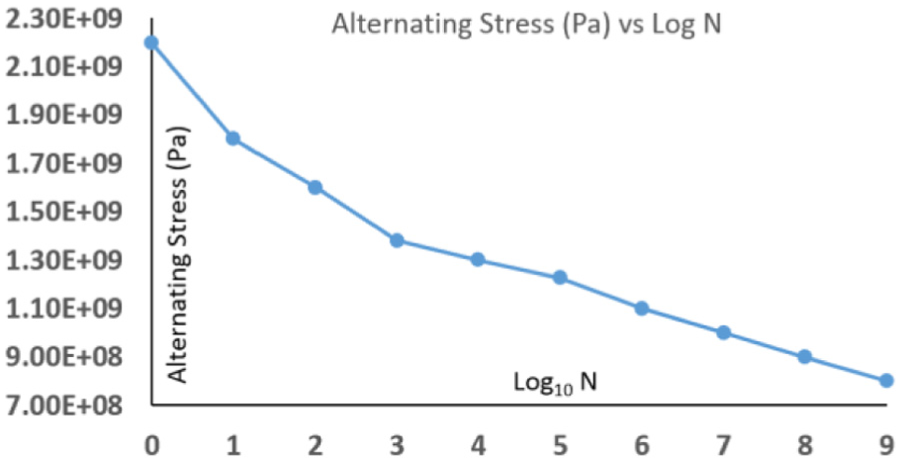
S-N curve for spar, web and stiffener material at stress ratio R = –1 (Epoxy Carbon UD 230 GPa).
After performing the static analysis, the time-varying load signal is used to calculate the fatigue life, damage, and safety factor for the blade. The stress life approach is used with Goodman’s criteria for mean stress correction and von Mises stresses are used as stress component. It is seen that the blade has the available life of around 28 years and corresponding damage of 3.58 for the load cycle shown in Figure 16. The load scale factor is then varied to see the effect on fatigue. Figure 22 shows the variation of available life (years), accumulated damage, and safety factor at the fatigue critical location (FCL) with the load scaling from 0.25 to 2.5. Figure 23(a)–(d) shows the available life, factor of safety, damage, and the rainflow cycle plots, respectively, at the FCL which is on the skin near the root of the blade. These plots are for a 1-year load cycle made of 8760-h signal. The life units are in hours and stress ratio R is −1. The design life is taken as 40 years (350 and 400 h).
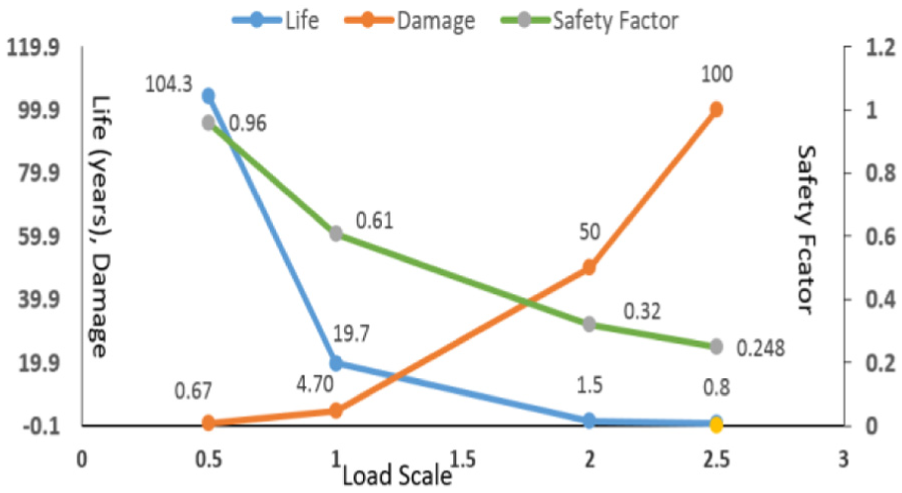
Variation in available life, damage, and safety factor with load scaling at stress ratio R = –1 and S-Glass as skin material.

(a) Available life in FCL zone (2.443E05 h = 27.9 Years), (b) safety factor in FCL zone, (c) damage in FCL zone, and (d) rainflow amplitudes and mean values for stress ratio R = –1 and von Mises criteria.
Effect of stress ratio
The importance of studying the effect of stress ratio R on the fatigue life of composite materials was highlighted by authors such as Huh et al.
50
and Roundi et al.
51
Most of the studies have focused either on tension–tension or compression-only loadings. Gambone,
52
however, has analyzed a wide range of stress ratios −1 ≤ R ≤ 0.5 and its effect on the mode-II delamination of carbon/epoxy composites in terms of strain energy release rate range
Hence, present authors have carried out fatigue analysis of the blade for stress ratios of −1, −0.5, 0.1, and 0.5, and the results are shown in Figure 24. It shows the effect of stress ratio on the fatigue parameters. It is seen that the stress ratio for fully reversed condition of −1 is the least favorable while with R = 0.5 is the most favorable. These findings are in line with the similar studies mentioned above and can be explained by the fact that stress ratio of −1 means a high stress amplitude as compared to positive ratio.

Variation in available life, damage, and safety factor with stress ratio (R) and S-Glass as skin material.
The von Mises stress variation at the node where maximum static stress is found is calculated from the load signal and the static analysis results. A software program in MATLAB is created to extract the rainflow cycles from the variable nodal stresses. The rainflow matrix in Figure 23(d) shows that the smaller stress amplitudes up to 4 MPa are more in number and contribute more to the fatigue failure than the large stress amplitudes. Note that due to some modeling error far away from root zone, there are some areas where high damage and low life are shown by the ANSYS tool which can be ignored as it is not in the FCL zone near the blade root.
Effect of stress criteria
The fatigue analysis is also carried out by considering the maximum principal stress criteria. Table 15 shows the difference in the fatigue life and safety factor for maximum principal stress and von Mises stress criteria and Figure 25 shows these plots. It is seen that the maximum principal stress accounts for lower fatigue life and safety factor than von Mises criteria due to higher principal stresses as seen in other studies. 53
Fatigue results considering two static stress criteria at a stress ratio of −1.
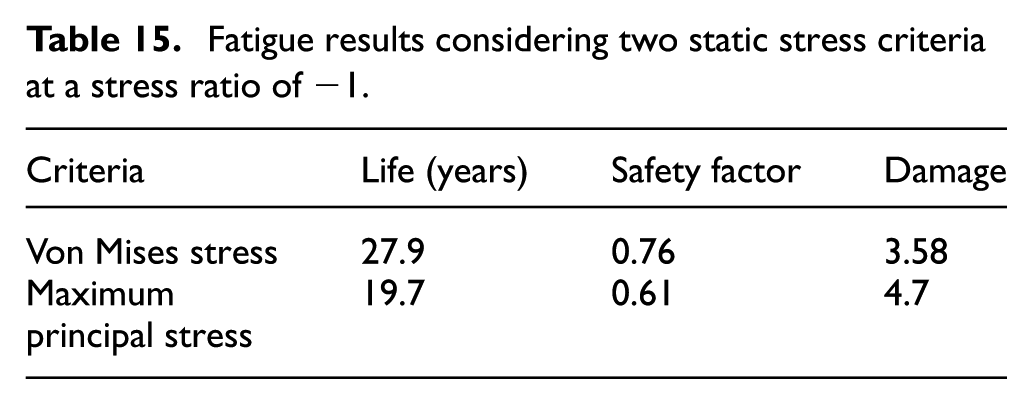

(a) Available life in FCL zone (1.72E5 h = 19.7 years) and (b) safety factor in FCL zone for stress ratio R = –1 and maximum principal stress criteria.
Analysis with different skin materials
The fatigue life, damage, and factor of safety were also calculated by doing analysis with glass fiber–reinforced epoxy laminate (QQ1) and carbon/glass-hybrid-fiber-reinforced epoxy (P2B) for skin material. The material properties are shown in Table 16 which are first used to do static analysis.
Material properties for various skin materials.

QQ1 is the glass-fiber-reinforced epoxy laminate made up of Vantico TDT 177-155 Epoxy Resin, Saertex U14EU920-00940-T1300-100000 0’s, and VU-90079-00830-01270-000000 45’s fabrics. P2B is a carbon/glass-hybrid-fiber-reinforced epoxy laminate made up of Newport carbon NB307-D1-34-600 G300 prepreg at 0° and glass NB307-D1-7781-497A at ±45°. The S-N curves for QQ1 and P2B were calculated using the CLD referred from Mandell et al. 49 and shown in Figure 26. The S-N curves are shown in Figure 27(b) and (c). These properties are used for the fatigue analysis. The fatigue results for various load scales are shown in Figure 28 for all the three skin materials.

Constant life diagrams (CLDs) for carbon and glass fibers for different stress ratios. 49

S-N curve for skin materials: (b) QQ1 and (c) P2B for stress ratio R = –1.
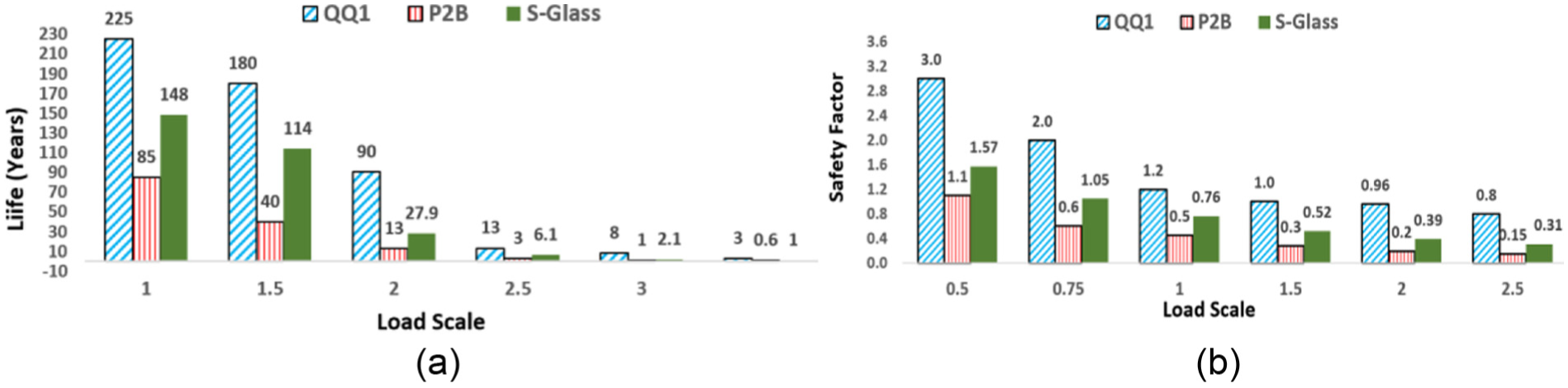
(a) Variation in fatigue life and (b) safety factor for different skin materials for stress ratio R = –1.
CZM of blade root joint
The root joint of the current blade consists of epoxy/resin composite core enclosed inside the steel sleeve. This adhesively bonded root joint is a critical area which can lead to delamination. The failure of the wind turbine root joint due to delamination has been studied by many researchers using CZM. The benefit of this method is the possibility of modeling debonding without requirement of crack and thus can be used to predict damage initiation in a healthy material.
Kalkhoran et al. 55 analyzed the debonding initiation and progression at the adhesive root joint of 23-m-long blade of a 660-kW HAWT using CZM approach. They implemented a cohesive zone constituent law based on dissipated energy and used double cantilever beam (DCB), end notch flexure (ENF), and mix mode bending (MMF) tests under static and fatigue loading for developing root joint material properties. The static analysis was effectively used to find the critical blade position for doing fatigue analysis.
Salimi-Majd et al. 47 analyzed the loading conditions at the root joint of a large wind turbine blade throughout a full rotation of the blade for the CZM-based fatigue analysis. They concluded that bending loads are more effective than the axial forces for failure of adhesively bonded root joint with blade horizontal position being critical due to high delamination index. This position and load ratio are taken as inputs for fatigue analysis. The load ratio R was defined as the ratio of minimum to maximum delamination index, while delamination index is a measure of relative strains at the beginning of delamination with those of the cohesive interface element.
Hosseini-Toudeshky et al. 56 analyzed the progressive fatigue debonding of the adhesively bonded root joint of a 660-kW wind turbine blade under cyclic loading using CZM modeling. They could verify the results of the numerical analysis for mode I, mode II, and mixed-mode crack initiation and propagation with experimental tests. They noted that the maximum length of the deboned area after a typical overloading can go up to 40% of the height of the root joint in 1 month of operation under fatigue loading and thus highlighted the significance of debonding analysis. Khoramishad et al. 57 developed a numerical damage model for adhesively bonded joints under fatigue loading that is only dependent on the adhesive system and not on joint configuration. They integrated a strain-based fatigue damage model with CZM model to simulate the damaging influence of the fatigue loading on the bonded joints. Bak et al. 58 developed a new method to simulate fatigue-driven delamination based on CZM which can predict both quasi-static and fatigue crack propagation. Their method directly links crack growth and damage evolution of cohesive zone to Paris law. This makes their method distinct with other available methods which have structural dependency on strain energy release rate. They also found good numerical convergence even at coarse meshes which is a significant benefit for computational efficiency to analyze complex turbine blades.
Considering the significance of the CZM-based damage analysis as seen from the above literature, the authors of this study carried out the CZM of the root joint with fatigue analysis to study its behavior under cyclic loads. The interface properties of the cohesive layer for mixed-mode loading are shown in Table 17. The static analysis is first carried out on the root joint modeled as cohesive zone. The results for the maximum principal stress and deflection are shown in Figure 29 which show the critical area in the interface zone.
Cohesive zone properties.


Maximum principal stress and deflection at the interlaminar region.
Fatigue analysis is then carried out by applying fully reversed load cycles for various load cycles. The results for the life and damage at the critical location found from fatigue analysis of the CZM model for various load cycles are shown in Figure 30. It is seen that the damage at the interface area increases and available life decreases as the number of cycles are increased. However, the life of 2.72E8 s (8.6 years) at 10E8 cycles and 1.96E9 (62 years) at 10E6 cycles is higher than the life of 17.9 years found earlier without CZM analysis for 3.5E05 cycles.
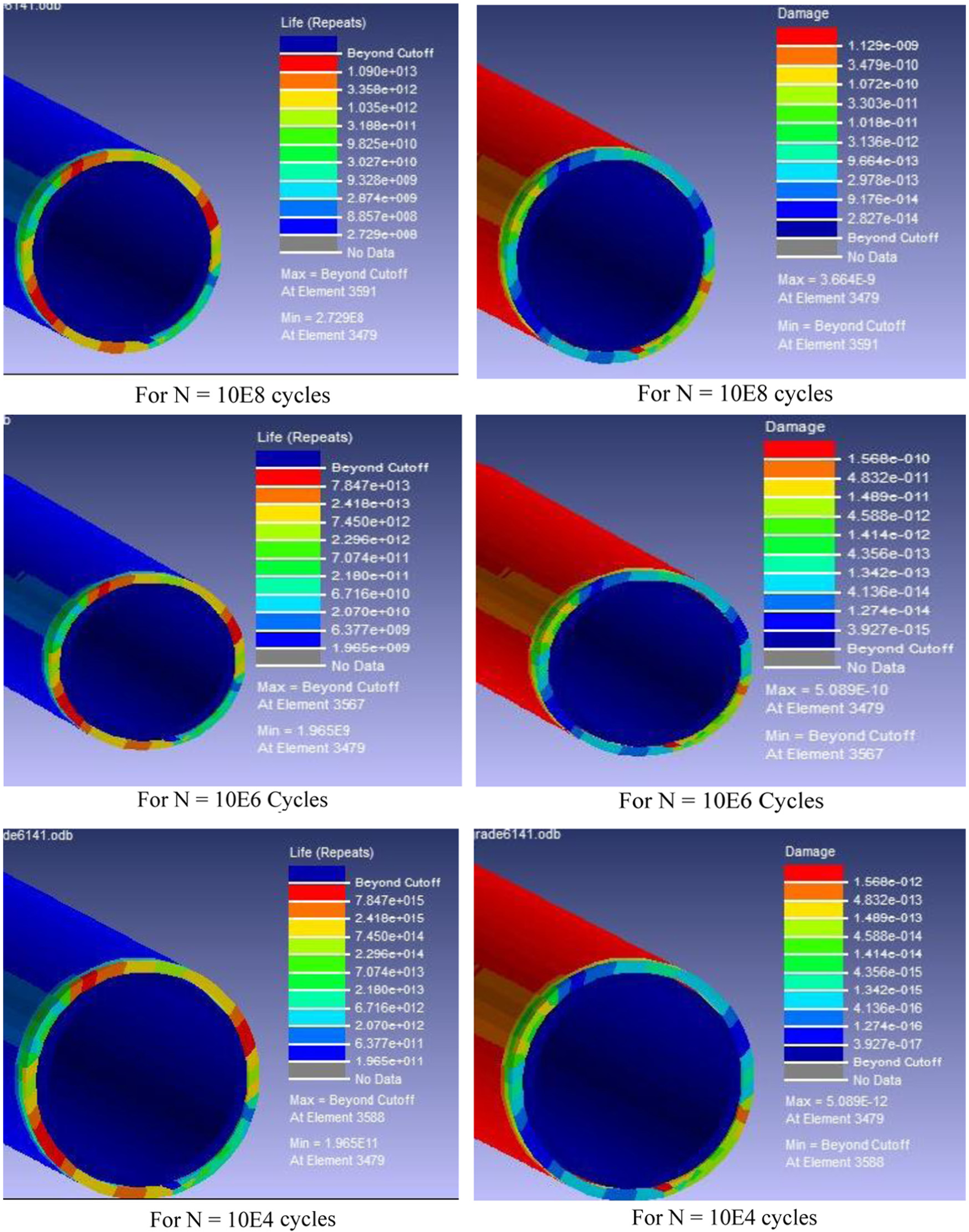
Life (seconds) and damage at the root joint for 10E2, 10E6, and 10E8 repeating cycles.
Conclusion and future work
The objective of this is to examine the structural response of a HAWT blade made of composite material to random wind loads. A reference wind turbine blade from Perkins and Cromack 25 was modeled in 3D CAD software and its natural frequency and static structural analysis results were first compared with the available results to check the accuracy of the modeling and static analysis. The modal frequencies and static structural results based on BEM approach were found to be very close to the reference, thus validating the model. After this, wind pattern for Salem city in Tamilnadu, India was calculated using three stochastic statistical methods—ARIMA, Markov chain, and Kalman filter. These models were developed based on the mean wind speed and the Weibull distribution data available in the reference for Salem city. Markov chain approach was selected due to its accuracy, and wind loads for 1 year were calculated for the predicted wind pattern using BEM method. These loads were used to perform fatigue analysis to calculate the fatigue life, damage, and safety factor. The variable stress vector due to wind loads was used to calculate rainflow matrix of stress amplitudes.
The authors conclude following:
This article presents an integrated methodology consisting of blade modeling, comparisons of long-term wind forecasting methods followed by forecasting of long-term wind speeds, aerodynamic load calculation and static, and fatigue analyses of composite HAWT blades for a site where limited or no raw wind data available for the site. It also analyzes conventional fatigue and CZM-based approach for root joint of blade. This end-to-end methodology is a unique contribution from authors in HAWT blade analysis.
It is found that the Markov chain model is an effective method to predict long-term wind speeds as compared to the ARIMA model which is more suitable for the short-term wind prediction. When the raw wind data are not available, Markov chain approach performs quite well in generating the synthetic wind as it does not need historical wind data as training data.
For fatigue analysis, the Markov chain–based wind prediction is found to be more effective as compared to ARIMA and Kalman spectrum because of higher variation in wind speeds leading to higher alternating stresses which influence fatigue. This effectiveness of Markov chain is found to be more in the months of higher mean speed.
The fatigue analysis results show that the critical area for blade failure is near the joint of the handle and the blade body. This is in line with various available studies on blade fatigue analysis.
CZM of the blade root is an effective method to analyze fatigue-induced debonding without the need to have initial crack. 57 However, in the current model, this method provided less conservative results, that is, higher available life. This is highly dependent on the properties of the interface elements and needs further study.
The smaller stress amplitudes contribute to the fatigue damage accumulation more than the high stress amplitudes.
The Epoxy S-Glass UD material is found to have better fatigue performance than E-Glass UD (QQ1) and carbon/glass-hybrid-fiber-reinforced epoxy (P2B) materials as it gives the highest fatigue life, better safety factor, and the lowest damage among the three materials for blade skin. It is also seen that Epoxy S-Glass UD material has least fatigue sensitivity for life and safety factor when load scale is varied from 0.25 to 2 as compared to QQ1 and P2B. P2B has the maximum sensitivity.
As an extension of this work, the authors propose to extend the modeling and analysis methodology developed in this article to large wind turbine blade with complex material layup in different parts of the blade such as the NREL 5 MW blade. 59 The authors plan to consider multiple input parameters such as pressure, humidity, and temperature and use newer methods such as ANN to predict mean wind speeds for long term. Authors would like to analyze effect of interface properties on the life and damage evolution using CZM approach. Finally, the authors would like to study the effect of variation of blade geometry, blade weight, and geospatial variation of wind loads on the fatigue life of this large blade.
Footnotes
Academic Editor: Aditya Sharma
Declaration of conflicting interests
The author(s) declared no potential conflicts of interest with respect to the research, authorship, and/or publication of this article.
Funding
The author(s) received no financial support for the research, authorship, and/or publication of this article.