



Abstract
In this article, the issue of robust stability analysis for a sort of uncertain neutral system with mixed time-varying delays is studied. A new Lyapunov–Krasovskii functional comprising quadruple-integral term is introduced so as to develop a less conservative stability condition. A novel discrete and neutral delay-dependent stability criterion based on linear matrix inequalities is given using delay-central point method as well as reciprocally convex combination approach, which is derived by integral inequality approach. Compared with the existing literature, this criterion can greatly reduce the complexity of theoretical derivation and computation. Finally, three numerical comparative examples are designated to verify the superiority of the proposed approach in reducing the conservation of conclusion.
Keywords
Introduction
In the real world, a number of dynamic model systems, such as networked control systems, process control systems, and nuclear reactor control systems, contain significant time delays in the transmission of data and materials. Neutral delay is the leading example of many types of time delay, which not only exists in the system state but also has to do with the derivative of the system state. This neutral time-delay system is common in practical engineering application of population ecology, distribution network in lossless transmission line, heat exchanger, robot in the rigid environment, and so on. Therefore, the asymptotic stability analysis of neutral delay systems has become a hot research field recently.1–25
For the stability analysis of neutral delay systems, the most common approach is directly to construct Lyapunov–Krasovskii functional (LKF) in the time domain combined with linear matrix inequality (LMI). In this framework, finding ways of reducing the conservatism of obtained results has become a core issue concerned by scholars home and abroad. There are many useful methods in terms of analysis, such as augmented functional method,1,2,22,26–36 free weighting matrix method,12,14,22,35 and delayed decomposition method.5,6,8,26–28,32,33,35 The similarities of these methods are that they can make full use of the time-delay information and thus have positive effect on reducing the conservatism of the conclusion. However, with the introduction of too much matrix variables and the increasing number of segmentation, there has been unbearable burden on theoretical analysis and engineering calculation. In this case, a novel analysis method called independent influence analysis (IIA)1,2,7,11,13,14,26–30,32,33,36 which has the characteristics of simple form and less matrix variables is favored by everyone. Its characteristic is bound to promote the asymptotic stability analysis of time-delay systems. For instance, Gu et al. 37 first introduces Jensen’s inequality to the asymptotic stability analysis of time-delay systems. Then, Ramakrishnan and Ray26,27 and Zhang et al. 28 apply Jensen’s inequality to do further promotion and get more effective conclusions. In this article, the novel stability criterion skillfully introduces new integral inequality to deal with cross terms. Therefore, it leads to the noticeable reduction in the complexity in calculation and conservativeness in conclusion.
In addition, convex combination approach29–31,38,39 also attracts considerable attention. A new stability criterion for time-delay systems is obtained by convex combination approach in the works by Zhu et al. 29 and An et al. 30 In the study by Zhu et al., 29 by applying the reciprocally convex combination approach, a new lower conservative asymptotic stability criterion is obtained on the basis of LMI. Similarly, the new asymptotic stability criterion for nonlinear systems with time-varying delay is obtained as a result of Jensen’s inequality as well as the reciprocally convex combination approach in the work by An et al. 30 In the study by Phat et al., 31 the convex combination approach is utilized to calculate the additional time-variable term, and a strictly constrained nonlinear time-varying coefficient is obtained which led to more advantageous results in stability analysis. In this article, reciprocally convex combination approach is adopted to limit the cross terms of LKF derivatives. Therefore, the lower conservative results were obtained.
In the study by Sun et al., 1 triple-integral functional term is introduced in the newly constructed LKF, and it is concluded that the stability condition for time-delay system is significantly improved. Inspired by Sun et al.,1,2,3 for linear systems with time-varying delays, a lower conservative stability criterion is obtained by constructing the LKF which consists triple-integral functional terms. In the study by Liu, 4 a new LKF including time-varying delay information is constructed. Based on IIA, the delay-dependent robust stability criteria for interval time-varying delay systems are obtained. In the study by Zhang et al., 32 by building a novel segmentation LKF and avoiding the convex combination approach and free weighting matrix method, which only applied tighter bounding inequality integral conditions, a new stability criterion is given for discrete systems with interval time-varying delay. In the study by Peng and Fei, 33 the robust stability for a sort of uncertain Takagi–Sugeno (T-S) fuzzy systems with interval time-varying delay is researched. By constructing a proper LKF which contains delay segmentation characteristic, with the help of tighter bounding integral inequality to handle cross terms, the stability conditions are given to prove that the conclusion in terms of computational efficiency is less conservative.
In the works by Sun et al.
1
and Fang et al.,
6
it is not universal that discrete delay and neutral delay, which are known constants, are took into consideration, without considering time-varying delay. In previous studies,6–8 the stability for neutral systems with time-varying delays is studied, but the results only were related to discrete delay and its derivative, without containing relevant neutral delay information. Therefore, the conclusion has certain conservatism. Recently, a novel stability criterion for a class of neutral systems with mixed time-varying delays is obtained in previous studies.9–15 This criterion is related to both discrete delay and neutral delay. However, the conservatism of the research conclusion above needs further reduction. It is worthy of further study that how to select the appropriate LKF and apply tighter bounding approach, which is in favor of synthesis of controller and reduction in the conservation of conclusion, without increasing complexity in theory and computation. In this article, first of all, the delay range is divided into two equidistant subintervals, and in each subinterval, a new LKF comprising quadruple-integral term and quadratic forms of double-integral term is introduced. Second, double-integral functional term is added into new augmented vector in initial definition, such as
For a sort of uncertain neutral system with mixed time-varying delays, a novel criterion is obtained, which is simple in form and less conservative in conclusion. In the case of the uncertainty for the norm bounded, the discrete and neutral delay-dependent stability condition in terms of LMIs is given by utilizing IIA, reciprocally convex combination approach combined with delay-central point (DCP) method, 27 where the delay range is divided into two equidistant subintervals, and in each subinterval, a new LKF is introduced. Different from the previous methods, first, a new LKF comprising quadruple-integral term and augmented functional term is used. Second, applying tighter integral inequality bounding cross terms of functional derivatives is conducive to enlarge maximum allowable delay bound (MADB) and reduce conservatism in conclusion. Finally, the validity and superiority of proposed criterion are verified by the numerical comparative examples.
Problem description
Consider this uncertain neutral system with mixed time-varying delays as follows

where

where A, B, and C are known positive definite constant matrices with proper dimensions;

where D,
Lemma 1
For any positive definite constant matrix
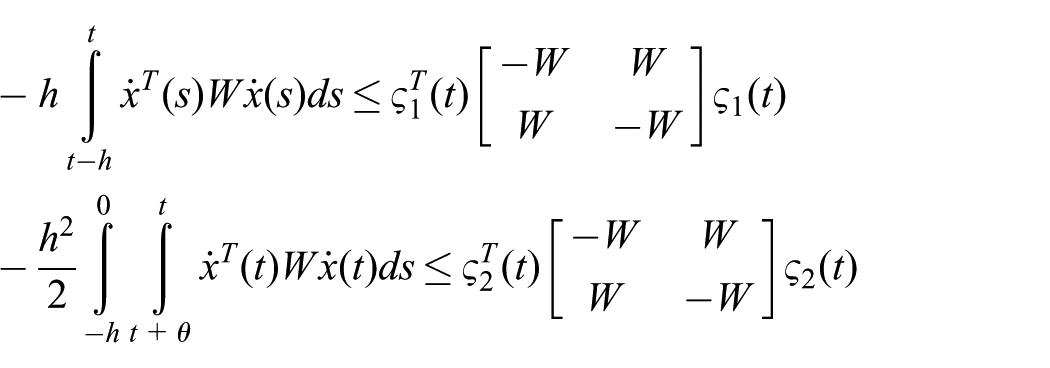
where

Lemma 2
For any positive definite constant matrix
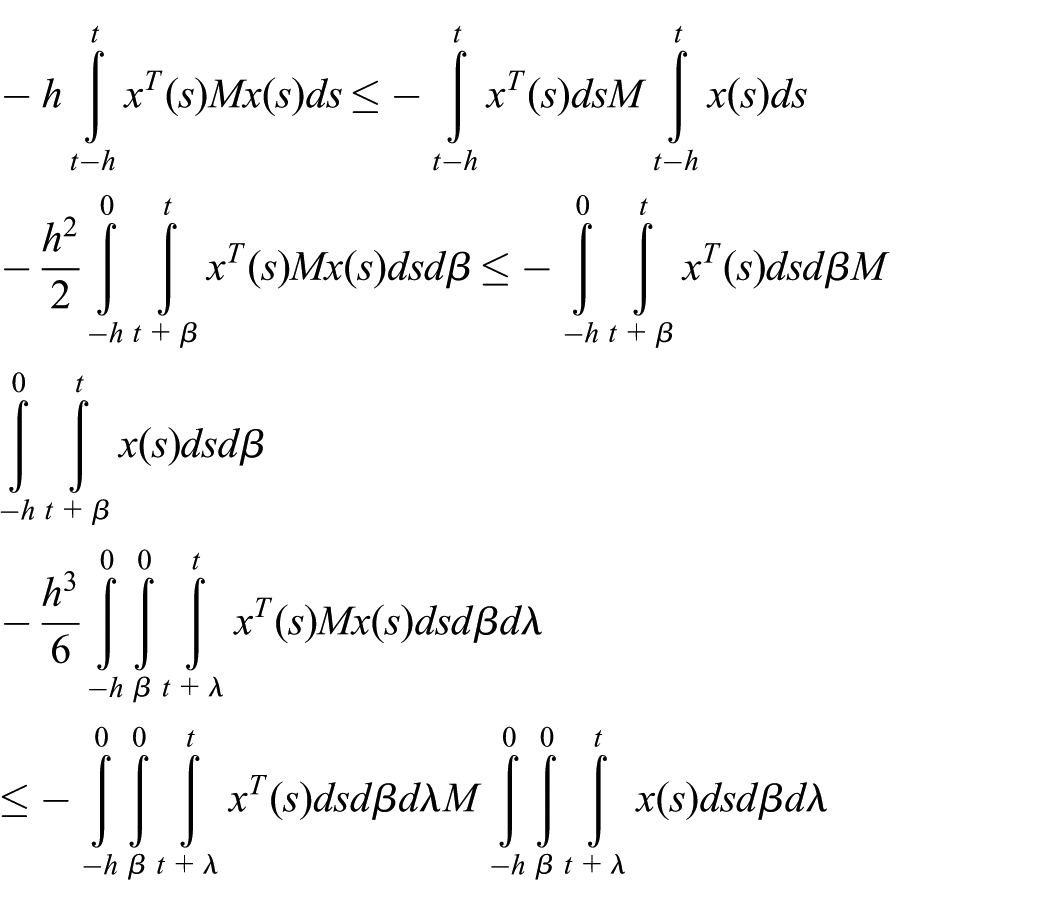
Lemma 3
For any positive definite constant matrix

where

Main results
Consider the nominal linear neutral condition of system (equation (1)) as follows

Theorem 1
For scalars

where

Proof
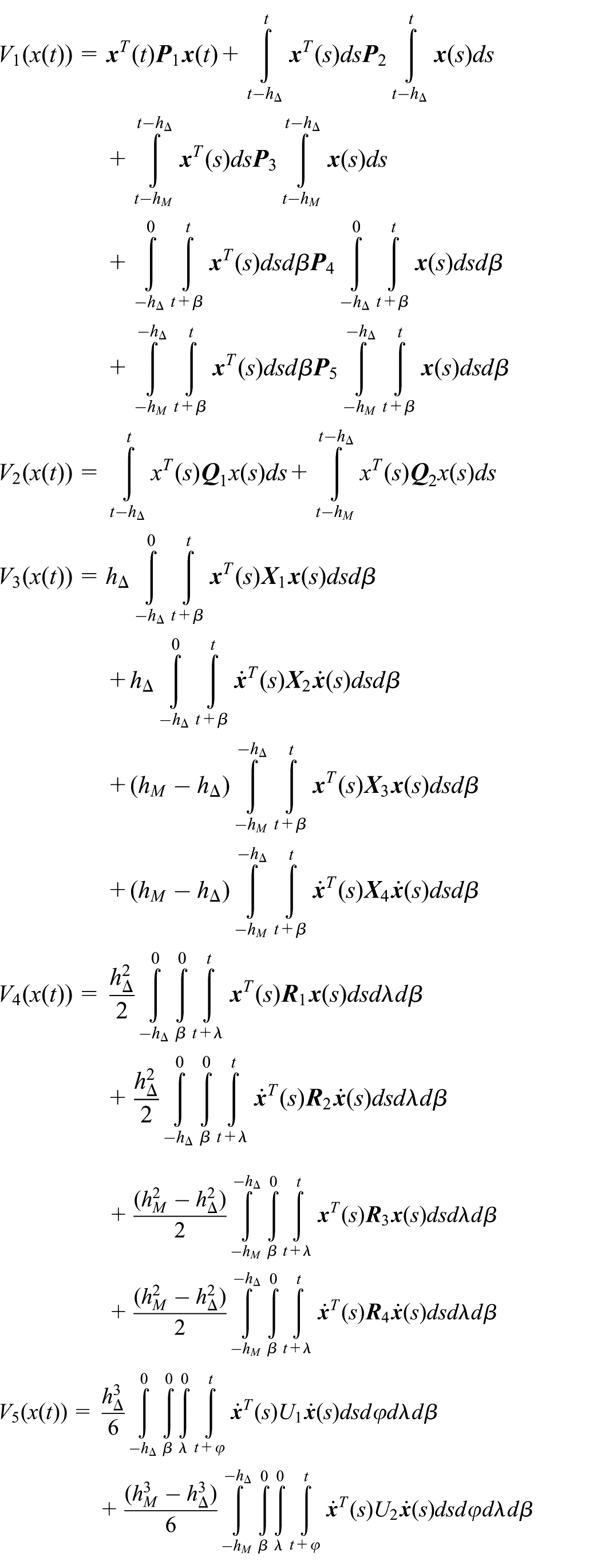
The delay range is divided into two equidistant subintervals at time-delay midpoint
Case 1. When

where
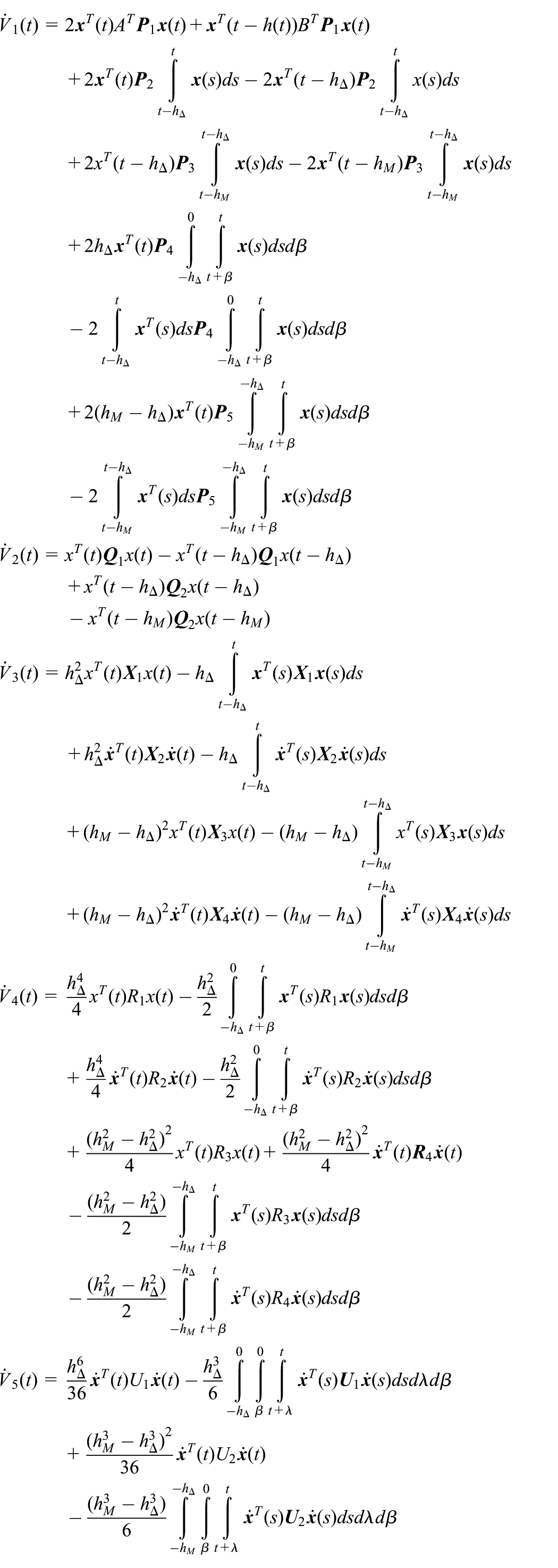
The time derivatives of

where
As can be seen from Lemma 1 and Lemma 2, respectively, we could have the inequalities as follows

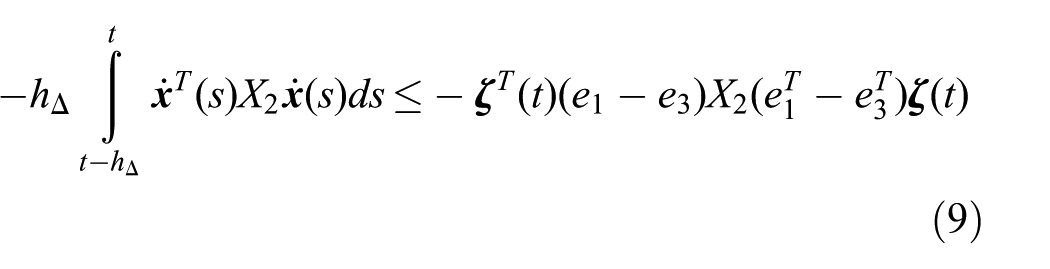
where
From Lemma 3, we have the following inequality
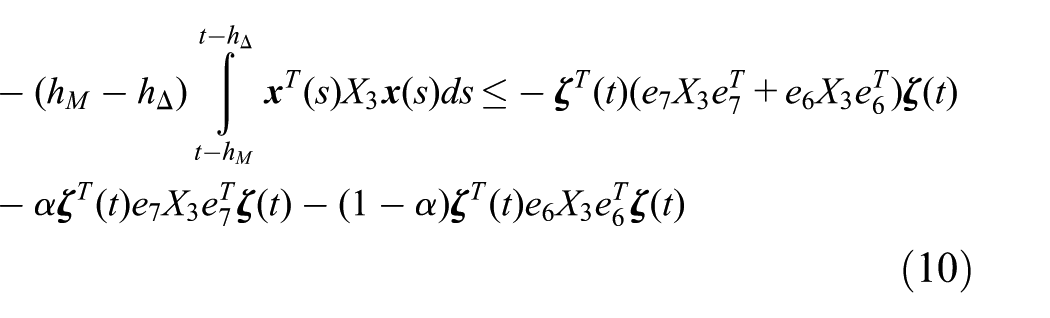
Similarly, the following inequalities can also be obtained


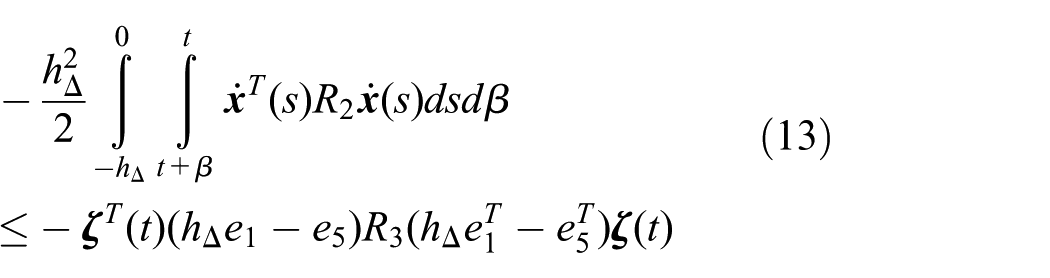


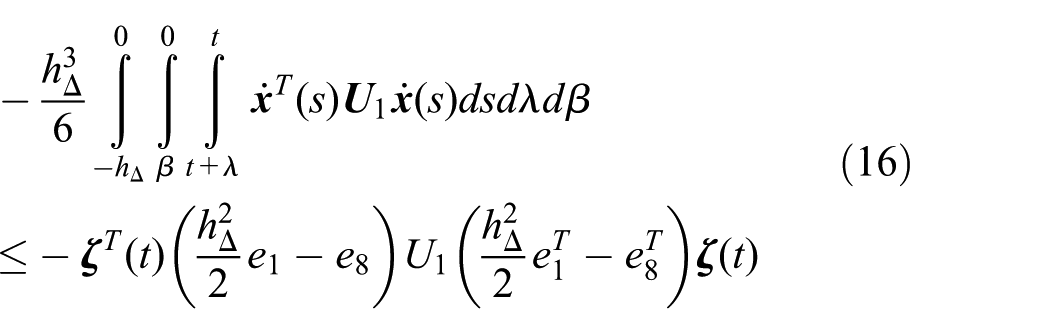

Substituting equations (8)–(17) in equation (7),

where

For


namely


Since

If
Case 2. When

where

where


where

If
Since
Remark 1
In this article, the uniqueness of new LKF is reflected in the two following sides. First, the delay range is divided into two equidistant subintervals, and in each subinterval, a new LKF comprising quadruple-integral term and quadratic forms of double-integral term is introduced. Different from the previous methods, a new LKF is used. Second, unlike in the study by Ramakrishnan and Ray,
27
double-integral functional term is added into new augmented vector in initial definition, such as
Remark 2
In formula (5), the novel stability criterion does not involve redundant-free weighting matrices but only skillfully introduces new integral inequality to deal with cross terms. This leads to the noticeable reduction in the complexity in calculation and conservativeness in conclusion.
Remark 3
In formulas (10), (11), and (14), as an alternative method, reciprocally convex combination approach is adopted to limit the cross terms of LKF derivatives. Therefore, the lower conservative results were obtained.
Remark 4
For a given scalar
Theorem 2
For the scalars

where
Next, we investigate robust stability issue for uncertain neutral system with mixed time-varying delays in the following section.
Theorem 3
For the scalars

where
Proof
Replacing
Numerical examples
In this section, two typical numerical examples are used to demonstrate superiority and less conservatism of this method. It is easy to obtain the feasible solution using the LMI toolbox of MATLAB. MADB is the most common measurement to evaluate the stability of time-delay system.
Example 1
Consider the uncertain neutral system with mixed time-varying delays as follows
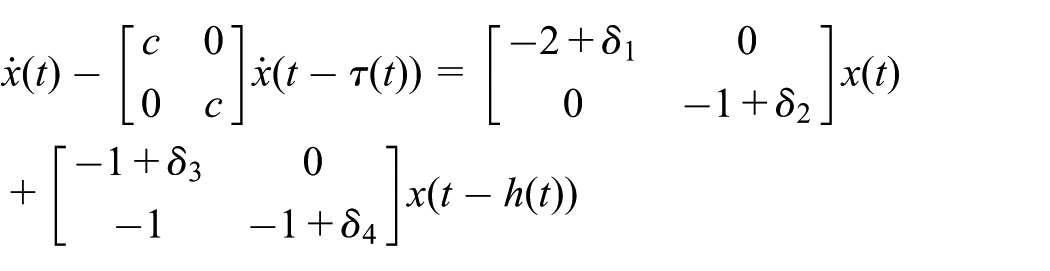
where
The stability of the system is discussed in two cases:
1. When
MADB for a given
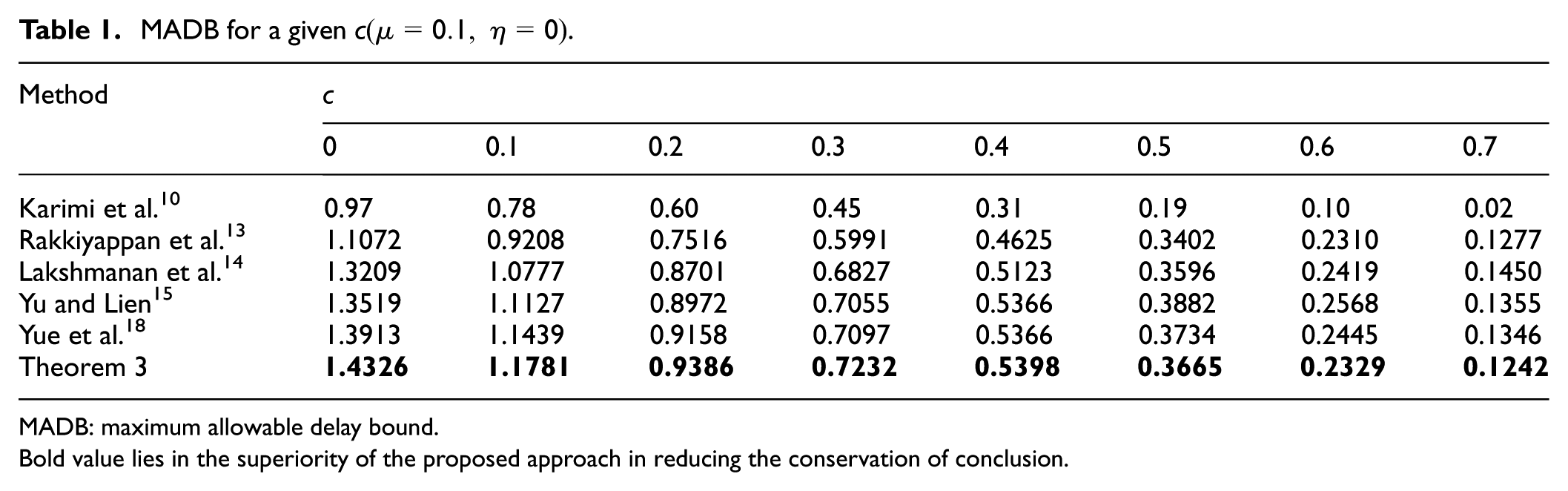
MADB: maximum allowable delay bound.
Bold value lies in the superiority of the proposed approach in reducing the conservation of conclusion.
As can be seen from Table 1, with the increase in c, MADB will gradually reduce. Compared with the existing literatures,9,12–14,17 the proposed method (Theorem 3) is less conservative, especially when c is small.
2. When
MADB for a given

MADB: maximum allowable delay bound.
Bold value lies in the superiority of the proposed approach in reducing the conservation of conclusion.
As can be seen from Table 2, the approach of this article extends the MADB value. Compared with the existing literatures,9,12–14,17 the results are less conservative.
Example 2
Considering another uncertain neutral system, the parameter matrices are as follows
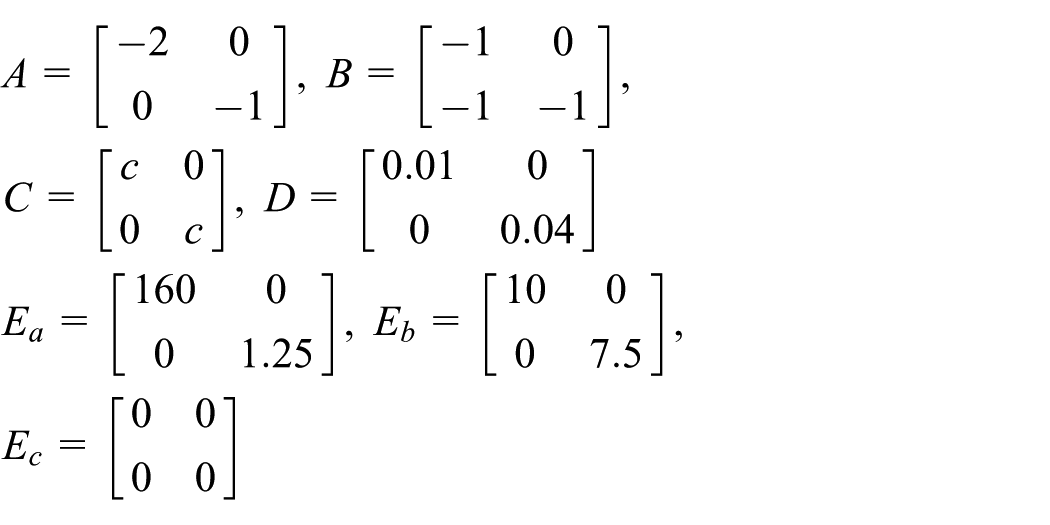
When
When
MADB for a given

MADB: maximum allowable delay bound.
Bold value lies in the superiority of the proposed approach in reducing the conservation of conclusion.
MADB for a given

MADB: maximum allowable delay bound.
Bold value lies in the superiority of the proposed approach in reducing the conservation of conclusion.
As can be seen from Tables 3 and 4, the approach of this article extends the MADB value. Compared with the existing literatures,11,12,15,17 the results are less conservative.
Conclusion
In this article, we discuss the issue of delay-dependent robust stability for a sort of uncertain neutral system with mixed time-varying delays. Based on the new LKF comprising quadruple-integral augmented term, a new delay-dependent stability criterion in terms of LMIs is proposed. Both the discrete delay and the neutral delay are related to the criterion. In order to improve the computational efficiency and simplify the conclusion, the criterion is gained by tighter integral inequality bounding method and reciprocally convex combination approach instead of model transformation method and free weighting matrix method. Therefore, it is concluded that the criterion can obtain a less conservative conclusion due to take full advantage of the delay lower bound information. Finally, the numerical simulation results demonstrate that the proposed method is more superior and competitive than the existing methods in the literature.
Footnotes
Handling Editor: Hamid Reza Karimi
Declaration of conflicting interests
The author(s) declared no potential conflicts of interest with respect to the research, authorship, and/or publication of this article.
Funding
The author(s) received no financial support for the research, authorship, and/or publication of this article.