




Abstract
Auxiliary lanes on two-lane highway are lanes setting on the right side of highway for the slow vehicles, and they can provide safe overtaking chances for cars using the original lane instead of the opposite lane. Based on the principle that the net benefit is greater than zero, the calculation model of the minimum spacing of auxiliary lanes on two-lane highway is established. After calibrating the model parameters, recommended minimum spacing values for auxiliary lanes are given corresponding to different highway classes, design speeds, and terrains. Based on traffic simulation data, the relationship model is established among the length of auxiliary lane section with uniform widths, traffic volumes, and driving speeds. By analyzing the design capacity of two-lane highway, suggestion values of the length of auxiliary lane section with uniform widths are given for two-lane highway with different design speeds and terrains. Based on driving safety and questionnaire survey on lateral vehicle spaces, calculation formula and suggestion values are presented for the width of auxiliary lanes on two-lane highway.
Introduction
According to the statistics by the end of 2015, the total mileage of highway is more than 4.58 million kilometers in China, and the two-lane highway accounted for less than 30% of the total mileage. 1 However, the number of accidents on two-lane highway was more than half of the total. And hazardous overtaking is a main reason for accidents 2 because overtaking drivers need to occupy opposite lanes. By setting the auxiliary lanes on the right side of highway, the risk caused by overtaking on two-lane highway can be avoided. However, there is no item of auxiliary lanes in “Technical Standard of Highway Engineering (JTG B01-2014)” 3 in China. In “Design Specification for Highway Alignment (JTG D20-2006),” 4 the climbing lane is defined as a lane setting at the right side of the upslope section. It is applicable for freeway and Class I highway with two lanes in each direction, or continuous upslope sections of Class II highway.
The accident investigation on two-lane highway in the United States Final Technical Report TNW2008-04 5 showed that setting passing lanes can reduce rear-end accidents (RAR) and all the accidents rate (ARR). L Schumaker et al. 6 concluded that adding passing lanes are the best option for safety and cost considerations especially when agencies have constrained budgets when compared to no countermeasure implemented and upgrade to four-lane undivided. In HCM2010, 7 two parameters (PTSF, percent time-spent-following and ATS, average travel speed) are used to evaluate the benefits of passing lanes. It shows that PTSF on the section of highway where setting passing lanes is equal to 58%–62% of its upstream section, and ATS is 1.08–1.11 times of its upstream section (Transportation Research Board 2010). A Al-Kaisya and Z Freedman 8 found that passing lanes make car-following percentages decrease 33%–43% upstream and 7%–19% downstream, respectively. National Cooperative Highway Research Program Report 500 9 showed that passing lanes can reduce 25% of the total accident rate, and the traffic situation has been improved significantly within 5–13 km downstream. Passing lanes make the delayed time decrease 7% and the number of overtaking increase 30% within a 16 km section of highway. 10 J Gattis et al. 11 concluded that the capacity of rural two-lane highway with passing lanes increased and the accident rate reduced. SD Schrock et al. 12 used crash modification factors (CMFs) to estimate the safety benefits of widening shoulders and adding passing lanes on rural two-lane roads. It was determined in this study that CMFs for shoulders widening and the addition of passing lanes for low-volume roads are 0.95 and 0.65, respectively. EB (Empirical Bayes) is recognized as the most reliable method for creating CMFs. 13 A good example of a complete safety effectiveness evaluation was completed for Michigan where the authors such as Persaud et al. 14 used EB and cross-sectional analysis to accurately evaluate passing lane additions.
L Howard and SD Schrock 15 advised that the spacing of passing lanes is 5.5–17.5 km. Morrall and Hoban 16 proposed the evaluation method of passing lanes. Kim et al. 17 analyzed different layouts of passing lanes on two-lane highway and put forward that setting on both sides are the best layouts through field measurement and computer simulation.
In this article, auxiliary lanes on two-lane highway have the same function with passing lanes, so it is meaningful to study the design method of auxiliary lanes.
In China, the research on the passing lanes on two-lane highways is rare. Cheng et al. 18 studied the traffic conditions of the setting of auxiliary lanes on two-lane highway. Benefit assessments and design elements of auxiliary lanes are urgent to study in China so as to support the revision of “Technical Standard of Highway Engineering (JTG B01-2014)” and “Design Specification for Highway Alignment (JTG D20-2006)” and to provide references for departments of highway planning, design, construction, and management.
Benefit analysis of auxiliary lanes
Safety benefit
Safety benefit is produced by avoiding traffic accidents, so it equals to the economic loss of traffic accidents. It includes direct property loss and casualty loss. According to the related researches of traffic accidents forecasting, 19 the safety benefit calculation model of setting auxiliary lanes on two-lane highway per year was given as equation (1)

where Eas is the annual safety benefit of setting auxiliary lanes on two-lane highway, 10,000 RMB/year; ku is the proportion of usual sections of a two-lane highway, %; Ap is the average direct property damage per accident, 10,000 RMB/accident; Ad is the average casualties cost of traffic accidents, 10,000 RMB/p; Pd is the accident casualty rate of usual sections of two-lane highway, p/accident; k is the overtaking accident rate, and it can be taken as 1.8%–2%;
20
yi is the length of usual section i, km; kc is the proportion of the rural section of two-lane highway, %;


where AADT is the annual average daily traffic volume, pcu/d; L is the length of two-lane highway, km; X is weighted transverse slope, %; DZ is access density of roadside, numbers/km; r is the proportion of roadside village, %; W is the width of subgrade, m; hb is the proportion of bicycle, %; ht is the proportion of truck, %; G is the weighted longitudinal slope, %; and hm is the proportion of motorcycles, %.
Using equation (1), the discount value of each year’s safety benefit during the highway service life can be obtained. The sum of all discount values is the safety benefit of setting auxiliary lanes on two-lane highway. It can be shown as equation (4)

where Es is the safety benefit of setting auxiliary lanes on two-lane highway during the highway service life, 10,000 RMB; N is the highway service life, years; i is the discount rate, and it is usually taken as 8%.
Traffic operation benefit
After setting up auxiliary lanes on two-lane highway, more overtaking opportunities for fast vehicles are provided, so highway capacity and vehicle speed will increase, and traveling delay will reduce. Reduced delay can be transformed into benefits.
Freight benefit
Saved time per kilometer by truck can be calculated by equation (5)

where Th is the saved time per kilometer by truck after setting auxiliary lanes, h/km; Q is the traffic volume, veh/h; Lh is the proportion of trucks, %; Vq is the average speed of trucks before setting auxiliary lanes, km/h; and Vh is the average speed of trucks after setting auxiliary lanes, km/h.
The interests of funds occupied by goods will increase because the traveling time increases. The increased interests can be avoided after setting auxiliary lanes, and this is the freight benefit of auxiliary lanes on two-lane highway. It can be calculated by equation (6)

where Sh is the freight benefit per vehicle per hour, 10,000 RMB/veh/h; w is the average weight of goods per vehicle, t/veh; Pr is the average price of goods, and it is usually taken as 500 RMB/t; Gcf is the proportion of circulating funds, and it is usually taken as 30%; I is the annual loan rate of circulating funds, and it is usually taken as 6%.
Passenger benefit
Saved time per kilometer by car can be calculated by equation (7)

where Tk is the saved time per kilometer by car after setting auxiliary lanes, h/km; Lk is the proportion of cars, %;
Passengers can product more GDP in the saved time, so the passenger benefit per hour after setting auxiliary lanes can be calculated by equation (8)

where Sk is the passenger benefit per vehicle per hour after setting auxiliary lanes, 10,000 RMB/veh/h; H is the average number of passengers per car, p/veh; and b is the gross domestic product per person, 10,000 RMB/p.
After setting auxiliary lanes on two-lane highway, traffic operation benefits equal to the sum of freight benefits and passenger benefits.
According to equations (5)–(8), discount values of each year’s traffic operation benefits during the highway service life can be obtained. The sum of all discount values is traffic operation benefit of setting auxiliary lanes on two-lane highway. It can be shown as equation (9)

Costs of setting auxiliary lanes
The costs of auxiliary lanes are mainly composed of the construction and maintenance costs. They can be calculated by equations (10) and (11), respectively

where C1 is construction cost of auxiliary lanes, 10,000 RMB; A is the constructive area of auxiliary lanes, m2; and B1 is the construction cost of auxiliary lanes per unit area, 10,000 RMB/m2

where C2 is the maintenance cost of auxiliary lanes per year, 10,000 RMB/year; and B2 is the annual average maintenance cost of auxiliary lanes per unit area, 10,000 RMB/m2/year.
According to equations (10) and (11), discount value of each year’s cost during the highway service life can be obtained. The sum of all discount values is cost of setting auxiliary lane on two-lane highway. It can be shown as equation (12)
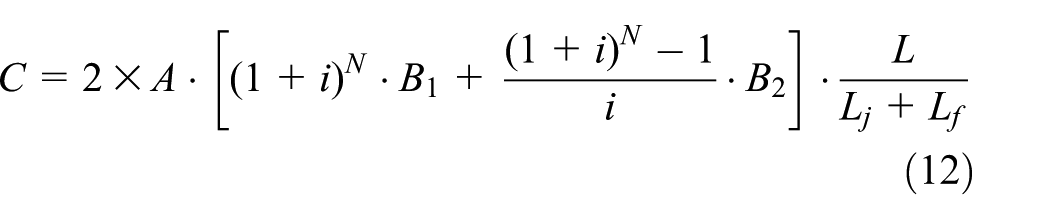
where C is the cost of auxiliary lane on two-lane highway during the highway service life, 10,000 RMB; N is the highway service life, years; Lj is the spacing of auxiliary lanes, km; and Lf is the length of auxiliary lanes, km.
Net benefit
The net benefit of auxiliary lanes on two-lane highways can be calculated by equation (13)

where E is the net benefit of auxiliary lanes on two-lane highways during the service life, 10,000 RMB.
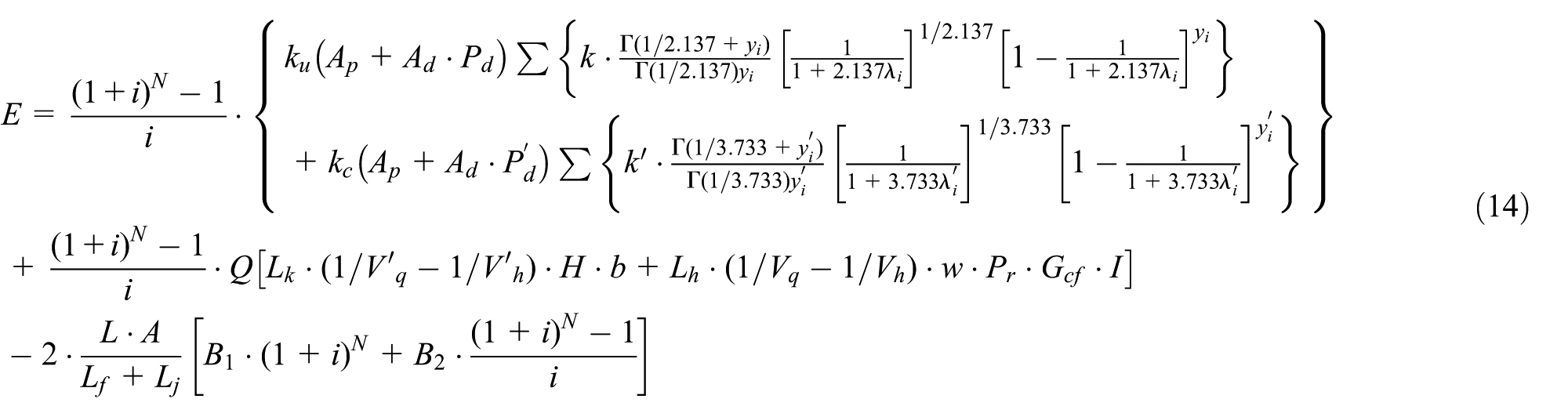
Putting equations (4), (9), and (12) into equation (13), equation (14) can be obtained
Spacing of auxiliary lanes
Model establishment
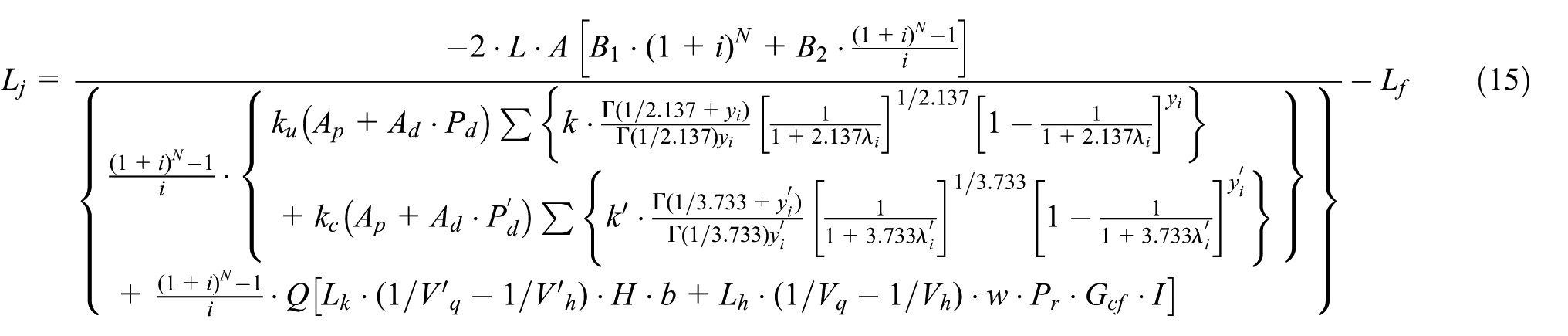
The cost of auxiliary lanes increases with the decrease of spacing, so calculation model of minimum spacing for auxiliary lanes can be given according to the principle that the net benefit must be greater than zero. It can be obtained by above analysis and shown as equation (15)
Model parameter calibration
Economic loss of traffic accidents
Economic loss of traffic accidents includes direct property loss and casualty loss.
1. Direct property loss.
According to the statistics of traffic accidents in the recent decade in China, 2 the number of traffic accidents and direct economic loss are listed in Table 1.
Data of traffic accident in China.

It can be seen that the average loss of traffic accidents in the recent 10 years in China shows an increasing trend. To calculate the discount value of direct economic loss in 2015, the discount rate was taken as 8% 21 and the calculated discount values are listed in Table 2. In Table 2, the average value is 7200 RMB, so direct property loss was calibrated as 0.72.
Discount values of direct economic loss in 2015.

2. The casualty loss of traffic accident.
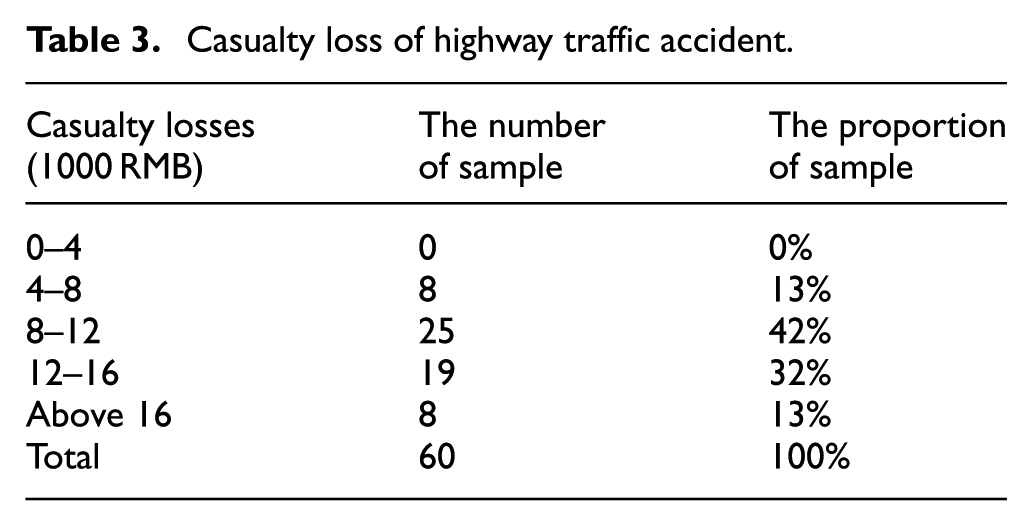
Survey questionnaires and telephone inquiries were used to get the casualty loss of traffic accident during the first half of 2015 in Harbin. A total of 20 lawyers, 20 police, and 20 insurance personnel were investigated. The survey results are shown in Table 3. It can be seen that nearly 74% person think the value of casualty loss ranges from 80,000 to 160,000 RMB. The average value is about 115,000 RMB, which is taken as the casualty loss of traffic accident.
Casualty loss of highway traffic accident.
Construction and maintenance costs
Construction costs for two-lane highway in different terrain regions are shown in Table 4. 22
Construction cost (unit:10,000 RMB/m2).

The maintenance costs of Class II and Class III highways are not less than 21,000 and 15,000 RMB/km, respectively. The widths of highway subgrade are 9 and 7 m for Class II and Class III highways, so the maintenance costs are obtained and listed in Table 5.
Maintenance cost.

Traffic volume
According to the literature of Cheng et al., 18 the boundary values between general and serious conflicts were taken as the thresholds of traffic volumes that ought to set auxiliary lanes. In addition, the traffic volume should be less than design capacity. Thus, traffic volumes for setting auxiliary lanes on two-lane highway could be obtained, and the values are listed in Table 6.
Traffic volume for setting auxiliary lane on two-lane highway.

In the key project of “Capacity Research on General Highway,” the correction factors of the capacity under different terrains were recommended. 23 The correction factors are shown in Table 7.
The correction factors of capacity.

According to the correction factors of capacity, design capacity values of two-lane highway in different terrain regions are obtained and listed in Table 8.
Design capacity values of two-lane highway.
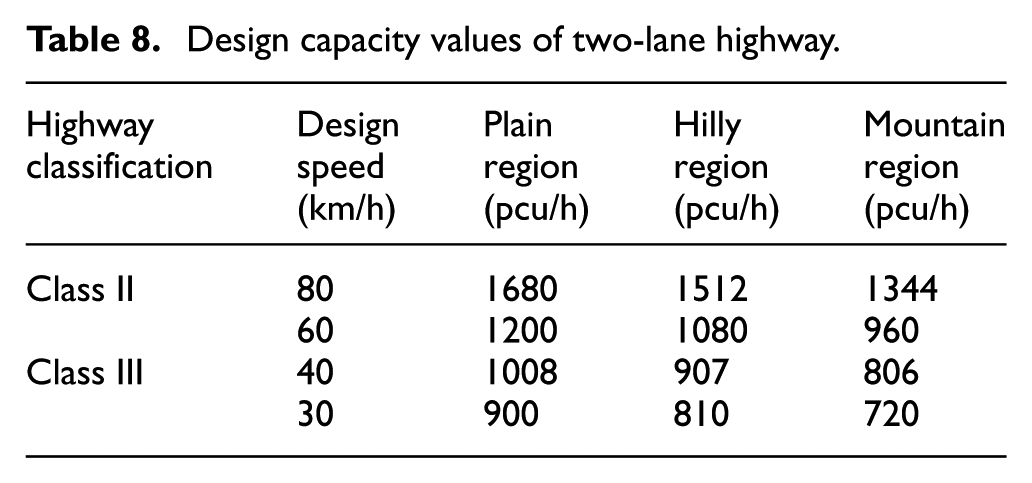
According to Tables 6 and 8, traffic volumes for setting auxiliary lanes corresponding to different terrain regions are obtained and listed in Table 9.
Traffic volume for setting auxiliary lane corresponding to different terrains.

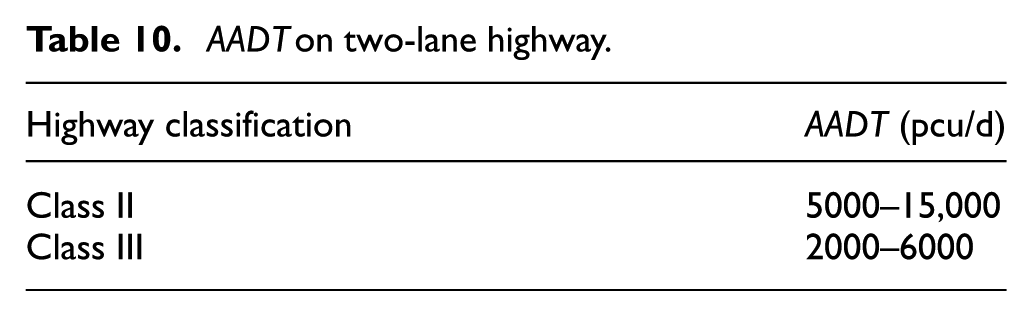
According to “Technical Standard of Highway Engineering (JTG B01-2014),” 3 AADT values are listed in Table 10.
AADT on two-lane highway.
Operating speed
In accordance with the study of the relevant literature, 24 the calculation models of operating speed on two-lane highway are shown as equation (16)

where a and b are model parameters, whose values are shown in Table 11.
Model parameters.

According to “Technical Standard of Highway Engineering (JTG B01-2014)” 3 and Table 6, values of v/c could be obtained and are listed in Table 12.
Values of v/c of two-lane highway.

Application example
Assuming there are two Class II highways with design speeds of 80 and 60 km/h, and two Class III highways with design speeds of 40 and 30 km/h. Their lengths are all 100 km. N is 15 years, and Lf is 400 m. I is 8%. ku is 80% and kc is 20%. X is 15%, and Dz is 0.8/km. G is 2%. w is 3.816 t/vehicle, and H is 18.27 p/vehicle. Traffic volumes on two-lane highway are shown in Table 13.
Traffic volumes on two-lane highway.

On the two-lane highway, the proportion of trucks is higher than on the other highway and it is mostly 50%. 25 Therefore, both Lh and Lk are taken as 50% in this example.
Free flow speed of cars (Vf) and trucks (Va) corresponding to different highway classifications are shown in Table 14.
Free flow speeds of car and truck.

According to the models, the minimum spacing for auxiliary lanes with the length of 400 m can be obtained, which is shown in Table 15.
Minimum spacing for auxiliary lane with the length of 400 m on two-lane highway.

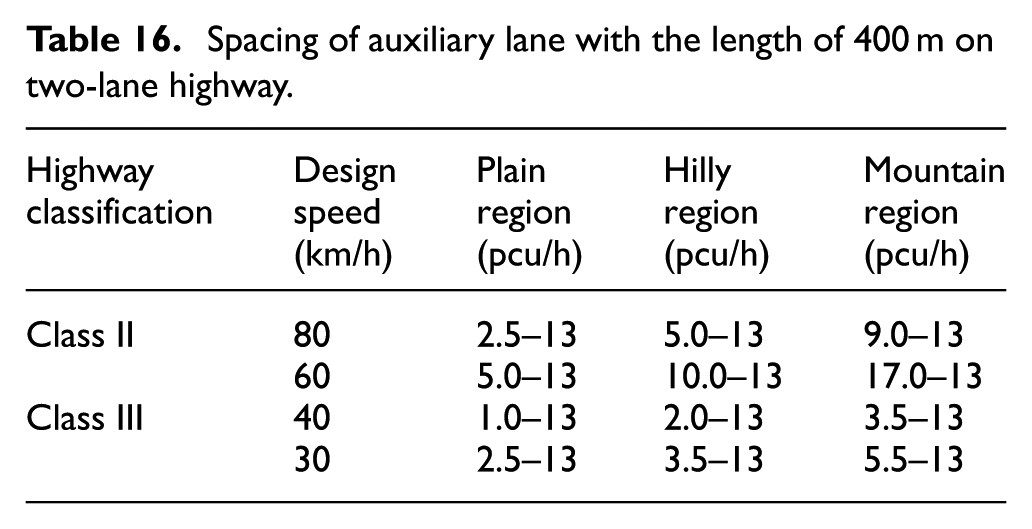
The relevant studies showed that the traffic situation was greatly improved when the spacing of passing lanes was 5–13 km. 26 Considering the traffic operation of auxiliary lanes is similar to the passing lanes, 13 km is regarded as the maximum spacing of auxiliary lanes. Then, ranges of spacing for auxiliary lanes with the length of 400 m can be given and they are shown in Table 16.
Spacing of auxiliary lane with the length of 400 m on two-lane highway.
Geometric design indexes of auxiliary lanes
Length of auxiliary lane
Figure 1 is a diagram for auxiliary lane on two-lane highway. Auxiliary lane is made up of three parts: L, Lj1, and Lj2, which denote the length of auxiliary lane section with uniform width, diverging and merging transition section, respectively. The principle of auxiliary lanes is similar to the climbing lane, and both of them separate high-speed from low-speed vehicles. Thus, the length of transition section of auxiliary lanes can refer that of climbing lanes. According to “Design Specification for Highway Alignment (JTGD20-2006),” 4 the length of diverging transition section is taken as 50 m, and the length of merging transition section of auxiliary lanes is taken as 90 m.

Diagram of auxiliary lane on two-lane highway.
Relationship model
The length of auxiliary lane section with uniform width is positively related to vehicle traffic volume, while negatively correlated with driving speed. VISSIM simulation software was used to obtain data of traffic volumes and speeds, so as to find out the relationships among them, and establish the quantitative relationship model.
The lengths of auxiliary lane section with uniform width were set as 150, 200, 250, 300, 350, 400, 450, and 500 m. Driving speeds were set as 30, 40, 50, 60, 70, 80, and 90 km/h. Traffic volume data were obtained according to the principle of minimum traffic delays. The data are shown in Table 17.
Traffic simulation data.

By regression analysis of the data in Table 17, the relationship model was established and it was shown as equation (17). It can be seen that the length of auxiliary lanes has positive linear relation with traffic volumes and negative linear relation with driving speeds

where L is the length of auxiliary lane section with uniform width, m; Q is traffic volume, pcu/h/ln; and V is driving speed, km/h.
Suggestion values
In equation (17), driving speed is taken as design speed, and traffic volume is taken as design capacity of two-lane highway in “Technical Standard of Highway Engineering (JTGB01-2014).” 3 According to Table 7, the length of auxiliary lane section with uniform width can be calculated. The suggestion values are shown in Table 18.
Suggestion values of the length of auxiliary lane section with uniform width (unit: m).

Width of auxiliary lanes
Calculation method
Considering that most of the low-speed vehicles on highway are large and medium-size trucks, the width of auxiliary lanes can be calculated according to equation (18)

where B is the width of auxiliary lanes, m; a is the width of large and medium-size trucks, m; according to “Outside Dimension Limits of Motor Vehicles (GB1589-2004),” the value of a was taken as 2.5 m; c is inside clearance, m; and y is outside clearance, m.
Relevant studies 22 showed that the outside clearance can be calculated according to equation (19)

where v is driving speed of large- and medium-size trucks, m/s.
Inside clearance
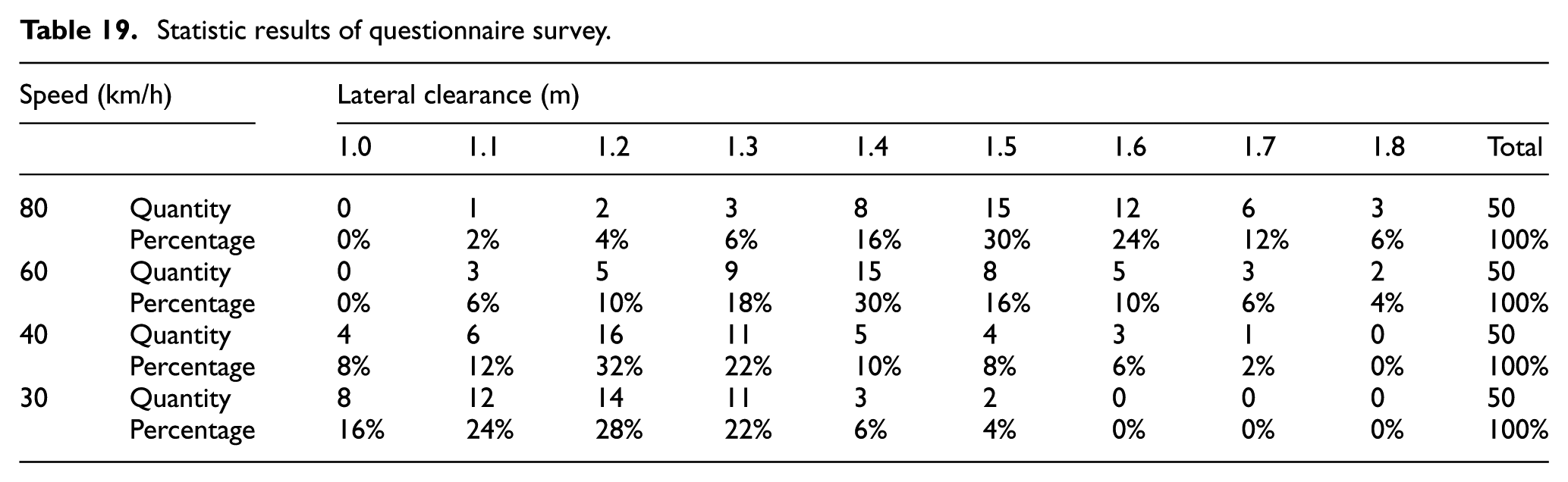
The method of questionnaire survey was adopted to determine inside clearance between overtaking and overtaken vehicles during the first half of 2015 in Harbin. A total of 70 drivers of cars, minibuses, and trucks were investigated. The statistic results are shown in Table 19 and Figure 2.
Statistic results of questionnaire survey.

Distribution of drivers’ selected lateral space under different speeds.
Average value of lateral clearance can be obtained by Table 19 and Figure 2. They are 1.52, 1.41, 1.27, and 1.19 m, respectively, when overtaking speeds are 80, 60, 40, and 30 km/h. In equation (19), inside clearance c was taken as half of above average values of lateral clearance.
Suggestion values
According to equations (18) and (19), the required width of auxiliary lanes can be calculated, and they are listed in Table 20.
Calculation values of the width of auxiliary lane.
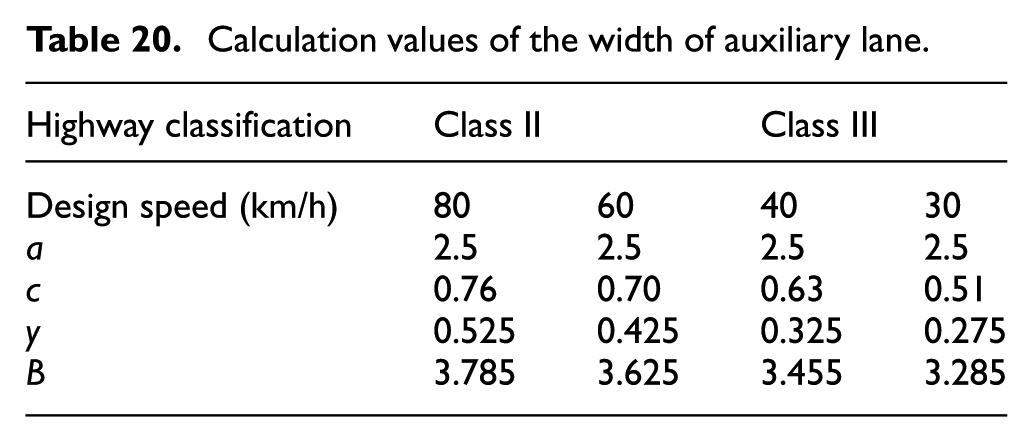
Considering that slow vehicles could occupy part of shoulders when driving on auxiliary lanes, the width of auxiliary lanes can reduce. Based on Table 20, it is recommended that the width of auxiliary lanes for Class II highway is 3.5 m, and it is 3.5 and 3.25 m, respectively, for Class III highway with design speeds of 40 and 30 km/h.
Conclusion
Through the benefit analysis of setting auxiliary lanes on two-lane highway, calculation model of auxiliary lanes spacing was built. Based on the traffic simulation and questionnaire survey, this article conducts the research of the length and width of auxiliary lanes on two-lane highway. Following conclusions can be drawn:
The lower the grade of highway, the shorter the minimum spacing of auxiliary lanes on two-lane highway.
For the two-lane highways with the same grades and design speeds, the minimum spacing of auxiliary lanes in mountain regions is the largest, and it is the smallest in plain regions.
For the two-lane highways with the same grades and terrain conditions, the minimum spacing of auxiliary lanes increases with the decrease of design speeds.
For auxiliary lanes of two-lane highways, the length of section with the uniform width depends on design speeds and terrain conditions, and higher design speeds and favorable terrain conditions often lead to longer auxiliary lanes.
It is recommended that the width of auxiliary lanes for Class II highway is 3.5 m, and it is 3.5 and 3.25 m, respectively, for Class III highways with design speeds of 40 and 30 km/h.
Footnotes
Academic Editor: Xiaobei Jiang
Declaration of conflicting interests
The author(s) declared no potential conflicts of interest with respect to the research, authorship, and/or publication of this article.
Funding
The author(s) disclosed receipt of the following financial support for the research, authorship, and/or publication of this article: This research was sponsored by Chinese National Natural Science Foundation “Design Method of Auxiliary Lane on Two-lane Highway Based on Overtaking Safety Evaluation,” the Scientific Research Foundation for the Returned Overseas Chinese Scholars, and Jilin Province Science and Technology Development Project (201404-13011GH).