




Abstract
Considering that average convergence rate estimation of clonal selection algorithms is a difficult problem and is still in its infancy, this article researches the convergence rate of an elitist clonal selection algorithm. It derives the best individual transition probability matrix from the directional transition probability of best individuals in algorithm populations and constructs matrix norms that meet certain requirements to resolve difficulties in calculating the matrix caused by large algorithm populations in practical applications, thereby proposing a simple and effective method of estimating average convergence rate of the algorithm. In addition, simulation experiments are performed to validate universality and validity of the estimation method.
Keywords
Introduction
Artificial immune algorithm is an intelligent algorithm that is inspired by biological immune mechanisms and utilized to solve complex issues. As an important branch of artificial immune algorithm, clonal selection algorithm has received increasing attention by domestic and international scholars and experts in computational intelligence.1,2 Although scholars have made fruitful achievements in studying clonal selection algorithms in recent years, the studies focus on algorithm implementation, improvement, and engineering application, and the theoretical analyses concentrate on algorithm convergence. Convergence rate, which is an important part of theoretical researches on clonal selection algorithms, not only illustrates the algorithm convergence but also plays an important role in establishing proper stropping criteria and measurement standards to comprehensively and objectively evaluate execution strategies. 3 The convergence rate is influenced by the selection of parameters and the characteristics of objective functions. Due to the lack of effective analytical methods, however, there are few reports on convergence rate of clonal selection algorithms and no strict theoretical conclusions. Moreover, such mathematics-based shortage restricts further expansion, development, and application of clonal selection algorithms. 4
Currently, researches on the convergence rate of clonal selection algorithms are still in their infancy. 5 The existing researches mostly base on the Markov Chain theory and estimate the convergence rate by studying characteristic values of state transition matrices: 6 (1) this method obtains approximate convergence rate by estimating the maximum eigenvalue that is smaller than 1 in the state transition matrix while reasonable estimate of the characteristic value needs to be further discussed and (2) since antibody populations in the steady-state distribution are made up of satisfactory solutions, the method is too conservative. In practical applications, not all antibodies are required to achieve optimal solutions. It is acceptable as long as one or one kind of antibodies achieve optimal solutions. Timmis et al. 7 show a convergence rate estimation method based on Markov Chain models. Since some parameters need to be further discussed, the method is unsuitable for practical applications. What’s more, these methods achieve qualitative research results and merely apply to specific forms of clonal selection algorithms, thereby failing to estimate the convergence rate of ordinary clonal selection algorithms. 8
The elitist strategy is a basic condition to ensure algorithm convergence. Therefore, this article draws lessons from convergence rate analysis in genetic algorithms, employs relevant knowledge of stochastic processes, proceeds from the best individual transition probability matrix, and constructs the best individual transition probability matrix to matrix norms that meet certain requirements, thereby proposing a simpler and more effective method of estimating average convergence rate of elitist clonal selection algorithms. In addition, simulation experiments are performed on different elitist strategies to validate universality and validity of the estimation method.
Elitist clonal selection algorithms
Clonal selection is one of the most famous biological immunological mechanisms. 9 Clonal selection algorithm, which is based on clonal selection, takes unknown objective functions as the antigens and possible optimal solutions as the antibodies. In this case, the affinity between antibodies and antigens represents feasible solutions to the function values. Only cells able to recognize antigens will divide, proliferate, and be selected. Moreover, the selected cells are restricted by affinity maturation. Due to the intrinsic characteristics, clonal selection algorithms have enormous potential for solving optimization problems. It is predictable that clonal selection algorithms will be widely used in the optimization field in the future. Wherein, CLONALG proposed by De Castro and Von Zuben 10 in 2002 is one of the most representative clonal selection algorithms in recent years since it marks the beginning of optimization resolution on the basis of intelligent algorithms. After that, researchers have drawn lessons from clonal selection from multiple perspectives and proposed different clonal selection algorithms. Moreover, most of these algorithms are based on elitist strategy.11–14 In order to illustrate the problems conveniently, the article demonstrates basic procedures and flowchart graphs of elitist clonal selection algorithm:
Step 1. Initialization: let
Step 2. Affinity calculation: calculate the affinity of all antibodies in
Step 3. Elite preservation: select individuals with the highest affinity in
Step 4. Affinity maturation: perform clone operations and mutation operations on the
Step 5. Immunization update: generate d antibodies to substitute d individuals with the lowest affinity in
Step 6.
The basic flowchart graph of the algorithm is shown in Figure 1.
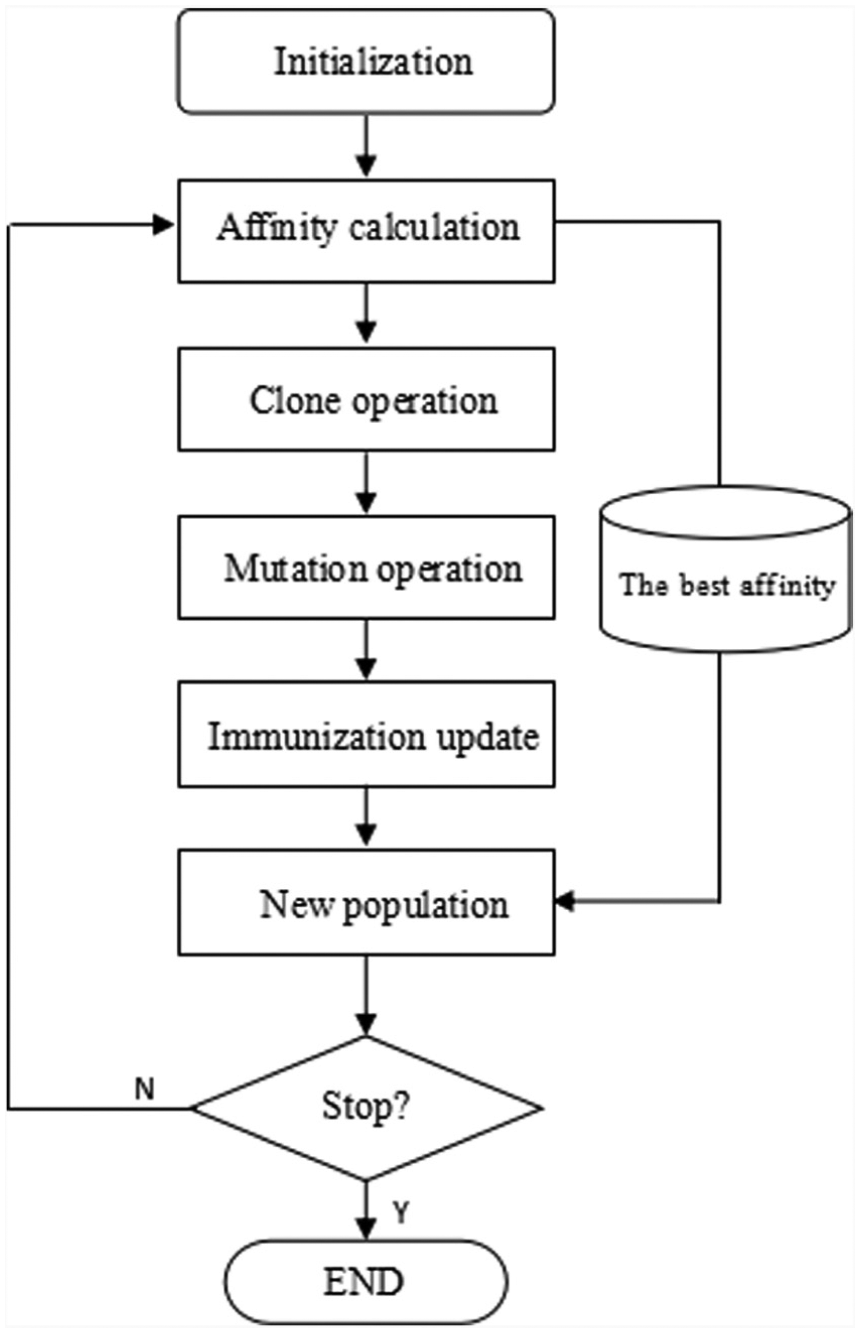
A flowchart graph of elitist clonal selection algorithms.
Convergence rate analysis
When the number of iterations approaches to the infinity, global convergence of such clonal selection algorithms has been proved. In addition, global optimal solutions are included in the steady-state distribution. 15 The above analysis shows that changes of the best antibodies reflect the convergence rate accurately. Therefore, it is possible to estimate the convergence rate of elitist clonal selection algorithms by virtue of the best individual transition probability matrix.
For simplicity, it is assumed that there is only one optimal solution;
In order to calculate the best individual transition matrix

For any two states,

Obviously, the best individual transition probability matrix is as follows

Let the sub-matrix constituted by elements of the state transition matrix

The state transition matrix of clonal selection algorithms is a random matrix (a homogeneous Markov chain) and the matrix
On this basis, Theorem 1 and Lemma 1 are given.
Lemma 1
Let

Theorem 1
Let

In the formula,
Proof
The non-recurrent matrix

In the formula,

For any non-absorbing state

Since best individuals of the initial populations obey uniform distribution, then

Let

Justified
Antibodies have multiple states in practical applications, not to mention the populations constituted by antibodies, which makes it difficult to calculate Matrix
Lemma 2
Let
The matrices
It is possible to estimate the average convergence number as long as the best individual transition probability matrix
Considering the general measurable function, let the code length be

For general measurable functions, when the Hamming distance between the best individuals of the initial populations and the global optimal individuals is

Let the average transition probability of other individuals be

According to Lemma 2

According to Theorem 1, the average convergence number of elitist clonal selection algorithms is
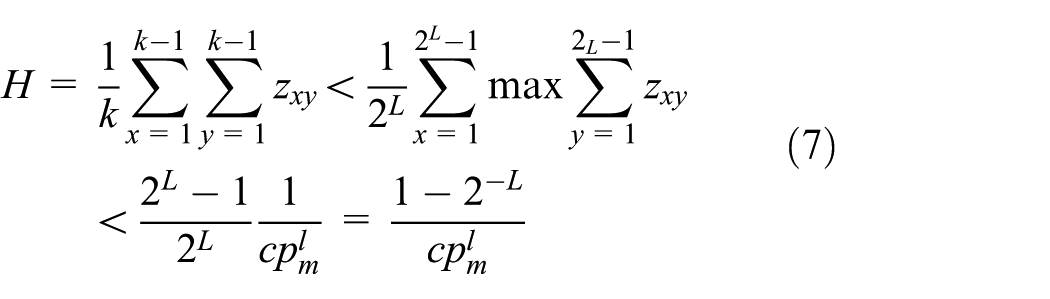
In the formula,
Simulation experiment
In order to validate the universality and validity of the estimation method proposed, immune memory clonal selection algorithms (IMCSA), real clonal selection algorithms (RCSA), and clonal selection algorithm for classification (CCSA) are employed to perform simulation experiments on the following two multi-modal functions:
Test

In the formula,
2. Test

In the formula,
Parameter settings of the three algorithms.

IMCSA: immune memory clonal selection algorithms; RCSA: real clonal selection algorithms; CCSA: clonal selection algorithm for classification.
Experimental results of the three algorithms.

IMCSA: immune memory clonal selection algorithms; RCSA: real clonal selection algorithms; CCSA: clonal selection algorithm for classification.
In Table 2,
Conclusion
This article introduces the best individual transition probability matrix to research average convergence rate of elitist clonal selection algorithms. Considering that the large algorithm population size in practical applications may cause difficulties in calculating the best individual transition probability matrix, the article constructs the best individual transition probability matrix into matrix norms that meet certain requirements, thereby proposing a new method of estimating average convergence rate of clonal selection algorithms. In addition, simulation experiments are performed to validate universality and validity of the estimation method. It is important to note that Formula (7) is targeted at ordinary measurable functions and
Footnotes
Acknowledgements
The authors would like to thank the editors and all the anonymous reviewers for their valuable comments and suggestions which are very helpful in improving the quality of the paper.
Academic Editor: Hamid Reza Karimi
Declaration of conflicting interests
The author(s) declared no potential conflicts of interest with respect to the research, authorship, and/or publication of this article
Funding
The author(s) disclosed receipt of the following financial support for the research, authorship, and/or publication of this article: This work was supported by Jiangsu Province prospective Joint Research Project (BY2016057-01), Jiangsu Provincial University Natural Science Research Project (16KJB520005), Lianyungang Industry Prospects and Common Key Technology Projects (CG1609), and the Science & Technology Project of Lianyungang (CG1419, CG1413).