




Abstract
In engineering application, a quantitative description of both fatigue and creep damage mechanisms is demanded for high-temperature alloy. This work employs the cohesive zone model to numerically simulate the crack propagation in a nickel-based super-alloy. Two separate damage evolution equations are introduced into the cohesive zone model to describe the fatigue and creep damage, respectively. Effects of temperature and loading hold period are discussed. The comparison shows a reasonable agreement between numerical results and experimental observations and confirms the potential of cohesive zone model for more complex loading conditions in engineering.
Keywords
Introduction
Many mechanical parts are working under the various external loading conditions, suffering from thermal, mechanical, and environmental loads. Tong et al. 1 investigated effects of creep, fatigue, and oxidation on crack propagation in a nickel-based super-alloy at 650°C. The work concluded that the oxidation appears to be the predominant mechanism for crack growth under long dwell loading condition due to the limited creep at the crack tip. In the work of Evans et al., 2 two alloys were studied under various temperatures including room temperature (RT) and hard vacuum to discuss the interactions of creep, fatigue, and environment damage. Lu et al. 3 also investigated the influence of temperature and hold time on creep–fatigue crack growth behavior. Several different temperatures and hold time levels were employed in the test. The results show that temperature and hold time both have positive effects on the crack growth. The higher the temperature or hold time, the faster the crack growth. Prakash et al. 4 studied the combined role of fatigue, creep, and oxidation, especially the time dependence in crack growth, and built up the connection between microscopic appearance of crack behavior and macroscopic variations of the loading condition. Wei et al. 5 considered the oxygen enhancement of the nickel-based super-alloys in the crack growth. It said that some elements, such as Nb-rich carbides, can significantly enhance crack growth when they are oxidized. Roy et al. 6 verified that even short hold time can significantly enhance the crack growth at elevated temperature. Experimental observations provide sufficient evidence for considering temperature and time effects in modeling of material failure.7,8 The life of mechanical parts depends on both loading amplitude and loading time. Experimental data did not provide sufficient knowledge about the total life of the mechanical parts, as analyzed in Zhang et al. 9 To give a more accurate prediction, especially for complex geometry parts, a constitutive description of the creep–fatigue crack is of importance.
In mechanical product design, the finite element method (FEM) is becoming a usable and staple numerical analysis tool. However, the damage process is not represented in most computations because it is difficult to handle numerically. Nowadays, more and more attentions are focused on the cohesive zone model (CZM). The earliest concept of the cohesive zone modeling was proposed by Barenblatt 10 to investigate ideal brittle materials. Later, Dugdale 11 and Barenblatt 12 raised their own models to treat the unpractical infinite stresses at the crack tip. Based on these pioneer works, the CZMs have been generalized so that ductile material failure under both mixed mode loading conditions13–15 and fatigue loading conditions16–18 are considered in combination with the extended finite element method (XFEM). 19 Modeling creep–fatigue is still a challenging task for computational mechanics of materials.
The aim of this work is to develop a CZM for predicting fatigue crack propagation of structures loaded at elevated temperature. Effects of dwell time and temperature on the crack growth in nickel-based powder metallurgy (PM) super-alloy should be integrated in the CZM. Two separate fatigue and creep damage evolution equations will be introduced based on the cohesive zone approach. Several sets of experimental data are used to determine the model parameters and to verify the computational predictions.
CZMs
Modeling of fatigue crack growth
In the CZM, the material failure is described by an additional cohesive law. As soon as the stress state in the material reaches the certain criterion, the CZM superimposes to the continuum mechanics formulation of the element. The traction-opening relation in the cohesive zone is determined by the cohesive law.
In this work, the cohesive zone law proposed by Xu and Needleman
20
is modified to simulate the crack propagation in the nickel-based super-alloy with a threshold value.
15
Figure 1 schematically illustrates material failure under monotonic loading condition (dashed line) and under cyclic loading with one cycle (solid line), respectively. Analysis
17
has confirmed that the mode I failure mechanism dominates the fatigue crack extension procedure for cracked specimens. It means the normal traction

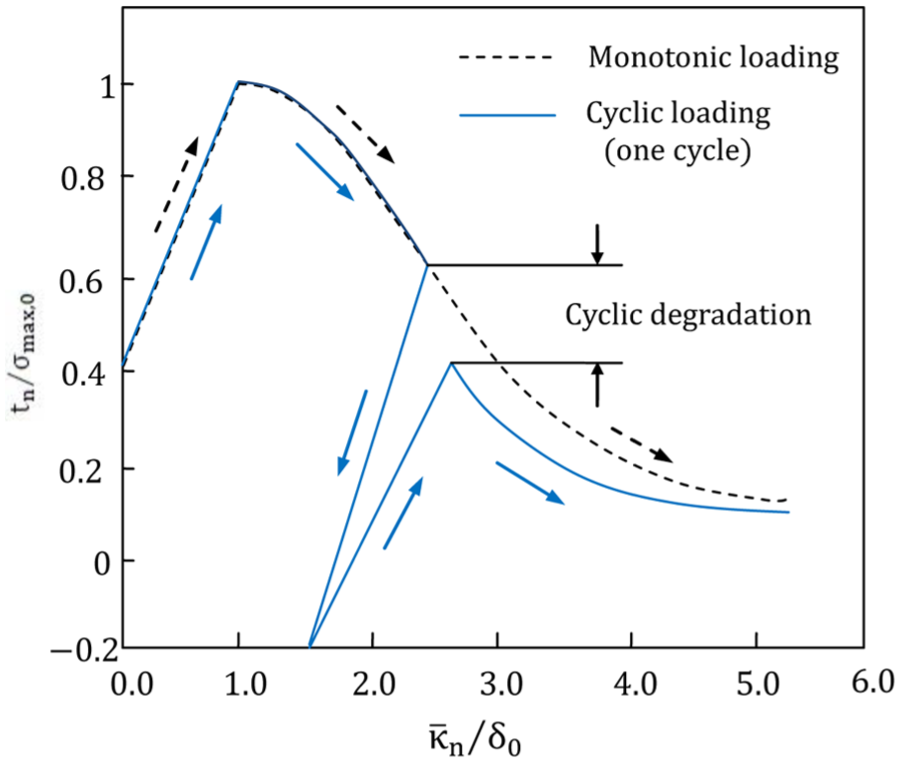
The sketch of cohesive curves under monotonic loading and cyclic loading (one cycle) conditions, respectively.
Above

where
In the CZM, the ultimate material strength is characterized by

where

Considering the cyclic loading, the damage variable,

with

where
Creep damage accumulation
At high temperature, the material mainly suffers from thermal attack. The mechanical stress is generally lower, so that the rate-independent plastification can be neglected. In practice, creep may occur within yield loading surface and creep behavior is decoupled with material plasticity for simplification. The creep can be divided into three phases, namely, primary, secondary, and tertiary creep regions. The creep strain rates in the primary and tertiary creep regions are not stable but time-dependent. In the secondary phase, the creep strain rate is usually considered to be independent of time and can be expressed by Norton–Bailey model as

where
To consider the time effects on the crack growth under low frequency loading, especially under high temperature condition, the creep damage has to be considered separately. If the creep damage is introduced into the CZM, following the suggestion in Bouvard et al., 25 the creep damage evolution in the CZM can be written as

where C, p, and r are material parameters which can be determined with experimental data. Minor modification is made on the model in Bouvard et al.
25
〈·〉 denotes the Macaulay brackets with

with

thus the creep–fatigue damage accumulation can be employed in the CZM.
The CZM introduced above has been implemented into the XFEM.
15
The extended finite element is a handy way for considering a cohesive law containing a finite threshold value
Verifications
Experiments
The experiments were produced by Yang et al.26,27 The standard compact tension (CT) specimens (Figure 2(a)) with the width
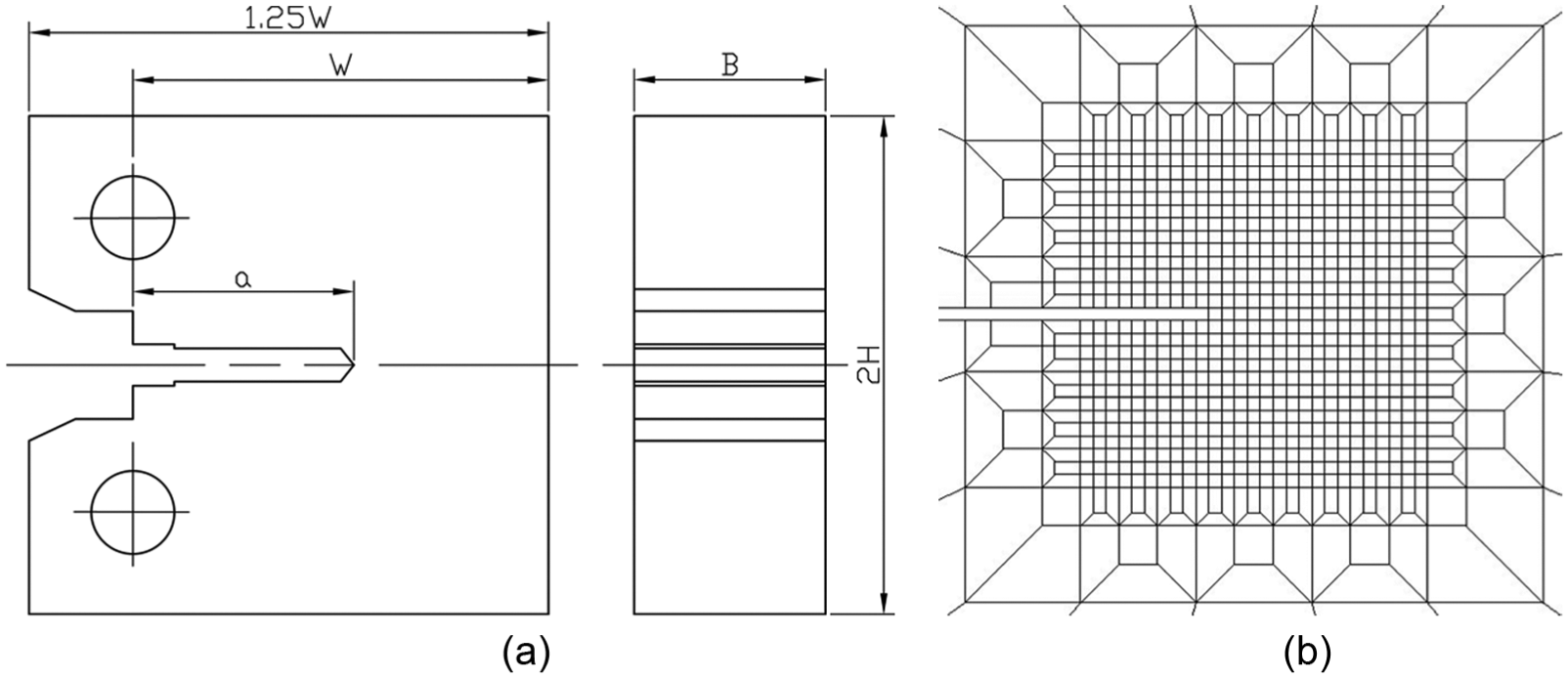
Sketch of (a) compact tension (CT) specimen and (b) finite element mesh of crack tip.
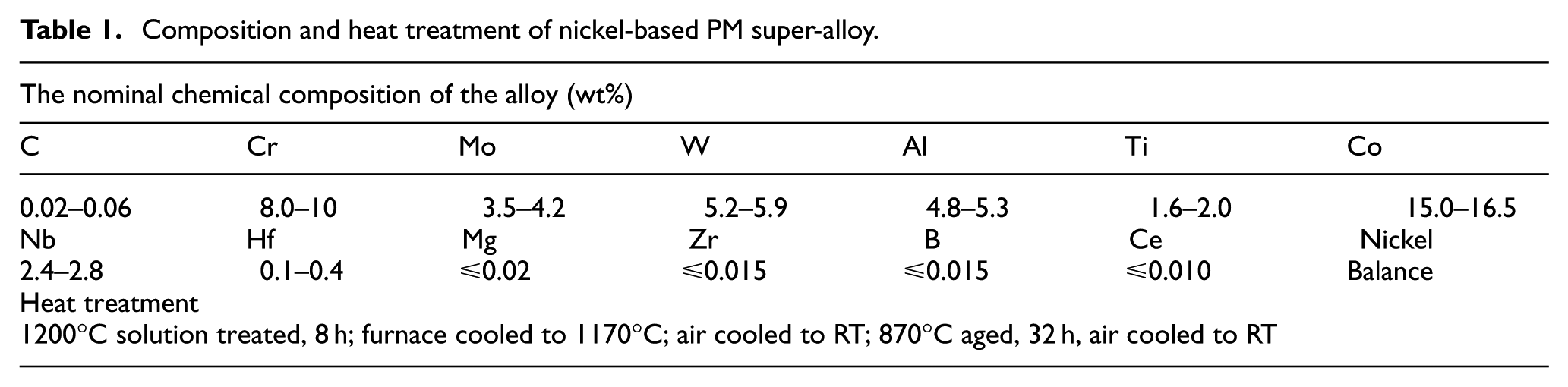
Composition and heat treatment of nickel-based PM super-alloy.
Results
In the present CZM, material failure is dominated by the damage variable D. The cohesive function (equation (1)) is indifferent for life prediction. In the known works,25,28 the creep–fatigue can be predicted using the damage model (equation (6)); however, the dwell time was limited within very small region. No systematic experiments were considered for verifications.
For the present material, the test results shown in Figure 3 exhibit the effects of dwell time

Comparison of computational and experimental crack growth rates versus the stress intensity factor range
In Figure 3, experiments with different dwell times are denoted using different symbols. Obviously, da/dN increases with
Crack growth rates

Frequency dependence of crack growth rate (a)
Figure 5 shows the effects of temperature on the crack growth. In the simulations, it is assumed that there exists no creep damage under RT,

Comparison of numerical and experimental crack growth rate in terms of stress intensity factor range
Conclusion
Creep–fatigue with long dwell times and various temperatures is generally difficult to be predicted. Using the CZM, this work has introduced a damage model for describing creep–fatigue crack propagation at elevated temperature and with long dwell time for a nickel-based PM super-alloy. The model has been implemented into the XFEM. The computational results confirm the following:
The damage evolution equation suggests a nonlinear coupling of mechanical cyclic loading with temperature.
The CZM can predict the fatigue crack growth properly in the high frequency region. In fatigue with long dwell time, the computational prediction still contains deviations.
The new creep damage evolution equation for the CZM describes temperature effects in life prediction. The existing experiments agree with computations pretty well.
The cohesive zone approach can be applied for more complex loading conditions or complex specimen geometries with great potential in numerical analysis of the creep–fatigue crack propagation.
Footnotes
Handling Editor: Michal Kuciej
Declaration of conflicting interests
The author(s) declared no potential conflicts of interest with respect to the research, authorship, and/or publication of this article.
Funding
The author(s) disclosed receipt of the following financial support for the research, authorship, and/or publication of this article: In this paper, the research was sponsored by the National Natural Science Foundation of China (Project No. 51305025).