



Abstract
The scope of traffic incidents impacts the performance of traffic incident impact assessment. The inadequate impact scope of the traffic incident will weaken the performance of the traffic incident impact assessment and increase the cost of travel time and payment. This article mainly analyzes road enclosure method, plume model method, and spherical extrapolation method to determine the scope of impact of traffic incident. Advantages and limitations of these three models are presented. Based on these analyses, some improvements are proposed on the basis of the existing situation.
Introduction
At present, research on the scope of traffic incident 1 is divided into qualitative research and quantitative research. Qualitative research, generally coming with a theoretical framework, mainly proposed some framework-oriented actions and policies based on the impact of traffic incident. Quantitative study by contrast does the related research on the diffusion range of traffic incident space in accordance with the scope of the study.
The diffusion range of vehicle queue is estimated by the improved cumulative arrival departure model, and the idea of the Lawson et al. 2 method is proposed to obtain the congestion diffusion range. The model also assumes that the arrival and departure rates of vehicles are constant and are not suitable for the estimation of supersaturated intersections. JB Sheu et al. 3 define six random traffic state parameters based on lane change behavior to predict the queue length at the incident occurrence point. This model is only applicable to the study of congestion caused by traffic incidents in a lane, without consideration of queue length overflow upstream detector. A fuzzy queue length model is proposed by LP Fu and B Hellinga. 4 The model is based on the length of queue length information, vehicle arrival information, and lane closing information to predict the vehicle queue length at the location of traffic incident. The model can accurately predict the queue length caused by traffic incident. M Baykal-Gürsoy et al. 5 proposed a method to calculate the queue length caused by traffic incident on the road using M/M/C queuing model and studied the change of vehicle queue length under different traffic incident conditions.
By learning the method of determining the research scope of traffic impact assessment, a study found that the methods for determining the scope of traffic incident mainly include road enclosure method, plume model method, and spherical extrapolation method.
Road enclosure method
The road enclosure method 6 is mainly in the place of traffic incident center, extending to the periphery in all directions to the nearest trunk roads (including secondary road, arterial road, and expressway or freeway). Since the road enclosure method in practical applications is simple and practical, it is currently widely used in China. In November 2007, according to the notice from the Ministry of Housing and Urban-Rural Development, China Academy of Urban Planning and Design and several Chinese Transportation Research institutions stipulated the method for determining the research scope of traffic impact assessment together, as shown in Table 1.
Recommended traffic impact assessment study range of Housing and Urban-Rural Construction industry standard.

The basic idea is that traffic incident is divided into three levels of impact. According to the specific circumstances of each city and the surrounding traffic conditions at the incident, on the basis of Table 1, each city can make appropriate adjustment of traffic incident influencing the range.
Plume model method
The plume model method, also known as the Gaussian plume model, 7 is one of the atmospheric dispersion models which belongs to environment mathematical model and is a air quality model which describes the quantitative relationship between pollution and pollutant concentrations in the atmosphere.
The impact of traffic incident on the surrounding road network is similar to that of the poisonous gas and exhaust gas into the atmosphere, composed by many units. The system is a stable and open system, 8 in which each unit is equivalent to a circle and is assigned to the entire scope of the study. Under the impact of traffic incident, it is diffused in the direction of turbulent flow field in the same state. The impact of traffic incident is related to the type and intensity of traffic incidents and proportional to the intensity of traffic incident. The impact of the road or intersection within the scope of the impact is equal to the impact of the traffic incident unit (Figure 1.). In view of this similarity, the plume model is introduced for determining the maximum distance under different impacts degree of the traffic incident on the surrounding road network.

Wind of continuous point source diffusion and traffic incident diffusion schematic illustrations.
The method is based on synergetic theory 9 and derived as follows.
Infinite space diffusion equation of wind of continuous point source is as follows

Its normal solution (normal concentration distribution formula) in the application of traffic incident is as follows

where
Using the hypothesis

According to Robert formula:

In order to carry out the estimation, we make further assumptions, then

Because the diffusion constant is only a function of x, based on the dimensional analysis, in the formula:
Assume that after the diffusion of the delaying traffic volume, the unit in the boundary point along the x direction, within the scope of traffic incident, the impact of traffic incident unit on the road, or the intersection is equal to the average impact C of the unit before the diffusion of the delaying traffic volume. Equation (6) is further simplified as follows

where Q means the impact that the traffic incident unit has on the surrounding road network and
Regarding the allocation of the delaying traffic volume produced by traffic incident, we only consider the allocation of x and y. In other words,
If the confidence coefficient is 0.95, the confidence interval of r is (
According to the confidence interval, when
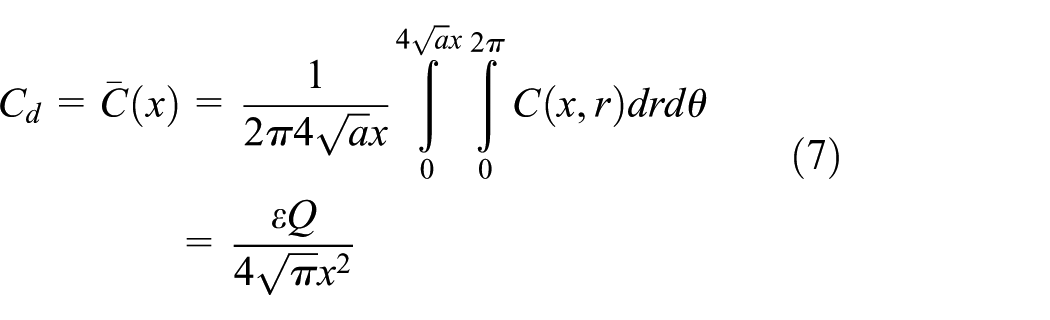
With the help of the gravitational field theory

where P means potential energy and
If the potential energy of the traffic incident depends on its severity, then there is an equation (9)

where P means potential energy (the severity of the traffic incident) and
While traffic incidents make the value of volume to capacity ratio be above 0.75, the comfort degree of road users will significantly decrease, the traffic will be unstable and congested. The maximum affected distance is as follows

where
Spherical extrapolation method
When using the spherical extrapolation method, 11 we consider the location of the traffic incident as the center and divide the surrounding road network into several circles. Then, we turn outward in circles and get the traffic volume of each road. Finally, we determine the outer circle of traffic incident according to the evaluation index and the threshold.
First, let us make some assumptions:
Each road’s traffic flow is distributed evenly.
The road’s traffic capacity can meet the added traffic demands by traffic incident.
The assumption is derived from the following idea: on the road farther away from the traffic incident area, the distribution of traffic flow should be less and more uneven, and on the road near the traffic incident area, the distribution of traffic flow should be more concentrated and more uniform. Then, within the scope of traffic incident, it can be considered that the traffic flow entering the traffic incident area is almost evenly distributed. And in reality, the road capacity could normally satisfy the additional traffic demand caused by the traffic incident.
As shown in Figure 2, the traffic incident happens on point O, it is assumed that the traffic incident and road network could satisfy the above assumptions.
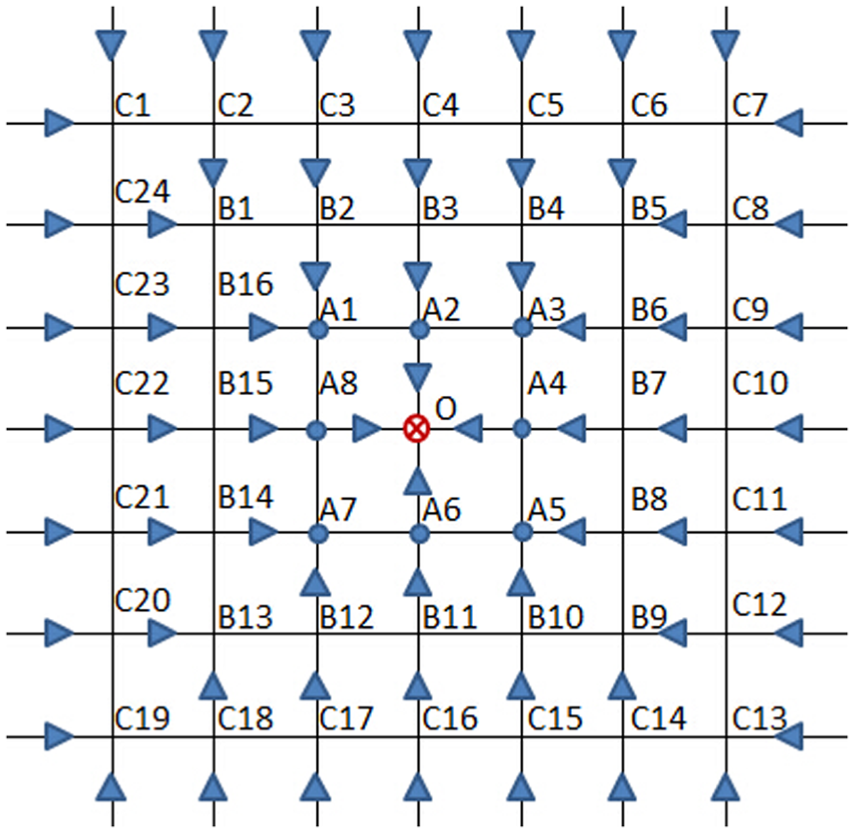
The road network of spherical extrapolation method.
All road on the road network in the picture can be divided into two types. One is the circle road (surrounding the location of the traffic incident, consisting of a closed circle, balancing the traffic flow by going a roundabout route, avoiding blocking the road between circles one by one), such as
For the road network, from the first

where c means capacity and r is the load level corresponding to the service level in different locations or on different roads.
If the k value is higher than the preset threshold value K (e.g. 3%), roads from the first j circle entering the first
The road capacity in the actual road network is different, but spherical extrapolation method is based on the assumptions of uniform distribution. Within the scope of traffic incident, the delaying traffic volume is averaged by the road between the same circle.
In view of this, we propose an improved spherical extrapolation method on the basis of the original spherical extrapolation method in this article, whose core idea is: assuming that each road saturation tends to be identical, in accordance with the residual capacity of the road between the same circle (actual capacity minus existing traffic volume) to assign different weight to each road, according to the weights to distribute the delaying traffic volume caused by traffic incident instead of uniform distribution. Figure 3 is a schematic diagram of this method.

The schematic diagram of improved envelops extrapolation method.
Concrete steps for this method: as shown in Figure 3, for the traffic incident point O, first, the generated traffic volume first outflows from the first control cross section (A circle in the figure) outside the point O. Then, the traffic flow passed through the first control cross section outflows from the second control cross section (B circle in the figure) outside the point O. Then, it uses the same method to find the third control cross section (C circle in the figure), and so on.
It is necessary to calculate each road’s traffic capacity and get each road’s background traffic flow in peak hours on the basis of determining the type of roads. Then, we can determine the weight by the residual capacity of the road between the same circle and take it as the basis to gradually calculate the traffic volume of each road, which is shown in equation (12)

where i is the ith road between the same circle,
However, distribution of the delaying traffic volume produced by traffic incident considers not only the

In Figure 3, if the
In addition, to a certain extent, we can also make up further for the deficiency of spherical extrapolation method by predicting the following two aspects: on one hand, it is to estimate the rough proportion of the distribution of the delaying traffic volume produced by traffic incident in different main direction. On the other hand, the delaying traffic volume produced by traffic incident dissipates with the distance. For the former, we can roughly speculate by the distribution of the population and traffic attraction intensity of the land around the traffic incident. For the latter, according to the relationship between travel frequency and distance, we can deduct dissipation of the delaying traffic volume produced by traffic incident between circles in proportion.
Summary
Currently, determining traffic impact scope is mainly for determination of static changes (such as construction facilities), and the sudden traffic incident scope’s determination is scarce. This article studies the determination of the scope of traffic incident and proposes new ideas which are conducive to relieve traffic congestion and reduce losses.
The previous method has high precision, but in the beginning, it has certain roughness in the determination of candidate regions. At the same time, the method is complicated and needs a large amount of high-precision data, which is not real-time and is not good for the traffic dispersion work.
The following three methods all have their own advantages and limitations. In terms of the road enclosure method, it can be used directly and quickly. The road enclosure method has less restriction and saves time and cost. But its subjectivity is stronger and it also lacks the necessary theoretical basis. Regarding the plume model method, its application condition has a bigger gap with the reality and to a certain extent it is unreasonable. But the method is simple and easy to be programmed into software, which can be applied to the determination of the scope of traffic incident after in-depth development. In terms of the spherical extrapolation method, although it has some shortcomings, it has the clear road network structure and the simple model forms. Because of its convenient calculation and convenient operation, it can guarantee real-time processing of traffic incident to a certain extent. When using the spherical extrapolation method to determine the scope of traffic incident, compared with previous method, it does not need to consider the road impedance which is a complicated problem, and we can start from the easily calculated and observed saturation index, and that is a breakthrough.
Footnotes
Academic Editor: Hai Xiang Lin
Declaration of conflicting interests
The author(s) declared no potential conflicts of interest with respect to the research, authorship, and/or publication of this article.
Funding
The author(s) received no financial support for the research, authorship, and/or publication of this article.