



Abstract
Besides errors and stochastic variation, the observed data always have more or less imprecision. In contrast, classical statistical procedures are based on precise measurements and do not allow imprecision of the individual observations. Therefore, to integrate imprecision of the observations, classical statistical techniques are required to generalize for fuzzy numbers. Since lifetime measurements are also more or less fuzzy, therefore, this study was aimed to generalize parameters and reliability functions estimation for the three-parameter lifetime distributions in such manners to integrate fuzziness of the lifetime data. The obtained estimators assimilate fuzziness and stochastic variation of lifetime observations, whereas classical techniques are only based on stochastic variation. This propagation of fuzziness makes the proposed estimators more realistic and suitable for lifetime analysis. Therefore, in order to model lifetime data, the suggested techniques are far better alternative.
Introduction
In daily life situations, we encounter with continuous variables, and the observations are recorded in the form of precise numbers. Conversely, measurement of any continuous variable always has more or less imprecision. 1 In the scientific world of measurements, it is very obvious that the words like “exact” or “equality” need to be banned because continuous phenomena cannot be measured exactly. 2 Besides continuous measurements, there are some situations where the precise measurements are not possible because of their irregular nature. As an example, one can say depth of a river cannot be measured accurately, but can only be approximated due to the wave nature of water. Similarly, one cannot define a precise criterion in many situations like unhealthy and healthy person, good and bad student, and cool and normal temperature, leading to imprecision of the single measurement. From these arguments, it can be concluded that in fact real measurements have two types of uncertainties, that is, random variation and imprecision of individual observations, so-called fuzziness. 3 Classical statistical procedures are used for modeling variation among the observations without taking fuzziness into account. By doing so, we may lose information, and the inference based on incomplete information gives misleading results. As a result, another system of modeling was needed to integrate the imprecision of a single measurement for making inference. For the system of models to merge fuzziness of the individual observation, Zadeh 4 contributed the idea of fuzzy sets.
A binary response characteristic function, that is, indicator function has significant importance in the classical set theory. It is usually denoted by

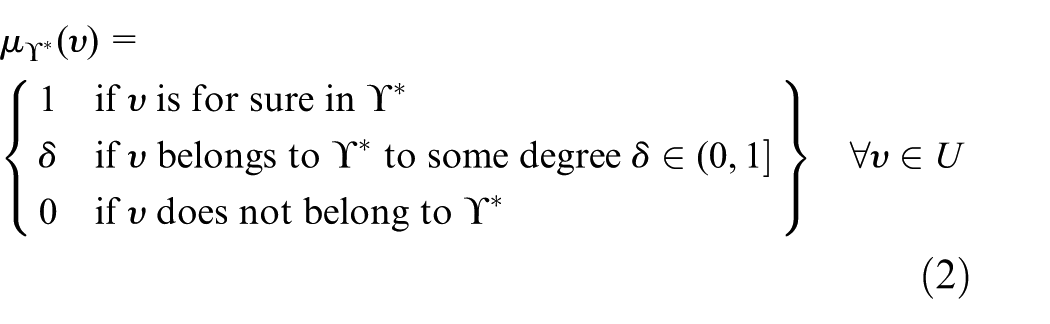
In fuzzy set, the idea of classical set was generalized, that is, two-valued logic is progressed to multi-valued logic. Therefore, indicator function from the classical set notations was extended to the membership function
Elements of fuzzy set
Some essential elements of fuzzy set theory from Viertl 3 are given as follows.
Fuzzy number
From the special fuzzy subsets of
Support of the

which is a bounded set.
So-called δ-cut of the fuzzy number

representing a finite union of non-empty compact intervals
Special representation of fuzzy numbers are called fuzzy intervals, for which the δ-cuts are non-empty closed intervals.
Remark 1
Let
Lemma
For the set

with
Remark 2
One should keep in mind it is not necessary that all families of nested finite unions of compact intervals are the δ-cuts of a fuzzy number. But the construction lemma given below remains true.
Construction lemma
Let

Extension principle
This is generalization of an arbitrary function

Fuzzy vectors
Let
The corresponding δ-cuts are
Theorem
For any arbitrary continuous function,

Lifetime analysis
In lifetime analysis, the variable of interest (life time) is the time until the occurrence of an identified event that maybe death of a patient in biomedical, failure of a mechanical equipment in engineering, change of address in demography, and so on. Main aim of these analyses is predicting the probability of an event, mean survival time, and reliability of equipments.8,9
The life time of a system, component, or individual is random and unpredictable and hence it is amenable to statistical laws. To model lifetime data through statistical ways, the development started in the 20th century, and since then, significant literature has been added.
From literatures,10–16 it is evident that the parametric approaches Weibull, Pareto, and gamma distributions are considered the best models for lifetime analyses. These are described by the probability densities as follows
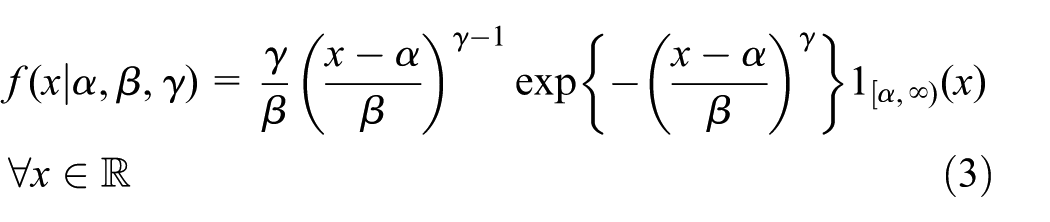
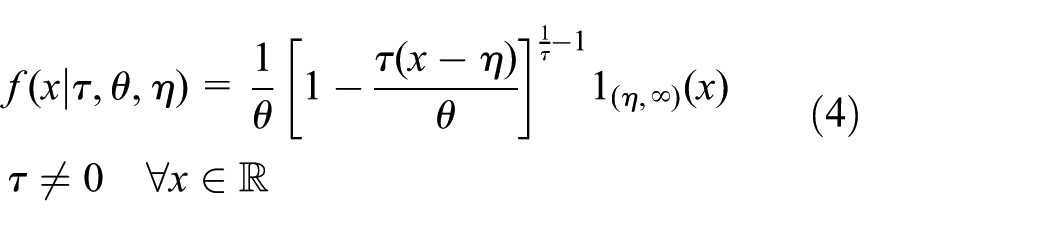

For precise lifetime observations

the classical parameter estimates based on


The estimate of the reliability function of the three-parameter Weibull distribution is defined as 17

For three-parameter Pareto distribution given in equation (4), the maximum likelihood estimators, that is,




where
The estimated reliability function of three-parameter Pareto distribution is 18

For gamma distribution presented in equation (5), taking

Solve equation (16) to get an estimate of

and

The estimated reliability function of the three-parameter gamma distribution has no explicit form; therefore, it can be obtained from its cumulative distribution function (CDF) as

For details, see Cohen and Whitten. 19 In classical statistics for proficient reliability analysis, mostly large data are required. But with the technological advancement, life time of mechanical units as well as survival life of human is increased. Therefore, it is very time consuming and expensive to obtain a large number of observations. To get sophisticated results with small sample size, it is required to utilize all the available information in the best way.
As discussed earlier, continuous phenomena cannot be measured accurately; therefore, lifetime observations need to be described best by fuzzy numbers. Subsequently, in addition to classical statistical methodology, fuzzy models are additionally necessary to analyze realistic lifetime data. Realizing the importance of fuzziness research has been conducted from the last couple of decades,20–33 but still most of the times fuzziness of the individual observations is ignored, which leads to non-representative estimates. For three-parameter log-normal distribution the parameter estimates based on fuzzy life times are presented in Shafiq et al.; 34 therefore, in this article, generalized (fuzzy) estimators for three-parameter lifetime distributions, that is, Weibull, Pareto, and Gamma are proposed.
Three-parameter lifetime distributions estimation and fuzzy life times
Let

Generalized estimators for the Weibull distribution
Let
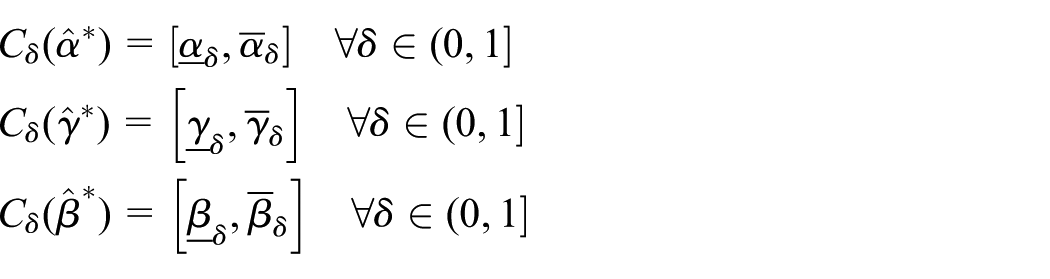
For the fuzzy estimator

and

From

and

Let

and

Let

Example 1
An example of fuzzy lifetime measurements with trapezoidal characterizing functions is given in Figure 1.

Characterizing functions of the trapezoidal fuzzy life times.
To get characterizing functions of the fuzzy estimators
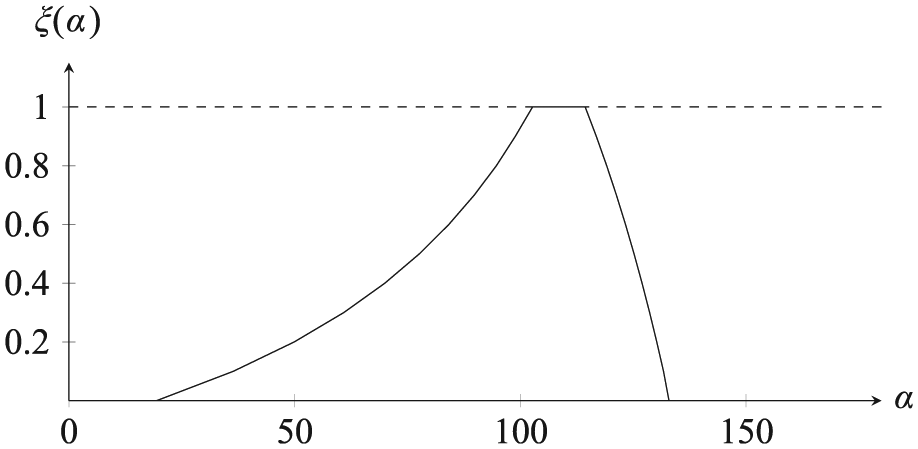
Corresponding characterizing function of the fuzzy estimate
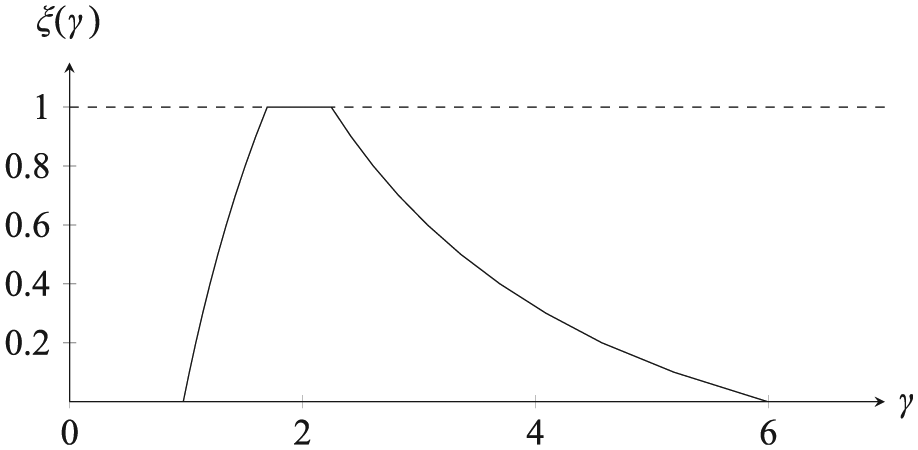
Corresponding characterizing function of the fuzzy estimate
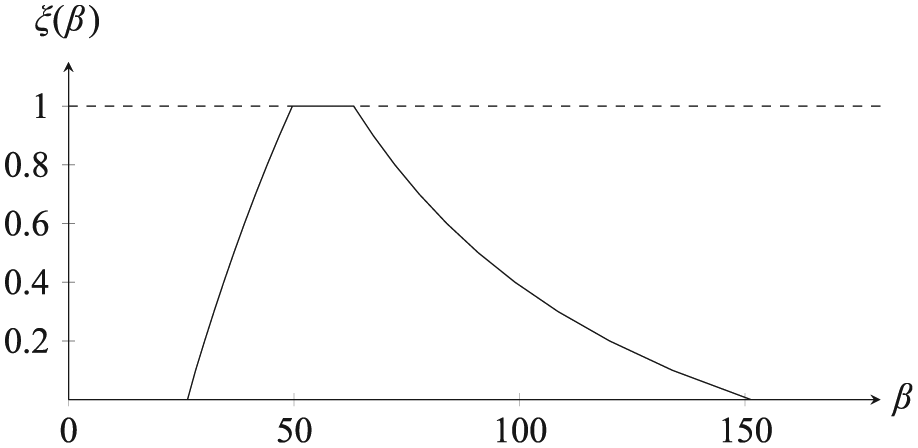
Corresponding characterizing function of the fuzzy estimate
The data presented in Figures 2–4 elicited characterizing functions of the generalized (fuzzy) estimators, which are attained from aforementioned algorithms. These estimates are improved representation of the corresponding parameters as those are based on random variation in addition to fuzziness of lifetime observations. The propagation of fuzziness in the estimation makes the inference more suitable in real-life applications. In Figure 5, curves show the upper and lower boundaries of the δ-cuts for the supports of the corresponding characterizing functions for some values of

Some lower and upper δ-level curves of the fuzzy estimate of the reliability function of Weibull distribution.
The estimators mentioned in and characterizing functions reflected in Figures 2–5 are based on the available information, that is, fuzziness and random variation. The inclusion of fuzziness in inference makes these estimates more detailed for realistic lifetime data.
Generalized estimators for the Pareto distribution
The generalized (fuzzy) estimators of the three-parameter Pareto distribution are denoted by
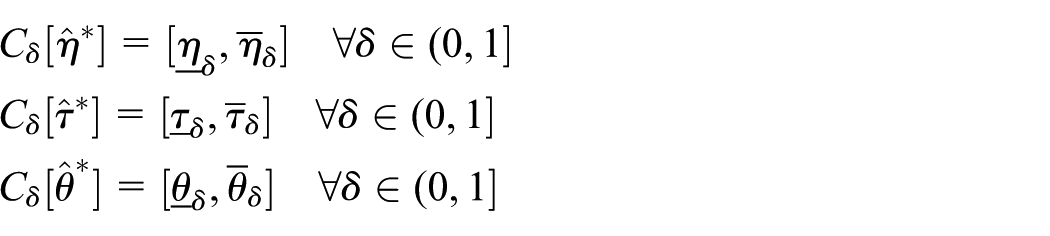
Using equation (11), obtain the corresponding lower and upper ends of the generating family of intervals for the defined fuzzy parameter estimate

and

Let

and

Using generating family of intervals

and

For the fuzzy estimator

The above-explained algorithm for Pareto distributions is applied in example 2.
Example 2
As an example, characterizing functions of some fuzzy lifetime observations are given in Figure 6, and the obtained characterizing functions of the fuzzy parameter estimates that are based on both fuzziness and random variation of life times are depicted in Figures 7–10.

Trapezoidal fuzzy life times.
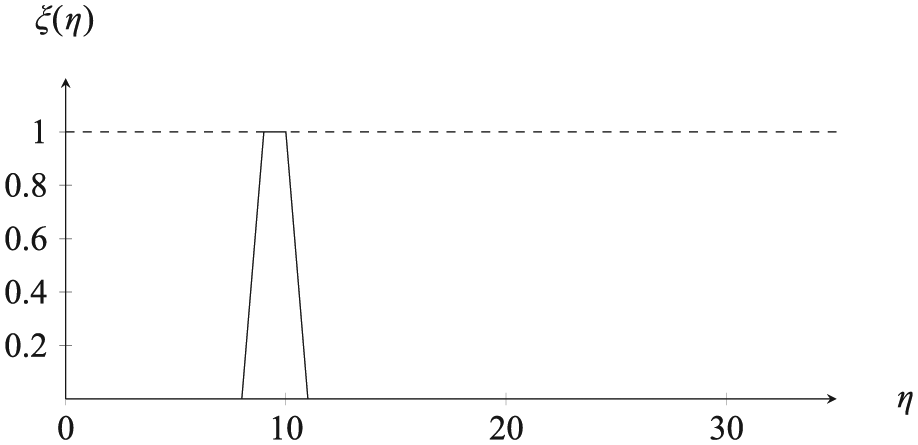
Characterizing function of the fuzzy parameter estimate

Characterizing function of the fuzzy estimate

Characterizing function of the fuzzy estimate

Some lower and upper δ-level curves of the fuzzy estimate of the reliability function of Pareto distribution.
Based on the fuzzy lifetime observations mentioned in Figure 6, the characterizing functions of the corresponding fuzzy parameter estimates are depicted below.
The characterizing functions of the generalized estimators
Generalized estimators for the gamma distribution
In addition to random variation, to integrate fuzziness of the life times for the three-parameter gamma distribution, based on fuzzy lifetime observations

Using equation (16), lower and upper ends of the generating family of intervals of the fuzzy estimate

and

Similarly, using equation (17), ends of the generating family of intervals of the fuzzy estimator

and

In the same way, based on equation (18), ends of the corresponding generating family of intervals for the fuzzy estimate

and

Based on equation (19), lower and upper δ-level curves of the fuzzy estimate of the reliability function of the three-parameter gamma distribution are obtained through the following equations

where
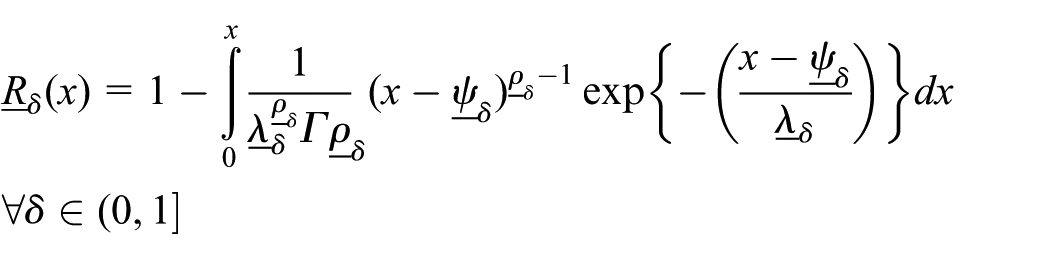
and

Example 3
For this example, characterizing functions of fuzzy lifetime observations are given in Figure 11. The fuzzy estimates, based on the above-proposed fuzzy estimators, are obtained in such a way that utilizes fuzziness of lifetime observations in addition to stochastic variation.
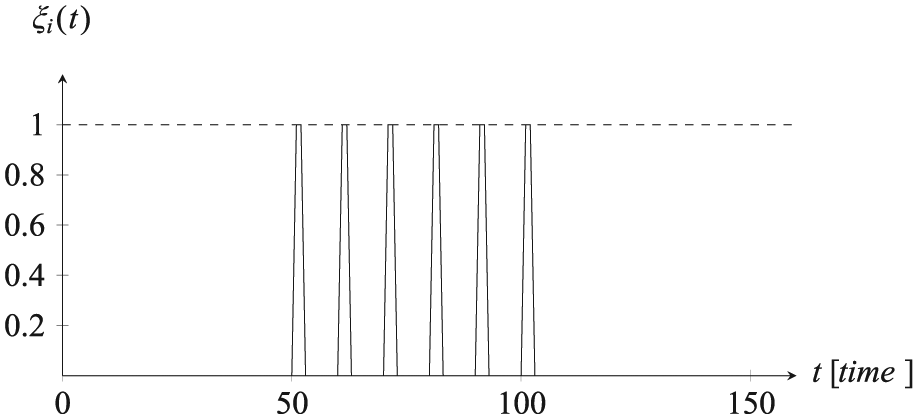
Characterizing functions of trapezoidal fuzzy life times.
The data reflected in Figures 12–14 are characterizing functions of the generalized (fuzzy) estimates

Characterizing function of the fuzzy estimate
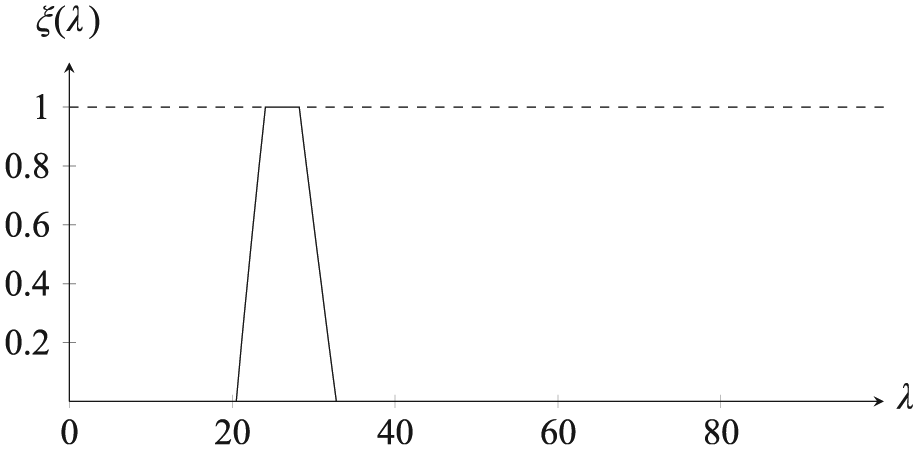
Characterizing function of the fuzzy estimate

Characterizing function of the fuzzy estimate
In Figure 15, curves show the upper and lower boundaries of the δ-cuts for some values of
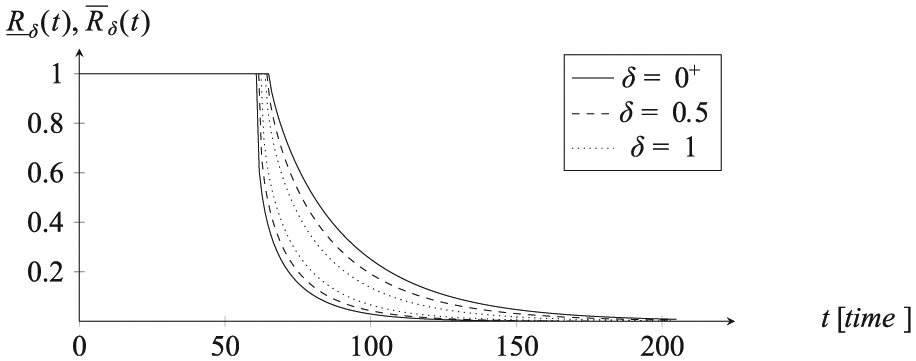
Some lower and upper δ-level curves of the fuzzy estimate of the reliability function of Gamma distribution.
Conclusion
Besides errors and stochastic variation, the observed data always result in more or less imprecision. Therefore, for the lifetime measurement, we required up-to-date models to represent life times, that is, fuzzy numbers. Subsequently, in addition to adapted standard statistical estimation procedures, imprecision of the lifetime measurements is required to obtain appropriate results. In this article, methods to obtain characterizing functions for the fuzzy estimates of the three-parameter lifetime distributions are proposed. The integration of both uncertainties obtained from fuzziness of individual observations and stochastic variation among the observations makes the proposed estimators more general. Therefore, the inference based on proposed estimators is more appropriate in real-life applications.
Footnotes
Academic Editor: Soheil Salahshour
Declaration of conflicting interests
The author(s) declared no potential conflicts of interest with respect to the research, authorship, and/or publication of this article.
Funding
The author(s) received no financial support for the research, authorship, and/or publication of this article.