




Abstract
Fatigue damage is the most important failure mode of wire ropes, and models of cumulative fatigue damage of wire ropes under multiple impact loads have been proposed based on the principle of microdamage linear accumulation. Fatigue damage of wire ropes under a single impact load obeys lognormal distribution, but when under different impact loads, it presents bilateral trailing phenomenon. In this work, a fitting method of wire rope fatigue life analysis under many different impact loads based on double Pareto lognormal distribution is proposed, which can accurately describe and reasonably explain the above phenomenon. The fitting result of test data calculated by double Pareto lognormal distribution is better than the result calculated by lognormal distribution and power-law distribution. This reveals that the model of double Pareto lognormal distribution can well describe the reliability degradation process of wire ropes, thereby providing guidance on the fatigue life estimation of wire ropes.
Keywords
Introduction
As key bearing components in engineering project, wire ropes are widely used in the fields of mine, bridge, shipping, aerospace, and aviation because of their flexible spatial spiral structures. A great deal of research activities on the reliability and service life of wire ropes have been carried out due to their wide range of applications. However, there have been no mature methods to assess the reliability and service life of them up to now due to their complicated structures and a variety of stress types that are involved. In engineering fields, the fatigue life of wire ropes is routinely conservatively estimated, leading to a huge amount of waste. In 1988, 8000 wire ropes replaced and collected from laboratories and engineering sites were analyzed in America. It revealed that there was only slight strength loss or even no strength loss among more than 70% of the replaced wire ropes. Meanwhile, based on the statistical results in Japan, the strength of more than 50% of replaced wire ropes could reach 90% of the strength level of new ones. Chinese statistical results also showed that 20%–30% of the consumption on wire ropes could be saved if the state detection was reinforced or improved and the replacement was undertaken timely. 1 Therefore, research on the accurate methods for assessing the service life of wire ropes is of great significance, which can improve the work efficiency and raise economic benefits of wire ropes.
Fatigue damage is the key failure mode of wire ropes, and how to model the fatigue process and assess the reliability and service life of wire ropes becomes more and more significant. A lot of research on the fatigue of wire ropes has been carried out. Torkar and Arzenšek 2 analyzed the failure of hoisting wire ropes, discovered fatigue fracture characteristics of steel wires, and observed the fatigue crack source on the surface caused by decarbonization. Chaplin 3 discussed the effect of wear in detail on the standards for inspection and replacement of wire ropes. Atianxa4–6 calculated the fatigue strength of steel wires based on their geometrical characteristics, alternating tensile stress, bending stress, and contact stress according to the actual working conditions of wire ropes. Beretta and Boniardi 7 calculated the fatigue strength of eutectoid steel wires under two different types of surface treatments based on the proposed calculation method for the fatigue strength of steel wires. Paton et al. 8 deeply studied the relationship between the rigidity and fatigue strength of wire ropes during the tensile fatigue process. The failure modes of wire ropes studied by a bending fatigue tester were summarized in the US navy manual of wire rope, 9 in which the inner stress of wire ropes was analyzed, and the effect of wire rope diameter and pulley diameter on the failure of wire ropes was presented. Gerdemeli et al. 10 analyzed fatigue life of axial loaded wire rope strands with finite element method and obtained fatigue life variance of axial loaded 1 + 6 simple strand based on Goodman approach. Wang et al. 11 analyzed 6 × 19 + IWS rope and three-layered strand using finite element method and presented implications to fatigue life estimations of fretted wires. Research on the service life of wire ropes mainly focuses on stress failures under axial static and fatigue loading currently. However, theoretical and experimental research on the service life of wire ropes under multiple different impact loads in practical use has not been carried out.
Aiming at solving the above issue, models and processes of cumulative fatigue damage under different impact loading conditions are proposed and analyzed for wire ropes in this work, including cumulative fatigue damage under a single impact load, repeated action of the same impact load, and a combination of several different impact loads. The fitting of cumulative fatigue damage under combined impact loads is carried out by double Pareto lognormal distribution to assess the fatigue life of wire ropes.
Assumption of model
Wire rope failure is affected by many factors such as wear, corrosion, and fatigue caused by the integrative action of bending, stretching, and vibrations. Wire rope failure under impact loads is induced by the performance degradation caused by cumulative fatigue damage under the integrative action of different impact loads. Damage of wire ropes caused by each impact load is stochastic due to the uncertainty of stress levels and other environmental factors.
Damage of wire rope caused by impact stress load
Wire rope failure is induced by the cumulative fatigue damage under the integrative action of different impact loads. Damage of wire ropes under a single impact load is first discussed as follows.
Damage on a wire rope under the kth (k = 1, 2, &, K) magnitude of different impact loads


When the wire rope failure is induced by the cumulative fatigue damage under the repeated action of an impact load

where
The damage of steel wire gradually increases with the increase in load action times.

where ratio


When

It can also be written as follows

As the damage increment under every impact load
Cumulative damage of wire rope


Damage of wire rope caused by integrative action of different impact loads
If a wire rope is under two different loads, the corresponding cumulative damage is denoted by

where

where * expresses convolution.
The mathematical expectation and variance of

It can be obtained that the expectation and variance of cumulative damage

The relationship between the distribution of cumulative damage and the cycle numbers under two-step loading.
Wire rope failure is induced by the cumulative fatigue damage under the integrative action of different impact loads. Hence, the above formula can be extended to cumulative damage under K magnitudes of different impact loads. Cumulative damage under each magnitude of impact load is denoted by

The mathematical expectation and variance of

The sum distribution of two or more logarithmic normal distributions cannot be expressed usually, and its distribution curve does not fully meet the standard logarithmic normal distribution as shown in Figure 1. The sum distribution presents the bilateral trailing phenomenon in its distribution curve, which becomes especially evident when under the condition of multistage stress accumulation. The major part of the above distribution curve usually obeys logarithmic normal distribution, but the tail of the distribution curve is closer to power-law distribution. Thus, direct use of logarithmic normal distribution to describe cumulative damage under the integrative action of different impact loads will lead to imprecise results, whereas double Pareto lognormal distribution provides a better method to describe the distribution characteristics of bilateral power-law trailing phenomenon.16,17 Double Pareto lognormal distribution can be formed by the superposition of a variety of logarithmic normal distributions, which is consistent with the characteristics of the cumulative damage distribution under combined impact loads. Thus, the double Pareto lognormal distribution is adopted to analyze cumulative damage under integrative action of different impact loads and finally to acquire more precise fatigue life estimation of wire ropes.
Double Pareto lognormal distribution
Random process

It is proved that the distribution of random variable
Probability density function of the double Pareto lognormal distribution is as follows

where x is a variable, and
Parameter estimation
The service life of a wire rope under the integrative action of different impact loads is related to the coupling of damage under each impact load. It has been demonstrated in the previous study that the service life of a wire rope under a single impact load obeys logarithmic normal distribution, so the service life under combined impact loads is the coupling of multiple logarithmic normal distributions. Double Pareto lognormal distribution is recommended to express such coupling.
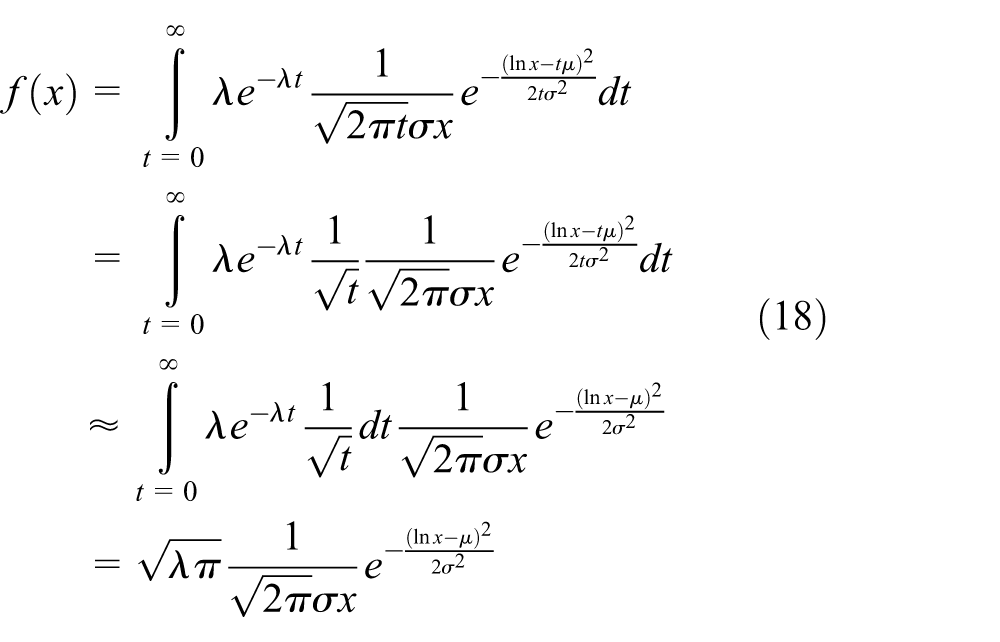
It is assumed that cumulative fatigue
then


The formula indicates that an adjusting parameter
The fatigue life

The above formula obeys normal distribution

Therefore, the reliability function of wire rope under impact load

By substituting the estimated values of the parameters into the above equation, the reliability function of a wire rope under different specific impact loads can be acquired. As the service life of a wire rope obeys double Pareto lognormal distribution, the average life

Case study of reliability life assessment on wire rope
The impact loads of a wire rope in actual service vary at a certain stress range. The impact load of a wire rope in use is assumed equivalent to K magnitudes of different impact loads, and the service life in use is assessed by double Pareto lognormal distribution based on the life estimation under the K magnitudes of different impact loads.
A certain type of wire ropes was chosen for this case study. It consists of six threads, which are 10.0 m in length and 32.2 mm in diameter. Five samples were randomly chosen to be tested. The impact experiments of these wire ropes with fixed-ends were carried out under impact loads in actual service ranging from 3.0 × 10⁵ N to 8.0 × 10⁵ N, and impact speed ranges from 30 to 80 m/s. Tensions of both ends of the wire ropes were measured by strain gauge.
First, cluster analysis of actual stress state is conducted for the wire ropes by the method of k-mean clustering. The two-dimensional coordinates of wire rope stress
Impact times under different impact loads of the five wire ropes.

The impact stress loading of the wire ropes in actual service can be considered to be equivalent to the integrative action of the five impact loads
Then, the service life of wire ropes under the five impact loads is calculated. The service life of the wire ropes under the five impact loads is estimated according to the method reported in the literature, 15 as shown in Table 2.
Service life estimation under different impact stress loads based on microdamage.

According to double Pareto lognormal distribution, the adjusting parameter λ needs to be determined. Damage increment of steel wires under the action of impact stress loads

Figure 2 presents the measured data from Table 2 and the fitted curve based on the formula (16). The value of

The exponential distribution fitting curve of damage increment under the stresses.
The values of
Formula (22) is a ternary quadratic equation. By substituting the data in Table 1 into Formula (22),
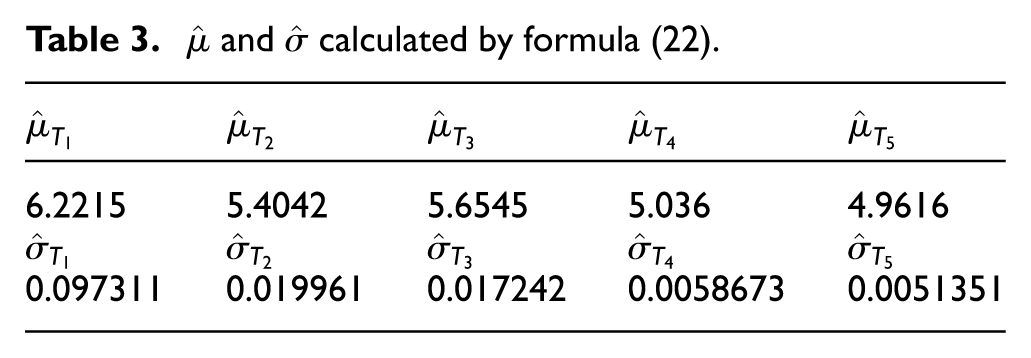
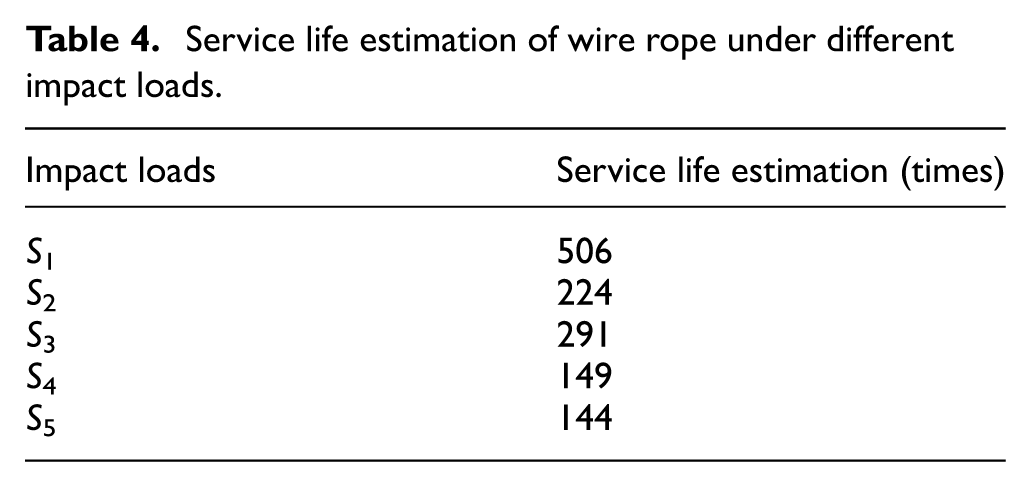
Then, the service life estimation of the five wire ropes under actual impact stress loads is determined, as shown in Table 4.
Service life estimation of wire rope under different impact loads.
Interval estimation on the service life of wire ropes (confidence level, 1 − α = 0.95) under different impact stress loads can be determined by the method of Bootstrap, as shown in Table 5.
Interval estimation on service life of wire rope under different impact loads.

From the service life of wire ropes shown in Table 5, it can be concluded that the interval estimation on the service life of wire ropes determined by the proposed model and double Pareto lognormal distribution can well express the life time evaluation in use and can be directly applied for reliability assessments. The service life prediction based on the double Pareto lognormal distribution is more practical than the estimation under a single impact load for wire ropes. It should be noted that double Pareto lognormal distribution has more parameters than the logarithmic normal distribution, which means that more test data are required to acquire more accurate assessment of those parameters.
Conclusion
As the reliability degradation process of wire ropes under different impact loads is similar to logarithmic normal distribution and presents bilateral trailing phenomenon, double Pareto lognormal distribution is recommended to describe the reliability degradation under multiple impact fatigue loads. Double Pareto lognormal distribution can reasonably explain the above phenomenon. Moreover, it provides a new method for service life assessments from the perspective of random processes. The case demonstrates that double Pareto lognormal distribution can well describe the reliability degradation process for wire ropes and accordingly provide the experience and reference for integrative assessments of wire rope reliability.
Footnotes
Academic Editor: Filippo Berto
Declaration of conflicting interests
The author(s) declared no potential conflicts of interest with respect to the research, authorship, and/or publication of this article.
Funding
The author(s) received no financial support for the research, authorship, and/or publication of this article.