




Abstract
Nowadays, rapid increase in automobile ownership results in traffic congestions especially in large cities all over the world. Park-and-ride mode could ease traffic congestion in urban areas without abandoning traffic demands. The optimization of park-and-ride facility location and charging rules are of importance for travelers, governments, and environment. Therefore, a multi-objective model considering investments and pollution is proposed and a bi-level genetic algorithm is designed. The case study of Shunyi in Beijing is conducted and the results show that the optimization model is feasible, which could provide suggestion for charging policies and park-and-ride locations.
Introduction
In the past two decades, China’s urbanization process has developed significantly and residents’ travel demand keeps increasing. Statistic data show that China’s urbanization process has increased by more than 20%, while ownership of motor vehicles increased by more than 10 times in recent 10 years. Air pollution comes with the rapid development of the automobile industry, and so, new-energy automobiles come upon the stage including electrical automobiles. The application of electrical automobiles could reduce the emission of CO2, NOx, and so on; none the less, the environment does not improve because of the large base number of traditional fossil-fuel-power automobiles. Electrical automobiles are now mostly used in public transit system such as electrical buses and taxis, which is still a small part of the automobile industry. To greatly improve the condition of air and environmental pollution, new-energy automobiles need to be widely used and designed with fewer disadvantages such as short driving ranges. Furthermore, a novel type of travel (park-and-ride (P&R) mode) could improve these problems effectively in a short time by transferring part of car-mode travelers to mass rapid transit (MRT) system (for example, subway).
Large cities in China are planning to construct the urban rail transit networks widely, as an alternative travel pattern, since the urban rail transit system has large capacity with low energy consumption and pollution. By the end of 2016, a total construction plan of 43 cities’ rail transit systems has been approved with total mileages of nearly 8600 km. Meanwhile, many cities all over the world try to equip rail transit station with P&R to solve the problems of both traffic and environment. In this way, travelers can park their own vehicles at the designated P&R hub and then continue the remaining transport with public transport system (e.g. subway) to achieve the purpose of a low-carbon travel.
A good P&R system can satisfy the travel demand of citizens, which solves the traffic problem in central areas, the traffic congestions, and other issues. In Beijing, if travelers have the in-a-day rail transit card/ticket record, it will only cost 2 Yuan, which is a really low price, to enjoy the P&R parking space. However, the expense of P&R facility construction and operation is very high so that subway is necessary. For example, if the cost of construction and maintenance in the suburbs is allocated to each parking space, the cost is about US$5000 and US$300 for each parking space, respectively. In 2016, the government subsidies for rail transit system are nearly 6 billion Yuan each year in Beijing. Nowadays, Beijing provides a series of high-quality P&R facilities and services, which are bound to greatly increase the government’s financial burden. Therefore, how to optimize the P&R facility location and parking charges without passenger volume’s reduction (e.g. MRT system) in the subway system is important. Finally, the goal is to achieve minimum cost and reduce negative effect of environment. We can draw a conclusion that it is significant to formulate P&R and charging rules.
This article selects P&R facility in Shunyi District of Beijing as a case study, and the investigation based on traveler behavior characteristics is conducted. First, we propose the optimization location model of P&R site/facility. Second, traveler preferences on the P&R mode are analyzed to research the optimization of P&R facility location and charging level of parking, which could be a reference for charging policy in the future. The remaining of this article is organized as follows. Section “Literature review” introduces the related work in this field, while the proposed multi-objective model is described in detail in section “Formulation.” Section “Algorithm” presents the design of the genetic algorithm to solve the multi-objective model. In Section “Case studies,” we introduce the case study of Shunyi District in Beijing. Section “Conclusion” concludes the work of this article and future work.
Literature review
P&R, as a kind of traffic demand management strategy, to a certain extent, solves problems such as urban traffic congestions and air pollution, which is widely used all over the world. Car travelers transfer to public transit system (e.g. bus and subway) at P&R facility; meantime, it scatters the traffic demand and encourages people to take public transportation to city central area, 1 which raises study enthusiasm of domestic and international scholars. The main research contents involve the P&R facility’s location and plan of P&R layout mode, P&R facility’s fee policy, and the influence of some other P&R properties on traveler behavior.
Many scholars researched on the P&R layout pattern and location planning. Among them, the important principle is to intercept cars through P&R facilities during travels and make these facilities available. 2 Facility location is really critical, even met with heavy traffic congestions. If a typical commuter on private cars is setting off, it will be hard to abandon their cars and transfer to other public transit vehicles, which gives P&R facilities a good revelation: P&R facilities should be set in the upper position of congestion area so that travelers can avoid serious traffic jams. In the traffic jams, travelers would like to choose public transit which has been proved effective in many literatures.3,4 These principles are also verified in the early study, such as maximum demand cover and adjacent high-quality public transit service. 5 Aros-Vera studied P&R facility’s location problems using logit model, where travelers could either select transfer (P&R) facilities or choose a car travel. Research finally proposed a linear programming method called p-hub, determining a certain number of the specific location of P&R facilities, to ensure full use of these facilities. 6 Holgui et al. invented a set of tools in order to get the best location of P&R facilities, and the locations are verified through the linear city and two-dimensional (2D) city, which stimulated the biggest market share. Research was based on the assumption that travelers would choose P&R mode if and only if the total price is lower than the car travel prices. 7 Holguín-Veras et al. 8 proposed a decision framework according to the New York P&R facilities, which had a reference to the location of the potential P&R site. Farhan and Murray 9 developed tools based on experts and association of geographic information system (GIS) to determine the best location of P&R facilities. Faghri et al. 10 put forward an expert system of GIS tools to determine the optimal location of P&R facilities and made reliability verification based on an actual case. Farhan and Murray 11 built a multi-objective programming model of P&R facility’s location. Yang and Wang 12 used a balanced approach to study site location and parking pricing problem in a linear city.
Facility fee system is a key point in the research, which directly affected the traveler’s choice of P&R mode. Habib et al. selected 14 busiest P&R parking lot in Vancouver and then conducted a survey on the commuters’ preference on the parking fees. In the survey, parking fee varied from 0 to US$6. Increasing P&R parking fees would greatly lead to the current shunt of P&R facility users. But compared to the private car travel all the way, more people would choose rail transit travel mode. 13 Xiong has carried out a research on the influence of changing parking fees in Shenzhen. Then, he put forward two inflection points called the indifference price point and the optimal price point. 14 Wang et al. 15 studied optimal location and price of P&R facilities in linear cities and concluded formula of the optimum parking fees in different locations to lower the traveler’s cost and increase the P&R facilities’ profit. Olsson did a survey on factors of mode selection and found that free parking was the most important factor that affected P&R mode. In addition, the study showed that women and the elderly were willing to pay more P&R parking fee. 16 Syed et al. selected urban rail transit around San Francisco, according to feedback on parking fees to research travelers. Research showed that the change in the daily parking fee would not have apparent influence on travel patterns and facility location. 17 TCRP research showed that P&R parking fees from scratch or increased parking fees will have a huge impact on the P&R model. However, it did not affect rail transit mode. Since commuters could choose other ways, such as walking, cycling, or parking on the side of the road. 18 Calthrop et al. 19 studied the cost of parking around working place. If canceling the free parking, it would have huge effect on personal travel mode. 20
On the impact of P&R facilities’ properties on travel behavior, P&R parking capacity and the safety degree were the important factors in the P&R utilization rate; meanwhile, the high cost of downtown parking and the lack of parking space are the main reasons why users selected P&R. The Dutch study 21 also showed that the lower car accessibility, for example, limiting parking capacity and increasing the parking fee, could promote users to choose P&R or public transportation. Merriman 22 concluded that each additional parking space would increase 0.6–2.2 subway passengers through related data research on the parking capacity of subway stations in Chicago subway. In the process of P&R facilities’ operation management, the price influenced travel behavior significantly.23–26 In addition, the time of finding parking space, the convenience degree of P&R facilities, and parking adequacy were the main factors as well.27–29
From the operation of P&R facilities, the rationality of the construction and how to solve the location planning scientifically still exist as controversy. Parkhurst 30 has pointed out that P&R policy did not reduce road traffic flow, but affected the road traffic flow distribution. But, Martin Lucas Smith put forward different views according to the British P&R measurements. Smith proved that P&R did not have sustainable development in the aspect of both economic benefit and environmental protection. Taking Cambridge as example, he pointed out that P&R measurements have brought some negative effects. 31 Vuchic, based on data of North American P&R survey, found that costs of construction of P&R facilities were really expensive. However, it was still one of the most desirable transportation modes and costs were much lower than building the parking lot in the central of the city. 32 With the arguments arose recently, we can put forward more scientific and reasonable requirements on the construction of P&R facilities: improving the traffic condition and reducing the operating costs in the meantime.
Formulation
Notation
The indices, parameters, and variables used in the model are defined as follows:
D Depreciation of equipment
f Frequency of railway (subway)
h Electricity consumption for 1 km running of MRT
I Number of the candidate P&R facilities
T Range of time horizon
w Observation time interval
Double-objective model
P&R facility could effectively alleviate traffic congestions and air pollution in urban areas, but it needs high service level and reasonable pricing. Therefore, the objective of the model is to minimize the total investment of P&R facilities and air pollution, where the model tries to figure out the optimized location of transfer hub (P&R facility) and pricing of parking. The total investment consists of the construction cost and the operating cost. Specifically, the construction cost includes the cost of infrastructure and equipment purchase cost of P&R facilities. The operating cost is the net cost, which is Electricity costs + Depreciation of equipment − P&R parking revenue − Rail fare income.
From the current situation of the P&R parking lot operating in Beijing, the general parking cost is very low of 2 Yuan/day, so the total benefit is negative. Therefore, the financial subsidy from national and local governments is necessary. The specific two-objective optimization model is as follows


s.t.


where equations (1) and (2) are objective functions of air pollution and total investment of P&R facility, respectively; constraint (3) ensures the capacity of rail transit system; constraint (4) limits the number of parking space; and constraints (5) are the quantity limit of P&R facilities.
In addition, the choice probability of choosing P&R mode (
Utility function
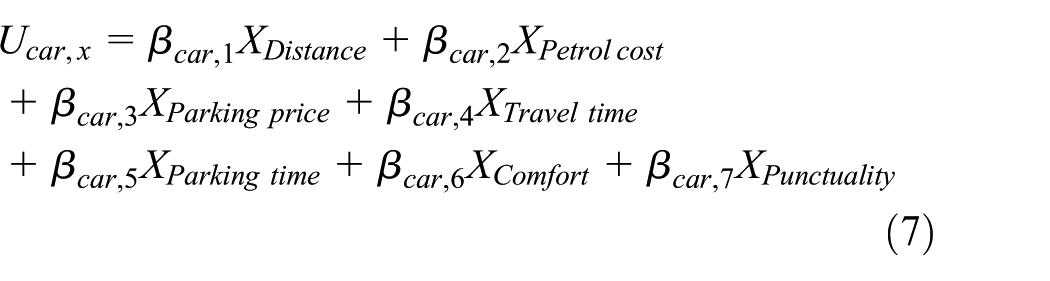
The five main indexes of travel in this article are travel distances, travel costs, travel time, comfort, and punctuality. In addition, the travel modes in this article are set as cars and rail transit. If the travelers do not choose P&R mode, then the travelers choose the rail transit. The main costs of car travel are the cost of oil and parking, while the main costs of urban rail transit P&R mode are rail tickets and parking charges when transferring at P&R facility. The total travel time of the car is the sum of the car travel time and the time to find the parking space (searching time), while the total travel time of the rail transit is made up of the P&R searching time and the rail transit time.
With regard to comfort, this article measures it in congestion. The congestion is divided into three levels: comfort, crowded, and very crowded, with 3 people/m2, 6 people/m2, and 9 persons/m2 on rail transit vehicles, respectively. This article defines the comfort of the cars as 1, while the subway comfort is 2. In terms of punctuality, we describe it by the variation in travel time.33–35 And punctuality of subway is set as 1, while the car’s punctuality is 2. Both smaller values of comfort and punctuality mean better situations.
Non-aggregated models have a wide range of applications in the traffic pattern division and traffic assignment. The basic assumption is that the preference for a choice can be described in terms of “attraction” or “utility” when making a choice. The utility theory is the basis for non-aggregate model, where the travelers always choose the scheme with maximum utility. The utility of a scheme varies with different indexes of travel (mentioned above), which finally affects the choice of travel pattern. Generally, the choice of the travel mode is related not only to the service level of traffic mode but also to the personal attributes of travelers and travel characteristics.
In this article, the travel modes are alternative: rail transit (P&R) and cars. The multivariate logit model is adopted as the utility function, which is a logarithmic function

where
The utility functions of cars and P&R mode for rail transit are as follows
Car
P&R mode for rail transit (mass rail transit)

Therefore, the choice probability of the two travel modes is related to the utility, where the specific relation is shown in equation (9)

where
Algorithm
The model mentioned above formulates a multi-objective optimization problem, which could determine the location of P&R facility, the frequency of the subway, parking fees, the searching time, and the capacity of parking facilities. The proposed model is complex and could only be solved by heuristic algorithms. Therefore, we designed a bi-level genetic algorithm. In addition, the multi-objective optimization problem should first be converted into a single-objective problem. The upper level generates the schemes of location and other issues (see specific steps), while the lower one calculates the exhaust emissions and travel costs. The specific steps of bi-level genetic algorithm in this paper are as follows:
Step 1: Initialization. Generate the initial population of the upper level problem with binary codes, where each individual represents a scheme of location.
Step 2. Calculate the fitness value of the population of the upper level.
Step 2.1. When a location scheme is fixed, the initial population of the lower level problem is generated by real coding. The individual indicates the position of the P&R facility, the frequency of the P&R facility, parking fees, the time for finding the parking space, and the parking facilities’ capacity.
Step 2.2. Calculate the fitness value of the individual of the lower level: exhaust emissions of cars and travel costs.
Step 2.3. If the fitness value is satisfied or the number of iterations is limited, the lower level calculation will be terminated and return the optimal fitness value to Step 3. If not, go to Step 2.4.
Step 2.4. Operate selection, crossing, and mutation. Then return to Step 2.2.
Step 3. Calculation terminate criterion. If the fitness value of the upper level is not converged or the number of iterations is not reached, go to Step 4; otherwise, the calculation is terminated.
Step 4. Operate selection, crossing, and mutation of the upper level, and then, return to Step 2.
The settings of the parameter in genetic algorithm are listed in Table 1.
Values of parameters in genetic algorithm.

Case studies
Brief introduction
The Houshayu Subway Station (Line 15) in Shunyi District of Beijing is selected for case study. The P&R facility is located in the northwest of Beijing and the southwest of Shunyi District, about 19 km away from the center of Beijing, which is a significant transit hub (connecting Shunyi District and suburban of Beijing). The operation of P&R facility of Houshayu is now not in a good state, although open P&R facilities are already set. Because of the bad systematic planning and the existence of unoccupied land at nearby, this article tries to optimize the location of the P&R facility, which may provide suggestions for upgrading and improvement of P&R facility in the future. According to the design principles of P&R systems and land use patterns near the subway, four candidate sites for the P&R facility are selected as the candidate ones (Figure 1). Other relevant parameters of the subway station are shown in Table 2.

Houshayu Subway Station and four candidate P&R hubs.
Settings of relevant parameters.

See specific meaning of parameters in section “Formulation.”
Choice probability
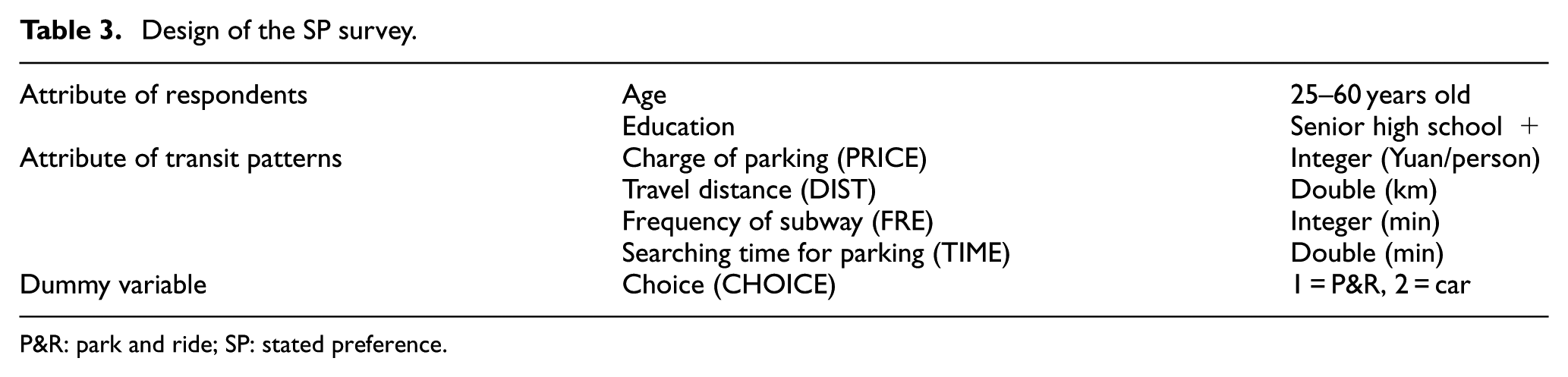
In order to obtain the probability function of choosing P&R facilities, the stated preference (SP) survey is conducted. The commemorative personnel of the Houshayu Subway Station in Shunyi District of Beijing was investigated mainly and 460 valid questionnaires were collected among 500 questionnaires. The design of the investigation is shown in Table 3.
Design of the SP survey.
P&R: park and ride; SP: stated preference.
Since the transit modes are limited to only two alternative modes, the Binary Logit model in the discrete analysis software Biogeme 2.0 could be used to calibrate the formulas (7) and (8) with the P&R model as reference. It can be seen that the five factors (the dummy variable, the parking fee, the travel distance, the frequency, and the searching time for parking) are significant at the 90% confidence level. The P&R facility dummy variable is positive, indicating that travelers are biased toward the P&R facility when other factors are constant. In addition, the parking lot charges have the greatest impact on the probability of selection, indicating that travel costs have a significant impact on travel patterns, followed by searching time for parking. It shows that travelers are sensitive to time since the main respondents are commuters. The results of calibration are listed in Table 4.
Calibration results of utility function.

Results
After 1000 times calculations of the proposed genetic algorithm, it was found that the fitness begins to converge at the 714th generation (see Figure 2). And the result of calculation at present state is as follows: P&R facility is set at the one which is at the east of Houshayu Station, frequency is 10 min, and parking charges equal to 5 Yuan/time. In addition, the reduction in tail gas pollution is 52.6%, and the net operating cost of P&R facilities is 4.8 Yuan per day for each parking space.

Results of iteration of the proposed algorithm.
Conclusion
Based on the preference of travelers, this article analyzes the optimization of transfer hubs’ location and charging. We propose a two-objective optimization model with low air pollution in P&R and total costs, which could provide suggestions for location of P&R and charging policy. We take P&R facility of Houshayu Subway Station as an example, and the data of the real world are used for analysis and testing. The results show that the probability that travelers choose the mode of transportation is affected by the parking lot, the searching time for parking, the travel distance, and the frequency of the subway. The optimal design of P&R facility of Houshayu Subway Station is carried out according to the preference of travelers based on former results. The optimization results show that the whole system reaches the optimal state when the P&R facility is the one which is located at the east of Houshayu Station, while the parking fee is set at 5 Yuan/time, and 10 min for the subway frequency. Meanwhile, the air pollution is improved at a high level, and the whole P&R system operating cost is the lowest.
Footnotes
Academic Editor: Tao Feng
Declaration of conflicting interests
The author(s) declared no potential conflicts of interest with respect to the research, authorship, and/or publication of this article.
Funding
The author(s) disclosed receipt of the following financial support for the research, authorship, and/or publication of this article: This work is supported by Beijing Natural Science Foundation (8172039).