




Abstract
This article focuses on synchronizing timetables of train services at a rail transfer station. The main aim is to determine an optimal schedule of train services, given that the departure and arrival times of some particular trains are known. An exponential utility function is introduced to measure the synchronization levels between different train services. A nonlinear integer programming model is proposed to achieve the objective of a synchronized timetable. A dynamic programming approach is then designed to solve the developed model. Finally, a numerical example with real-world datasets is implemented to demonstrate the effectiveness of the proposed approaches.
Introduction
The main goal of train timetable with synchronization is to ensure feasible and efficient connections between different train services, namely, ensuring the smooth transfer of passengers from one service to another at transfer stations in a railway network. It is clear that the synchronization quality of train services is a crucial concern for both passengers and operational companies. A train timetable with better connections can quickly evacuate the arrival and departure passengers at transfer stations.
Synchronizing timetables for public transit systems has recently received considerable attention. Some early studies considered stochastic environments and set the delay and line headway as the decision variables in their models.1–3 In contrast, other studies have straightforward viewed the departure and arrival times as the decision variables.4–10 The primary reason leading to this distinction is that the assumption conditions of these studies (i.e. deterministic and probabilistic conditions) are different. Of course, the headway of line and the arrival and departure times of trains can be converted to each other. Due to reliability and punctuality of passenger train operation, this article also treats the arrival and departure times of each train at the transfer station as decision variables in order to synchronize train timetables.
A proper timetable must concentrate on minimizing the passengers’ waiting time associated with a high-quality train services. Mohring et al. 11 found that passengers often perceived their waiting times to be almost twice that of the actual waiting times. Niu et al.12,13 developed several nonlinear optimization models to minimize the total passenger waiting time based on time-dependent demand for a rail corridor. Of course, a number of existing studies considered the transfer passenger demands to calculate the total transfer waiting time. Liebchen 14 optimized the periodic event-scheduling problem by considering shorter passenger waiting time, at both stops and transfers. Wong et al. 6 and Kwan and Chang 7 considered the transfer passengers to be “weights” in an objective function to estimate the passenger transfer time. Hsu 15 formulated a continuous model to calculate the mean passenger transfer waiting time. Recently, Niu et al. 10 calculated the exact total transfer waiting time under the condition of time-varying demand. Furthermore, some papers calculated the approximate passenger transfer waiting time.3,16,17 To summarize, it is more important to calculate the transfer passenger waiting time in the connection optimization process.
However, it must be noted that the number of transfer passengers can hardly be accurately calculated at a station with several transfer directions. Ceder et al. 4 assumed that the running time is fixed and proposed a mixed integer linear programming model that aimed at maximizing the number of simultaneous bus arrivals at transfer nodes. On this basis, Ibarra-Rojas et al. 5 formulated the timetabling problem for a network that aimed to maximize the number of synchronizations to facilitate passenger transfers and avoid bus bunching along the network, and they provided an effective multi-start iterated local search algorithm for the problem. However, these studies are mainly applied to bus scheduling in public transit networks and are rarely used to synchronize train timetables for railway networks.
Combined with the passenger dissatisfaction index in Kwan and Chang, 7 this article converts the connection slack time (i.e. the time between the arrival time of the feeder train and the departure time of the connecting train) into the level of services for train synchronization. Then, the total level of services of train connections is defined as the optimization objective, which can simultaneously maximize the number of seamless connections and minimize the slack times of all the trains. Without loss of generality, our model can also treat the requirement of the transfer demand by embedding the “weight” of transfer passengers in the objection function, similar to Wong et al. 6 and Kwan and Chang. 7
In addition, because connection optimization is a complex task, the synchronizing train timetables in different networks are optimized using special models and algorithms. The example of two lines with a transfer station was studied by Niu et al. 10 Sivakumaran et al. 18 considered an idealized system that delivers its users to a common destination by requiring each transfer from a feeder to a trunk-line vehicle. For reducing transfer time in real time, Chowdhury and Chien 19 optimized dynamic dispatching vehicles at transfer stations by connecting four transit routes. Dou et al. 20 researched the coordination between buses and trains. These studies challenged special physical network structures from different perspectives.
For a special transfer station with different grade routes, for instance, at a transfer node with high-speed rail routes and ordinary rail routes, generally speaking, establishing timetables of high-speed trains take precedence over timetables of ordinary trains. Hence, it is completely necessary to develop a model and high-performance algorithm to optimize the synchronizing train timetables for the specific transfer station. The article mainly focuses on the connection relationship at a transfer station. Because train operation conditions are limited, the departure and arrival times of some trains at the transfer station generally cannot be changed, for example, high-speed trains. However, to facilitate passenger transfer, these particular trains also need to be connected by the other trains (e.g. ordinary trains) that have several alternative departure and arrival times. Naturally, the purpose of this article is to schedule the latter trains to connect the special trains.
Although the train timetable with synchronization problem for the public transit system has been studied extensively, we still do a lot of work. First, we describe a connection process between trains in detail and define connecting time windows and feeder time windows. Second, based on the exponential utility, an efficient objective function is established to depict the level of services for train synchronization in the proposed model, which can maximize the number of train seamless connections and minimize the connection slack time. Finally, we design the exact dynamic programming (DP) optimization algorithm to solve this problem and achieve better results.
The remainder of this article is organized as follows. First, we present an analysis for our defined problem in section “Problem statement.” Our developed formulation is presented in section “Optimization model.” In section “DP approach,” DP approach is established to solve the problem. In section “Numerical example,” a numerical example is provided to illustrate the application of the model. Finally, the section “Results” summarizes our results and suggests areas of further research.
Problem statement
As mentioned, it usually occurs that some special trains require connection to other trains at a given transfer station, while the departure and arrival times of all the special trains at the transfer station cannot be changed. To clarify the problem, we refer to these special trains as fixing trains, for example, high-speed trains, running longer-distance trains, and high-load trains which have a higher grade than the others, and the priority will be given to draw up timetables of the fixing trains. Compared to the fixing trains, the lower grade trains are considered as non-fixing trains (e.g. ordinary trains, running shorter distance trains, and low-load trains), namely, the timetables of the fixing trains are predetermined before finishing schedule of the non-fixing trains. Moreover, there are two necessary preconditions that should be known in this study. The first hypothesis is that all trains stop at the transfer station and then traverse it. The other is that the two types of trains stop at independent platforms without operation conflicts.
We use
As shown in Figure 1, the fixing trains stop at platform A and the non-fixing trains stop at platform B. It should be noted that the non-fixing trains with departure times greater than


Illustration of the connections at the transfer station.
Similarly, a fixing departure train has a corresponding time window for the non-fixing arrival trains, which is referred to the feeder time window, denoted as

Optimization model
Objective function
We introduce the level of service of train synchronization to measure the connection slack time and the number of connections in this article. To establish the objective function, we define the following
Connection from the fixing train to the non-fixing train
As for a fixing arrival train, Wong et al.
6
supposed that it can be connected by one departure train at most, which is consistent with the hypothesis in this article. Figure 2 shows the sequence of events at the transfer station. Common sense dictates that the fixing arrival train i cannot be connected to the non-fixing train

Illustration of a connection from a fixing train to a non-fixing train.
Subsequently, we use

where

We use the exponential utility function to reflect the level of services of the connections, which increases with the decrease in the connection slack time and is defined as below

where
Connection from the non-fixing train to the fixing train
For connecting each non-fixing arrival train, we note that the non-fixing trains with arrival times within the feeder time window can connect with the fixing departure train. As shown in Figure 3, the fixing departure train i can join train

Illustration of a connection from a non-fixing train to a fixing train.
We use vector

The binary variable


where
In the above formulation, if

It should be noted that potential information is hidden in equation (9), that is, the objective function can maximize the number of connections between trains. In this study, given that the departure time of the last non-fixing train is equal to T, the total number of connections depends on the arrival times of the last train. As shown in Figure 4, train m is the last fixing train and train n is the last non-fixing train. Apparently, the connection number in Figure 4(b) is higher than that in (a), and the objective value of that in (b) is higher than that in (a). Therefore, the proposed objective function can simultaneously optimize the connection slack time and the number of connections.
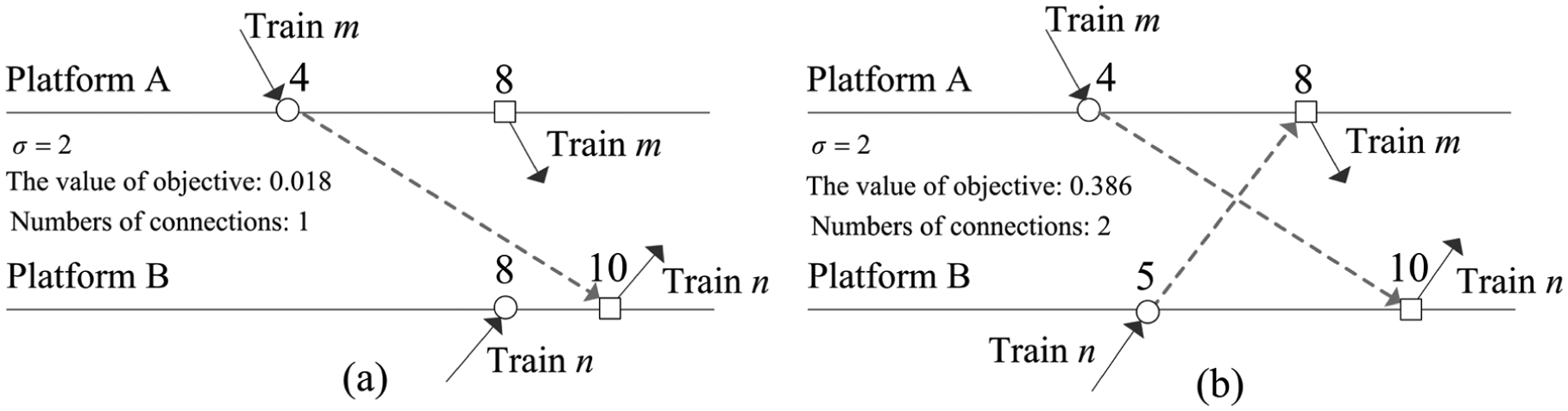
Example of connection between the last fixing and non-fixing trains.
Constraints
1. The dwelling time

where
2. To fulfill the service requirements, the departure times of two consecutive trains should satisfy the following inequality (11). Simultaneously, to ensure safe operation conditions, the arrival times must satisfy inequality (12), as shown in Figure 5


where

Illustration of the time interval constraints for two consecutive trains.
3. When two consecutive trains come into the station, the time gap between the departure time of the last train and the arrival time of the former train is less than the additional minimum safety headway, as shown in Figure 5

where
4. During the study period


DP approach
For synchronizing train timetabling problem, the intelligent heuristic algorithms, such as genetic algorithm and simulated annealing algorithm, are widely applied.6–10 Although these algorithms are tractable, so far, it is difficult to appraise the quality of solution obtained by these algorithms, especially for large-scale problem. Thus, DP is designed for the proposed nonlinear integer programming model in this article, which is accurate algorithm and can obtain the optimum solution. It is well known that the shortcoming of the DP is curse of dimensionality. However, due to exquisite design in the algorithm, it is fully able to obtain an accurate solution in a short time for our model.
Stage and state
In DP, the state variables of each stage naturally consist of the arrival and departure times of the non-fixing trains. This article sets 1 min as the time unit of the study horizon
On the premise of the determining stage, it is essential to analyze the inherent relations of state variables for the two adjacent stages. In this problem, when the arrival and departure times of train
First, because each non-fixing train is limited by constant time intervals in constraints (10)–(12), the arrival time window, defined as

If the arrival time of train j is given, that is,

Second, when the arrival and the departure times of train j+1 are assigned, that is,


Illustration of the time windows.
It is clear that


For clarifying the above content, a simple case is developed. The number of fixing trains and the non-fixing trains are three and five, respectively. The arrival times of the three fixing trains are 1, 6, and 11, and their departure times are 4, 9, and 14, respectively. The other parameters are
From equation (16), we can calculate the value of

Example of solving the time windows.
Recursion equation
In Figure 8, when the arrival and the departure times of train j+1 are given, we can calculate the arrival and the departures time windows of train j,



Illustration of the transmitting state variables in adjacent stages.
where
By assuming that the initial state is

Algorithm procedure

To verify the validity of the algorithm, we calculate the above example using the DP approach, for which the optimal schedule is obtained, as shown in Figure 9; its objection value is 6.14. The connection relationship of each train is expressed in this figure, in which (H1→V1):1.00 means that the objective value of the train connection is 1 (i.e. seamless connection) from the first fixing train to the first non-fixing train.

An illustration of the timetable synchronization of simple example.
Numerical example
Input data
In this section, there are 56 fixing trains and 60 non-fixing trains traversing a transfer station in the study horizon from 6:30 to 21:30. The maximum and the minimum headways for the non-fixing trains at the station are 25 and 5 min, respectively; the maximum and the minimum dwelling times are 10 and 2 min, respectively. The additional minimum safety headway of trains coming into the station is 5 min. The time for passengers to walk across the interchange platform
Arrival and departure times of all fixing trains at the transfer station.

Results
Through the DP approach to solve this example, the best departure and arrival times of all the non-fixing trains are obtained as shown in Table 2, during 420.51 s of computational time by C++ language programming on a workstation of Inter Core E5-2609 with 2.50 GHz and 32GB RAM.
Optimal arrival and departure times of all non-fixing trains.

From Table 2, we can easily summarize the relationships of connections between the non-fixing trains to the fixing trains, as shown in Table 3, where WT denotes the transfer waiting time, V1 is the first non-fixing train, H2 indicates the second fixing train, V1→H2 is the connection from the first non-fixing train to the second fixing train, and V60→∅ denotes that the 60th non-fixing train is not connected by any fixing trains. It should be noted that the total number of connections is 114 and the number of seamless connections (i.e. WT = 0) is 80 in Table 3. Because the seamless connection dominates in the optimum solution, that is to say, the proposed method is effective for this problem.
Relationships of connections between the non-fixing trains to the fixing trains.

To further verify the effectiveness of the proposed model and algorithm, this article compares the DP and regular connection plan in Table 4, which has even departure and constant dwelling times of 5 min for each non-fixing train. We can see that the objective value and the average dwelling time associated with the designed plan are much better than the regular plan.
Comparison of the different schedules.

Conclusion
This study formulated a nonlinear integer programming model to synchronize the fixing trains and the non-fixing trains at a transfer station. In order to clarify the problem, the connecting time window and the feeder time window are introduced in the model. An exponential utility function is adopted as the objective function to measure the level of the train connection quality, which can ensure the maximum number of seamless connection and the minimum transfer waiting time. For generating accurate solution in shorter time, the DP approach is designed to solve the proposed model, and its effectiveness is verified by a real-world example. Moreover, further research should consider several transfer stations in a railway network to optimize the timetable synchronization and design a more efficient optimization algorithm.
Footnotes
Academic Editor: Xiaobei Jiang
Declaration of conflicting interests
The author(s) declared no potential conflicts of interest with respect to the research, authorship, and/or publication of this article.
Funding
The author(s) disclosed receipt of the following financial support for the research, authorship, and/or publication of this article: The work described in this paper was supported by the National Natural Science Foundation of China (grant no. 71261014).