



Abstract
Solar energy is a renewable and free energy. We can take advantage of such characteristics to produce solar cooling through adsorption especially in an area such as the city of Monastir, Tunisia, where the Sun is abundant. A mathematical model and simulation are carried out to optimize heat and mass transfers performance in a flat solar collector using zeolite/water and activated carbon/methanol pairs during desorption phenomena. A commercial simulation software COMSOL Multiphysics has been developed to provide us with the time–space evolution of temperature and average fluid content. Numerical results have shown that the activated carbon desorbs faster than the zeolite. Besides, in order to get an important solar coefficient of performance, it is necessary to have an important incident solar energy. It has also been found that to improve the solar coefficient of performance, an adsorption–ejection system is statically studied.
Keywords
Introduction
One of the most important challenges the world has been facing is reducing environmental pollution especially when it comes to ozone layer depletion and energy consumption. Conventional compression cooling systems, such as refrigerators and air conditioners, not only deteriorate the ozone layer but also require huge amounts of electricity. The solar refrigeration system is the key to such issues. It makes good use of solar energy as it is clean, renewable, and sustainable. Also, it may have applications in both developed and developing countries. Applications in developing countries such as vaccine storage or large-scale food preservation have been the subjects of much research, for example, see G Santori et al. 1 and A Allouhi et al. 2 The solar adsorption refrigeration device depends heavily on the adsorbent working pairs. The most common pairs are zeolite/water, 3 silica gel/water, 4 activated carbon/methanol, 5 and activated carbon/ammonia. 6 While comparing working pairs, it has been noticed that activated carbon/methanol and zeolite/water are the most appropriate pairs for cooling purposes at low temperature. 7 The performance of the adsorption cooling device can be carried out by theoretical and experimental studies on the adsorption refrigeration technology using activated carbon/methanol and zeolite/water pairs. The adsorption ice-maker prototype with semi pilot scales has been elaborated, realized, and tested. 8 The development of a computation program has given an estimate of the activated carbon and methanol quantities in the adsorption refrigerator, energy balance, and the design of its various components, as well as the machine performance coefficient. The results have shown that the thermal coefficient of performance (COPth) and the solar coefficient of performance (COPs) are 0.49 and 0.081, respectively. AA Askalany et al. 9 have theoretically and experimentally studied the performance of the adsorption cooling system. The maximum COPth obtained from the theoretical work was about 0.35. The COPth achieved by the system is 0.35 at 373K driving temperature and 295K evaporator temperature, and the experimental SCE could go up to the value of 70 kJ kg−1, whereas the theoretical SCE is 83 kJ kg−1. MA Hadj Ammar et al. 10 have numerically investigated the performance of a tubular adsorber for an adsorbent refrigeration system. The results have shown that the COPs = 0.21, when the tube diameter of D = 0.18 m, a number of eight tubes for filling 1 m2 and using double glazed cover for the collector leads. W Chekirou et al. 11 have carried out a mathematical model and simulation to optimize heat and mass transfer performance in the tubular adsorber of a solar adsorption cooling machine. They found that the maximum performance of the system is COPth = 0.424 and COPs = 0.143, when the internal adsorber radius and solar collector surface area are 54.55 mm and 1 m2, respectively. HZ Hassan et al. 12 have demonstrated via a theoretical simulation of a solar adsorption refrigerator that a very small variation in the effective thermal conductivity of the reactor (between 0.5 and 0.528 W m−1 K−1), the procedure pressure during adsorption, and desorption procedures have been approximately constant. The utmost COPs has reached 0.2 at Canada’s temperature on 30 June 2009. A Zaghnani et al.13,14 have studied numerically heat and mass transfers within a plane adsorber during water desorption by a zeolite 13X bed using two-phase and three-phase models. During this study, the author has performed the adsorption geometry, heat transfer coefficient, and the ratio of thermal anisotropy. I Solmuş et al. 15 have experimentally studied the adsorption properties of a natural zeolite/water pair. They compared the cyclic adsorption capacity swing at different condenser, evaporator, and adsorbent temperatures along with activated carbon/methanol, silica gel/water, and zeolite 13X/water pairs. They have found that the cycled mass of the natural zeolite/water pair has the lowest dependency on evaporator and condenser temperatures. According to the references cited above, all researchers are interested in improving the performance of the adsorption cooling system by studying the effect of the various elements of the system (evaporator, condenser and adsorber), the nature, and shape of the collector as well as pairs used.
As such, the purpose of this article is to state the heat and mass transfers evolution under the climatic conditions of the city of Monastir, Tunisia. Furthermore, a static study has been conducted in order to optimize the performance of solar adsorption cooling system using zeolite/water and activated carbon/methanol pairs. A combined adsorption–ejection cycle and its coefficient of performance (COP) have been studied in this article to have a continuous refrigerating machine.
Description of combined adsorption–ejection cooling system
A classical adsorption cooling machine operates intermittently (Figure 1(a)). To overcome this disadvantage, a combined adsorption–ejection cycle has been studied in this section (Figure 1(b)). There are four subsystems considered in the combined system: the adsorber, the ejector, the condenser, and the evaporator.

(a) Solar adsorption refrigeration scheme and (b) continuous combined adsorption–ejector refrigeration system.
During daytime, the adsorber absorbs solar energy with water desorbing from zeolite. During this period, once the adsorber is connected to the ejector and disconnected from the evaporator by means of valves 1 and 2, the ejector refrigeration starts. Water vapor at high temperature and pressure from zeolite enters the ejector and is accelerated in the convergent–divergent nozzle. At the nozzle exit, the primary flow reaches a supersonic velocity and a lower pressure and entrains the water vapor from the evaporator into the suction chamber with the valve 3 opening. The mixture of the two streams is under a uniform pressure going up to the inlet of the constant-area section. The mixture is then compressed into the condenser by the diffuser, in which hypothetically the temperature and pressure of water vapor reach mid-values, Tc and Pc in the ideal process, and is cooled into liquid, then enters into the receiver, and finally returns to the evaporator by the throttle valve. In the afternoon, the valves are exchanged to disconnect the adsorber from the ejector and to connect the adsorber to the evaporator. When the pressure in the adsorber is reduced to certain value of Pe, the adsorption refrigeration starts. It is the refrigerating period. This period lasts until the following morning.
Mathematical model
The adsorber considered in this study (Figure 2) is a flat collector having the following features: 1 m2 area (length L = 1 m and width l = 1 m) and height H = 4 cm. A collector filled with zeolite grains and a collector filled with activated carbon are used alternatively. The collector has been connected to a condenser during the desorption phase where the temperature is 313K.

Solar plan setup.
Simplifying assumptions
The plane adsorber considered in this article can exchange heat according to the width and the height of the collector. The medium inside the adsorber is composed of a solid phase (zeolite or activated carbon), a liquid phase (water or methanol), and a gaseous phase (vapor water or vapor methanol).
Some assumptions have been taken into consideration to obtain a closed set of governing macroscopic equations:
Thermophysical properties of the porous bed are temperature independent;
Coupled heat and mass transfers are assumed to be two-dimensional;
Compression work and viscous dissipation are negligible;
Porosity of the bed and grain are constant;
Porous medium is isotropic, homogeneous, and undeformable;
Fluctuation terms are supposed negligible;
Dispersion terms and tortuosity terms can be modeled as diffusive flow;
Solid–liquid and gas–solid surfaces are immobile;
Assumption of local thermal equilibrium is valid.
Equations of the model
The macroscopic governing equations to solve the problem taken into consideration are based on mass and thermal energy balance laws. Taking into account these assumptions, the simplified equation system is as follows:
Mass conservation equation
Solid phase

Liquid phase

Gaseous phase

Energy conservation equation

The effective heat capacity of the porous bed is given by

The effective thermal conductivity is given by

The kinetic desorption is given by

where X is the fluid content which is determined by Dubinin’s equation

In this study,

where

Initial and boundary conditions
The temperature and fluid content in the adsorber are initially supposed to be constant


where
At the inlet face (x = 0), the collector is connected to the condenser during desorption phase. The thermal boundary condition is written as follows

The faces (y = 0), (x = L), and (x = 0) are thermally insulated by an insulator. Taking into account a very low overall conductance, the thermal boundary conditions are given by


The upper face of the collector (y = H) is exposed to the Sun, so the surface is heated by solar energy; therefore, the thermal boundary condition is written as follows

COP
Solar adsorption cooling system
The cooling adsorption machine COPs is defined by the ratio between the amount of cooling produced during a full day and the amount of incident solar energy which is obtained by integrating the instantaneous power defined by

Thus, the COP equation is as follows

Combined cooling system
The COP of the combined system is expressed as follows

The deduced

where w is the optimal entraining rate given by the relationship used by E Nahdi et al. 17

where r is the compression ratio and ξ is the engine ratio.
Numerical model
To simulate numerically the heat and mass transfers during desorption, a finite element method has been adopted to solve numerically the above system of equations (1)–(16). A computer code using the commercial simulation software COMSOL Multiphysics has been developed.
Results and discussions
Model validation
In order to validate the numerical code, the obtained results are compared with the experimental data of Marmottant et al. 18 We have taken the incident solar energy measured experimentally during the day of 9 July 1984 without desorption. The numerical simulation allows us to trace the upper face temperature and that of the lower face (Figure 3(b)). The result of the current research is in accordance with experimental results along with α = 0.77, h1 = 2 W m−2 K−1, and h2 = 6 W m−2 K−1.

(a) Solar energy time evolution on 9 July 1984 and (b) temperature time evolution without desorption on 9 July 1984.
Feasibility study of temperature and average content
During this study, we have taken solar recordings on 9 July 1984 along with the parameters obtained, α = 0.77, h1 = 2 W m−2 K−1, and h2 = 6 W m−2 K−1. The numerical simulation allows us to trace the temperature time evolution of the upper face and that of the lower face of the collector as well as the average fluid content time evolution, respectively, as shown in Figure 4(a) and (b) for zeolite/water pair and activated carbon/methanol pair. Figure 4(a) shows a smaller temperature difference of activated carbon/methanol pair than that of zeolite/water pair. This is due to the thermal resistance in the case of zeolite/water pair which is more important than the activated carbon/methanol pair. Figure 4(b) shows that the average water content remains constant for a period of time that corresponds to the heating period. The same is observed for the average methanol content. These curves start to decrease from t = 9 h 21 min for zeolite/water pair and t = 10 h 16 min for the activated carbon/methanol pair. This instant corresponds to the desorption phase starting point, hence the decrease in the content of water or methanol. This states that the average fluid content is strongly related to the temperature, and it decreases with the increase in the latter as shown in Figure 4(b). The curves obtained have shown that the average fluid content (water or methanol) gradually decreases to a limit value which corresponds to the content fluid balance. For the zeolite/water pair, we have retained t = 14 h 35 min which corresponds to the end of desorption at a maximum heating temperature Th = 371.51K (taken as the front and rear face average temperatures) and a limited water content Xf = 0.228 kg kg−1. For the activated carbon/methanol pair, we have retained t = 14 h 13 min which corresponds to the end of desorption at a maximum heating temperature Th = 378.519K (taken as the front and rear face average temperatures) and a limit content Xf = 0.160 kg kg−1. These results allow us to observe that the average content in methanol decreases more rapidly than that in water. In fact, activated carbon desorbs faster than zeolites. This implies that the activated carbon/methanol pair regenerating temperature is lower than that of the zeolite/water pair.

(a) Zeolite/water and activated carbon/methanol pair temperature time evolution and (b) average water and methanol content time evolution.
COPs variations according to seasons
In order to study the heat and mass transfers during desorption under Monastir’s climatic conditions, the numerical calculations have been carried out on four typical days of the year according to the city of Monastir’s meteorological parameters. These days are 21 December, 21 March, 21 June, and 21 September.
The incident solar radiation variations during these days are depicted in Figure 5. With respect to these parameters, the temperature time–space evolution and the fluid content are presented in Figures 6 and 7.

Solar energy time evolution during the four typical days 21 March, 21 June, 21 September, and 21 December.

(a) Zeolite/water pair temperature time evolution during the four typical days 21 March, 21 June, 21 September, and 21 December. (b) Activated carbon/methanol pair temperature time evolution during the four typical days 21 March, 21 June, 21 September, and 21 December.

(a) Average water content time evolution during the four typical days 21 March, 21 June, 21 September, and 21 December. (b) Average methanol content time evolution during the four typical days 21 March, 21 June, 21 September, and 21 December.
We have compiled in Tables 1 and 2 the different COPs recorded values of both pairs during the four days. This study has shown that a faster desorption by activated carbon rather than by zeolite causes an activated carbon/methanol COPs to be higher than that of the zeolite/water pair.
Zeolite/water COPs variations during the four typical days in Monastir area.
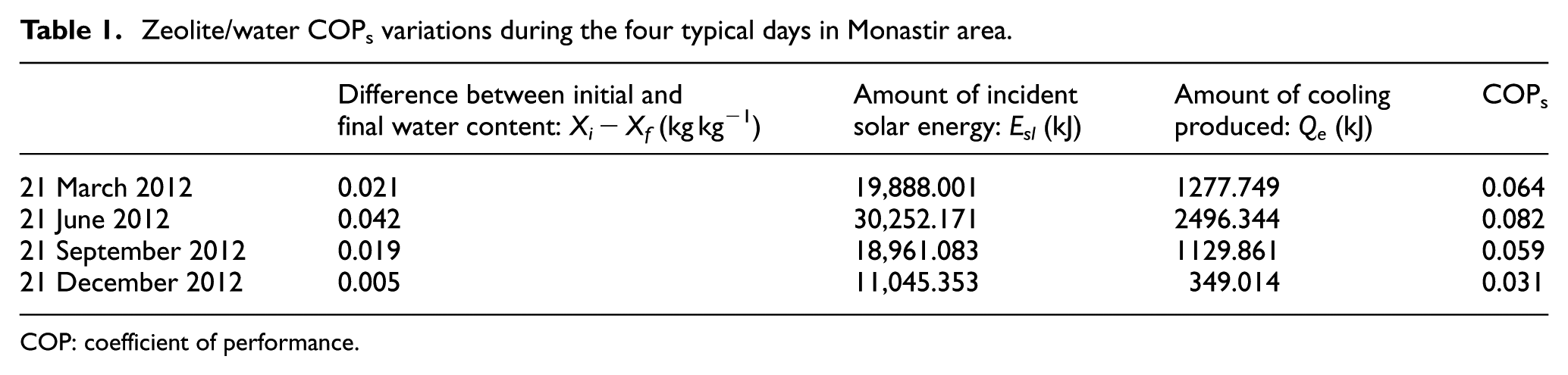
COP: coefficient of performance.
Activated carbon/methanol COPs variations during the four typical days in Monastir area.

COP: coefficient of performance.
The COPs is <8.2% and 12.8% for the zeolite/water and activated carbon/methanol pairs, respectively.
Static study of the combined refrigeration system
We have studied the COP combined performance factor (Figure 8(a) and (b)) using zeolite/water and activated carbon/methanol pairs, respectively, during the four typical days 21 March, 21 June, 21 September, and 21 December.

(a) Zeolite/water pair COP combined variations during the four typical days 21 March, 21 June, 21 September, and 21 December. (b) Activated carbon/methanol pair COP combined variations during the four typical days 21 March, 21 June, 21 September, and 21 December.
It increased approximately from 3.65% to 17.96% for an entraining ratio w = 0.038 and w = 0.183 on hot days, for zeolite/water and activated carbon/methanol pairs, respectively. There is a slight increase in the COPs for zeolite/water pair because of the entrainment effect w. In fact, the entraining ratio w is low. It is advisable to increase w in order to increase the COPs value. Unfortunately, w depends on the Pc and Pe which are low.
Conclusion
In this work, a numerical model describing the heat and mass transfer in flat solar collector using zeolite/water and activated carbon/methanol pairs is presented. The commercial simulation software COMSOL Multiphysics is used to determine the evolution of different variables such as temperature and average fluid content under the climatic conditions of the city of Monastir.
The results have shown that the system performance in summer is better than that in winter and using activated carbon/methanol pair is better than zeolite/water pair. For example, the COPs is <8.2% and 12.8%, for the zeolite/water and activated carbon/methanol pairs, respectively.
To improve the performance of an intermittent adsorption cooling system, we have used a combined adsorption–ejection cycle. The results have shown that the COPs increased about 3.65% for zeolite/water pair and 17.96% for activated carbon/methanol in summer.
Footnotes
Appendix 1
Academic Editor: Bo Yu
Declaration of conflicting interests
The author(s) declared no potential conflicts of interest with respect to the research, authorship, and/or publication of this article.
Funding
The author(s) received no financial support for the research, authorship, and/or publication of this article.