



Abstract
The turbo-pump and turbine are driven by liquid fuel fed into a gas generator, where the fuel is oxidized with a liquid oxidizing agent. For stable operation of the turbine, the combustion temperature of the gas generator must be maintained below 1000 K. The thermodynamic characteristics of kerosene oxidation in the gas generator must be understood to optimize the design and operation conditions of the liquid-fueled rocket engine system. Herein, the 3-species surrogate mixture model for kerosene was selected, and the detailed Dagaut’s kerosene oxidation mechanism consisting of 225 chemical species and 1800 reversible chemical reactions was utilized. The exit gas temperature and product gas composition in the gas generator under fuel-rich conditions were simulated by applying the perfectly stirred reactor model. The perfectly stirred reactor model was used in combination with the liquid spray model for evaporation of the droplets and the two-temperature model for evaluation of the flame temperature separately from the locally averaged reactor temperature. The theoretical prediction of the gas species fraction and soot yield could be improved by applying the tar cracking mechanism, where the reaction characteristics under high temperature were taken into account.
Introduction
The Korean Space Launch Vehicle-II (KSLV-II) that is currently under development in South Korea consists of a three-stage system, and all the engines are the turbo-pump type, where kerosene and liquid oxygen are used as propellants. The propellant is combusted in the main burner of the rocket engine at high pressure and temperature in order to generate thrust. Therefore, auxiliary equipment that transfers the propellants into the main burner should be designed to operate at pressures exceeding the operating pressure of main burner.
The pump-fed-type system is composed of a combustion chamber, turbo-pump, turbine, and gas generator (or pre-burner). Such systems can also be classified into two types according to reuse of the gas after driving the turbo-pump, that is, open and staged combustion closed cycle. In the open cycle type, some of the propellant is combusted in the gas generator to operate the turbo-pump, and product gases are exhausted through the nozzle at the bottom of the rocket. In the staged combustion closed type, after the turbine, the flue gases are combusted again to improve the combustion efficiency, leading to a consumption of low amount of unburned fuels.
In South Korea, a gas generator, which is one of the main components of the turbo-pump-type liquid-fueled rocket engine operating under fuel-rich conditions, has been developed. The operating conditions and performance of the gas generator significantly influence the stability of operation of the turbine, especially the combustion temperature, and may cause severe thermal damage to the turbine blade. In order to prevent such damage to the blade, the operating temperature of the gas generator should be maintained at 1000 K.1,2 Therefore, the fuel feeding conditions are adjusted to either fuel-rich or fuel-lean conditions to control the temperature. The fuel-rich condition is generally applied to the system because it is easy to operate the system and select the material comprising the system.1,2 In addition, unstable combustion due to poor performance of the gas generator could induce hot spots around the injector and chamber wall, which can cause severe thermal damage to the system. Furthermore, the fuel-rich combustion generates some amount of soot, which can cause physical damage to the downstream equipment, such as the turbine blades. In order to determine the optimized design and operating conditions for the gas generator, it is necessary to understand the thermodynamic characteristics of kerosene combustion and soot formation as the initial step of the system design. In this work, numerical studies on the performance of the gas generator under different conditions are carried out. An appropriate model is developed to predict the characteristics of kerosene combustion and the soot yield in the gas generator.
Numerical analysis
Surrogate mixture model
Kerosene, one of the most widely used propellants for gas generators in liquid-fueled rockets, consists of hundreds to thousands of hydrocarbon compounds. It is hard to consider every component in kerosene for numerical study. Some studies have used certain chemicals to simplify the complicated characteristics of kerosene as alternatives to the actual composition; this system is known as the surrogate mixture model. The chemicals may be the major components of the high molecular fractions, determined by species analysis, such as gas chromatography–mass spectrometry (GC/MS). 3 The models can be classified into 1-, 2-, and 3-species models based on the number of species considered. Due to its simplicity, the 1-species surrogate model has advantages for numerical modeling of the processes considered, although there are certain differences in the physical and chemical properties as compared with actual kerosene.4–7 Although the 2- and 3-species surrogate mixture models may provide more detailed kinetic models that better represent the combustion behavior of kerosene, there are issues in terms of the computational efficiency.8–11 Kerosene is a complex mixture of alkanes (50%–65% vol.), mono- and poly-aromatics (10%–20% vol.), and cycloalkanes or naphthenes (mono- and poly-cyclic, 20%–30% vol.). The 3-species surrogate mixture model comprises 74% n-decane, 15% n-propylbenzene, and 11% n-propylcyclohexane.
Method of numerical study
In order to predict the composition of the combustion gas during fuel-rich combustion of kerosene in the gas generator, the modified perfectly stirred reactor (PSR) model was employed by Foelsche et al. 12 The original PSR model is limited for analysis of typical gas generator conditions because the model does not include spatial gradients for the properties. Notably, the temperature distribution caused by the flame kernel and the delay of fuel evaporation are not considered in this model; thus, the two-temperature and droplet evaporation models were coupled to the PSR model. Furthermore, Dagaut and colleagues’9,13 model consisting of 225 chemical species and 1800 reactions has been utilized for the detailed kinetic modeling of kerosene combustion. This kinetic model has been proven to be an accurate representation of the mechanism of kerosene combustion based on the surrogate model. It has been verified that the model effectively predicts the mechanism of combustion over a wide range of pressure and temperature conditions. This PSR model with Dagaut’s reaction mechanism is herein referred to as the “Existing Kerosene Combustion Model.” The numerical study was carried out with python code using the open source software Cantera.
Governing equations
The PSR is an ideal reactor model in which perfect mixing is achieved inside the control volume and has no spatial variations of temperature and composition. 14 The governing equations for the mass and energy balance are represented in the PSR as presented below. 12
Mass balance equation

Energy balance equation

where

where

where

where

The input residence time in the PSR is defined as

where the density of the mixture

In the following analysis, the two-temperature model and droplet evaporation model were implemented into the PSR model, which is a modification of the Existing Kerosene Combustion Model. The flow diagram of the computational sequence is shown in Figure 1.

Flow diagram of computational sequence.
Droplet evaporation model
According to Lawver, 15 after kerosene and liquid oxygen are supplied to the gas generator, the liquid oxygen immediately evaporates, after which the reaction can proceed. The evaporation of kerosene is relatively delayed while kerosene combustion proceeds. Therefore, the reaction time was modified using the droplet evaporation model. The maximum droplet lifetime is defined as

where B is the Spalding transfer number, a dimensionless number, and it is expressed as

The fuel properties of B and

The calculation was modified to proceed according to the PSR model after the kerosene was completely evaporated, and the method is only plausible when the droplet lifetime is less than the residence time for the PSR model.
Two-temperature zone model
As mentioned earlier, the fuel-rich combustion condition in the gas generator causes a rapid increase in the temperature around the injector or wall of the reactor; the flame kernel is then generated and propagates to sustain combustion. In order to reflect this behavior, the two-temperature zone model, which separates the chemical reaction and the reactor temperature, has been used in the PSR model.12,16 The “chemical temperature” comprises the temperature in the high temperature stoichiometric region affected by the O2 fraction, the reactor temperature at the exit, and the residence time. This temperature must be attained to initiate the high-enthalpy reaction near the injector region. 17 A temperature more consistent with the actual combustion temperature of the injected liquid fuel droplets is used to drive the reaction kinetics. When stoichiometric combustion occurs, the oxygen concentration is drastically reduced, and the residence time takes a minimum value.
In this study, the chemical reaction temperature was estimated to be the temperature based on an O2 fraction of less than 5% and the minimum residence time, as shown in Figures 2 and 3, respectively. Meanwhile, the reactor temperature at the exit was predicted using the energy balance equation in the governing equation. During the prediction, the heat loss of the propellants due to phase change by evaporation should be considered for prediction of the gas temperature at the exit because it is assumed that only gas-phase reactants are placed into the reactor in the PSR model alone. Control of this temperature is critical for predicting suppression of the thermal damage and designing the turbine blade.

Variation of concentration of oxygen and kerosene with temperature at O/F ratio of 0.34.

Variation of residence time with temperature.
Tar cracking reaction
Various definitions of tar have been reported corresponding to differences in the chemical species.18–20 At the EU/IEA/US-DOE meeting held in 1998, tar was defined as an organic mixture with a molecular weight exceeding that of benzene. Milne et al. 21 classified tar as organic compounds produced from thermal cracking or gasification processes, and it has been generally assumed that tar comprises aromatic compounds such as benzene, toluene, and naphthalene. The extent of conversion of tar by thermal cracking, as measured by Jess, 22 was found to be 80%–100% at 1500 K, which was selected as the chemical reaction temperature, as shown in Figure 4. However, a significant amount of non-reactive tar was observed in the products based on the numerical data obtained with the PSR model employing Dagaut’s mechanism.9,13 Therefore, consideration of the tar cracking behavior is required for improving kerosene combustion.

Variation of tar conversion with temperature.
Jess 22 experimentally analyzed the thermal cracking characteristics of tar under hydrogen and steam atmospheres. The experimental data showed that the cracking of naphthalene mostly produces soot, benzene, methane, and carbon monoxide, whereas the cracking of benzene produces methane and carbon monoxide. The cracking of toluene produces methane and benzene.12,19,20 Tar cracking results in formation of soot from the thermal cracking of naphthalene, and thus, generation of soot during the reaction can be expected. Based on experimental data, Fourcault et al. 23 established a tar cracking reaction pathway; a simplified schematic diagram of the reaction pathway is shown in Figure 5, where soot was assumed to be solid carbon. The reaction kinetic parameters for such reactions are listed in Table 1 and have been incorporated into the Existing Kerosene Combustion Model.

Schematic of tar cracking reaction model.
Rate expressions for tar cracking reactions.

Soot oxidation
Other studies of soot oxidation have shown that the production of carbon monoxide predominated over production of carbon dioxide.7,24,25 This may be important for predicting the concentration of carbon monoxide generated during fuel-rich combustion. Because the detailed chemical reactions involved in tar cracking suggested by Fourcault et al. 23 do not consider the kinetics of the soot oxidation reaction, the latter is separately considered in this work.
The soot oxidation reactions proceed with the involvement of OH (hydroxyl) radicals, O radicals, oxygen, carbon monoxide, steam, and by the backward reaction of soot formation. Among these reactions, it has been reported that the reactions involving OH radicals and oxygen predominate over the other reactions. Therefore, the soot oxidation reaction has been considered as follows 26


In this study, the experimentally determined kinetic parameters for soot oxidation were used, as listed in Table 2.7,26 Soot oxidation via OH radicals predominates over oxidation via O2 because the activation energy is almost zero for the reaction involving the OH radical.
Rate expressions for soot oxidation reactions.

Herein, the two-step reaction model was used for soot production. One step involves soot formation, which is included in the tar cracking reaction model. The other step is soot oxidation, where soot reacts with two major oxidizing species, such as OH and O2. There are a few multistep detailed models where poly-cyclic aromatic hydrocarbon (PAH) formation and the soot particle dynamics, such as incipient soot formation, growth, agglomeration, and oxidation, are considered. However, the latter is not considered in this work.
Results and discussion
Selection of surrogate mixture model
Dagaut et al. 9 proposed 1-, 2-, and 3-species surrogate mixture models with a combination of n-decane, n-propylbenzene, and n-propylcyclohexane for kerosene combustion in a jet stirred reactor (JSR) and predicted the composition of the product gas under the experimental conditions listed in Table 3. A comparison of the measured and predicted compositions of the product gas from oxidation of kerosene as a function of the reaction temperature is presented in Figure 6. Most of the calculated data are in good agreement with the measured data, except for that relating to the precursors of soot, such as the aromatic compounds and PAHs. For the cases calculated using the 1-species and 2-species surrogate mixture models, prediction of the concentrations of 1,3-cyclopentadiene (1,3 CPD), benzene, and toluene was not possible (or there were some limits to these predictions). In contrast, the calculated concentrations of the soot precursors obtained with the 3-species surrogate mixture model were relatively well predicted. As mentioned, the 3-species surrogate mixture model comprises 74% n-decane, 15% n-propylbenzene, and 11% n-propylcyclohexane. Under fuel-rich conditions, prediction of the soot yield may be important because simulation of the composition of the product gas is considerably influenced by soot formation and oxidation. Therefore, the 3-species surrogate mixture model was selected for the ensuing analysis of kerosene combustion under fuel-rich conditions in the gas generator.
Experimental conditions for combustion of kerosene in jet stirred reactor.


Comparison of the measured (M) and calculated (C) concentrations of soot precursors using 1-, 2-, and 3-species surrogate models for kerosene combustion in JSR: (a) 1-species (n-decane), (b) 2-species (74% n-decane and 26% n-propylbenzene), (c) 2-species (74% n-decane and 26% n-propylcyclohexane), and (d) 3-species (74% n-decane, 15% n-propylbenzene, and 11% n-propylcyclohexane).
Modeling of kerosene combustion using Dagaut’s model
The empirical data from Lawver’s 15 study were used to validate the kerosene oxidation model employing the conditions listed in Table 4. It is instructive to note that the range of the mixture ratio includes off-design conditions for the gas generator developed in South Korea. 27 Dagaut’s mechanism was validated at the maximum pressure of 40 atm under the experimental conditions of the JSR. These chemical mechanisms and kinetic parameters have been widely used in many papers, including those by Kim et al. 10 and Yu and Lee, 17 to predict the combustion behavior under the high pressure conditions of a real gas generator.
Experimental conditions for combustion of kerosene in gas generator.

O/F ratio: oxidizer-to-fuel ratio.
Figure 7 shows the results predicted with the PSR model using Dagaut’s detailed kinetic model, as well as the measured compositions of the product gas. Most of the predicted product compositions are in reasonable agreement with the experimental data. However, the concentration of carbon monoxide was significantly underestimated and that of methane was slightly overestimated. A similar trend for the gas composition was reported by Yu and Lee 17 and Huzel and Huang. 1 The exit temperature of the product gases was calculated to be in the range of 850–1140 K within the O/F ratio (oxidizer-to-fuel ratio) range of 0.3–0.4, which represents typical gas generator operating conditions, as shown in Figure 8. As mentioned earlier, the temperature was predicted by considering the latent heat of vaporization. However, the temperature conditions for Dagaut’s model are known to be 900–1300 K. Therefore, Dagaut’s mechanism may not be suitable for predicting some of the reactions occurring at 850–900 K. The reaction pathways for this low-temperature oxidation of hydrocarbon compounds are not included in this prediction. This may explain the difference in the carbon monoxide and methane concentrations. The published experimental data for the molecular weight and the modeling results are presented in Figure 9. The molecular weight was overestimated, and it is postulated that the high molecular weight chemicals were not converted into low molecular weight compounds. Furthermore, if most of the unreacted chemicals were converted into carbon monoxide, this would increase the concentration of carbon monoxide.

Comparison of predicted and experimental composition of product gas at various O/F ratios: (a) CO2, (b) CO, (c) CH4, (d) H2, (e) C3H6, and (f) C2H4.

Comparison of predicted and experimental reactor temperature at various O/F ratios.

Comparison of predicted and experimental molecular weight of product gas at various O/F ratios.
Modeling of kerosene combustion with tar cracking and soot oxidation
Based on previous results and assumptions, Dagaut’s kerosene oxidation model was modified by including the tar cracking and soot oxidation reactions and was applied to the modified PSR model. The results of the simulations using the modified kerosene oxidation models and experimental data are shown in Figure 10 for various O/F ratios. The modified model with tar cracking and soot oxidation was more congruent with the measured carbon monoxide and methane concentration data than Dagaut’s previous model. Nonetheless, modification of the kerosene oxidation model did not affect computation of the exit temperature of the reactor, as shown in Figure 11. In the evaluation of the tar consumption, the formation and oxidation of soot during kerosene oxidation were considered; thus, the concentration of carbon monoxide increased as mentioned earlier, and the molecular weight decreased (Figure 12). Such results are in closer agreement with the measured values than the values predicted with the existing model. In summary, consideration of the tar consumption and soot reaction process for prediction of the kerosene combustion behavior indeed produced close agreement with the thermodynamic properties of the product gas under fuel-rich conditions in the gas generator.
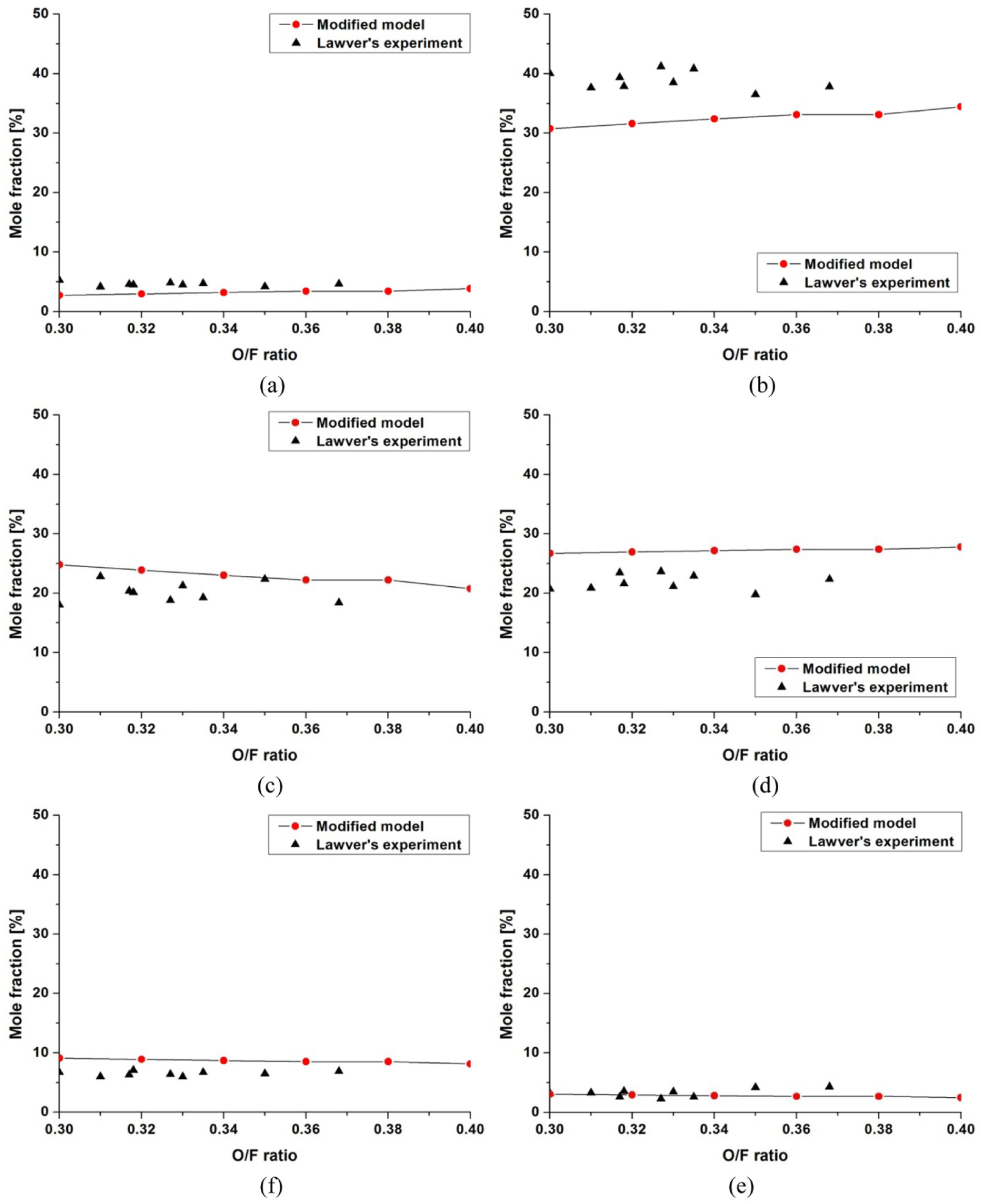
Comparison of predicted values from modified model and experimental composition of product gas at various O/F ratios: (a) CO2, (b) CO, (c) CH4, (d) H2, (e) C3H6, and (f) C2H4.

Comparison of predicted values from modified model and experimental reactor temperature at various O/F ratios.

Comparison of predicted values from modified model and experimental molecular weight of product gas at various O/F ratios.
Modeling of soot yield
Figure 13 presents the computed soot yield as a function of the O/F ratio, which was compared against the data calculated with the two-dimensional kinetics (TDK) rocket nozzle performance computer program that employs 19 reactions for soot formation. 28 Examination of the modeling result indicates that as the O/F ratio increases, the soot yield increases to reach a peak value at an O/F ratio of 0.6 and then decreases. The present numerical solution and simulation data obtained with the TDK program show highly similar trends, and the slight difference may be attributed to the discrepancy between the surrogate mixture model and the detailed kinetic model.

Comparison of data from this study and the study of Nickerson and Johnson 28 calculated using TDK program for soot mass fraction at various O/F ratios.
There are only a few studies in which both the gaseous components and soot yield are predicted, where the study by Yu and Lee 17 is an exception. Although Lee and colleagues used different soot formation and oxidation mechanisms, they obtained similar results to those in this work. The soot formation and oxidation model developed herein is a reduced mechanism with fewer species than those used by Lee and colleagues Moreover, this modified model can produce simple yet accurate results compared to their study published using the soot formation and oxidation consisting of 101 chemical species and 544 reactions. 17
Conclusion
A kerosene combustion model was developed to predict the combustion behavior in the specified O/F ratio range of 0.3–0.4. To consider the fuel-rich condition, the 3-species surrogate mixture model was selected, and the droplet evaporation and two-temperature zone models were incorporated into the PSR model. This is a modification of the Existing Kerosene Combustion Model. Dagaut’s detailed chemical reaction model including the tar cracking and soot oxidation reaction was utilized for improving the prediction.
The 3-species surrogate mixture model is more effective in predicting concentration of the soot precursors, such as aromatic compounds and PAHs. This modified kerosene oxidation model can predict the thermodynamic properties of the product gas. The exit temperature of the product gases was calculated to be in the range of 850–1140 K within the O/F ratio range of 0.3–0.4. Furthermore, the maximum soot yield was obtained at an O/F ratio of 0.6, which is in good agreement with the simulated and experimental results documented in the literature. Therefore, the model presented in this study can predict the thermodynamic properties of the product gas and the soot yield as accurately as existing models in the literature employing similar conditions.
Footnotes
Appendix 1
Academic Editor: Oronzio Manca
Declaration of conflicting interests
The author(s) declared no potential conflicts of interest with respect to the research, authorship, and/or publication of this article.
Funding
The author(s) disclosed receipt of the following financial support for the research, authorship, and/or publication of this article: This work was supported by the Korean Government (MKE) from the Manpower Program (No. 20144010200780) and also the National Research Foundation of Korea (NRF) (grant no. NRF-2016M1A3A1A02005033) funded by the Korean Government (MEST).