




Abstract
For task-centric human–computer interactions, information display is a crucial element based on which users make their decisions. Since providing more information may not always promote the user’s awareness of the situation, we investigate the relationship between information availability and user decision-making characteristics by conducting an experiment in the form of a war-simulation game. The results show that different types of operators rely on different types of information in decision-making. A workflow of adaptive provision of information is also introduced using our conceptual architecture for an adaptive user interface for task-centric in-vehicle applications. A pilot study presented in the article is an attempt to add user-oriented design to task-centric in-vehicle operations to meet different requirements of operator decision-making.
Keywords
Introduction
With the growing use of developed information technologies, adaptive systems are gradually embedded in various equipment platforms, 1 which make human–computer interactions more intelligent. The adaptive human–computer interface (AHCI) was proposed with this goal in mind. The AHCI is a neoteric interface pattern that can adapt the display content and interaction mode autonomously 2 to meet different user requirements, changing the state of tasks and environments with the help of the cognitive psychology, computer science, and artificial intelligence technology. 3
Existing research in this field is focused on preferable display forms and mechanisms of interface elements. But the necessity of information contents in specific interaction tasks lacks consideration. Besides, although the design of the AHCI in personalized web and smartphone services matures rapidly, in the field of industrial control and in-vehicle applications, few AHCI mechanisms can satisfy the needs of all user interfaces. For a special in-vehicle application, adaptability should enable it to detect, identify, analyze, and execute tasks on its own like a “human brain,” as well as simplify its display/control interface in a limited in-vehicle space. However, studies in this area have made little progress.
As the purpose of human–computer interactions via a special in-vehicle application is to complete specific tasks, the operator is in charge of decision-making during the overall process by controlling the “task-centric” user interface. 4 Since the psychological activities and thinking strategies of decision-making are always affected by visual information processing, the user becomes aware of the task state based on task-related information. Intuition tells us that having more information yields better decisions. It was also suggested that using more visual information might be more useful in all situations. 5 Contrary to this belief, perceived information overload can decrease decision accuracy, even if it creates more confidence and reduces uncertainty because it may annoy the user by imposing heavier cognitive load, and distract attention from the information that really matters.6,7 Information redundancy can also extend the decision time, having a negative effect on decision-making efficiency. On the other hand, deficiency of information requires guessing the context before taking actions, which may cause inevitable human errors. To reduce information processing workload as well as improve interaction performance, information availability for the decision-making user should be discussed by interface designers.
When finishing a specific task, the operator makes a decision depending on the information that can provoke their experience or facilitate their logical thinking. The availability of such valuable information will make difference to the decision-making performance. Availability emphasizes the existence of specific information or functions provided by the interface that user can obtain easily. Although modern technologies deliver available information faster, our mind uses simple fast and frugal heuristics to ignore most information and rely on only a few important cues. 8 Most researchers consider the amount of information displayed by the interface, where filtering of information depends on expert opinions. But without consideration of the user’s point of view, it is hard to provide information that fulfills user demands. Horvitz and Barry 9 use the expected value of revealed information (EVRI) and expected value of displayed information (EVDI) to manage the quantity of information displayed by the interface for time-critical decisions. Davies et al. 10 find that interfaces with menus do not perform more efficiently than those without menus when commands can be entered using a keyboard and mouse. This is an implication for information availability consideration. Information availability is proposed to be an indicator to assess web service quality. 11 Promoting information availability also helps firemen to solve city’s emergency problems. 12 Davidsson and Alm 13 investigate which information should be provided according to the user needs in different contexts, and propose design guidelines for context-aware adaptive driver information systems.
Furthermore, the utility of specific information provided by interfaces varies with the users due to their own preferences and dependence. Information gets a higher evaluation when it is really useful for the user. 14 Sutcliffe 15 proposes a method to define user requirements, and establishes a link between task-related information needs and the types of information delivered using a case study of a shipboard information system. Oishi 16 studies the information availability of user interfaces, focusing on whether they provide necessary information for the user to complete a desired task.
Regarding task-centric special in-vehicle interfaces, the adaptive provision of information has been little studied, especially for different operators. Previous research typically designs an adaptive interface for a military system that depends on the cognitive and information processing abilities of individual users to (1) reduce the interface complexity, (2) increase the reaction speed and accuracy, and (3) decrease the cognitive load. 17 Noah and Halpin’s 18 adaptive interface for the C3I system presents some design principles from the perspectives of user cognition and information processing ability. However, the influences of individual thinking characteristics on users’ subjective actions are not taken into consideration. According to the theory of information availability, one can conclude that due to the diversity of thinking characteristics, the requirements for information in a specific task should be different from one user to another. Considering this implicit weighting process, the display of a single combination of information elements is obviously insufficient.
To reduce the time cost and workload for users by excluding unnecessary information, this article presents an experiment to investigate the relationship between the information availability and decision-making process of an adaptive interface design. In this pilot study, 41 students participated in a war-simulation game to make their own decisions in different situations. The results show that participants’ decisions are affected by their own characteristics, since they tend to adopt specific options in given situations. They also reveal that different decision tendencies correspond to different information preferences, implying that providing specific information according to preferences can dramatically reduce cognitive load.
Generally speaking, a decision can be divided into two parts, namely, the decision process and decision result. In practical situations, the quality of a decision can hardly be determined solely by the decision itself. Many factors, especially the resulting value to users, can be used to judge the decision’s quality. The long-term earning is thought to be more valuable. 19 Considering the risk of war, even decisions that correspond to the expected utility cannot ensure success. The failure of risky actions does not always mean an improper decision, especially when it is the only way to avoid a worse situation, for example, death. In this situation, the decision support system can just provide an advice according to the calculated expected utility to aid the human decision, but not to supplant the human. 20
Therefore, this article designs information provision in an adaptive interface by analyzing the decision process 21 and does not evaluate the quality of any decision results. Typically, users exclude those options that do not meet the requirements of a specific trait. 22 The automatic provision of necessary information avoiding other information presented in this article can help operators to concentrate on the decision-making and increase efficiency.
An AHCI conceptual architecture is established, which integrates cognition and decision-making psychology analysis into the adaptive interface implementation. Based on the architecture, customized information can be provided to every type of operators. This pilot study combines “user-oriented design” and “task-centric interaction” in the process of adaptive user interface design within the area of intelligent vehicle applications.
Conceptual architecture for implementation of adaptive provision of information in task-centric in-vehicle user interfaces
Task-centric AHCIs assist users in accomplishing particular problem-solving tasks. According to their special application conditions (e.g. multitasking in decision-making, different user characteristics, and intelligent design requirements), the conceptual architecture of a task-centric AHCI is established in Figure 1, which takes into account both task states and user characteristics.

Conceptual architecture of task-centric in-vehicle AHCI.
The architecture mainly consists of the information collection layer, the adaptive control layer, the interface configuration layer, and the user interface layer. 23
The information collection layer perceives atomic context information from external and internal devices to support task completion. In the adaptive control layer, using preliminary processing, unified composite context information is obtained from atomic context information and stored in the AHCI context database. The adaptive reasoning mechanism starts to work once the trigger context calls for an adaptive response in any part of the task execution process. It builds a relational mapping between the trigger context and interface configuration. The interface configuration layer requests the interface rendering engine to adapt the user interface to be suitable for the current task and user states according to the adaptive decision. In the user interface layer, adaptive information presentation and adaptive interaction modes are carried out to the user.
During the workflow execution, the trigger context is the link between adaptive causes and adaptive results. It comes from the related composite context and AHCI interaction analysis module. Since the task-centric AHCI emphasizes the ability to identify the task and user states sensitively at any time, the AHCI interaction analysis module is the motive power in the whole architecture to trigger adaptation. Taking into account both task and user, the AHCI interaction analysis performs two major works: task analysis and human factor analysis:
1. Task analysis
Task analysis is used to identify the current task state, decompose each task into subtasks, and describe the starting point, end point, time, and working mode of each task. Furthermore, each task is accomplished through a series of interactive events, where the interaction sequence and actions should also be identified.
2. Human factor analysis
Users make their decisions relying on their subjective judgment of the changing situation. The analysis of user characteristics and interaction states (e.g. the cognitive and reactive ability, information processing capability, behavior tendency, and psychological status) occurs in this sub-module.
The analysis of these two aspects forms the trigger context, and then to require the adaptive response. At the same time, the interface display in turn inevitably has positive or negative effects on the user’s cognitive psychology and decision-making behavior.
Accordingly, based on the corresponding relations between the user decision-making characteristics and information requirements, the interface configuration layer extracts the most appropriate information elements for different user types using the interface dynamic variation. 23 The adaptive provision of information can help the user to focus on the information they are really concerned about by avoiding distractions and confusion during their decision-making related to the in-vehicle task completion.
Experimental study: provision of information based on operator decision-making characteristics
Considering the limited interface area, not all relevant information can be shown in it. Since information shown in the interface should contain necessary content corresponding to operator’s cognitive actions, 24 the information density can be proper only when necessary information is displayed, 25 which also benefits the interaction performance.
Research results show that, even after training, soldiers still show various decision styles, namely, rational, intuitive, dependent, avoidant, and spontaneous. 26 In this case, their decision toward one specific task is inevitably affected by the decision style. In this article, taken students as participants, an experiment is established based on a war-simulation game in order to analyze different types of operator characteristics related to their decision-making. Information, such as the battle map, target information, and attack plans, is presented by an experimental in-vehicle interface. Moreover, appropriate information can help operators extract evidence useful and efficient for decision-making easily. The operator provides positive evaluation for easily obtained and appropriate information; however, such evaluation varies among individuals. Information availability is evaluated based on the information-assessment questionnaire reported by each type of operators. Operators are classified depending on their decision-making behavior. Then, this article discusses how to provide preference information for users based on different decision-making characteristics.
Experimental settings
The experimental platform was developed using LabVIEW on a laptop with 14-inch screen (resolution: 1440 × 900). To minimize the influence of operational differences among subjects, the only controller in this experiment was a mouse.
Regarding the actual application interface, considering the human ability to identify information at different locations of the interface when multitasking, the layout of the simulated experimental interface was designed as shown in Figure 2. The interface contains five zones: the map zone, task information zone, instruction message zone, feedback message zone, and control zone:
Map. The visualization display of the battlefield, including the location of enemy and geographical situation.
Task information. Decision-making task-related information, including “Threat degree” representing the severity of the possible host vehicle damage caused by enemies, where larger values mean that the situation is more dangerous; “Relative position” depicting the horizontal distance, height, and orientation angle between enemy and the host vehicle; “Target type” describing the type of each enemy the host vehicle met; and “Attack plan” providing the recommended coping method for each specific target.
Instruction message. The current task situation and requirements.
Feedback message. The feedback after control, and the device status of the host vehicle.
Control. Buttons to conduct decision-making.

Layout of war-simulation experimental interface.
During the experiment, each subject obtained a task in the form of an instruction message, made decision relying on the map and task information, and then clicked on the corresponding button to promote the progression of the task.
Experimental task design
The experimental study was divided into two stages:
Stage 1. The analysis of the characteristics of operator decision-making behavior, establishing a characteristic description of each operator.
Stage 2. The classification of the operators based on their characteristics, and investigation of the task information that is essential for each type of operators.
In the experiments, subjects run into five task situations. The corresponding task information is shown in Table 1. The meaning of information was explained to the subjects in the experiment instructions. Here, “M” represents a missile, “A” artillery, “H” a helicopter, “F” a fighter plane, and “T” a tank.
Task information in five task situations.

Tasks and information were the same for all subjects. The situations were mutually independent. The experimental task flow is shown in Figure 3. In Figure 3, “♦” depicts the host vehicle, “•” a non-attacking target, “ ” an attacking target, and “▲” a new found target.

Task flow of experimental trial.
Subjects were supposed to make their decisions regarding their actions (to attack, defend, or escape) in every situation. The decision results and time were recorded by the system.
In all, 41 subjects (age 20–29 years, 29 males and 12 females) without any vision or intelligence problems, who had never attended this kind of experiments before, were recruited from Beijing Institute of Technology, including bachelor, master, and Ph.D. students. In all, 10 subjects were involved in “Stage 1” experiment, where each subject repeated it 10 times. Once the number of trials, m, that is enough to identify subjects’ decision-making characteristics, was determined, 31 subjects were asked to perform “Stage 2” experiment, each repeating it m times.
After finishing the tasks, every subject answered a questionnaire about task information evaluation according to their own way of thinking during decision-making. The questions they answered are as follows:
Question 1. Please rank the importance of the four types of task information from highest to lowest according to your reliance during decision-making in each task situation (1, 2, 2s, 3, and 3s). The question was divided into 30 sub-questions asked from different perspectives: A. Threat degree B. Relative position C. Target type D. Attack plan
Question 2. Please evaluate each type of task information from the point of view of your decision-making process (benefited your decision-making process, had no effect on your decision-making process, or disturbed your decision-making process).
Results and discussion
Stability of decision-making behavior
In “Stage 1,” for each trial, the average decision time of 10 subjects in each task situation is shown in Figure 4.

Average time of decision-making.
The time cost decreases along with an increase in the number of trials. There were three periods during the whole experimental procedure:
Period 1 (Cognition and Decision). From time 1 to time 3, the decision time decreases quickly. In the first place, subjects realized the task information provided by the interface. In the beginning, except for thinking, the time was spent mainly on searching and waiting. Then, a decision was made after careful consideration.
Period 2 (Double check). From time 4 to time 7, the decision time decreases slowly. In this period, the time was spent mainly on hesitating whether the decision is right or not, and finally determining the selection.
Period 3 (Repeat the action). From time 8 to time 10, the decision time changes in a limited range. Subjects were just repeating their choices, which has nothing to do with decision-making.
Therefore, the analysis of the decision time shows that when number of trials is 7 (
Analysis of decision-making characteristics
According to the game background and recorded behavior of all subjects, a characteristic set (Risky, Calm, and Conservative) was created to evaluate operator decision-making characteristics. The values in the set represent the degrees an operator with the corresponding features. In this experiment, a subject might be more risky if he/she tends to choose “Attack,” or calmer if “Defend” is preferable, or more conservative when “Escape” is more likely to be chosen.
The recorded data for “Period 2” was used to calculate the feature values in the characteristic set using the Fuzzy Comprehensive Evaluation. 18
Let
In this experiment,

Definition of membership degree
If a subject made the decision like in Table 2, then
Example of subject’s decision.


Example of subject’s decision-making characteristics.
By calculating the comprehensive evaluation results from time 4 to time 7 (Period 2) for each subject, the characteristic of the subject is determined by the following principles:
If the evaluation results in “Period 2” were consistent, they determined the subject’s decision-making characteristic.
If the evaluation results in “Period 2” were almost consistent except for one time, then the most common outcome determined the subject’s characteristic.
If the evaluation results in “Period 2” were inconsistent, the analysis was extended to “Period 1,” and the most common outcome determined the subject’s characteristic.
Analysis of information availability based on user decision-making characteristics
Operator classification
In “Stage 2,” the number of subjects was increased to 41, including the former 10 subjects involved in “Stage 1.” According to the analysis above, 24 subjects were determined to be “Risky,” 14 “Calm,” and 3 “Conservative”:
Risky. Risky operators are more aggressive when making decisions. In this experiment, they tend to choose “Attack” more often than others in all situations.
Calm. Calm operators are patient in making a decision. They tend to avoid “Attack” or “Escape,” but preferred to “Defend” in more situations.
Conservative. Conservative operators do not want to cause any trouble when involved in a conflict. They preferred to choose “Escape” more often than others.
Information availability
A total of 41 questionnaires were received after the experiment. The analysis of information availability was done for every type of subjects classified above.
In “Question 1,” weights (1, 0.75, 0.5, and 0.25) were allocated to the four types of task information, respectively, according to each subject’s ranking order from the highest to the lowest. Since there were 30 sub-questions, there were 30 rankings for each subject. The sum of weights of task information was calculated by adding all weights given by each subject. For each type of task information, the evaluation of information availability was indicated by the average weights per person-time shown in Table 3.
Evaluation of task information in “Question 1.”
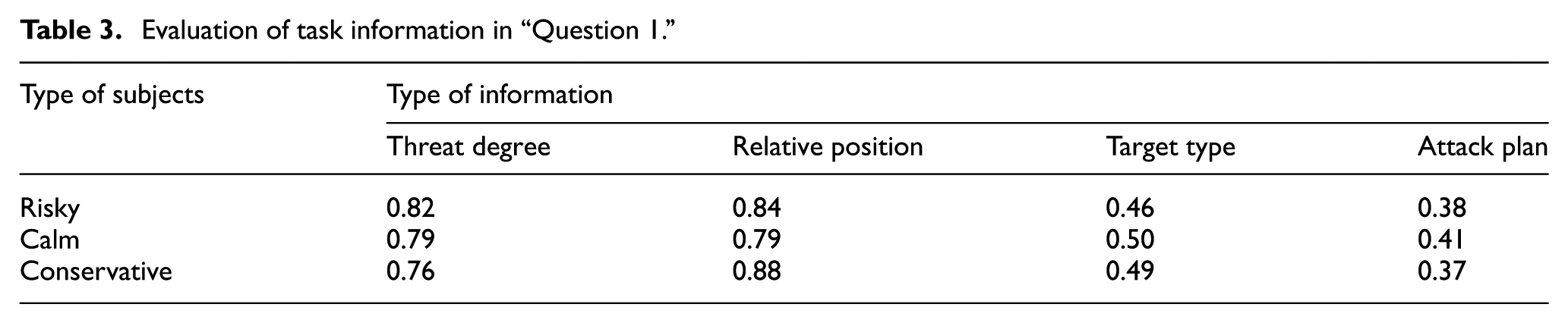
The results indicate that for all subjects, “Threat degree” and “Relative position” are more important than other task information. Subjects made their decisions mainly based on these two types of information. The most needed information was “Relative position,” which could promote a sense of direction. At the same time, “Attack plan” got lowest attention during the decision-making process:
Risky operators put more emphasis on “Threat degree” and “Relative position” than the other two types of operators, but put lower emphasis on “Target type” and “Attack plan.”
Calm operators treated “Threat degree” and “Relative position” with equal importance. But they paid more attention to “Target type” and “Attack plan” than the other types of operators. The four types of task information were all concerned during their decision-making.
Compared to the other two types of operators, conservative operators obviously relied more on “Relative position.” They also paid some attention to “Target type” similar to calm operators.
In general, it seems that the information availability of “Threat degree” and “Relative position” in the interface met the needs of risky operators, all four types of task information met the needs of calm operators, and all types of task information except for “Attack plan” were needed by conservative operators.
In “Question 2,” for each type of subjects, the frequency an evaluation was selected by each person was used to indicate the effect of the availability of information on the subject’s decision-making, as shown in Table 4. “B” indicates that the availability of information had a benefit effect on decision-making, “D” indicates that the availability of information disturbed decision-making, and “N” indicates that the availability of information had no effect on decision-making.
Effect of information evaluated in “Question 2.”

It can be seen that “Threat degree” and “Relative position” benefited all subjects’ decision-making processes. The differences are as follows:
For risky operators, the availability of “Target type” and “Attack plan” information had no effect on them.
For calm operators, “Target type” had even negative influence on their decision-making, which might have distracted their attention from the most important information. “Attack plan” played a positive role for some of calm operators, but was negative for others being confusing or annoying to them.
For conservative operators, “Target type” had a positive effect on their decision-making, while “Attack plan” disturbed them as reported in questionnaires.
In general, the information availability of “Threat degree” and “Relative position” in the interface helped all operators’ decision-making processes. In addition, “Target type” could have benefited conservative operators. But the effect of “Attack plan” on calm operators could not be confirmed.
The combination of analysis related to “Question 1” and “Question 2” is shown in Table 5, where “Q1” represents “Question 1,”“Q2” represents “Question 2,”“√” indicates that the information seems necessary to the operator, “×” indicates that the information seems unnecessary to the operator, and “N” indicates that it is neutral.
Evaluation of information availability from questionnaires

“Threat degree” and “Relative position” were indispensable to all types of operators. “Target type” was working well for conservative operators only. “Attack plan” was neutral for calm operators, but negative for the other two types of operators.
This article discusses users’ preferences toward information during decision-making tasks, and how to adaptively provide appropriate information for individual users without disturbing their way of thinking. The interface is simplified to reduce the cognitive load and pressure for better task completion.
Conclusion
Based on a war-simulation experiment, the analysis of operator decision-making characteristics and information availability for every type of operators is carried out in this article. Although it seems that more information provided by an interface would benefit the decision-making process, the results of the experiment show that information availability has different effects on different operators’ thinking processes. Some information may distract the operator’s attention from the most useful information needed to fulfill their goals. Accordingly, a suggestion regarding information to display based on the operator decision-making characteristics is proposed in this article. To reduce the operator’s information processing workload, a conceptual architecture for a task-centric in-vehicle AHCI is also introduced to implement the adaptive provision of information.
This study integrates user-oriented design into task-centric human–computer interactions of in-vehicle applications. The pilot study shows that it is necessary to examine different types of information provided by a task-centric AHCI for different decision-making requirements. On the basis of this pilot study, the method discussed in this article will be further applied to real soldiers in the next step, which will help further improve the proposed method under a specific application background. Also, we plan to enlarge the sample size and consider decision-making styles as well as risk preferences in the study of operator characteristics, and elaborate the study of information availability by considering different task situations. Whether different information presentation for different users is helpful for decision results will be discussed in a further study. Moreover, in industrial control systems and civil in-vehicle applications, users’ actions are also affected by users’ decision-making characteristics. Accordingly, the method proposed in this article can be treated as a guideline, and further extended to various areas.
Footnotes
Acknowledgements
The author would like to acknowledge the invaluable help of all participants in conducting the experiments.
Academic Editor: Xiaobei Jiang
Declaration of conflicting interests
The author(s) declared no potential conflicts of interest with respect to the research, authorship, and/or publication of this article.
Funding
The author(s) disclosed receipt of the following financial support for the research, authorship, and/or publication of this article: The work was supported in part by the pre-research project. This article only reflects the authors’ views, and funding agencies are not liable for any use that may be made of the information contained herein.