




Abstract
A method for predicting the residual velocity and deceleration of a projectile during normal low-velocity impact on a 2024-O thin aluminium plate is developed based on the similarity theory. Geometric scaling, the dissimilar materials of the projectile and different target thicknesses are considered. By a similitude analysis, the simulation criteria between the modelling and prototype experiments are obtained. The dimensionless velocity and deceleration of a projectile can be predicted by the relationship equations with the dimensionless dynamic pressure, projectile density and target thickness. On the basis of experimental data, the dimensionless residual velocity relationship is obtained and verified. In the range of normalised target thicknesses of
Introduction
In dimensional analysis, a replica of a prototype is derived by scaling one or more parameters of the prototype. Scaled replicas enable the economical and easy set-up of the experiments, especially in the engineering field. In terminal ballistics experiments, a scaling law is widely used in researching penetration and perforation, 1 and the dimensionless parameters make the relationship among the parameters intuitive.
In terminal ballistics experiments, geometric scaling is a convenient approach to test prototypes. Jones et al.2–4 conducted geometric-scale (geometric-scale factor = 0.25, 0.5, 0.75) and full-scale experiments to compare the plate perforation and reported that the dimensionless perforation energy and the dimensionless transverse displacement of the ductile target conform to the scaling law. Noam et al. 5 simulated the scaling of dynamic failure using two types of failure criteria, namely, the maximum stress criterion and strain energy density criterion; the obtained results could adequately describe the separation and adiabatic shear failure, respectively.
In hypervelocity impact experiments, impact velocities higher than 7 km/s are difficult to achieve using two-stage light-gas guns; thus, velocity scaling is used in order to reduce the impact velocity. Mullin et al. 6 used a dissimilar-material model and lower velocities through velocity scaling; and this approach yielded high correlations for the debris cloud structure, materials, and velocities. In a structure impact, the approach VSG-D 7 (initial Velocity, V0; dynamic Stress, σd and impact mass, G; with density factor) makes the target response (including the scaled force, displacement and final plate profile) in scaled replicas with different materials highly consistent with a prototype.
Rosenberg and Dekel
8
determined the relationship between the effective resisting stress
For terminal ballistics research, the geometric scaling, velocity scaling and normalised target thickness have been used, as mentioned above. The present work extends previous work by coupling these scaling methods for perforation research. In perforation experiments, the deceleration–time data and the residual velocity of the projectile are valuable output response parameters. The residual velocity of the prototype can be estimated through geometric-scaling experiments. However, in geometric scaling, a smaller model results in a higher projectile deceleration, which means that a downscaled experiment cannot adequately reflect the real-world (prototype) environmental and deceleration characteristics. Thus, in engineering experiments, the anti-overload capabilities of the projectile components (e.g. the fuse and warhead) of a downscaled geometric-scaling model may be difficult to assess.
Therefore, in this study, the geometry (i.e. the geometric scaling and target thickness), dissimilar projectile materials and impact velocity are considered for the prediction of the residual velocity and deceleration (specifically, for rigid projectile perforation of a thin aluminium plate at low velocities). The target thickness range in this study ranges from half of the projectile diameter to the projectile diameter. The rest of this article is organised as follows: first, the experiments and results are introduced; then, an equation for predicting the projectile residual velocity through a dimensional analysis is obtained; after describing and validating the simulation process, the dimensionless prediction equations for deceleration of the projectile are obtained by simulation; finally, using the obtained equations, the deceleration–time data of projectiles in the prototype model can be appropriately represented using a scaled model.
Experiments
Experimental setup
A gas-gun apparatus (Figure 1) with an inner diameter of 16 mm is used to launch the projectiles. The projectile impact velocity is less than 500 m/s. A steel chamber with a metal target is fixed in front of the gun barrel; this chamber has a circular hole in line with the barrel, through which the projectile could pass into and penetrate the target. The target is sandwiched between a C-shaped clamping rig and a C-shaped support plate using 10 bolts, and the support plate is welded with steel plates to ensure its rigidity (Figure 2). Rubber plates are placed behind the target as a buffer to stop and recover the projectile after perforation. On one side of the target chamber is a transparent acrylic plate window through which a high-speed camera equipped with a flash unit can record the projectile action. The camera is placed in such a way that it can photograph both the front and back of the target. The flash unit is placed between the window and the camera and can provide an exposure time of approximately 21 ms. A copper wire connected to a trigger mechanism is connected to the gas-gun muzzle. The wire is cut when the projectile passes through the muzzle, which in turn triggers the flash; simultaneously, photographs are manually captured using the camera at a frame rate of 44,000 fps.
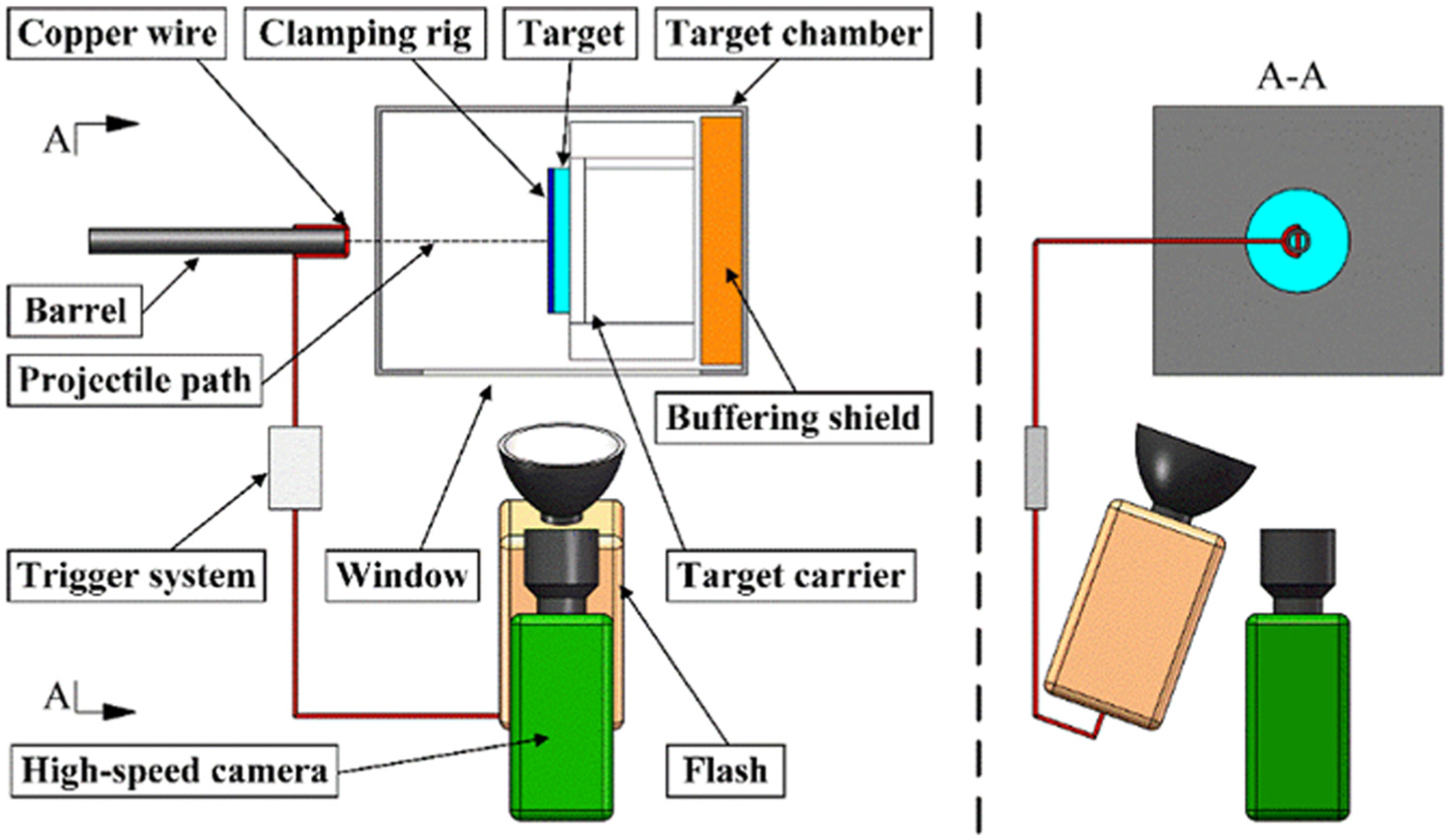
Gas-gun experimental system.
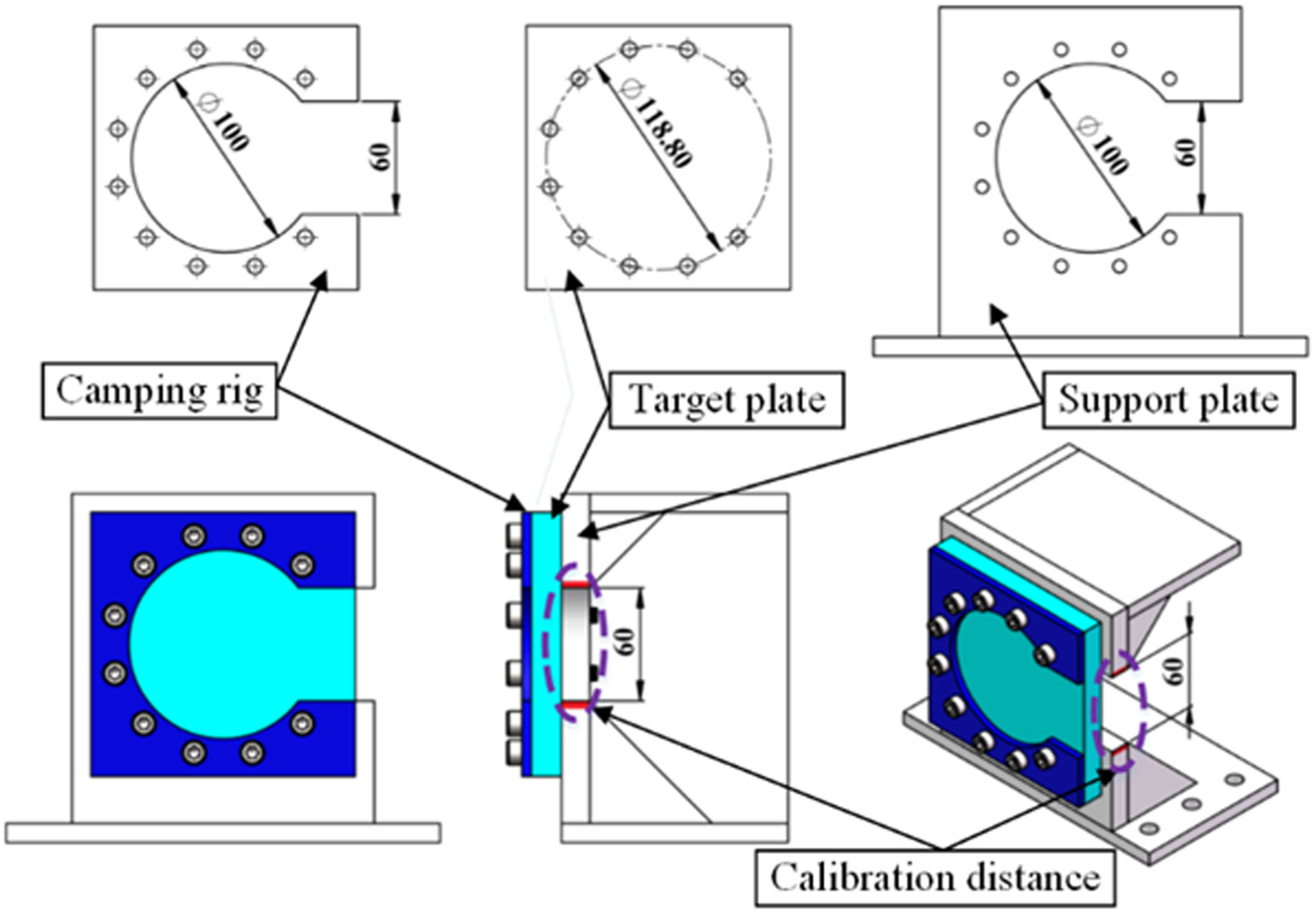
Metal target, C-shaped support and clamping rig.
Similitude analysis and experimental design
For a projectile perforating a plate, the three characteristic parameters are the residual velocity



In this study, all the targets were composed of 2024-O aluminium alloy. Due to it is a ductile metal with unchanged elastic modulus



Equations (4)–(6) are the dimensionless forms of equations (1)–(3)


Thus, three dimensionless pi terms, namely,

where
The perforation experiments are designed considering these three pi terms and the scaling factor λ. In the geometric-scaling experiments,

Dimensions of the two types of projectiles: (a) λ = 0.625 and (b) λ = 1.
In the dissimilar-materials experiments (hereafter, replica-D), 7055-t77 aluminium projectiles perforate 2024-O aluminium plates; the projectile and target dimensions are the same as those of the prototype in the geometric-scaling experiment. The normalised projectile density in the prototype is
In experiments where the target thickness is varied (hereafter, replica-T), we use 9.5- and 12-mm-thick targets. However, the projectile material and dimensions are the same as those of the prototype. The normalised target thicknesses in the prototype and in replica-T are
Experimental results and analysis
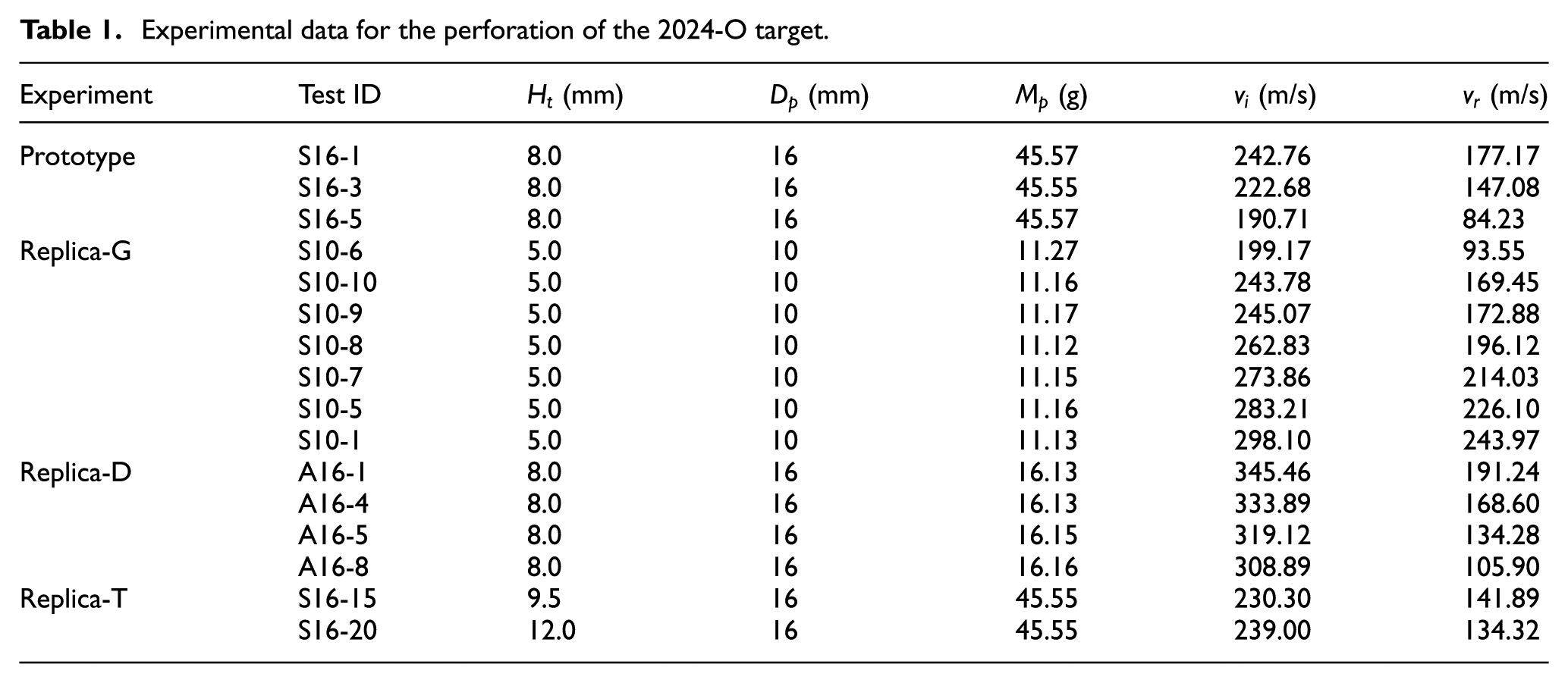
The experimentally obtained projectile residual velocities are presented in Table 1 and Figure 4, and illustrative high-speed camera images are depicted in Figure 5. After the perforation experiments, the steel projectiles did not exhibit any substantial deformation (Figure 6). The deformation of the nose tip of the steel projectile used in experiment S16-20 was not caused by penetration but by impact with the steel box after perforation; the aluminium projectiles exhibited only slight nose-tip deformation.
Experimental data for the perforation of the 2024-O target.
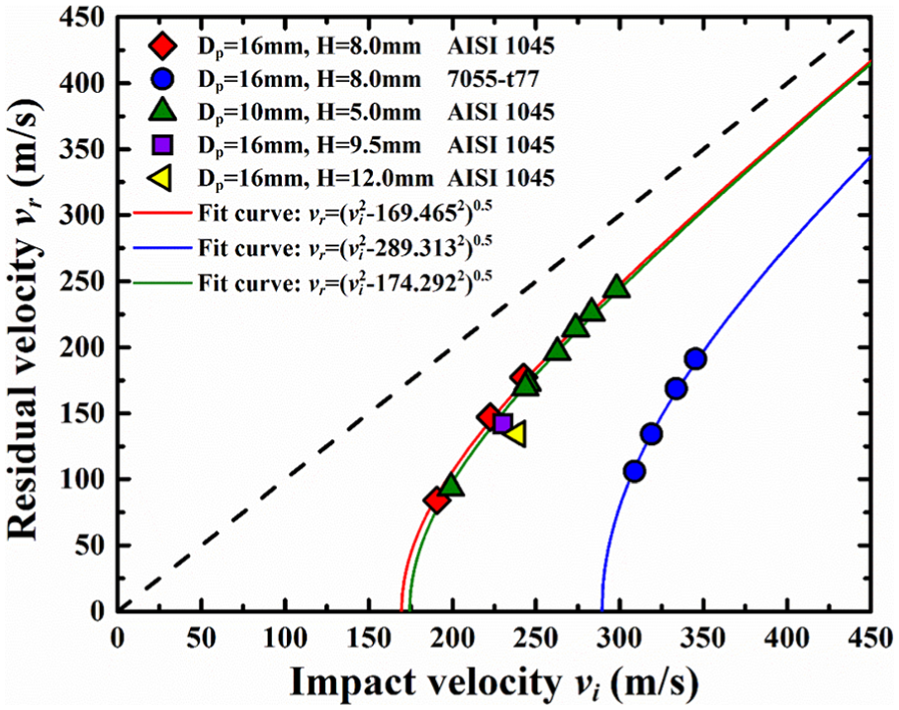
Residual velocity as a function of the impact velocity.

Illustrative images captured using the high-speed camera.
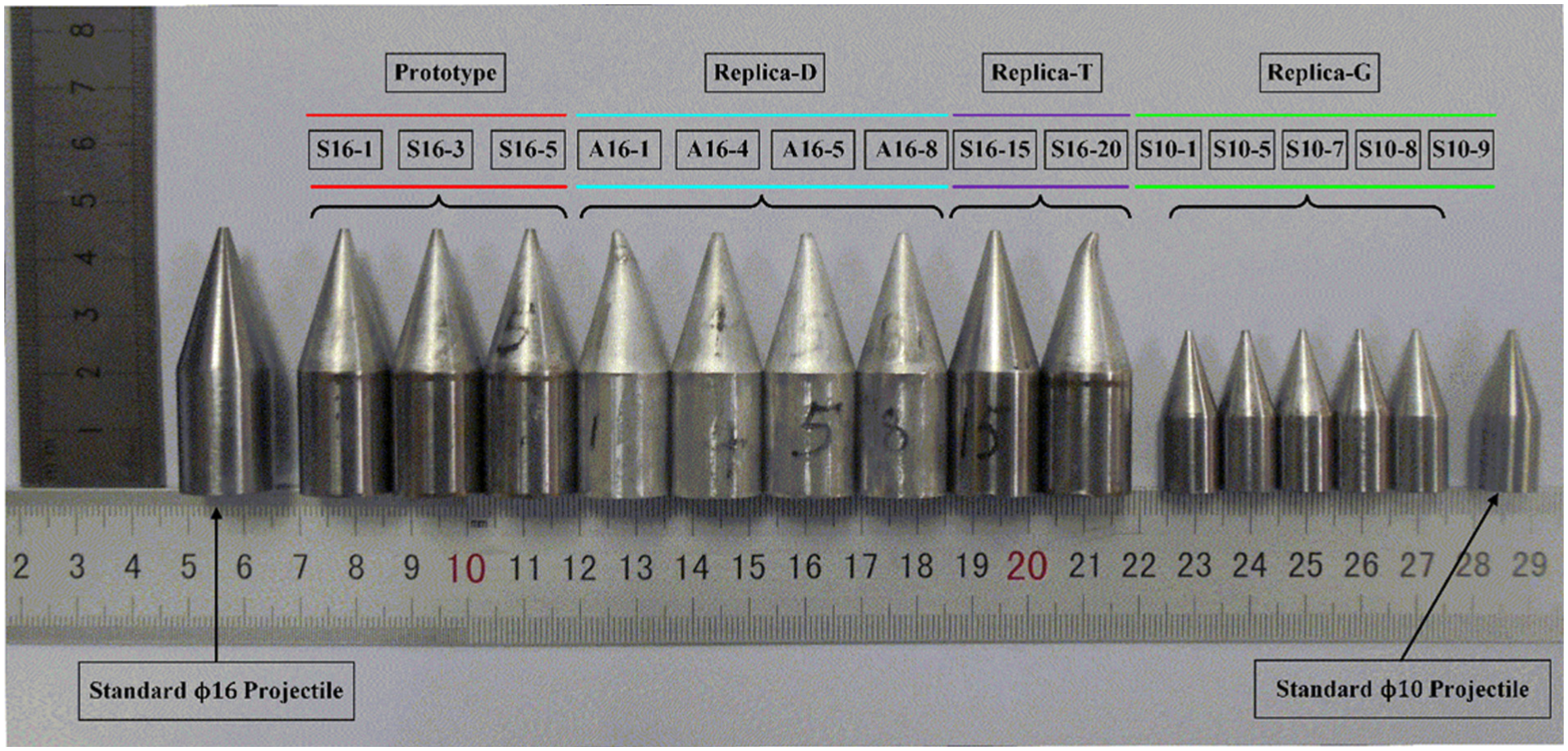
Dimensions of example projectiles after the perforation experiments, as well as the standard projectile.
Figure 4 illustrates the impact velocity as a function of the residual velocity using equation (11)

This equation was proposed by Recht and Ipson.
11
Here,

Accordingly, the perforation energy 12 can be estimated as the loss of projectile’s kinetic energy

As shown in Figure 4, the results of replica-G experiments have a good agreement with results of prototype experiments (S16-1, S16-3 and S16-5). According to the fitted curves (red line and green line), the ballistic limit velocities are 169.47 and 174.29 m/s for prototype and replica-G, respectively. But the results of replica-T (S16-15 and S16-20) are offset from the fitted curve (red line) of prototype experiments, which means that the perforation of thicker target costs higher kinetic energy. In replica-D experiments (A16-1, A16-4, A16-5 and A16-8), the ballistic limit velocity is 289.31 m/s and the average perforation energy is 673.61 J. The average perforation energy for prototype (S16-1, S16-3 and S16-5) is 643.75 J. 7055-t77 aluminium projectiles cost more kinetic energy than AISI 1045 steel projectiles to perforate the 2024-O aluminium plate of the same thickness. Different dynamic frictional coefficients of different projectile materials may cause the deviation, but the deviation is lower than 5%.
Figure 7(a) shows the normalised impact and residual velocities obtained through the experiments. The


Normalised residual velocity as a function of (a)
Figure 7(a) shows that when

From Figure 7(b), the residual velocity prediction for rigid projectiles for different target thicknesses, dissimilar materials and different geometric-scale factors can be achieved using a single dimensionless relationship equation.
As explained in section ‘Introduction’, the effective resisting stress (

According to Rosenberg and Dekel,
8
the relationship between the normalised effective resisting stress (
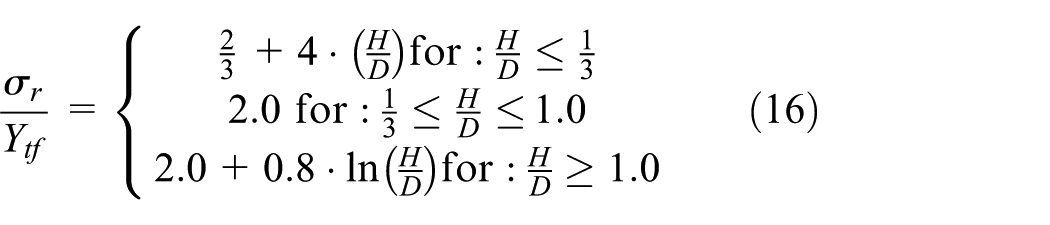
Combining equations (12) and (16), the fit curve of equation (17) is also listed in Figure 7(b). This method of residual velocity prediction 8 has demonstrated that equation (15) is valid

On the basis of the research of residual velocity prediction, for a rigid projectile perforating a 2024-O target, replicas with different geometries (geometric scaling and target thickness), dissimilar projectile materials and impact velocities can be similar to the prototype. The effect of the normalised projectile density
Numerical simulation
Numerical model and validation
Numerical model
A two-dimensional axisymmetric model is used to simulate normal penetration using the finite element code LS-DYNA (Figure 8). The projectiles can be assumed to be rigid; the constants used in the rigid material model for the steel and aluminium projectiles obtained from the literature are listed in Table 2.9,10 Similar to the target dimensions used in the experiments, the radius of the targets in the simulation models is set as 50 mm. The target is fully clamped at the boundary. *Contact_2D_Automatic_Single_Surface is used for the friction setting, and the targets are assigned the *Hourglass setting with the Flanagan–Belytschko stiffness. For reducing the computing time, refined shell elements are used as shown in Figure 8.

Finite element model showing a conical projectile and Zones I and II of the target plate.
Material constants for rigid projectiles.

The dynamic frictional force influences the perforation behaviour of the conical-nosed projectiles but is difficult to determine, as it varies with factors such as the stress state, temperature, material(s) between the contact surfaces, contact direction, projectile velocity and melting point of the material. This coefficient has been assumed to be 0–0.5 in simulations and theoretical analyses of aluminium-plate perforation in the literature.13–20 To simplify the model, ignoring the difference in the dynamic frictional coefficients of dissimilar materials, this coefficient is assumed to be 0.05 in all simulations in this study.
Using a bilinear elastic–plastic model (*MAT_PLASTIC_KINEMATIC), the yield stress and tangent modulus of the target material are obtained from its dynamic stress–stain curves (Figure 9), which were measured using a split-Hopkinson pressure bar (SHPB) test. However, the Young’s modulus from the fitted curve substantially deviates from that of aluminium; hence, in Table 3, the Young’s modulus is assumed to be
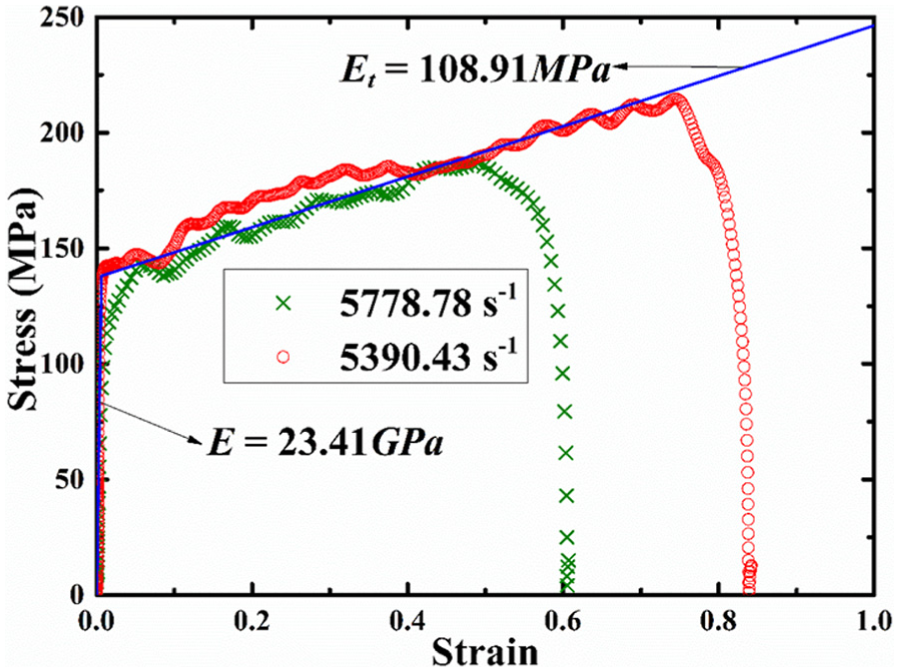
Stress as a function of the strain in 2024-O aluminium, obtained through an SHPB test.
Material constants for the 2024-O target.

Validation of the simulation method
The simulation can be validated by comparing the experimental and simulated impact velocity
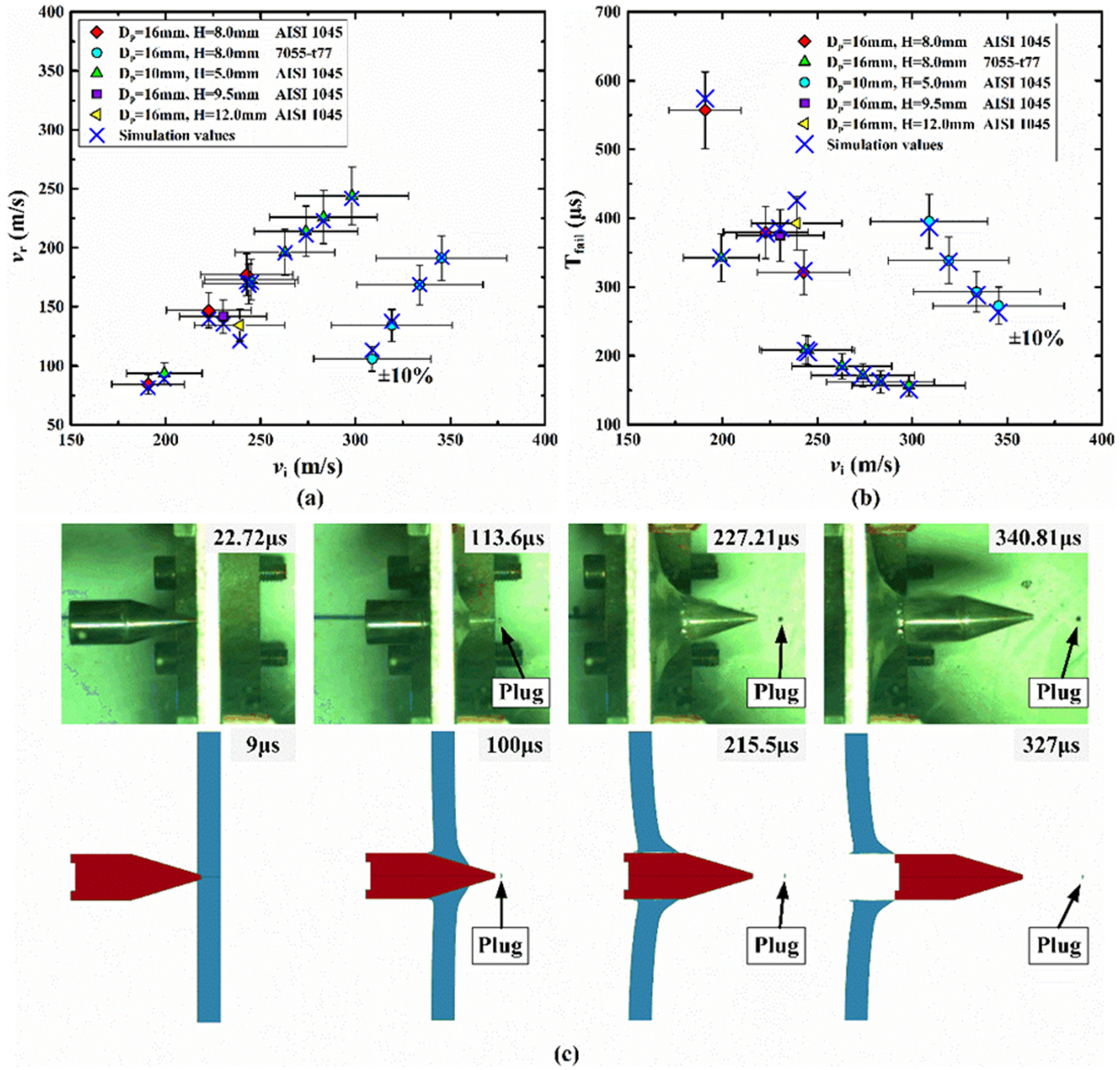
Validation of the simulated (a) residual velocity and (b) penetration time; (c) images of the perforation process in the S16-1 experiment (captured using the high-speed camera) and the corresponding simulation.
Deceleration filtering
In the simulations, the deceleration–time history often contains high-frequency components, one of which is an elastic wave oscillating along the projectile axis. 25 For the A16-1 simulation, high-frequency components can be substantially reduced using a fast Fourier transform and low-pass filtering (57,000 Hz) of the deceleration–time history (Figure 11). Using the authentication method of Fasanella and Jackson, 26 we then integrated the filtered deceleration curve (red solid curve) to obtain the velocity curve (green dashed–dotted line), which fits well with the velocity–time history curve (black solid line) derived from the simulation (Figure 11).

Projectile velocity and deceleration as a function of time. Black solid line: velocity–time curve from the simulation; blue solid line: deceleration–time curve from the simulation; red solid line: filtered deceleration–time curve; green dashed–dotted line: velocity–time curve integrated filtered deceleration–time curve.
After filtering, the profile of the deceleration–time curve can be simplified as a triangular wave, which can be characterised by the maximum deceleration during penetration (



In the next section, the deceleration–time curve is filtered by the same manner. For all simulations, before analyses, the (integrated) velocity–time curve is matched with the (simulated) velocity–time curve. And for simplicity, the effects of the Young’s modulus and Poisson’s ratio of the rigid projectile have been ignored. In all subsequent simulations, the Young’s modulus and Poisson’s ratio of the projectiles are assumed to be 203 GPa and 0.29, respectively (the same as those of AISI 1045 steel in Table 2). In the following simulations of dissimilar-material projectiles, only the densities are assumed to be different. In addition, in the next section, the target diameter is determined using the equation
Deceleration
Similarity analysis of the projectile deceleration
Considering three deceleration characteristics (
Simulation results.

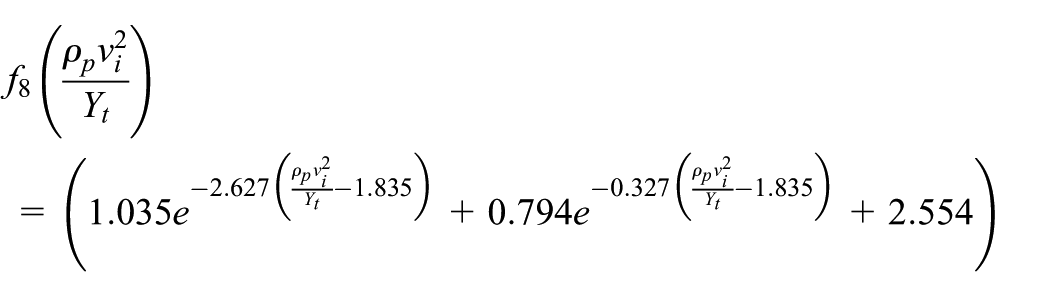
According to the results of simulations, the dimensionless relationship for

where



where




where


Discussion
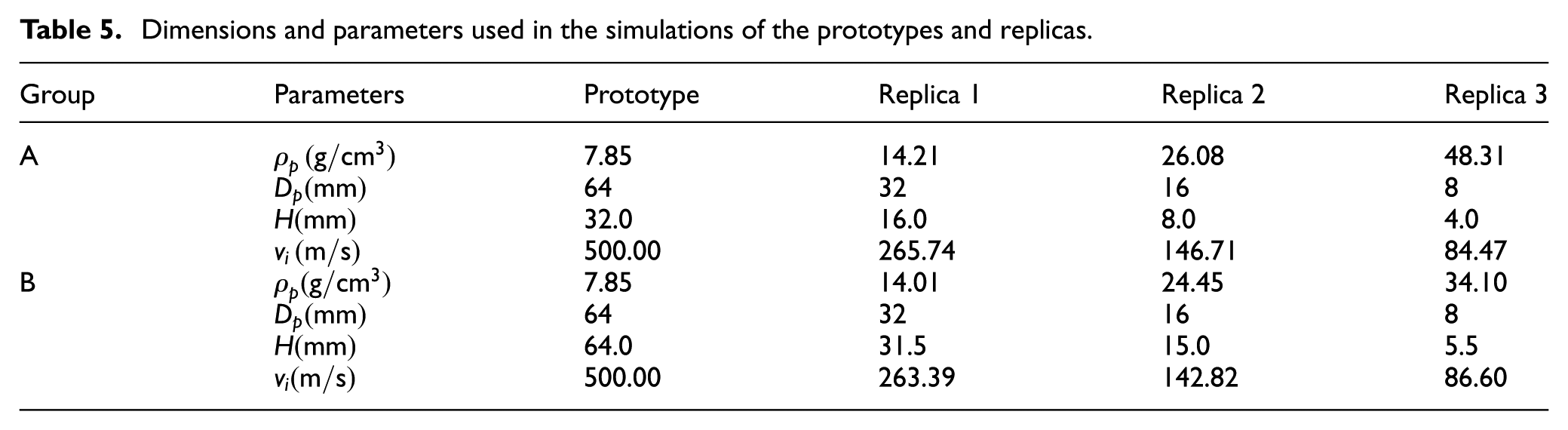
To verify the validity of equations (21)–(23), we modelled two simulations as prototypes: a 64-mm steel projectile penetrating a 32-mm-thick plate and a 64-mm steel projectile penetrating a 64-mm-thick plate. The projectile is assumed to be rigid, the initial impact velocity is 500 m/s, and the plate material is 2024-O aluminium.
Dimensions and parameters used in the simulations of the prototypes and replicas.
Theoretical and simulated results for Group A.

Theoretical and simulated results for Group B.


Deceleration–time curves of Group A: (a) before and (b) after filtering.

Deceleration–time curves of Group B: (a) before and (b) after filtering.
For deceleration–time curve similarity research, a dimensional analysis with the geometry (i.e. geometric scaling and target thickness), dissimilar projectile materials and impact velocity is still a valid way to find a prototype-like deceleration–time process in a downscaled model.
Conclusion
This study focused on the similarity of the residual velocity and deceleration–time data in dissimilar projectile materials and geometric-scaling models with
The similarity of rigid projectiles normally impacting 2024-O aluminium plates at low velocity was evaluated in this study. On the basis of the similarity criteria of the residual velocity and deceleration–time data, replicas with geometric scaling, different target thickness and dissimilar projectile materials can be similar to the prototype.
Through experiments and simulations, the residual velocity can be predicted by the single relationship equation with the main dimensionless parameters. Only the dimensionless pi term
According to the simulation results of a rigid projectile perforating a 2024-O aluminium plate in the range of
On the basis of the experimental and numerical results, the dimensionless term (
Footnotes
Academic Editor: Rahmi Guclu
Declaration of conflicting interests
The author(s) declared no potential conflicts of interest with respect to the research, authorship, and/or publication of this article.
Funding
The author(s) disclosed receipt of the following financial support for the research, authorship, and/or publication of this article: This study was financially supported by the National Natural Science Foundation of China (no. 11472053).