




Abstract
In the recent decades, many physical problems were modelled using the concept of power law within the scope of fractional differentiations. When checking the literature, one will see that there exist many formulas of power law, which were built for specific problems. However, the main kernel used in the concept of fractional differentiation is based on the power law function x−λ It is quick important to note all physical problems, for instance, in epidemiology. Therefore, a more general concept of differentiation that takes into account the more generalized power law is proposed. In this article, the concept of derivative based on the Mittag-Leffler function is used to model the H1N1. Some analyses are done including the stability using the fixed-point theorem.
Introduction
In the last decade, it was found that many physical problems’ behaviour follows the power law. Also, some powerful methods and mathematical models are shown in the fractional order concept from all over the world.1–5 However, for a specific physical problem, there is a corresponding power law that can be used to describe the future behaviour of the observed fact.6–10 This application of power law is found in many branches of science and technology. For instance, in statistics, a power law is used as a functional correlation connecting two quantities, anywhere a relative change in one quantity results in a comparative relative alter in other quantity, independent of the original size of those quantities, one quantity varies as power of another. Nonetheless, the concept of fractional calculus is based on the concept of power law, but the power law used within this field is nothing more than
New fractional differentiation based on Mittag-Leffler function
We present in this section the novel fractional operators based on the Mittag-Leffler function. The novel fractional derivatives are known as Atangana–Baleanu fractional derivative in Caputo sense (ABC) and Atangana–Baleanu fractional derivative in Riemann–Liouville sense (ABR). These definitions can be found in the study of Atangana and colleagues;11,12 we shall therefore present the definition as it is in the initial work.11,12
Definition 1
Let

In their work, they clarified that the function B has the same properties as that of Caputo and Fabrizio’s definition.
Definition 2
Let

Definition 3
The fractional integral associate to the new fractional derivative with non-local kernel is defined as

Here also they reported that when alpha tends to zero, the initial function is obtained, and when alpha tends to 1, the classical integral is obtained.11,12
Analysis of existence and unicity of the new system
Let us redefine the classical model of N1H1 spread by replacing the time derivative by time fractional derivative, and we shall recall that the reason for the modification has been presented in the ‘Introduction’ section. Nevertheless, it is important noting that the concept of local derivative that is used to describe the rate of change has failed to model accurately some complex real-world problems. Due to this failure, the concept of fractional differentiation based on the convolution of

A very important fact in differential calculus is to prove the existence and the uniqueness of the solution of a given problem; therefore, in this section, we aim to prove the existence of solutions for the new model. The system state is made up of
Theorem 1
The following time fractional ordinary differential equation

has a unique solution which takes the inverse Laplace transform and uses the convolution theorem below 12

With the theorem above, the system is equivalent to the following

A possibility of converting the above system to iterative routine is given below

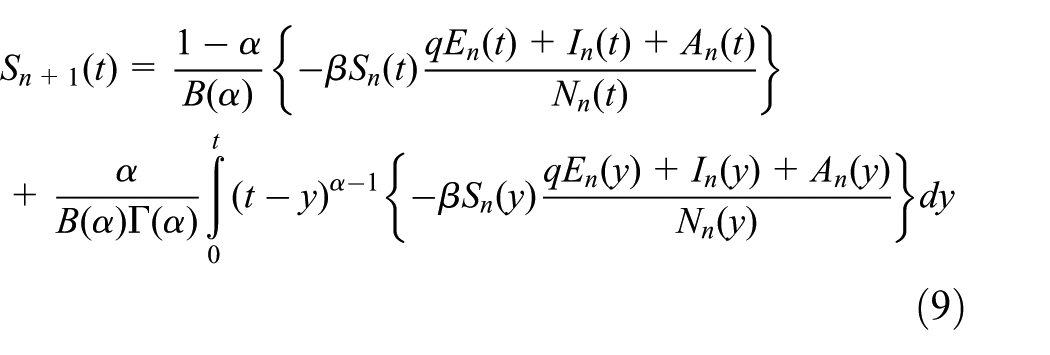

Taking the limit for a large value of n, we expect to obtain the exact solution.
Using Picard–Lindelöf approach to check the existence
The proof is reached if one considers the following operator
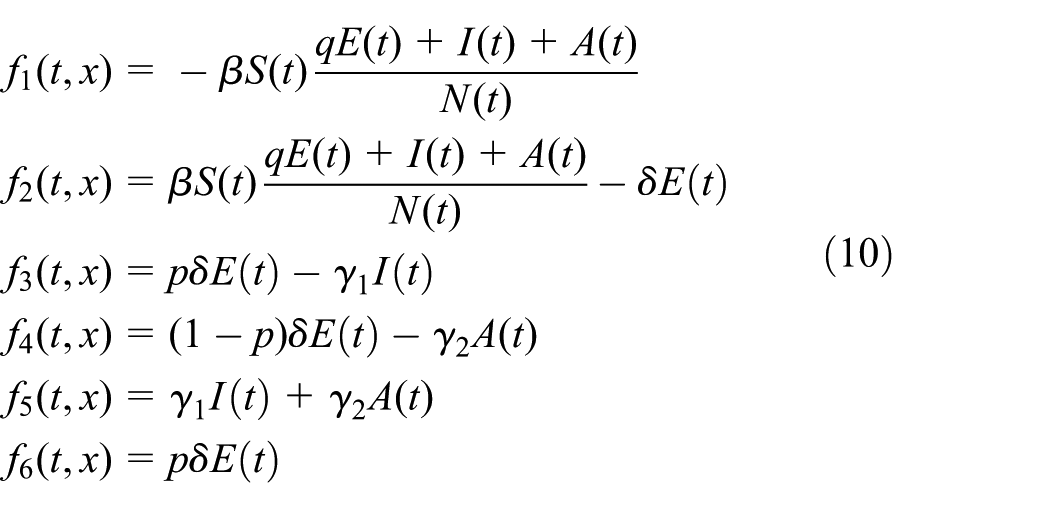
It is clear that
Let us consider

where
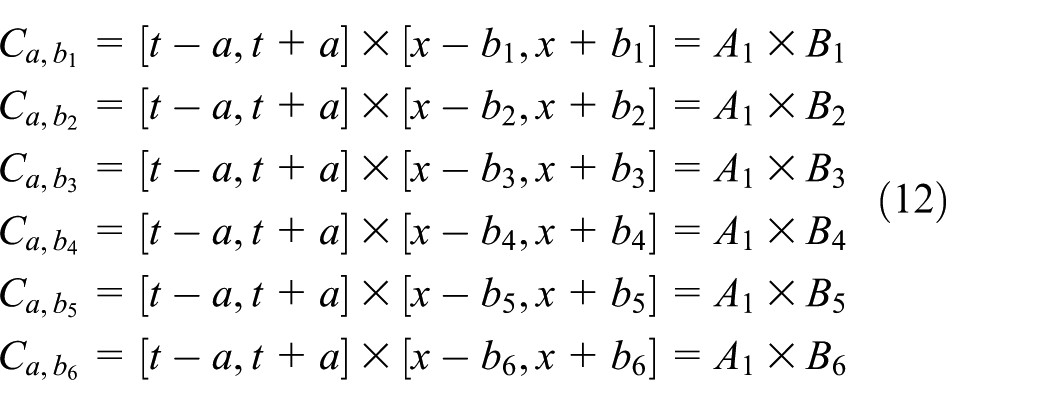
However, the fixed-point theorem of Banach space can be employed here together with the metric for our set of equations by inducing the uniform norm as

The next operator is defined between the two functional spaces of continuous functions, and Picard’s operator is defined as follows

Defined as follows

where X is the given matrix
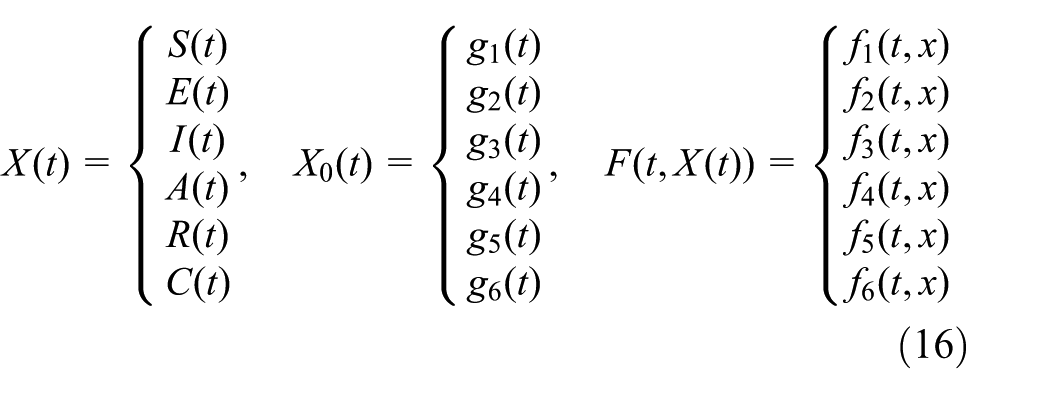
Due to the fact that there is no disease that is able to kill the whole world population, also the fact that the number of targeted population is finite, we can assume that all the solutions are bounded within a period of time


Here, we request that

We next evaluate additionally the following

With the definition of the defined operator in hand, we produce the following


where
Obtention of specific solutions via iteration approach
Since the extended model is nonlinear, it is sometimes difficult to have it solved using analytical method; therefore, the need of an iterative approach is important. The method based on integral transform and iterative method will be used here to obtain a particular set of solutions for the extended model. The integral transform used here is the well-known Sumudu transform operator which has the properties of keeping the parity of the function. The following theorem is needed for further investigation, and the initial introduction of this theorem can be found in the study of Atangana and Koca. 12
Theorem 2
Let

Proof
Proof of the theorem can be found in the study of Atangana and Koca. 12
To solve the above system (4), we apply the Sumudu transform of the Atangana–Baleanu fractional derivative of

Rearranging, we obtain following inequalities where

We next obtain the following recursive formula

And the solution of equation (25) is provided by

Application of fixed-point theorem for stability analysis of iteration method
Let
Theorem 3
Let

for all
Now, we consider the recursive formula (25) with (4) below
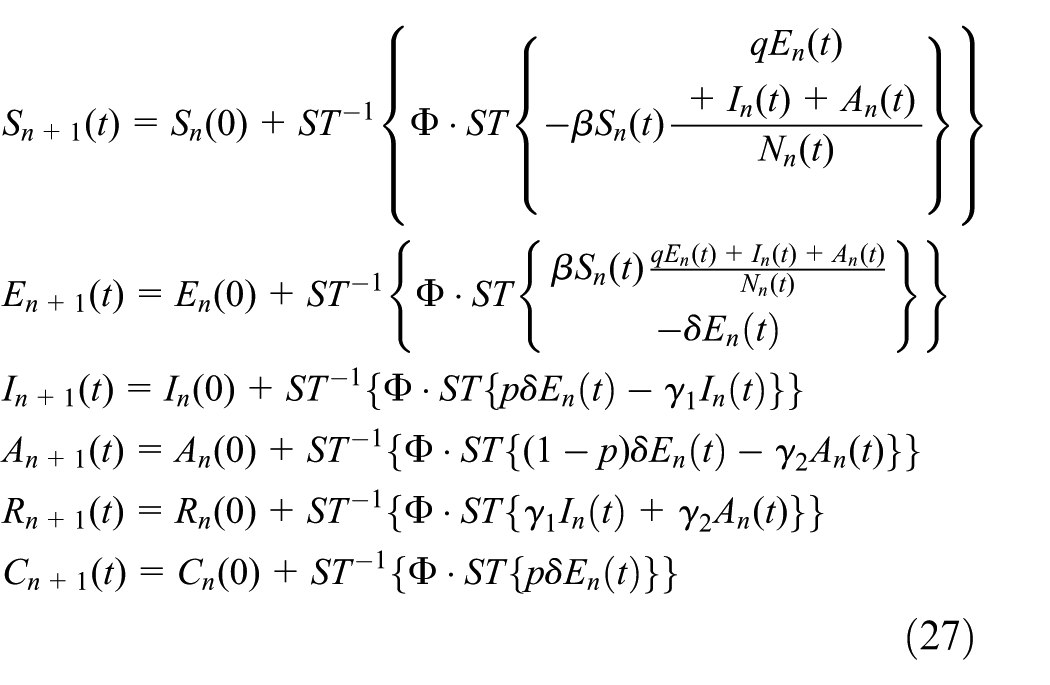
where
Theorem 4
Let H be a self-map defined as

is H-stable in

Proof
The first step of the proof shows that H has a fixed point. To achieve this, we evaluate the following for all

Let us consider equality (30) and apply norm on both sides and without loss of generality

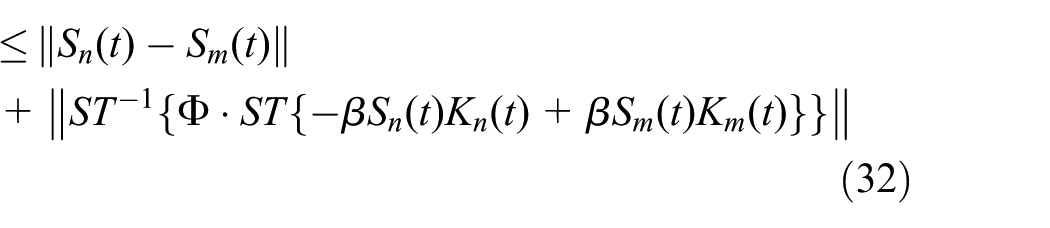
where

Because

where
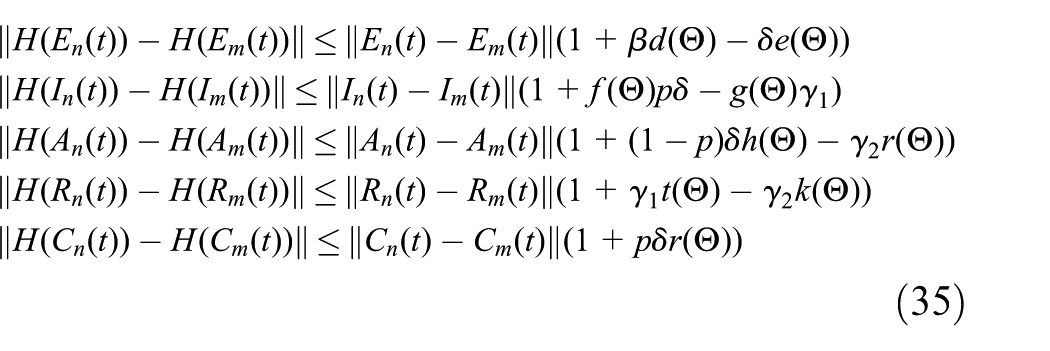
This completes the proof.
Conclusion
Many epidemiological models aim to describe complicated physical problems. To explain the spread of a given sickness, modellers use the concept of differentiation to predict the future behaviours of the spread. However, in the last passed years, many researchers rely on the concept of rate of change that is based on the Newton law. Other researchers make use of the concept of power law that is based on the concept of fractional differentiation. The fractional differentiation was introduced to model some complicated physical aspect; however, they have been found not quite efficient when modelling the spread of some diseases. Recently, due to the application of the Mittag-Leffler function in many fields of science and engineering, the fractional differentiation based on the generalized Mittag-Leffler function was constructed, and some applications were made with great success. In this work, we have extended the model of H1N1 to the concept of fractional differentiation based on the Mittag-Leffler function. We studied the existence of the generalized model using the fixed-point theorem. We presented the derivation of the solution using the Sumudu transform, and the stability analysis of the method is validated via the t-stable approach.
Footnotes
Academic Editor: Xiao-Jun Yang
Declaration of conflicting interests
The author(s) declared no potential conflicts of interest with respect to the research, authorship and/or publication of this article.
Funding
The author(s) disclosed receipt of the following financial support for the research, authorship, and/or publication of this article: The authors extend their sincere appreciations to the Deanship of Science Research at King Saud University for funding this prolific research group PRG-1437-35.