




Abstract
This study presents the analytical formulation of circular steel tubular column with hollow concrete section. This unified analytical formulation can evaluate the axial compression capacity and buckling load of this innovative composite section at normal and high temperature levels, as well as the normal and recycled concrete in a similar fashion. Therefore, the confinement effect on this composite section is uncertain, which in turn leads to complications in axially loaded compression evaluation, because the inner surface of the hollow concrete section is unrestrained. To this end, this study adopts the effective constraint, which can further assist in transmitting from normal concrete to recycled concrete material to address sustainability issues. In addition, the concept of average temperature is proposed to formulate the failure load of circular hollow recycled concrete–filled steel tubular section and circular hollow concrete–filled steel tubular section columns at high temperature.
Keywords
Introduction
In the past few decades, considerable research focused on the composite section, including load resistance under normal and high temperature levels. For example, the fire resistance property of concrete-filled steel tubular (CFST) columns has been extensively investigated 1 theoretically and experimentally. Kodur 2 presented simplified formulas to calculate the fire resistance limit of circular and square CFST columns, which were verified by his subsequent experiments. Lie3,4 investigated the fire resistance property of CFST columns for plain and reinforced concrete through tests. Test results show that high-strength CFST columns could not satisfy the requirement of fire resistance limit generally, according to Standard CAN/CSA-S16.1-M89 “Limit states design of steel structures.” Many researchers5–9 conducted a series of studies on CFST members through experiments and theoretical approaches. The studies proposed several methods to compute fire resistance, which has now been adopted in practical design.10–14
Recycled concrete can not only overcome the shortage in natural aggregates but also reduce construction waste after demolition or redevelopment. However, according to Xiao,
15
recycled concrete has higher variable coefficient
To this end, this study investigates the fire resistance analysis of HRCFST columns using finite element simulations and theoretical approaches for the first time. First, using limit analysis methods, a new design formula for ultimate axial strength is developed for the short and long HRCFST columns with different section components, including steel tube, rebar, and concrete, at normal temperature and under fire based on the average temperature concept. Finally, the numerical model is validated through existing experimental results of HRCFST columns. Eventually, this study can present a unified formulation for the axially loaded HCFST and circular HRCFST columns from normal to high temperature.
Theoretical formulation
The formulation of HRCFST columns under axial compression at normal temperature
The HRCFST columns at normal temperature show no extrusion pressure at the interface between the steel tubular section and recycled concrete in the early axial compression stage. With the increase in axial compression force, cracks in the recycled concrete started to appear and develop continuously.19–21 Moreover, the lateral expansion of recycled concrete surpasses that of steel, which produces extrusion pressure at the interface between the concrete and steel materials, which in turn generates additional resistance axially caused by compression, also known as confining pressure. For this purpose, stress distribution of HRCFST columns based on the concept of equivalent area (i.e. uniform formula) is investigated.
The confinement effects of HRCFST columns
This study adopts the concept of equivalent area first presented by Mander et al., 22 in which constraint of concrete is divided into two parts, namely, effective and noneffective constraint regions. With regard to HRCFST, as illustrated in Figure 1, the interface between steel and concrete is fully effective due to the steel tubular section. However, the effectiveness of another surface of the hollow concrete at its core is not justified well; thus, certain regions from the hollow concrete surface are identified as noneffective constraint regions. Furthermore, this study proposes a new concept of effective constraint region for recycled concrete.
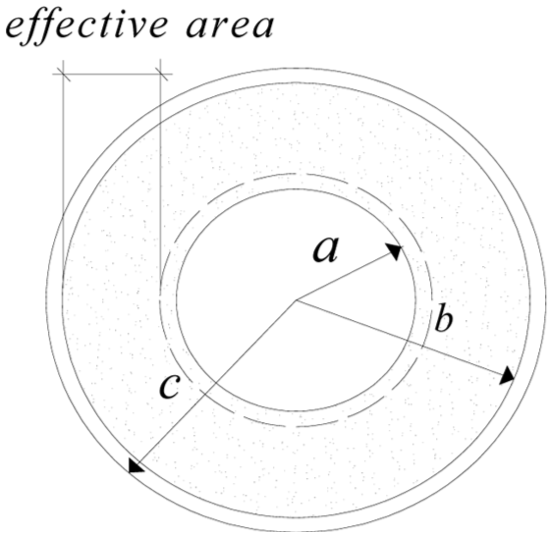
Section of HRCFST.
As previously mentioned, the porosity of recycled concrete can vary extrusion pressure to be different from that of normal concrete. Therefore, the porosity of recycled concrete materials is an additional factor on the noneffective constraint region. To measure the factors of unrestrained surface and porosity of recycled concrete, equations (1) and (2) are written as follows


where
Therefore, equation (2) can be used to interpret the confining effects of HRCFST. Compared with normal concrete, the recycled concrete has a larger porosity, and the actual area after deduction of porosity is smaller than that of normal concrete in the same cross-sectional area, which may be used as the equivalent porosity. With the principle of axial force equilibrium in the concrete section, the product of elastic modulus and area is always equal, such that

where
The relationship between replacement rate ratio R and elastic modulus E was established in equation (4) when using regression analysis from a set of test data, as tabulated in Table 1 (Figure 2)

Then, equation (5) can be obtained

Experimental data for elastic modulus.


Relationship between R and E.
The analytical formula for the axial compression of the HRCFST column
When the HRCFST section is under axial compressive pressure, recycled concrete gradually shifts into the triaxial compressive stress state. Meanwhile, recycled concrete materials become denser with the decrease in degree of porosity. For a clear demonstration, the theoretical derivation of the axial compression capacity of HCFST is initially investigated and then transformed into recycled concrete section by the concept of effective constraint.
The stress field of the concentric cylinder can be produced under the conditions of small deformation and good continuity of the qualified recycle concrete. These factors make concrete and steel tube produce the same longitudinal strain in the elastic stage for the axial component, which simultaneously leads to an elastic axis symmetric generalized plane strain problem for the radial component as long as the Poisson ratio of concrete is greater than that of steel. Therefore, the compatibility condition in the radial direction is satisfied. Thus, the Airy stress function of

Section of HCFST.
In summary, the axial compression capacity of HCFST can be divided into two components, namely, the axial and radial directions, which can be superimposed at the elastic stage, as illustrated in Figure 4 from Yu et al. 25 with some adaptive change.
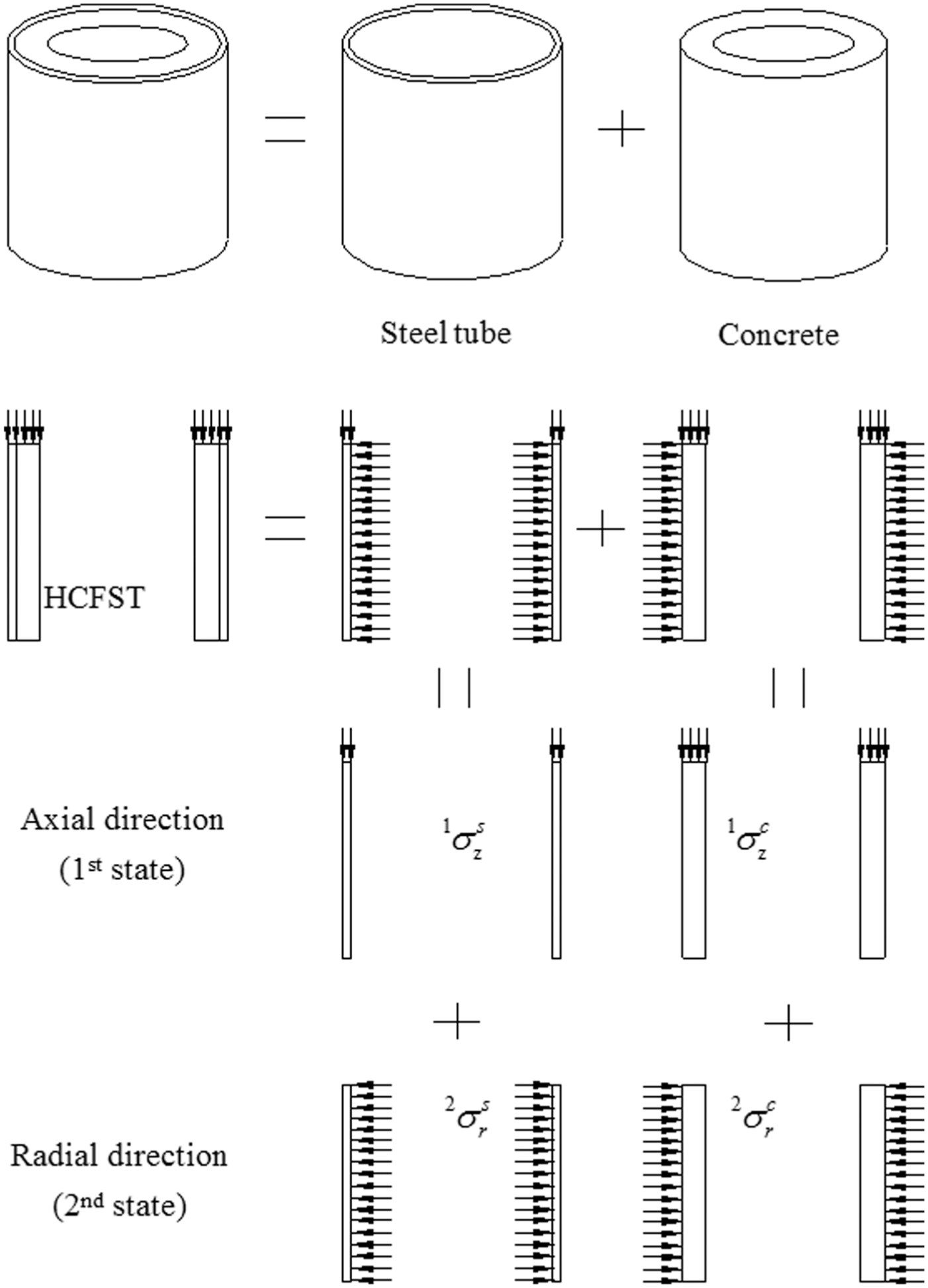
Loading distribution of axially compressive HCFST. 25
According to the compatibility condition in the axial direction, the axial strains of the entire steel–concrete composite, steel, and concrete section, denoted by the superscripts sc, s, and c, respectively, are the same as that in the HCFST, as given in equation (6)

Using Hooke’s law, radial strains εr of concrete and steel sections in relation to their axial strains εz are given in equation (7)

At the first state in Figure 4, the radial displacement at the interface between steel and concrete sections (i.e. inner surface) is described as equation (8), in which b refers to Figure 3.

The superscript at the left is the first state of uniaxial compression. Therefore, the longitudinal stress in the steel and concrete sections is obtained by Hooke’s law in equation (9)

At the second state of the plane strain of the thick-walled cylindrical tube model depicted in Figure 4, uniform radial stress distributions p1 and p2 on the hollow surface or inner surface (i.e. r = a) and at the interface between concrete and steel sections or outer surfaces (i.e. r = b) are given in equation (10)

Using the Airy stress function, radial and polar stress distributions in the plane strain problem are obtained using equations (11) and (12), respectively


Therefore, radial and polar stress distributions are given in equations (13) and (14) after substituting the boundary conditions of equation (10)


Strain distributions in polar coordinates are


Therefore, radial displacements at the second state in the inner surface of steel and the outer surface of concrete are given in equations (17) and (18), respectively


where vs and vc are the Poisson ratio of steel and concrete sections, respectively; a, b, c are the dimensions of the HCFST section as depicted in Figure 2. According to Hooke’s law, the axial stress distributions at the second state in steel and concrete sections are written as follows


Using the superposition of the first and second states, as indicated in Figure 4, the compatibility condition of the interface between steel and concrete can be given as follows

By combining the radial displacements in the first state as equation (8) and in the second state as equations (17) and (18) and the compatibility condition of equation (21), the lateral stress p of core concrete under the HCFST section is derived as follows.
By combining the radial displacements in the first state as equation (8) and in the second state as equations (17) and (18) and the compatibility condition of equation (21), the lateral stress p of core concrete under the HCFST section is derived as follows

According to the analytical solution25,26 for CFST members in the elastic phase, the effective axial stresses with confining effect on concrete and steel sections (i.e.


According to the axial force equilibrium of

Similarly, using the same principle as equation (22) to transform the axial compressive stress of normal concrete to that of recycled concrete of the HRCFST section and to replace the corresponding material properties for recycled concrete in equation (25), the elastic axial compressive stress of the HRCFST section can be written as follows

As the derivation process in Yu et al., 25 this expression of axial compression capacity is useful when replacement ratio R of recycled concrete is commonly adopted in the industry and is considered an important parameter to measure recycled concrete materials

where
The stability coefficient of the axially compressive HRCFST column with both stability and plasticity concerns is given in equation (28), as the formula in Yu et al. 27
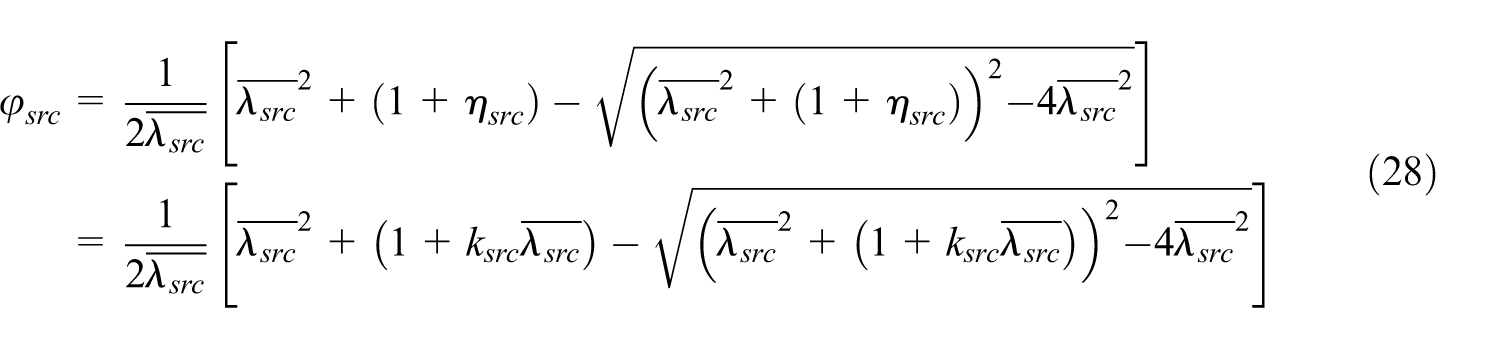
where ηsrc is the Perry factor accounting for the initial imperfection, which can be considered defects of the HRCFST, such as initial imperfection, which directly correlates to the slenderness ratio (i.e.
The formulation of HRCFST columns under axial compression at high temperature
When HRCFST and HCFST sections are attacked by fire, temperature distribution across the section is usually heterogeneous. The temperature across the member section will gradually decrease from the outside to the inside because of the low conductivity property of concrete materials. For the sake of formulating the fire resistance of the HRCFST section in a simple, reasonable, and accurate manner, average temperature by means of corresponding area can be adopted to develop the fire resistance of the HRCFST section because the thermal gradient that causes the thermal bowing effect can offset each other on different sides generally because of the symmetric column section. Thus, the average temperature across the member section is adequate to reveal the axial compression capacity of the HRCFST section with thermal effect, such as material deterioration
The formulas of calculating average temperature on the HRCFST section
The average temperatures of recycled and normal concrete are the mean value of the temperature distribution of the recycled and normal concrete section and similarly for the steel tubular section. According to the Green function and the difference of performance of recycled and normal concrete, 27 the formulas for average temperature on the steel and recycled and normal concrete sections can be formulated as equations (29) and (30) by means of regression analysis from 588 test data, respectively, as follows


where Ts is the average temperature of the steel tube (°C); t is the time of heating up (h) according to the standard temperature curve of ISO-834; Ds, Bs, Cs, Drc, Brc, and Crc are undetermined coefficients, which can be ascertained by the recurrence of finite element analysis; Trc is the average temperature of the recycled concrete and normal concrete (°C); and
Three parameters, namely, thickness of steel tube (3, 12, and 21 mm), thickness of recycled concrete (90, 300, and 500 mm), and hollow ratio (0, 0.45, and 0.75), are considered in the finite element simulation to describe various HRCFST sections. The undetermined coefficients can be ascertained, as shown in equations (31) and (32)

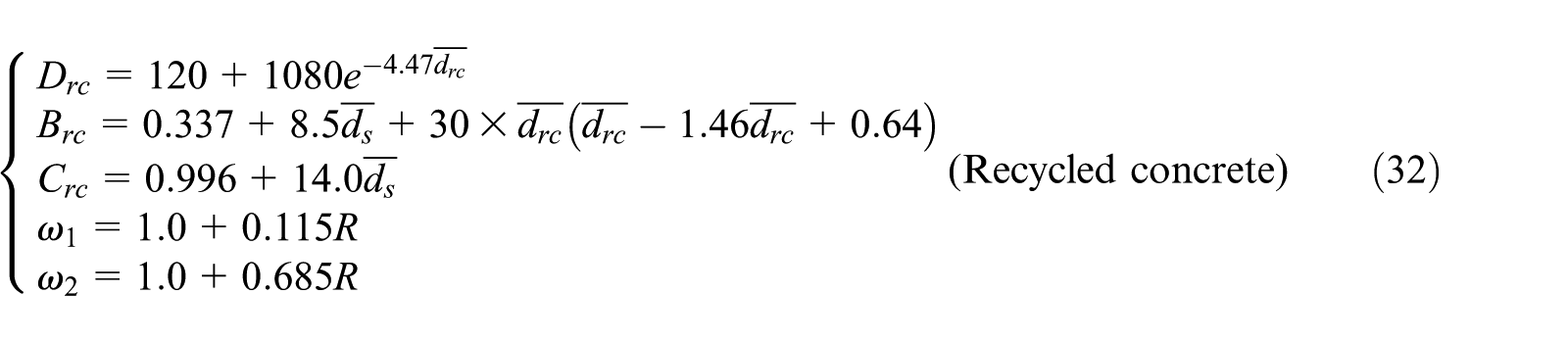
where
The formulas of axial compression load of HRCFST and HCFST under standard fire conditions based on the average temperature
In this section, the axial compression bearing capacity of the HRCFST column at ambient temperature in equation (27) can be transformed into the axial compression load of the HRCFST and HCFST columns with stability concern at high temperature according to the average temperature distribution on their section components as stated in section “The formulas of calculating average temperature on the HRCFST section.” Under standard fire conditions, cross-sectional areas of the recycled concrete and steel tube remain unchanged. However, the temperature distribution on the components no longer remains uniform and the bearing strength of recycled concrete
Therefore, the strength of recycled concrete

Moreover, the strength of the steel tube at higher temperature is given as follows

where T0 is the room temperature 20°C and Ts and Tcr are the average temperatures of the recycled concrete and steel tube, respectively, which can be obtained from equations (29) and (30). The implication of equations (33) and (34) is that the relation between strength and temperature can be expressed explicitly, which can simplify and standardize a set of different material grades. Thus, average temperature can be formulated in explicit form for clarity and brevity.
Similarly, at a particular time and temperature level, the formula of axial compression load

where the bearing strength

where
At temperature T, the stability coefficient of the axially compressive HRCFST column can be derived from equation (28) in a similar fashion, as follows

where
Experimental research
Experimental studies including six specimens were performed to assess the behavior of HCFST and HRCFST columns under axial compression and fire load. All specimens were heated with the standard temperature curve of ISO-834, 30 and the same axial compression ratio (n = N/N0 = 3) was maintained. The real furnace curves of RCFST and CFST columns are shown in Figure 5. The main objective of the test is to analyze the deformation process and failure modes of HRCFST columns at increasing temperature, in which the effects of the tested parameters were examined. Finally, a finite element model was developed for calibration according to the test results.
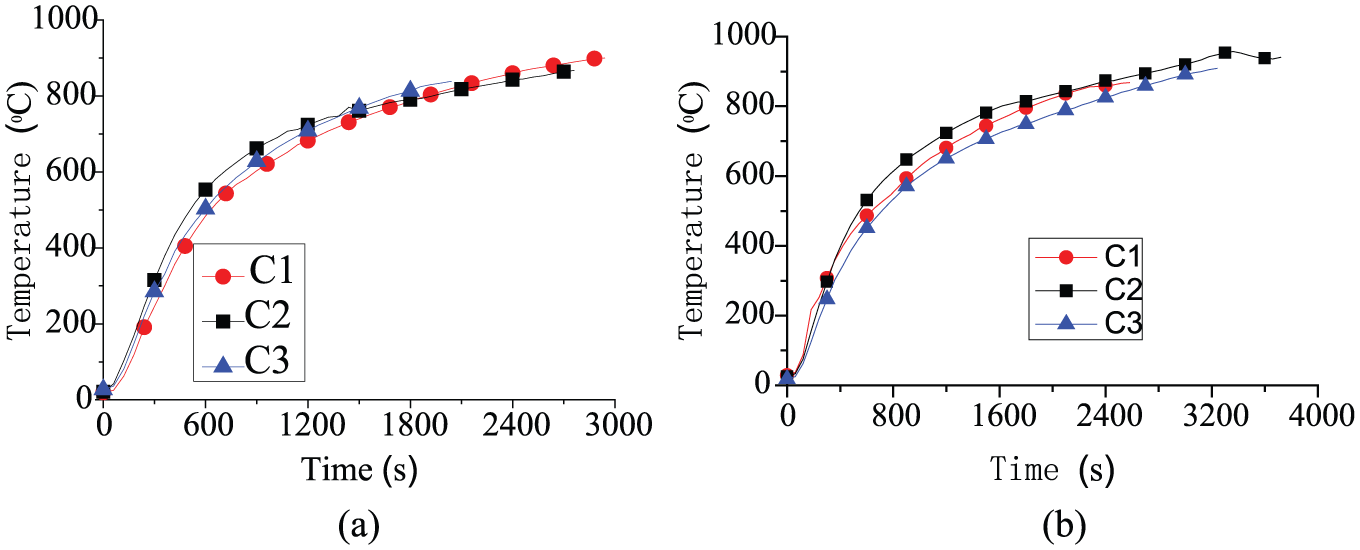
The real furnace curves of (a) RCFST columns and (b) CFST columns.
Test specimens
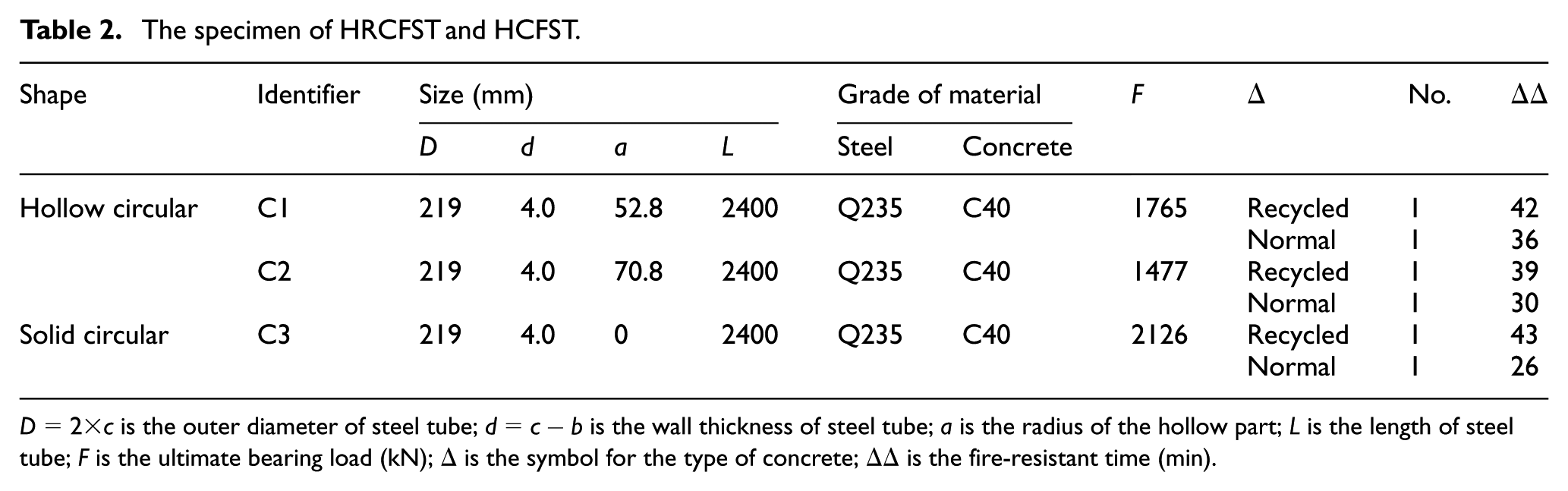
The details of the specimens of HRCFST and HCFST columns are listed in Table 2. Material properties of steel and recycled concrete were obtained from the tests. Figure 5 shows the experimental situation.
The specimen of HRCFST and HCFST.
In order to obtain the temperature changes. For HRCFST and HCFST columns, the thermocouples are arranged on the inner wall of the concrete and the outer wall of the steel tube, at half the height. In the section of RCFST and CFST column at half the height, the thermocouples are arranged in the ratio of 1/4, 1/2, 3/4 of the diameter of the concrete, and the outer surface of the steel tube. The temperature development in the specimens is shown in Figure 6. The load is applied through the loading fixture to the middle of the end of the component, treated as axial loading and there is no eccentricity.
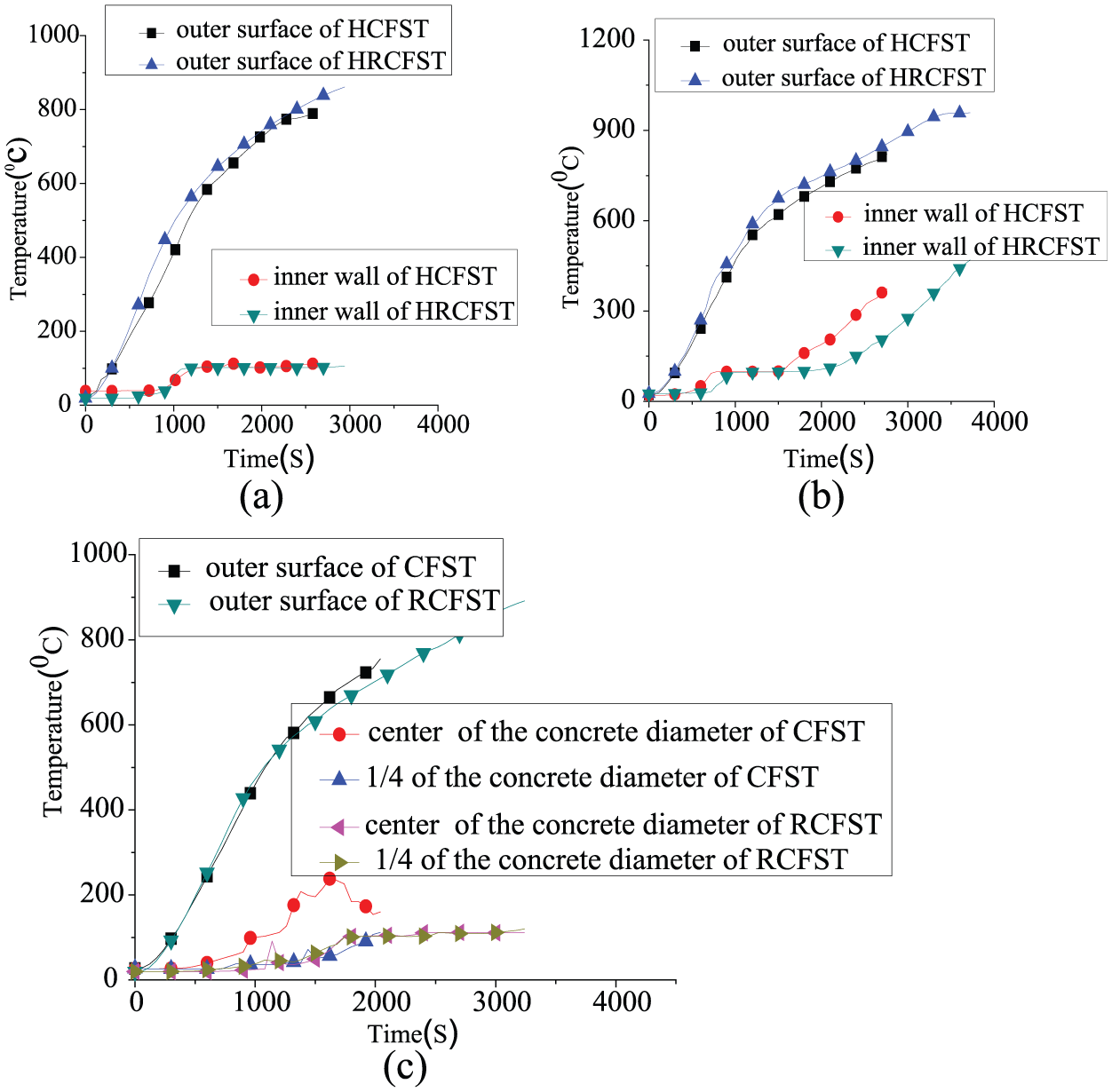
The temperature development of the specimens: (a) C1, (b) C2, and (c) C3.
Specimens of HRCFST and HCFST were placed in an electric furnace, as shown in Figure 7(a). The boundary condition of specimens is regarded as hinged at both ends, as shown in Figure 7(b), with the corresponding the connection treatment. The electric cooker heated the HRCFST and HCFST columns according to standard fire conditions. The ratio of preaxial compression load to the ultimate bearing load is selected as 0.3.
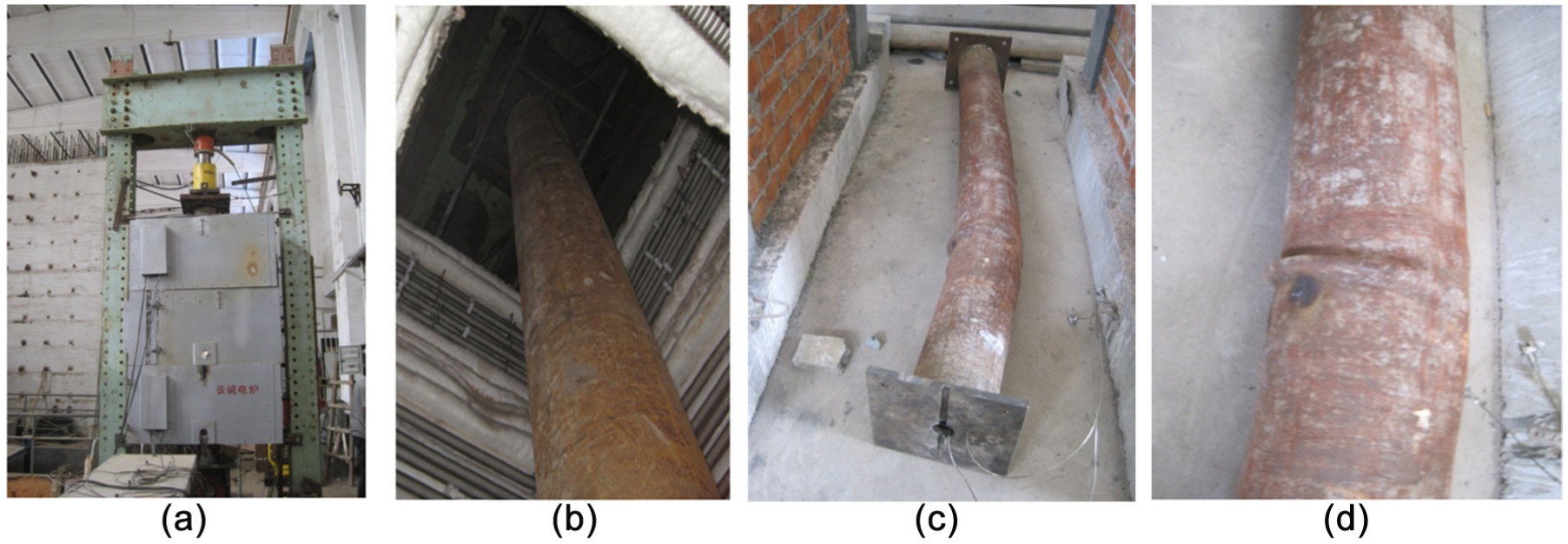
The loading and heating equipment in the experiments: (a) electric cooker, (b) resistance wire, (c) the column after experiment, and (d) local damage.
Test results
After 10–15 min of fire test, the HRCFST columns started to emit water vapor for 2–3 min before the columns failed, which indicates that water evaporation in the recycled concrete is completed and water–silica gel is completely destroyed. Meanwhile, the strength of the recycled concrete rapidly decreased, and the bearing capacity of HRCFST significantly reduced, which resulted in local damage and local plate buckling.
According to Figure 7(c) and (d), all test columns buckled at one-third of their length and the failure mode of the test columns occurred at the local plate buckling during the heating process. The load–axial displacement curves at the tip of the columns are illustrated in Figure 8.

Load–axial displacement curves of HRCFST and HCFST: (a) C1, (b) C2, and (c) C3.
HRCFST and HCFST columns with the same layout are heated conforming to the standard temperature curve and under the same loading procedure. Figure 8 shows that all HRCFST columns possess a longer fire resistance time and a higher fire resistance than those of the HCFST columns obviously because recycled concrete has less thermal conductivity than normal concrete, which can be attributed to its higher porosity. The top vertical displacement increases until it reaches their maximum displacements, during which thermal expansion of the columns is greater than those caused by mechanical loads. The strength of the HRCFST columns generally deteriorates with the increase in temperature against time. Thus, top vertical displacements at the top end of the columns caused by axial compression load are larger than that caused by thermal expansion; thereby, axial displacements of the columns begin to decrease (or increase in compression). When the members are unable to maintain force equilibrium, deformations of the members dramatically change. The fire-resistant time of RCFST columns and CFST obtained in this fire test are shown in Table 3.
The time of fire resistance of RCFST and CFST.

RCFST: recycled concrete–filled steel tubular; CFST: concrete-filled steel tubular.
Analysis and discussion
As shown in Figure 8, it is different that the performance of the different specimens under fire. From the comparison of the results of the fire tests of solid and HCFST and HRCFST specimens, their fire-resistant time results are all less than 1 h under the standard heating curve. The fire resistance test of C1 concrete showed that the fire resistance of HRCFST was slightly better than that of HCFST extended by about 14%, with the case of that fire resistance time of HRCFST was 49 min and the fire resistance time of HCFST was 43 min. According to the existing research results, the thermal conductivity of regenerated concrete is about 15% lower than that of ordinary concrete, which makes it difficult to transfer the heat to the inside of recycled concrete. So the fire resistance property of HRCFST is better.
Similar to the C1 specimen, the fire resistance of HRCFST in C2 specimen is superior to that of HCFST extended by about 30%, with the case that the fire-resistant time of HRCFST is 48 min and the fire resistance time of HCFST is 38 min. It is because of the lower thermal conductivity of recycled concrete than normal one. The fire-resistant time of solid RCFST is 51 min, and the fire-resistant time of solid CFST is only 34 min. Under the same pre-load, the fire-resistant time of the RCFST is 50% longer than that of the ordinary steel pipe concrete. This experimental phenomenon has a great relationship with the low thermal conductivity and high specific heat of recycled concrete.
In addition, by comparing the HRCFST specimen with RCFST one, it can be found that the fire resistance time of RCFST (C3) is higher than that of CFST. It is caused by hollow inner part of HCFST column, through which the heat energy could easily transferred from the gap of the upper end plate to the inside of HCFST. While, the heat transfer cannot be transferred to the solid CFST, can only rely on the transmission of heat conduction. For the solid CFST and RCFST, the proportion of the total heat transfer is almost 0, the heat transfer heat is almost all the heat transfer. Because the thermal conductivity is mainly for the heat conduction, therefore, the influence of difference thermal conductivity on HCFST is less than that on CFST or RCFST.
In summary, at a certain temperature, the axial compression load
The comparison of calculated value and experimental value.

t is the time of fire resistance (min); “Ratio” denotes the ratio of calculated value to experimental value; Δ is the author’s experiments.
Table 4 shows that the mean value and variance ratio from the present approach are 1.099 and 0.186, respectively. According to the previous research,37,38 the mean value and variance ratio shown in Table 4 are within the acceptable level. Therefore, the analytical formulation of compressive load-bearing capacity (equation (35)) and compression load (equation (37)) with stability concern of the HRCFST (HCFST) column under standard fire conditions is effective.
Conclusion
In summary, this study presents an analytical formulation of the axially compressive capacity and compressive load of HRCFST columns, which can feasibly extend to the normal concrete section. The application of recycled concrete has emerging sustainability concerns; however, the experimental results are limited for engineering design. Furthermore, accurately evaluating the compression load of the HRCFST section is difficult when the confining effect of this section has a partial effect. In addition, the axial compression of the HRCFST column at high temperature is also included in this study; this compression can unify the compressive capacity and load of the HRCFST and HCFST columns at ambient and high temperatures. Therefore, the proposed analytical formulation of axially compressive HRCFST columns can close the gap between the application and experimental study of recycled concrete member.
A few constructive remarks from this study are listed as follows:
Fire resistance time of the HRCFST section is longer than that of the HCFST section, which can be attributed to the smaller thermal conductivity of recycled concrete materials.
The analytical formulation for predicting the load-bearing capacity of the HRCFST columns at normal temperature has been proposed in this study. The analytical formulation was based on the simplified form of the strength formula for HCFST columns in this study.
Average temperature formulas could be derived by regression analysis of a significant number of finite element simulations. Based on this formula, the bearing capacity of HRCFST and HCFST columns, which have been proven experimentally, can be investigated.
Analytical formulas of the stability and load-bearing capacity of axially loaded HRCFST columns are proposed at high temperature with uniform thermal distribution, which are in good agreement with the experimental results of the failure load of HRCFST and HCFST columns under standard fire conditions.
Footnotes
Academic Editor: Alokesh Pramanik
Declaration of conflicting interests
The author(s) declared no potential conflicts of interest with respect to the research, authorship, and/or publication of this article.
Funding
The author(s) disclosed receipt of the following financial support for the research, authorship, and/or publication of this article: This study is funded by Sub Projects in the National Science & Technology Pillar Program during the China Twelfth Five-year Plan Period (grant/award no. 2014BAH25F05-2), Shenzhen Science and Technology Plan project (no. JCYJ20150327155221857), and Shenzhen Carbon Storage Cement-based Materials Engineering Laboratory.