




Abstract
Oil whip and resonance are the common faults of a rotor system. The faults directly affect its normal operation and can cause serious accidents. Based on the regularity of oil whip and resonance of the rotor system, a sensitivity study of the frequency reliability of the system is conducted. The technique developed utilizes random perturbation technology, reliability theory, and sensitivity technology. The reliability mode and the failure probability of the rotor systems are defined. The second-order joint failure probability is obtained using numerical integration methods. The variation regularities of the reliability are obtained and the influences of random parameters on the reliability of the rotor system are studied. The method presented provides a theoretical basis for the frequency reliability sensitivity design of the rotor system. A numerical example is analyzed to show the effectiveness of the proposed method.
Introduction
With the development of finite element technology and simulation techniques, reliability design is playing an increasingly important role in modern product design. But due to the complexity and diversity of random parameters, accurate results of complex systems cannot be obtained in the process of reliability design. Reliability sensitivity analysis can establish the importance of the random parameters, identify the most influential random parameter, and determine the sensitive and non-sensitive parameters on the systems’ reliability. Generally, randomness of the sensitive parameter must be considered. But the non-sensitive parameter can be used as the deterministic parameter. Therefore, the number of random parameters can be reduced which can simplify the design process of reliability.
Reliability sensitivity estimation methods have been greatly developed in recent decades. At present, there are primarily two kinds of computational methods for reliability sensitivity estimation, namely, analytical methods and numerical methods. The analytical methods are techniques based on first-order reliability theory1–4 and other higher order reliability methods (such as fourth-order reliability methods5–7). The numerical methods are based on Monte Carlo simulation (MCS) techniques. 8 To address the low computational efficiency of MCS, which in order to evaluate small failure probabilities or structural reliability requires a large number of costly analyses in each sampling cycle, many researchers developed numerical variance reduction techniques. Examples include Latin hypercube sampling,9,10 importance sampling,11–15 line sampling,16–18 and subset simulation. 19 In addition, other reliability sensitivity estimation methods based on most probable point system simulation, 20 stochastic response surfaces’ method, 21 and saddle-point approximation 22 have been developed. Further information can be found in some previous studies.23–25
A rotor system fault mainly consists of oil whip, shaft crack, rub-impact, and resonance. It is known that a typical rotor system may very often be a multi-fault system. For example, a rotor system is always liable to have some degree of unbalance, misalignment, and temporary bow. Simultaneous existence of multiple faults is a realistic situation for a rotor system, particularly when rotors operate under severe thermal and mechanical stresses. 26 In such situations, when more than one fault coexists in the rotor system, the reliability sensitivity estimation of the rotor system becomes a complex task.
In this article, the failure modes of a rotor system with oil whip and resonance are studied based on the fault features of oil whip and resonance. The reliability mode and the safety probability of the rotor system are defined as series modes. The reliability sensitivity estimation method of the rotor system is presented considering the correlation of the failure mode. According to theoretical analysis, the practical numerical results of the reliability sensitivity to the mean and standard deviation are provided which demonstrate that the proposed method is efficient and accurate.
Random perturbation of eigenvalue
The eigenvalue problem of a rotor system without gyroscopic moments can be expressed as


where
The mean and variance of the natural frequency can be expressed according to the random perturbation 27


where bs is the random parameter; E(ωi) and Var(ωi) are the mean and variance of ωi, respectively; E(bs) and
Reliability of rotor system with oil whip
Oil whip occurs in the range of rotation speeds higher than double the first critical speed of the rotor system. Based on reliability theory, the state function of oil whip is defined as

where ω1 and Ω are the first critical speed and excitation frequency of the rotor system, respectively.
According to the relationship of the first critical speed ω1 and excited frequency Ω, the failure state of the rotor system is represented as

The mean and variance of the state function g1 can be obtained; these are, respectively


The reliability index β1 is defined as

When the excitation frequency and natural frequency are normally distributed, failure probability P1 can be written as

where Φ( ) represents the normal probability distribution function.
Reliability of a rotor system with resonance
A great many of responses do not exceed the thresholds; however, the system may encounter resonance, which can cause the failure of structure systems, or the state of structure systems is in what may be called the quasi-failure state. Thus, the rotor system is guaranteed from avoiding resonance with an appropriate probability. The state function of resonance can be written as

According to the vibration stability criterion, the natural frequency should be far away from the excitation frequency. The failure state is represented as

where γ is specified within a given range.
The failure probability of the rotor system with resonance is

Correlation analysis
Due to homology of the excitation and characterization of the parameters, there is a general correlation between the failure modes of the rotor system. According to probability theory, the correlation coefficients of two failure modes can be obtained by the following formula

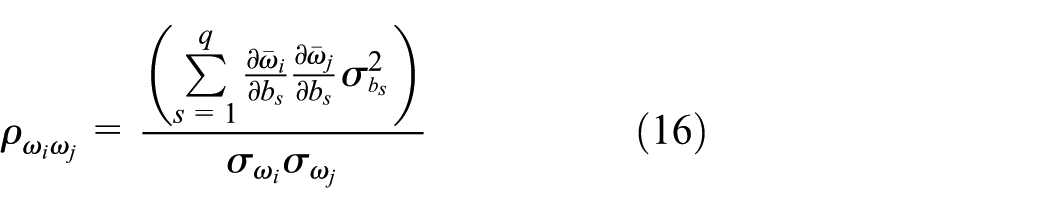
where
Reliability of a rotor system
For the rotor system, the reliability model can be simulated as a series system. The failure probability can be obtained as follows 28
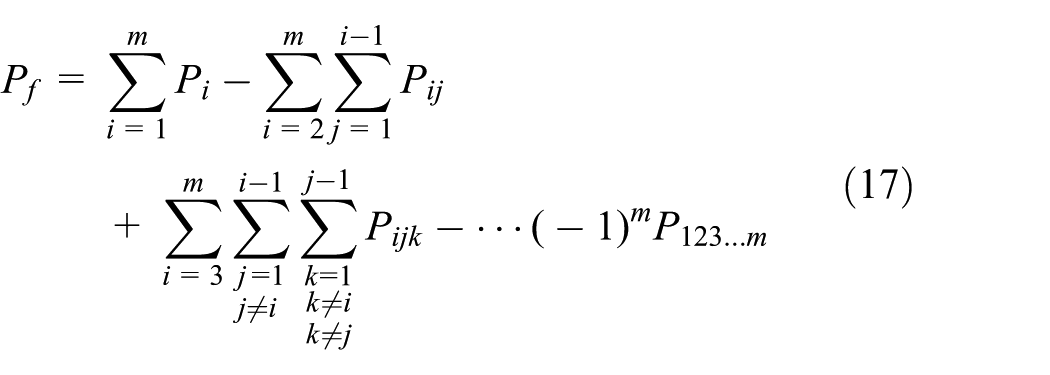
where Pi, Pij, Pijk, and P123…m are the one-, two-, three-,and m-order joint failure probabilities of the failure modes, respectively.
In most cases, equation (17) is written as

Thus, the reliability of a system is obtained to be

The two-order joint failure probability Pij can be obtained by the numerical integration method 29

where ΔSpq denotes the (p, q)th small domain in the main integration domain (as shown in Figure 1), (gip, gjq) stands for the centroid position of ΔSpq, and l represents the number of intervals in each coordinate axis


Main integration domain and the integration grid.
Reliability sensitivity analysis
Reliability sensitivity reflects the influence of random parameters on the systems’ reliability. The reliability sensitivity ranking results of random parameter can be obtained through the analysis. In most cases, it is interesting to study the reliability sensitivity with respect to the statistic characteristics of the random parameters, such as the mean and standard deviation.
The reliability sensitivities, with respect to the mean and standard deviation of the random parameters, are written as


The special computational procedure of equations (24) and (25) is summarized in Appendix 1.
Non-dimensional method of reliability sensitivity
Reliability sensitivity analysis reveals the statistical influence of random parameters on reliability. However, due to the different units of random parameters, it cannot clearly return the ranking results of the random parameters. The importance of sorting the statistical characteristics of the random variables can be obtained by the dimensionless regularization of the reliability sensitivity analysis.
In most cases, the standard deviation is used as a normalization factor to make the sensitivity measures dimensionless and more appropriate for variable ranking. 30 Non-dimensionalization can be achieved by


where
Numerical example
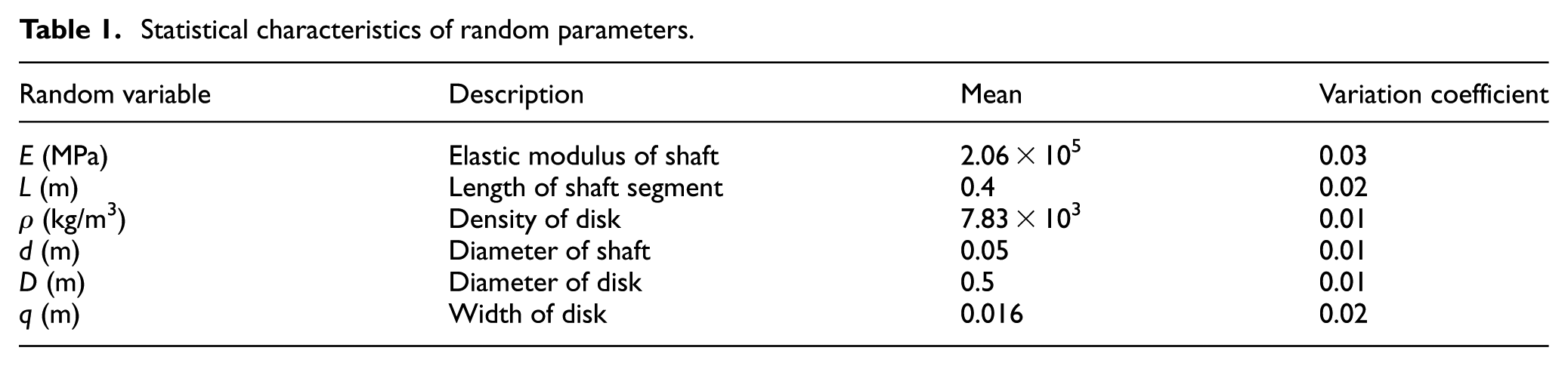
A rotor supported on two oil film bearings with two rigid disks, as shown in Figure 2, is used for the numerical simulation. In most cases, the material and size parameters of the rotor system are identified as random parameters, resulting in random parameter vector

Two-disk rotor model.
Statistical characteristics of random parameters.
According to the presented method, the statistical characteristics of the natural frequency can be obtained as follows


The reliability sensitivity curves with the excited frequency
It can be found from Figures 3–8 that reliability sensitivity trends, with respect to the mean of the random parameters, are different at different excitation frequency intervals. The reliability sensitivity trends with respect to the mean are shown in Table 2. The following rule can be obtained: when

Reliability sensitivity with respect to uD.
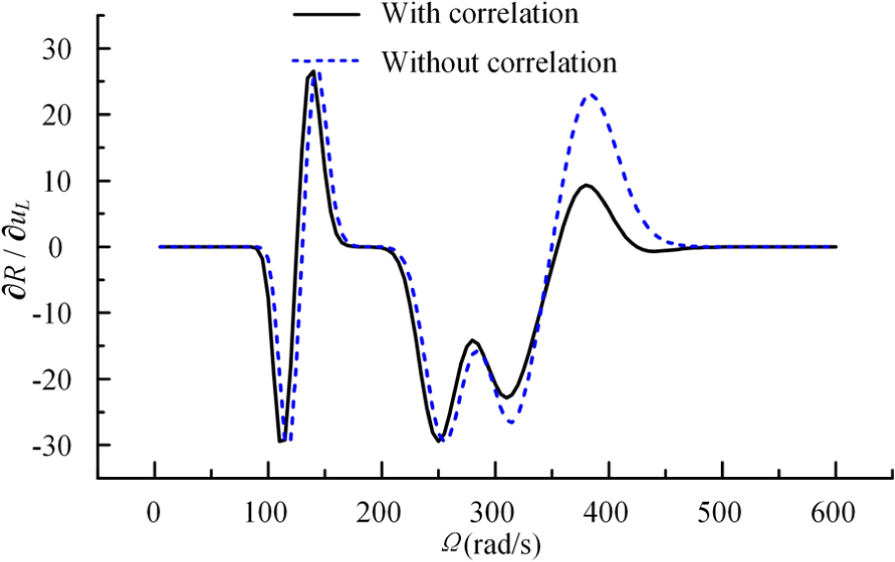
Reliability sensitivity with respect to uL.
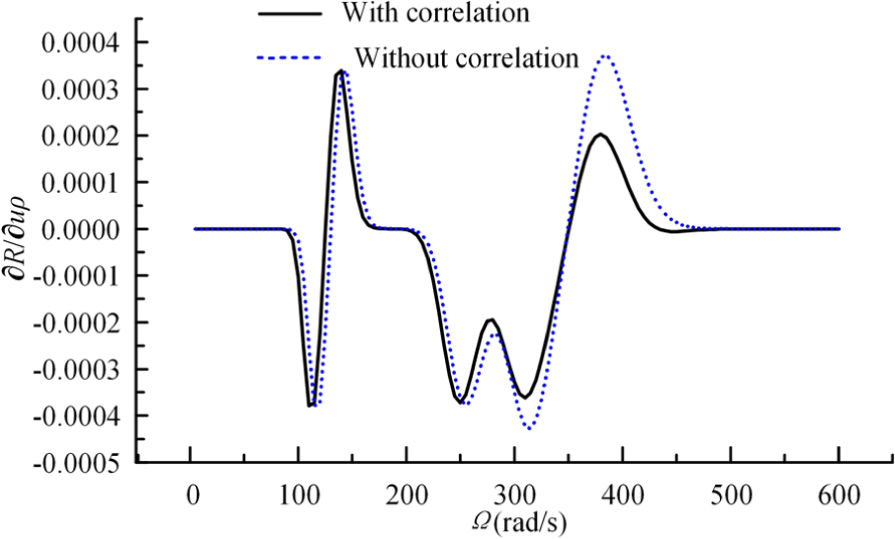
Reliability sensitivity with respect to uρ.

Reliability sensitivity with respect to uq.

Reliability sensitivity with respect to uE.
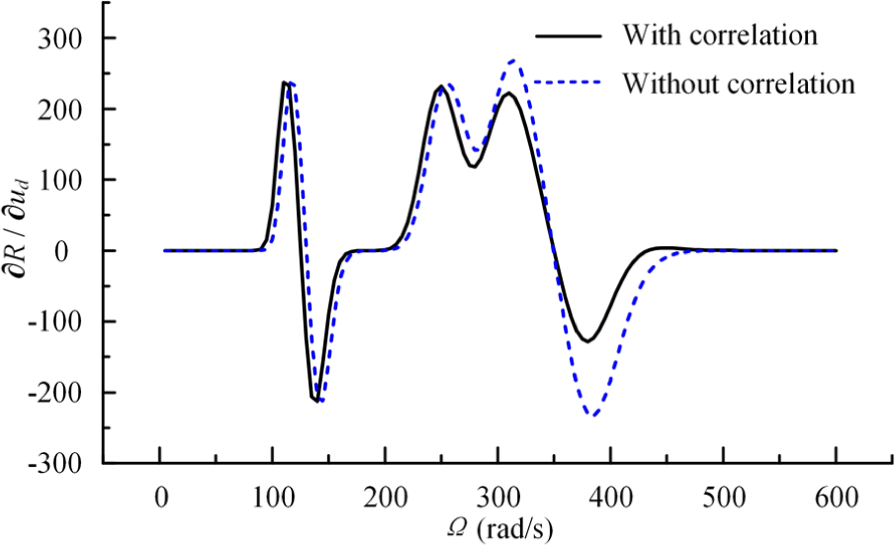
Reliability sensitivity with respect to ud.
Reliability sensitivity trends with respect to mean values.

Figures 9–14 show the sensitivity analysis in terms of the partial derivatives of the reliability with respect to the standard deviation of the random parameters. Table 3 gives the reliability sensitivity trends with respect to the standard deviation of the random parameters. The following relationships have been observed: when

Reliability sensitivity with respect to σρ.

Reliability sensitivity with respect to σd.

Reliability sensitivity with respect to σL.

Reliability sensitivity with respect to σD.

Reliability sensitivity with respect to σq.

Reliability sensitivity with respect to σE.
Reliability sensitivity trends with respect to standard deviations.

When
The dimensionless reliability sensitivity with respect to the mean and standard deviation of random parameters is shown in Figures 15 and 16, respectively. Generally, the higher absolute values of the dimensionless reliability sensitivity to the parameters show greater effect on system reliability. The information provided by the reliability sensitivity analysis with respect to the system parameters is also useful in identifying the parameters whose uncertainty plays a major role in affecting the reliability. The fundamental importance of reliability sensitivity with respect to the mean and standard deviation of the random parameters can be observed from Figures 16 and 17, albeit it may not be obvious. To determine accurately the sensitive parameters, the dimensionless reliability sensitivity with respect to the mean and standard deviation of the random parameters at some key value of excitation frequency will be examined. The absolute values of dimensionless reliability sensitivity with respect to the mean of the random parameters are shown in Table 4 at some key value of excitation frequency. The percentage of dimensionless reliability sensitivity with respect to the mean is shown in Figure 17 at some key value of excitation frequency. It is observed that the dimensionless reliability sensitivity with respect to the mean of the random parameters is ordered by L, E, d, q, D, and ρ. The dimensionless reliability sensitivity with respect to the mean is most sensitive to the length of shaft segment L but least sensitive to the diameter of disk D and the density of disk ρ.

Non-dimensional reliability sensitivity with respect to the mean of the random parameters.

Non-dimensional reliability sensitivity with respect to the standard deviation of the random parameters.

Percentage of dimensionless reliability sensitivity with respect to the mean.
Reliability sensitivity trends with respect to mean.

The absolute values of dimensionless reliability sensitivity with respect to the standard deviation of the random parameters are shown in Table 5, at some key value of excitation frequency. The percentage of dimensionless reliability sensitivity with respect to the standard deviation is shown in Figure 18, at some key value of excitation frequency. It is observed that the dimensionless reliability sensitivity with respect to the standard deviation of the random parameters is ordered as L, E, d, q, D, and ρ. The dimensionless reliability sensitivity with respect to the standard deviation is the most sensitive to the length of shaft segment L, but least sensitive to the diameter of disk D and density of disk ρ. This is consistent with the result of dimensionless reliability sensitivity with respect to the mean.
Reliability sensitivity trends with respect to standard deviation.


Percentage of dimensionless reliability sensitivity with respect to the standard deviation.
As is mentioned above, parameters L, E, d, and q can be used as sensitive parameters and D and ρ as non-sensitive parameters. Therefore, in the process of design and optimization of a rotor system, the statistical properties of sensitive parameters affect the reliability and thus must be considered. Non-sensitive parameters can be used as deterministic parameters. When considering the non-normal distribution of random variables, it is advisable to transform non-normal distribution into normal distribution with common methods first. Then the sensitivity analysis can be completed by the approach proposed in this article.
The reliability sensitivity method reflects the effect of design parameters on the product reliability is very necessary and important. The presented method can provide a theoretical basis for the reliability design and modification, reliability optimization, and maintenance of the rotor system. For the rotor system with two or more faults, usually there is a certain correlation between the various failure modes, and the proposed method provides a solution for the reliability sensitivity analysis of the coupling fault rotor system. Based on the proposed method, the reliability sensitivity analysis is convenient. The analysis results can provide a reasonable and necessary theoretical guarantee for the engineering design, manufacture, and evaluation of the rotor system.
Conclusion
Research on the reliability of multi-fault rotor systems is of great guiding significance for the design and structure optimization of a rotor. In this article, a reliability sensitivity estimation method for a rotor system with oil whip and resonance is presented. Techniques from reliability theory, random perturbation techniques, and numerical integration methods are all employed to resolve the reliability sensitivity estimation of a multi-fault rotor system considering the correlation of the multi-failure modes. The efficiency and accuracy of the proposed method are demonstrated by a numerical example. The presented method establishes a theoretical basis of reliability sensitivity evaluation for the multi-fault rotor system. Additionally, a further theoretical development of this method can be used to evaluate the reliability robustness optimization of multi-fault rotor system.
Footnotes
Appendix 1
Academic Editor: Jianqiao Ye
Declaration of conflicting interests
The author(s) declared no potential conflicts of interest with respect to the research, authorship, and/or publication of this article.
Funding
The author(s) disclosed receipt of the following financial support for the research, authorship, and/or publication of this article: This research was partially supported by the National Natural Science Foundation of China (grant nos 51005228 and U1433109) and Scientific Research Fund of Liaoning Provincial Education Department (grant no. L2014063).