




Abstract
In this article, we present an efficient method for solving nonlinear Fredholm integral equations of the second kind. The proposed method is based on the Galerkin method and transformations of shifted Chebyshev polynomials. This method is simple and computationally very attractive. Finally, illustrative examples and also the application of the proposed method to solve a functional differential equation are presented to show the validity and applicability of the technique.
Keywords
Introduction
Integral equations play a very vital role in science, such as numerous problems in mathematics and engineering (see, for example,1–5 and the references therein). For instance, one of the most important domains of applications of the ideas and methods of nonlinear functional analysis and also the theory of nonlinear operators of monotone type is integral equations of the Fredholm–Hammerstein. 6 Furthermore, this kind of integral equations appears in nonlinear physical phenomena such as electro-magnetic fluid dynamics, reformulation of boundary value problems (BVPs) with a nonlinear boundary condition. 7 This equation is as follows

where
Numerous numerical methods have been proposed for approximating the solution of above Fredholm–Hammerstein integral equations. For example, Tricomi
9
(section 4.6) introduced the classical method of successive approximations. Kumar and Sloan
10
have considered the solution of the Fredholm–Hammerstein integral equations and presented a collocation-type method to solve it. Brunner
11
used this method for the numerical solution of nonlinear Volterra integral and integro-differential equations. Guoqiang
12
obtained the asymptotic error expansion of this method and showed that the Richardson’s extrapolation can be performed on the solution and this will greatly increase the accuracy of numerical solution. Elnagar and Kazemi
13
investigated the Chebyshev spectral method to an equivalent equation of nonlinear Volterra–Hammerstein integral equations and discussed some convergence results. Hernandez et al.
14
applied a one-parametric family of secant-type iterations for equation (1) and established a semilocal convergence result for these iterations by means of a technique based on a new system of recurrence relations. Kaneko et al.
15
developed the Petrov–Galerkin method and the iterated Petrov–Galerkin method for equation (1) and established a framework for fast algorithms to obtaining approximate solutions based on Alpert’s Wavelets. Contea and Prete
16
proposed discrete collocation methods for Volterra integral equations of Hammerstein type, where the Laplace transform of the kernel rather than the convolution kernel itself is known a priori. For details of the application of the spectral methods for solving some differential equations,17–21 In recent years, numerous numerical methods have been proposed to find Hammerstein integral equations. These methods include Nyström type methods,22,23 projection methods,24,25 methods of special functions,25–29 wavelets,30–41 homotopy techniques, the Adomian decomposition method,42,43 Toeplitz matrix method,
44
polynomial interpolation procedures,45–47 and multigrid methods.
48
The main problem for solution of equation (1) is

These require a huge number of arithmetic operators, high computational costs, and a large storage capacity.13,15,34
Some methods also used operational vector. For example, in Mahmoudi,
33
equation (1) is investigated using Legendre wavelets basis. The method proposed there only works under the condition that the operational vector
The existing results presented above for solving the Hammerstein integral equations motivate the study of this type of functional integral equations. Therefore, the main contribution of this article is to correct these models, with regard to the computational costs. In this article, we present an efficient algorithmic method which is new and different from all the existing methods. Our method is based on Galerkin methods and transformations of orthogonal polynomials. This method is very simple to apply and offers several advantages in reducing computational costs.
This article is organized as follows. In sections “Properties of shifted Chebyshev polynomials” and “Galerkin method,” we, respectively, give an overview of shifted Chebyshev polynomials and Galerkin method with their relevant properties needed hereafter. In section “Main results,” the way of constructing the proposed method for solving Hammerstein integral equations is described. Numerical experiments and also the application of the proposed method to solve a BVP are presented in section “Illustrative examples.” Finally, conclusions are given in section “Conclusion.”
Solving the Hammerstein integral equations
Properties of shifted Chebyshev polynomials
Chebyshev polynomials are important in approximation theory and numerical analysis and in some quadrature rules based on these polynomials such as Gauss–Chebyshev rule that appears in the theory of numerical integration.49–51
Consider the well-known shifted Chebyshev polynomials of order

Moreover, these polynomials are orthogonal with respect to the weight function

where

Furthermore, for
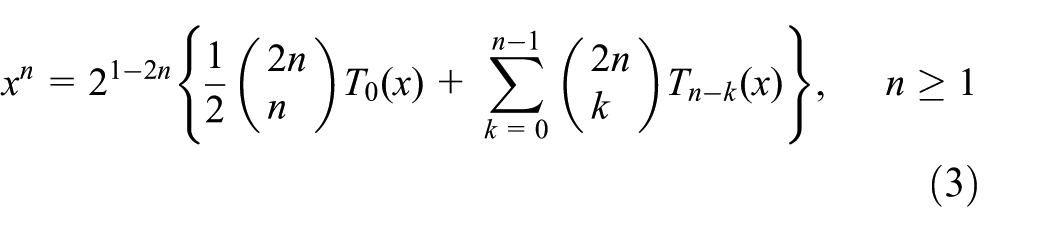
The first few powers in terms of shifted Chebyshev polynomials are (see the work by Mason and Handscomb (section 2.3) 50 and Synder 51 )

For some recent application of these polynomials, see Doha et al. 52 and Bhrawy and Alofi. 53
Galerkin method
The basic idea of the weighted residual method is to assume that the unknown function

And by assuming that the function
Substituting the approximate solution given by equation (4) into equation (1), the result is the residual function defined by

where

Since the residual function is identically equal to zero for the exact solution, the challenge is to choose the coefficients

where
Main results
Consider the approximate solution given by equation (4) which is

Then, by equation (1), we have

Now, by Taylor expansion of

where
Then, we have

Moreover, since

We obtain the following expansion for the above relation

Therefore, we can write

where

Now, by transformations of orthogonal polynomials based on formula (3), we will obtain an efficient method to solve equation (1). This method is as follows.
Algorithm 1
Step 1. Choose
Step 2. Use formula (3) and set
Step 3. Apply Galerkin method and solve the following nonlinear equations:

where,


Illustrative examples
In this section, we give some numerical experiments to illustrate the results obtained in previous sections.
Example 1
Consider the following nonlinear Fredholm–Hammerstein integral equation

with exact solution
To solve the above problem using our method, we do the following steps:
Let us consider

and using formula (3), we have

where

Similarly,

where

and using formula (3), we have

where

So, we have

Now, we multiply both sides of the above relation with
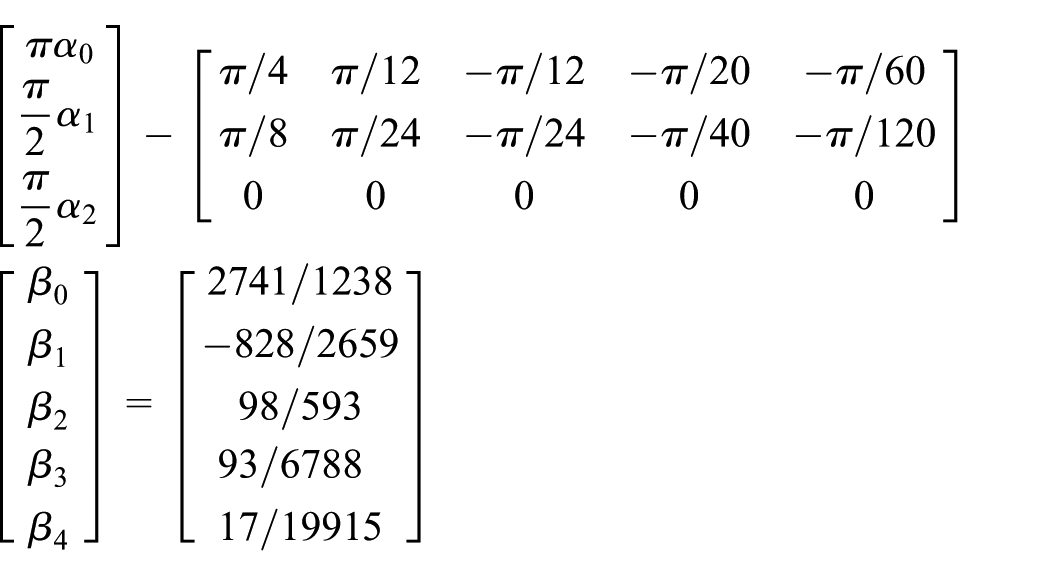
Therefore, we get

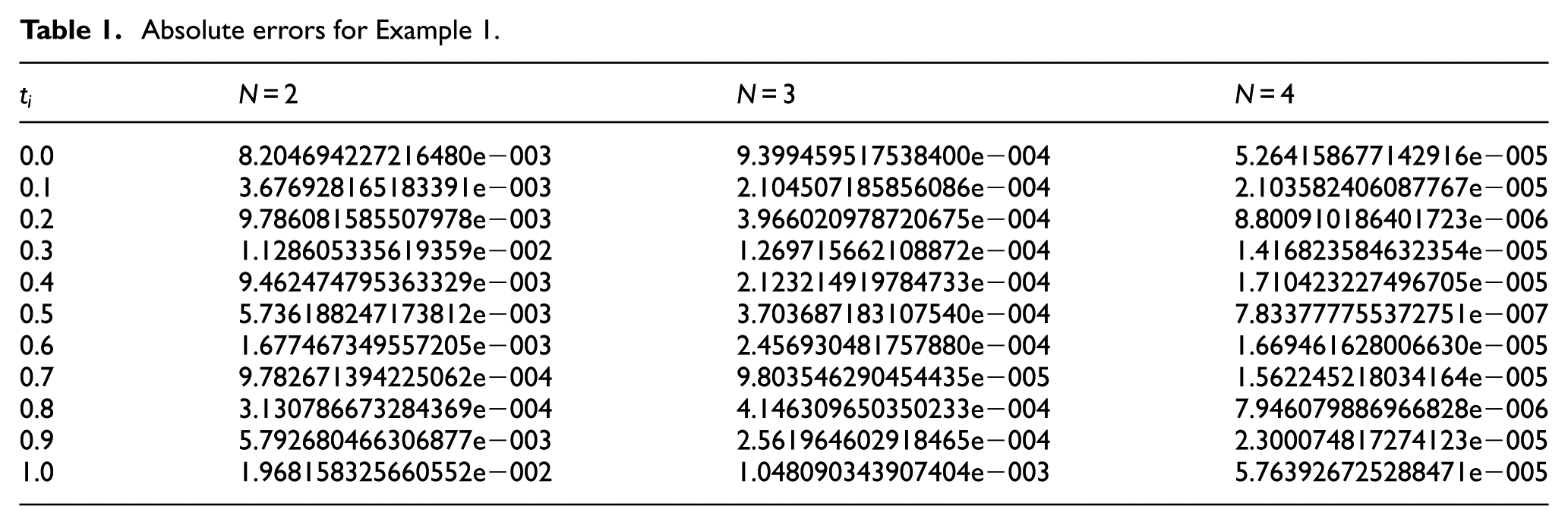
Table 1 and Figure 1 show the absolute values of error for N = 2, 3, and 4.
Absolute errors for Example 1.
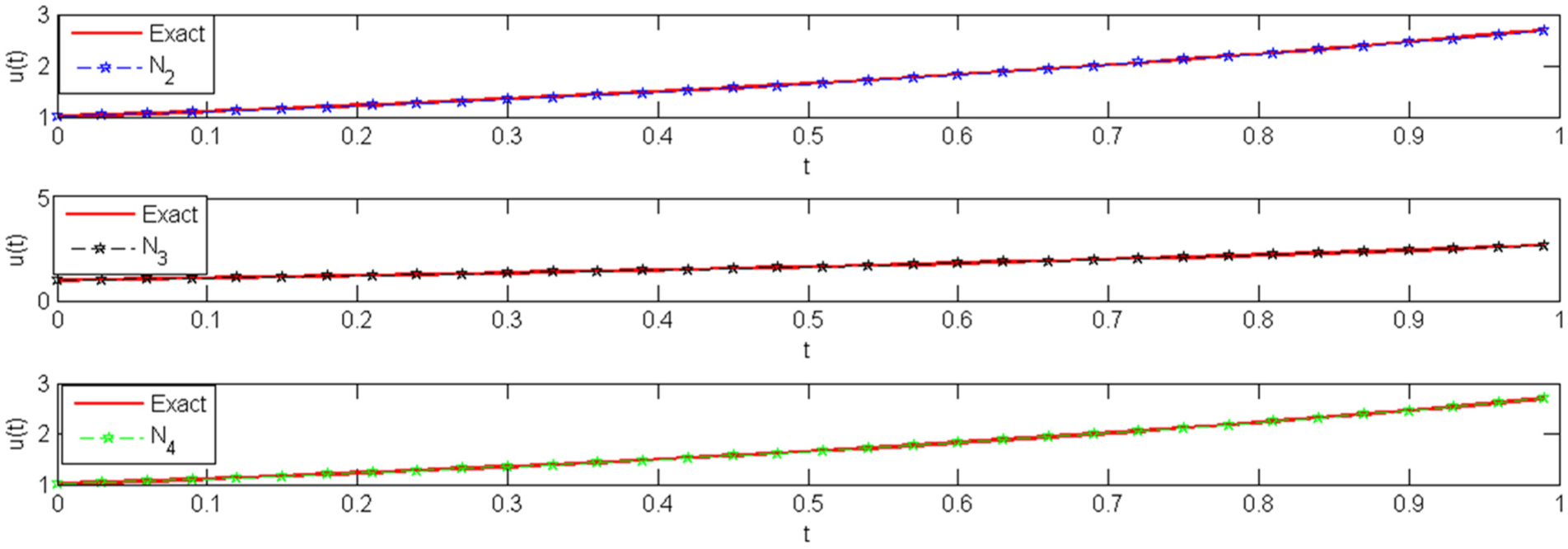
Comparison plot of exact and approximation solution of Example 1, for N = 2, 3, and 4.
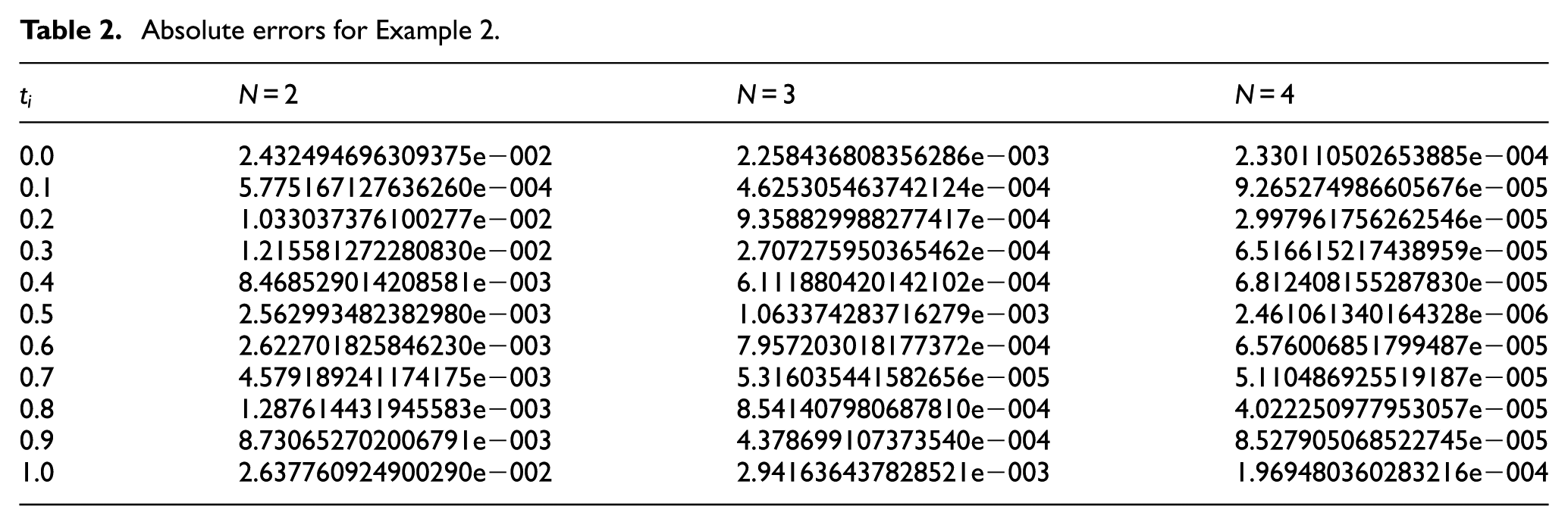
Example 2
As the second example, consider the following integral equation

with exact solution
Absolute errors for Example 2.

Comparison plot of exact and approximation solution of Example 2, for N = 2, 3, and 4.
Example 3 (application to the BVP functional differential equations)
One of the important problems in science and engineering is a BVP for functional differential equations which is investigated by numerous researchers.54,55 This problem can be converted, using Green’s function technique, into a Hammerstein integral equation.56–59 Here, we consider an example of this problem as an application of our methods.
Consider the two-point BVP

This BVP is equivalent with the following Hammerstein integral equation

where

is the Green function.
To solve this problem, we applied three methods.
Method I (using the shifted Chebyshev polynomials and Galerkin methods with approach of operational vector)
In this approach, first, we use the shifted Chebyshev polynomials as

where
Method II (using the shifted Chebyshev polynomials and Galerkin methods with the approach of the equivalent equation)
In this approach, first, by using the shifted Chebyshev polynomials, we obtain13,15,34

Then, we approximate

Method II (present method—Algorithm 1)
After testing these three methods on the mentioned example, we see that where the absolute errors in all three methods for Example 3 with different N, t is almost the same; however, the computational costs in these methods are different. In Table 3, we report the total CPU time for the corresponding methods.
CPU time for Example 3.

From the results, we can see that the present method works better than the other two existing approaches.
Conclusion
In this article, we have proposed a new algorithmic method for the solution of Hammerstein integral equation. This method is very simple to apply and to make an algorithm. Numerical examples are given to further compare the approximation solution of this method with the exact solution, which shows the feasibility and effectiveness of the method for solving Hammerstein integral equation.
Footnotes
Academic Editor: Yi Wang
Declaration of conflicting interests
The author(s) declared no potential conflicts of interest with respect to the research, authorship, and/or publication of this article.
Funding
The author(s) received no financial support for the research, authorship, and/or publication of this article.