




Abstract
In regions with abundant solar energy, building walls facing different directions absorb very different amounts of solar energy. These differences should be considered in thermal insulation design, unlike the current design standard in China, which does not take directionality into account when calculating the limit value of the heat transfer coefficient of building envelope. To address this short-coming, this article proposes a generalized non-balanced thermal insulation system for the building envelope: walls receiving greater amounts of solar energy should have less insulation, while walls receiving less amounts of solar energy should have more insulation. By analysis of outdoor synthetic temperatures for different orientations, non-balanced heat transfer coefficients are calculated under a constant heat flux condition. Considering the Lhasa region as a case study, the testing of an indoor thermal environment in winter was conducted, and a novel non-balanced thermal insulation system was built. The internal surface temperature of the external walls under two types of heat transfer coefficient limit values and the frequency responses of the two types of thermal insulation wall constructions are analyzed using the wall thermal theoretical method. The results show that this new thermal insulation design can make better use of solar energy, thus reducing conventional heating. This article provides a theoretical reference for the future design of non-balanced thermal insulation systems for building envelope and also provides a theoretical calculation method for the part of building envelope thermal design in the national standard of the People’s Republic China (Thermal Design Code for Civil Building-GB50176).
Keywords
Introduction
With continued national economic growth and increasingly higher requirements for indoor thermal comfort, building energy consumption in China will also continue to grow during the coming years. According to Xu, 1 in cold or severely cold regions, heat consumption from the external walls accounts for approximately 30% of the total heat consumption in building envelopes, and thermal insulation has an important influence on the indoor air temperature. Al-Khawaja 2 investigated the optimum thickness of insulation for buildings to reduce heat flow rate in Qatar, so the electricity cost was reduced. Sisman et al. 3 maximized present worth value of annual energy savings by determining optimum insulation thickness of different degree-day regions in Turkey. Daouas 4 calculated the optimum insulation thickness, energy saving, and payback period of a typical wall structure based on both cooling and heating loads, different wall orientations were considered. Kaynakli 5 presented a literature review on thermal insulation systems for buildings and their effect on energy consumption; the results could be a useful resource for researchers who studying the building envelope and other application. Accordingly, improving the thermal insulation system of building envelope is important for building energy efficiency.
China is rich in solar energy: the total annual solar radiation throughout the country is 3340–8400 MJ/m2. 6 Table 1 shows the specific radiation intensities of the solar energy received across different regions in China. Clearly, the distribution of solar energy across China is uneven. This article mainly studied solar energy–abundant regions. A region is considered to have abundant solar energy if it receives total annual solar radiation greater than 6000 MJ/m2 and if the annual sunshine time is above 2800 h. Within China, most of the Qinghai–Tibet Plateau, Yunnan–Guizhou Plateau, and Mongolian Plateau are solar energy–abundant areas. In terms of geography, most of the solar energy–abundant areas are of high altitude; in terms of climatology, most of solar energy–abundant areas are severe cold or cold zones where the daily temperature variations are large, while the yearly temperature variations are relatively small. In solar energy–abundant areas, the economy is less developed and the quality of the living environment is relatively poor. To solve the conflict between the scarcity of conventional fossil fuels and increasing demand for energy, solar energy must be fully exploited by scientifically improving the thermal insulation system of building envelope.
Specific radiation amount of solar energy resource zones in China.

According to the current design standard (Design Standard for Energy Efficiency of Residential Buildings in Severe Cold and Cold Zones) JGJ26-2010, 7 the limit value of the heat transfer coefficient of building envelope in different regions is based on the mean outdoor temperature during the heating period. The difference between the indoor and outdoor temperatures is the only factor needed to determine this limit value, so there is no directionality, that is, differing amounts of solar radiation based on the building wall orientation are not considered. This design method leads to varying wall heat fluxes for different orientations, which leads to varying internal surface temperatures of external walls, which actually intensifies the uneven radiation phenomenon. Additionally, using the same thermal insulation for all of the external walls is not conducive to effective solar energy utilization and results in waste. Yu et al. 8 analyzed the optimum insulation thickness of building walls by considering solar radiation effect on heat transfer of external walls in both cooling and heating seasons, and the results showed that the effect of walls’ orientation could not be ignored. Ozel 9 used the implicit finite difference method to determine optimum insulation thickness of buildings according to cooling requirements in Antalya which belonged to hot climate, which obtained the optimum insulation thickness for east, west, south, and north, respectively.
This article presents a generalized design principle for a thermal insulation system in building envelope by considering the climate characteristics of strong solar radiation. Testing of an indoor thermal environment and wall thermal theoretical method are used to determine heat transfer coefficients. This new type of thermal insulation system is significant for improving building energy efficiency.
Methodologies
Analysis of the solar radiation intensity
Solar radiation has a major heating effect on the building envelope. The solar radiation components include direct solar radiation, sky scattering radiation, ground reflection radiation, and atmospheric long-wave radiation. Unlike air conditioning in summer where the indoor and outdoor air temperature difference is typically small, in winter, it is significantly larger. Direct solar radiation directly affects the indoor thermal environment. We have thus calculated the direct solar radiation intensity on a winter day, 22 December, in Lhasa. The results are shown in Table 2. We can see that the direct solar radiation intensity varies hourly and that the total amount of the southern wall is much larger than that of the east and west. There is no direct solar radiation incident upon the north wall.
The direct solar radiation intensity on 22 December of vertical walls in Lhasa.

We then compared the total direct solar radiation intensity during heating period in Lhasa and Xi’an (a midwestern city in China) in Table 3. We can see that the total direct solar radiation intensity in Lhasa during the heating period is much larger than that in Xi’an city and the differences in different orientations are also large. A further consideration for Lhasa is the lack of conventional energy sources and fragile ecological environment; thus, there is an even greater motivation for making full use of the solar energy through thermal insulation design. The difference in solar radiation heat gains for different orientations should be taken into consideration during envelope design.
Comparison of the total direct solar radiation intensity during a heating period in Lhasa and Xi’an (MJ/m2).

The heating period is from 15 November to 15 March of the next year in Xi’an and Lhasa.
Outdoor synthetic temperature during a heating period
In solar energy–abundant areas, both solar radiation and effective long-wave radiation have great effects on heat transfer in the building envelope. When the indoor temperature is the same, the heat loss of external walls in different orientations is different. The current popular calculation model is to use the outdoor synthetic temperature to reflect this heat effect. The outdoor synthetic temperature is closely related to the orientation. It contains the heating effect of direct solar radiation, sky scattering radiation, ground reflection radiation, and the outdoor air temperature on the building envelope, as well as the heat dissipation effect of effective long-wave radiation from the building envelope’s external surface. In winter, neglecting radiation is equal to an enhancement of 3°C–5°C on the external surface of the building envelope, which is a risk factor for the heating calculation. 10 The outdoor synthetic temperature tsa can be described by equation (1)

where αa is the sum of convection and radiation heat transfer coefficients of the wall’s external surface (W/m2 K).
qe is described as
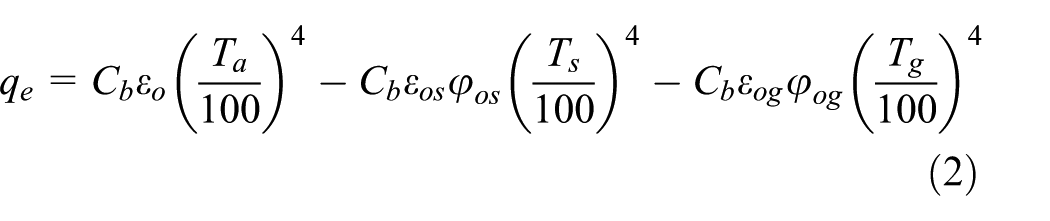
where Cb is the radiation constant of a blackbody, 5.67 W/m2 K4, and Ta is the outdoor air temperature (K); for sky radiation, surface is much larger than the external surface of the building envelope, such that εos = εo; for vertical walls, φos = φog = 0.5; Tg is the ground temperature (K) and Ts is the equivalent sky temperature (K).
As a consequence of regional, directional, and intermittent solar radiation variations, the outdoor synthetic temperature also experiences corresponding variations. This article considers the Lhasa region as an example and uses typical annual meteorological data 11 to calculate the hourly outdoor synthetic temperature of different orientations during the heating period. Table 4 shows the results. In the heating period, the mean outdoor air temperature is 1.14°C. The outdoor synthetic temperature of different orientations varies widely. Among them, the southern is the highest, the northern is the lowest, and the eastern and western fall in between and close to the outdoor air temperature.
Mean outdoor synthetic temperature during the heating period.

Considering 22 December as a typical day, hourly change rules in outdoor synthetic temperature of different orientations were explored. The results are shown in Figure 1.

Hourly change rules of the outdoor synthetic temperature on 22 December.
Figure 2 shows daily temperature differences in the outdoor synthetic temperature with respect to different orientations. We can see that solar radiation and effective radiation have a great effect on the change in outdoor synthetic temperature for different orientations. The outdoor synthetic temperature rises rapidly when there is solar radiation; when there is no solar radiation, effective long-wave radiation contributes to the reduction in the outdoor synthetic temperature. The southern calculation value is the highest, and the maximum value is more than 30°C. The northern calculation value is the lowest, and the maximum value is just 8.5°C. The outdoor synthetic temperature difference between day and night also varies with orientation. The southern outdoor synthetic temperature difference can reach more than 40°C, while the northern difference is less than 20°C. The daily temperature differences in the outdoor synthetic temperature are larger than that of outdoor air.
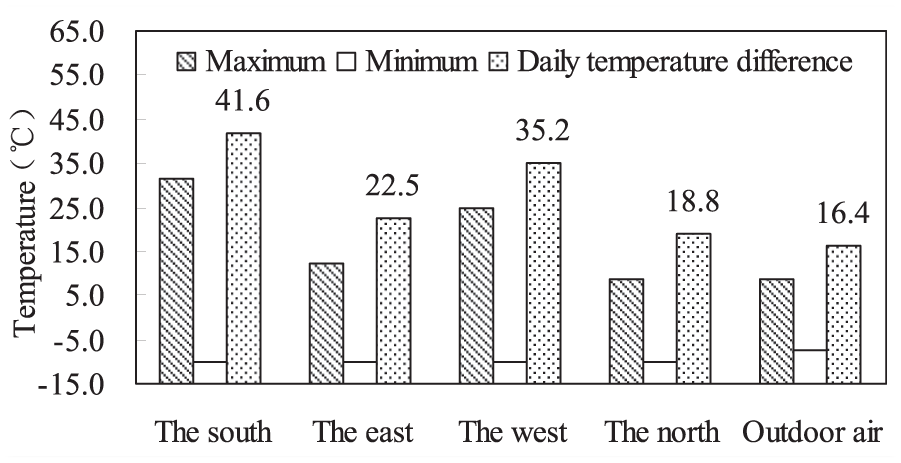
Daily temperature difference in the outdoor synthetic temperature for different orientations on 22 December.
Testing of the indoor thermal environment in winter
For further analysis of the heating effect of solar radiation on building envelope, testing of an indoor thermal environment was needed. The Golden Fan Hotel in Lhasa was selected as the test object—a four-story building that has southern and northern orientations and a frame structure. The external walls are aerated concrete walls and have the same thickness. The average heat transfer coefficient is 1.24 W/m2 K. The indoor heating equipment is an air conditioner, which was not used during testing.
According to the site conditions, two rooms on the third floor of the northern and southern orientations were selected for study. Test parameters included the indoor and outdoor air temperatures and the surface temperatures of the external and internal walls. The total test time was 24 h.
Figure 3 shows the test results of the indoor and outdoor air temperatures. We can see that the lowest outdoor air temperature is −5.6 °C, appearing at 8:00; the daily outdoor air temperature difference is 11 °C, and the average outdoor air temperature is −0.5 °C. In the southern room, the highest indoor temperature is 21.4 °C, appearing at 14:00; the lowest indoor temperature is 16.4 °C, appearing at 9:00; the daily temperature difference is 5 °C; the average indoor temperature is 18.6 °C. In the northern room, the highest indoor temperature is 8.9 °C, appearing at 18:00; the lowest indoor temperature is 7.9 °C, appearing at 8:00; the daily temperature difference is 1 °C, and the average indoor temperature is 8.3 °C. The average indoor temperature in the southern room is 10.3 °C higher than that in the northern room. Solar radiation has greater effects on the indoor thermal environment during winter.

The indoor and outdoor air temperatures in the southern and northern rooms.
From Figure 4, we know that the indoor average radiation temperature difference between the southern and northern rooms is huge. For the room without any heating equipment, the indoor radiation temperature in the southern room is closer to the human thermal comfort zone. During the test period, the temperature difference between inside and outside surfaces of the northern external wall was always positive, that is, there was always a net heat loss. However, from 12:00 to 20:00, the temperature difference between inside and outside surfaces of the south external wall is negative, that is, there was a net heat gain.

The temperature difference between the interior and exterior surfaces of the northern and southern external walls.
Design principle of a non-balanced thermal insulation system
In the current standard, for building thermal design and energy efficiency, the difference between the indoor and outdoor temperatures is the only factor to be taken into consideration for the design of the thermal insulation system; thus, the thermal insulation performance in different orientations is the same. This approach considers the worst-case outdoor conditions that could occur in winter to ensure that the indoor thermal environment meets the comfort requirements for all possible conditions. Furthermore, insulation system design is performed in consideration of the energy efficiency index. In North China and Northeast China, where solar radiation is relatively weak, these design conditions are reasonably consistent with the actual environmental conditions. However, in the solar energy–abundant regions, the probability of consecutive extreme chill weather is very small (<5%), and the solar radiation heating effect on the building envelope in different orientations is different. Testing of indoor thermal environment in winter shows that if walls of different orientations have the same thermal insulation performance, the absorption of solar energy will be reduced and will result in an uneven distribution of the indoor thermal environment (Figure 4).
Under current standards, when calculating the heat transfer of the building envelope, a modification coefficient for the building envelope is used to consider the heating effects of solar radiation and sky radiation, but this measure does not involve the change of wall construction; it only makes the calculation of heat transfer more accurate. For solar energy–abundant areas, thermal insulation design using a “constant heat transfer coefficient, un-constant heat flux density” does not make full use of solar radiation. 12
In terms of thermal resistance, to make the internal surface temperatures of the building envelope in different orientations the same, equation (3) can be used as it considers both the outdoor air temperature and solar radiation

where tisol is solar radiation equivalent temperature in different orientations ( °C).
We can see that different walls should use different heat transfer coefficients. The northern external wall thermal insulation should be increased significantly along with less increase in the insulation of eastern and western walls, while the southern external wall needs the least thermal insulation for the better use of solar energy. The differing insulation requirements depend on the indoor temperature, outdoor temperature, and solar radiation equivalent temperature. This new measure can meet energy-saving requirements, maintain the indoor thermal comfort, and improve the use of solar radiation.
External walls use different heat transfer coefficients called non-balanced heat transfer coefficients. The non-balanced heat transfer coefficient,

The heat flux density

where
From equations (4) and (5), we can obtain the ratio of heat transfer coefficients of different orientations in the non-balanced thermal insulation system. For a building in a particular region, non-balanced heat transfer coefficients can be determined according to the wall area, calculated ratio, and outdoor synthetic temperature.
The calculation of non-balanced heat transfer coefficients
The calculation of the non-balanced heat transfer coefficients of the building envelope is the foundation of generalized thermal insulation design. For an actual building, wall construction design relates not only to thermal performance of the buildings but also to the economy, safety and operability in the building construction, and application.
Therefore, when designing a non-balanced thermal insulation system, various factors should be taken into account. Two basic principles must be met: (1) the weighted average net heat loss of the external wall should be equal to the calculated value in the standard 13 when using a non-balanced heat transfer coefficient and (2) the external walls in any orientation should have the same heat flux density.
According to the investigation of the existing residential buildings in Lhasa, we found that southern wall finishes were easy to split and remove after use for a period of time. This is caused by the large daily variation in the southern outdoor synthetic temperature, that is, the thermal expansion and contraction stresses have destructive effects on the southern wall. 14 The destructive effects are more pronounced compared to a wall with no insulation when the southern wall uses an external thermal insulation system. The southern wall receives the greatest amount of solar radiation heat; thus, improving the thermal storage capacity of the heavy wall is an important design factor. In addition, in Lhasa, the window space in the southern wall of a residential building is larger, the solid wall area is smaller, and the number of structural nodes is larger. If we adopt the traditional thermal insulation system, construction difficulty and costs will increase.
Based on the above analysis, for the Lhasa region, to reduce the difficulty of construction and improve heat storage capacity of building envelope, a thick wall without insulation is suitable for the southern wall. The determination of the southern heat transfer coefficient is based on the assumption that the wall has a reasonable attenuation multiple and delay time relative to the outdoor synthetic temperature wave. 15 Wall material selection is also important when determining the heat transfer coefficient.
The attenuation multiple refers to the ratio of the outdoor temperature harmonic amplitude to the plane wall internal surface temperature harmonic amplitude, which reflects the thermal inertial resistance to extraneous changes in the wall. It can be described by the following equation

where ∑D is the total thermal inertia index and is equal to the sum of each material layer’s thermal inertia index; Y1,e, Y2,e, … are the heat storage coefficients of each material layer’s external surface (W/m2 K).
The heat storage coefficient of each material layer’s external surface can be described by equation (7)

where Sn is the heat storage coefficient of each material layer (W/m2 K) and Rn is the thermal resistance of each material layer (m2 K/W).
Delay time is the difference of two occurrence times: the occurrence time of high or low values in outdoor temperature, and the other is the occurrence time of high or low values in the plane wall internal surface temperature. Using first-order harmonics with a fundamental frequency of π/12 and a period of 24 h, the delay time through the wall can be described by equation (8)

The calculation results of the attenuation multiples and delay times of walls with different parameters are shown in Table 5. From Table 5, we can see that for a 370-mm-thick wall with a conventional configuration in Lhasa, all of the delay times exceed 12 h; for a 300-mm-thick wall with a conventional configuration composed of aerated concrete, the delay time is more than 12 h. When the delay time is approximately 12 h, the attenuation multiples are all above 30. The delay time and attenuation multiple are relevant to a wall’s thermal inertia index.
Attenuation multiples and delay times of walls in the Lhasa region.
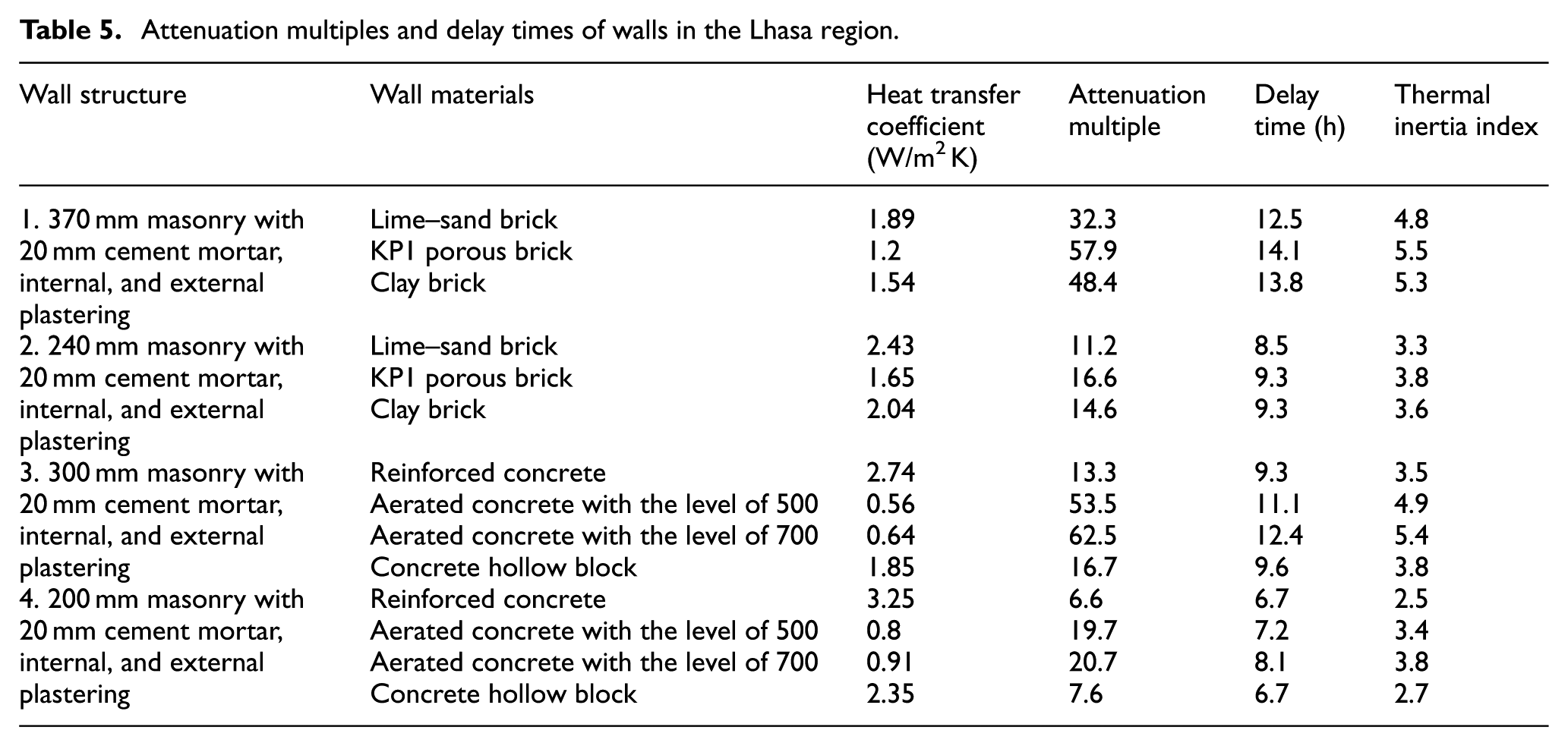
From these results, we can conclude that in a non-balanced energy-saving insulation construction, a conventionally configured wall with a heat transfer coefficient ≤2.0 W/m2 K can be used for the southern wall. When the wall’s thermal inertia index is larger than 4.5, it meets the requirements of delay time and attenuation multiple.
To know the typical building wall’s area, an investigation of residential building modality in Lhasa was conducted. Based on the rules of the area, ratio of a window to a wall in the Tibet Autonomous Region, the external wall ratio was determined to be 4.6:1:1:6.1. When defining F as the foundation area, the southern, eastern, western, and northern wall areas are, respectively, 4.6F, F, F, and 6.1F (m2). The net heat loss of the external wall per unit area is

where Keff and K are effective heat transfer coefficient and heat transfer coefficient of external wall, respectively (W/m2 K).
The weighted average net heat loss of external wall is described by equations (10) and (11)


where
The weighted average net heat loss of the external wall using balanced heat transfer coefficient is described as follows


Results and discussion
By setting the design indoor temperature to 18 °C, calculating the weighted average net heat loss per unit area,
The results of non-balanced heat transfer coefficient calculations.

As seen in Table 6, the value of the southern non-balanced heat transfer coefficient is the maximum, while the north wall’s is the minimum. The eastern and western walls fall in between. The limit values of the non-balanced heat transfer coefficient are southern wall ≤2.0 W/m2 K (thermal inertia index ≥4.5), eastern and western walls ≤0.71 W/m2 K, and northern wall ≤0.59 W/m2 K. The results clearly show the directionality dependence on heat transfer coefficient. Walls receiving greater amounts of solar energy should have less insulation, while walls receiving less amounts of solar energy should have more insulation. Within China, most of the Qinghai–Tibet Plateau, Yunnan–Guizhou Plateau, and Mongolian Plateau are solar energy–abundant areas. The result shows that the non-balanced thermal insulation theory is suitable for areas with a southward ratio of vertical solar radiation and indoor outdoor temperature difference greater than or equal to 4 W/m2 K, and the vertical solar radiation intensity is greater than or equal to 60 W/m2 in January. This idea has been applied to the part of building envelope thermal design in the national standard of the People’s Republic China (Thermal Design Code for Civil Building-GB50176).
The net heat loss of external walls
Based on typical building wall area parameters, we use the balanced heat transfer coefficient limit value and non-balanced heat transfer coefficient limit value to calculate the heat losses of the external walls for residential buildings and compare the results in Table 7.
The net heat loss of external walls when using balanced and non-balanced heat transfer coefficients.

We can see that, under two different heat transfer coefficients, the difference in the net heat losses of external walls of southern and northern orientations is large, but the total net heat loss difference is small. Therefore, in non-balanced insulation construction, the total net heat loss of external wall is within the required value of the standard.
The average internal surface temperature of external walls
The internal surface temperature of the external walls is one of the most important parameters affecting indoor thermal comfort. This temperature is affected by the wall heat transfer coefficient, thermal inertia, and outdoor synthetic temperature. Based on the existing wall construction in Lhasa, the new designed wall by non-balanced heat transfer coefficient will yield internal surface temperatures of the external walls different from the original due to the wall heat transfer coefficient and thermal inertia index changes.
The steady-state method is used to calculate the temperature of external wall’s internal surface under the two conditions. The equation is

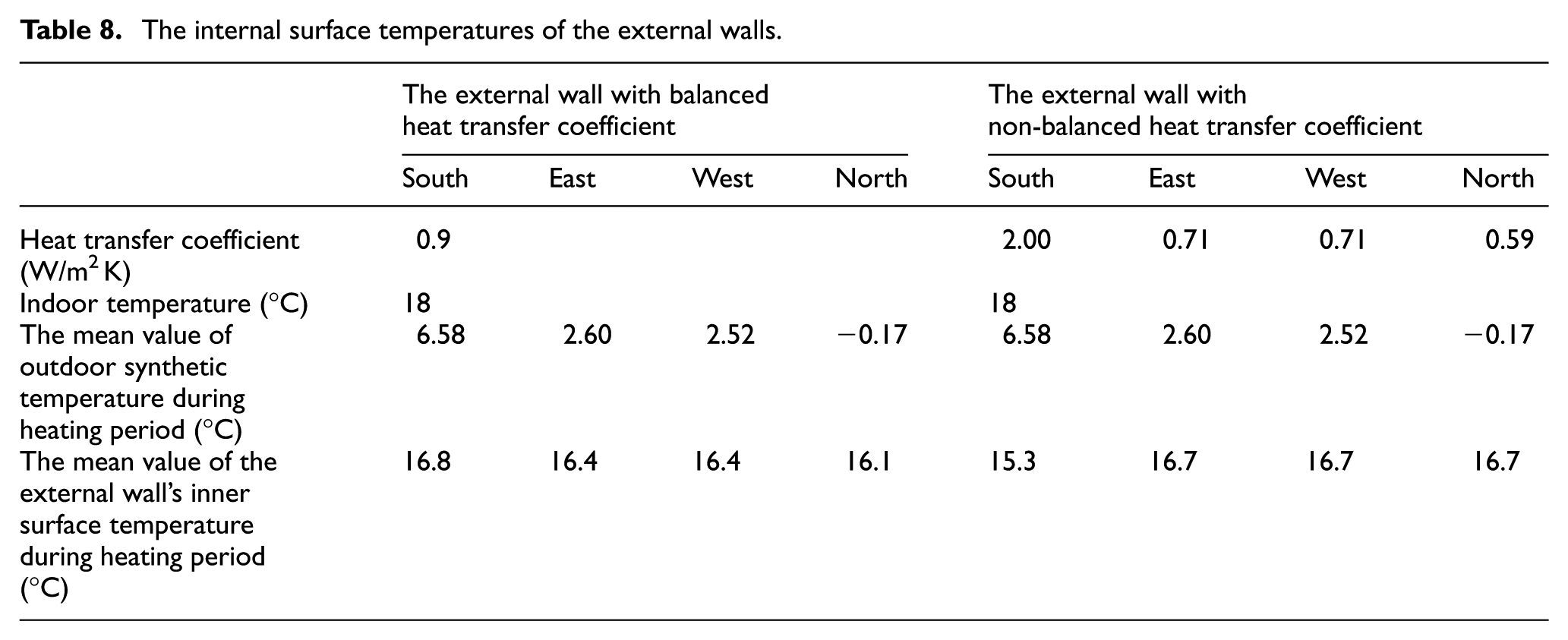
The internal surface temperature of the external walls is shown in Table 8. When using the balanced heat transfer coefficient, the southern external wall’s internal surface temperature is higher than that of northern wall, which would exacerbate indoor thermal environmental degradation in the northern room. When using the non-balanced heat transfer coefficient, by equation (10), the internal surface temperatures of the eastern, western, and northern walls are equal, while that of the southern wall is lower. Due to the delay time of southern wall, approximately 12 h, the minimum temperature value of the southern wall occurred when the outdoor synthetic temperature was highest; thus, the lower temperature would not affect the indoor thermal comfort.
The internal surface temperatures of the external walls.
Thermostability analysis of a non-balanced thermal insulation wall
When indoor temperature is fixed, the wall’s frequency response to the change in outer interference is the key to influencing heat transfer in the building envelope. Regarding the ambient as an input, the total transfer matrix of the multilayer battenwall is

where
The heat transfer frequency response of a battenwall building envelope refers to the battenwall’s interior surface attenuation, and time delay refers to the different frequency of the outdoor sinusoidal temperature wave amplitude when the indoor temperature was kept at zero. If the outdoor temperature wave is a sinusoidal temperature wave with a frequency of ωn, amplitude of Aon, and initial phase of φn, then the following imaginary part of the exponential function is incorporated

Thus, the delay time and attenuation multiple of battenwall’s interior surface to outdoor temperature perturbation quantity is


We can see from transfer matrix of the wall that the thermal characteristics of the wall depend on both materials and construction. For an actual building envelope, the thermal inertia index is used to evaluate the thermal performance. The thermal inertia index can be described by equation (19)

where R is thermal resistance of materials (m2 K/W) and S is heat storage coefficient of materials (W/m2 K).
For a multilayer wall composed of different materials, the thermal inertia index is

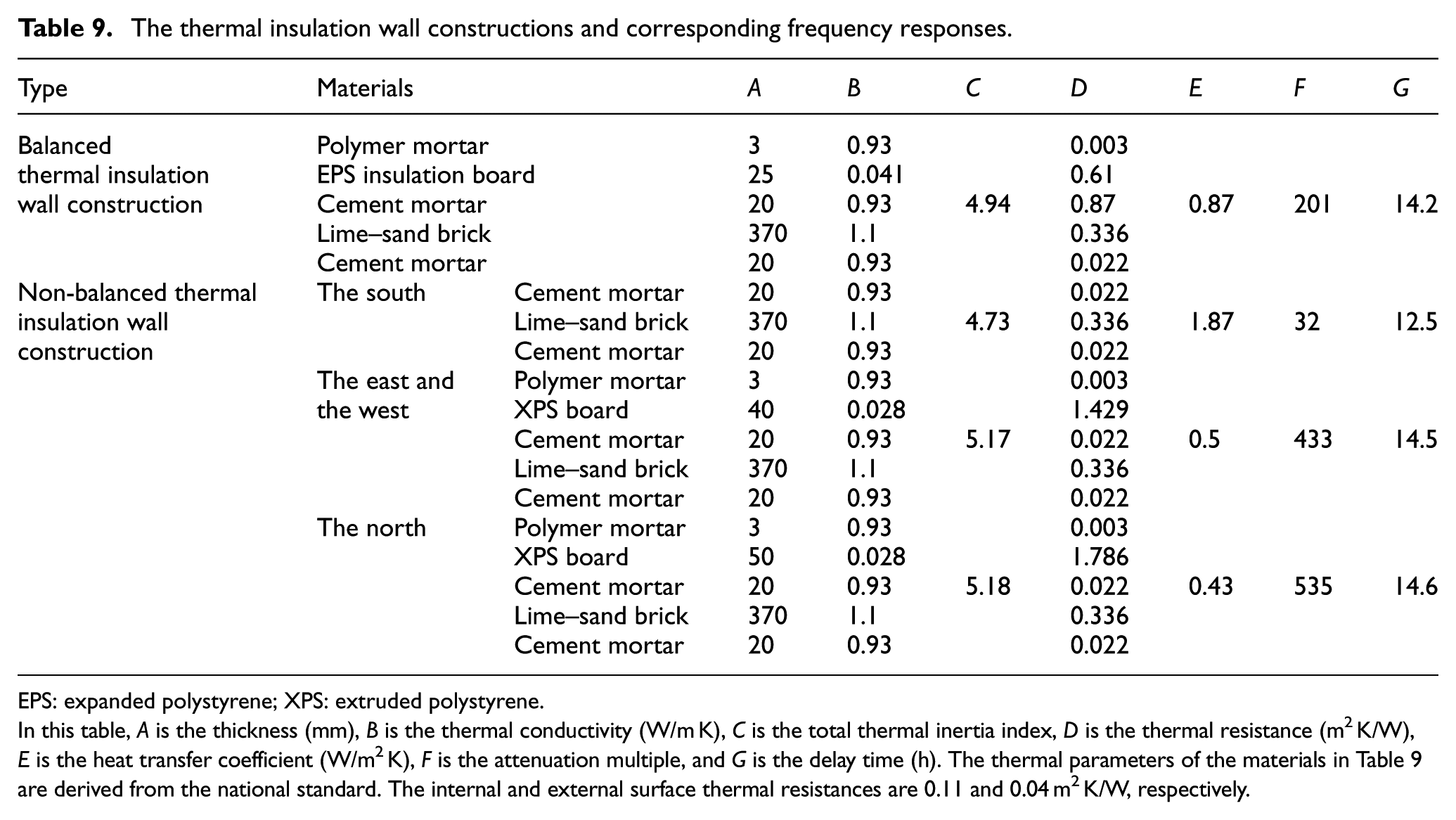
In the Lhasa region, sand–lime brick masonry is the most commonly used material system in local residential buildings. In this study, we formed a composite extruded polystyrene board (hereinafter referred to as XPS board) with a 370-mm-thick sand–lime brick wall. We used balanced heat transfer coefficient and non-balanced heat transfer coefficient limit values to design two thermal insulation wall constructions, as shown in Table 9.
The thermal insulation wall constructions and corresponding frequency responses.
EPS: expanded polystyrene; XPS: extruded polystyrene.
In this table, A is the thickness (mm), B is the thermal conductivity (W/m K), C is the total thermal inertia index, D is the thermal resistance (m2 K/W), E is the heat transfer coefficient (W/m2 K), F is the attenuation multiple, and G is the delay time (h). The thermal parameters of the materials in Table 9 are derived from the national standard. The internal and external surface thermal resistances are 0.11 and 0.04 m2 K/W, respectively.
The frequency response (delay time and attenuation multiple) of the two types of walls to the temperature wave with first-order harmonic and π/12 fundamental frequency is calculated by equations (15)–(18). The results are shown in Table 9. We can see that for the two types of walls, the delay time is more than 12 h and that the attenuation multiple is large. The attenuation multiple of the south wall in non-balanced thermal insulation construction is the minimum, that is 32, while the others are all above 200. We chose the southern wall that has the minimum attenuation multiple as an example. The southern outdoor synthetic temperature difference on 22 December was above 40 °C. The amplitude transferred to the inner surface was less than 1 °C after the attenuation effect of wall. The occurrence time of the lowest temperature delay was 12.5 h later than the outdoor synthetic temperature, and this point is the time that outdoor synthetic temperature was the highest. Therefore, for this case, the indoor thermal comfort was not affected. The attenuation multiples of the other walls in the non-balanced insulation construction were all above 400, and the inner surface temperature was close to a constant state.
Conclusion
Under the current design standard in China, walls in different orientations have the same thermal insulation performance, which causes different heat fluxes across the walls and is not conducive to optimizing the use of available solar energy. In this article, a generalized non-balanced thermal insulation system for building envelope was developed to solve this problem:
By analyzing the solar radiation intensity in solar energy–abundant areas and testing the results of an indoor thermal environment during winter in the Lhasa region, a non-balanced thermal insulation system in building envelope was necessary. And the value of the southern non-balanced heat transfer coefficient is the maximum, while the north wall’s is the minimum. The eastern and western walls fall in between. The limit values of the non-balanced heat transfer coefficient are southern wall ≤2.0 W/m2 K (thermal inertia index ≥4.5), eastern and western walls ≤0.71 W/m2 K, and northern wall ≤0.59 W/m2 K. The results show that walls receiving greater amounts of solar energy should have less insulation, while walls receiving less amounts of solar energy should have more insulation.
Using the Lhasa region as a calculation example, the outdoor synthetic temperature of different orientations varies widely in solar energy–abundant areas. The non-balanced heat transfer coefficient was calculated under a constant heat flux condition, and non-balanced thermal insulation system was designed for use in Lhasa, in which the northern external wall thermal insulation should be increased significantly along with lesser increase in the insulation for eastern and western walls, while the southern external wall needs no thermal insulation at all. The internal surface temperature of the northern wall in the non-balanced thermal insulation system is 0.6 °C higher than that in balanced thermal insulation design, which is conducive to indoor thermal comfort. Furthermore, to improve indoor thermal comfort, the wall’s frequency response to the change in outer interference should be enhanced.
Constant heat flux and wall thermal theoretical methods were used to design this generalized thermal insulation system in a building, which provides a theoretical reference for the part of building envelope thermal design in the national standard of the People’s Republic China (Thermal Design Code for Civil Building-GB50176).
Footnotes
Appendix 1
Academic Editor: Shuli Liu
Declaration of conflicting interests
The author(s) declared no potential conflicts of interest with respect to the research, authorship, and/or publication of this article.
Funding
The author(s) disclosed receipt of the following financial support for the research, authorship, and/or publication of this article: This study was supported by the National Natural Science Foundation of China (Major Program, No. 51590912) and the National Natural Science Foundation of China (General Program, No. 51578013).