




Abstract
The known studies in the area of gas turbine lifetime prediction do not result in the algorithms for on-line engine monitoring. This article introduces and investigates a new method for developing “light” mathematical models to estimate static thermal boundary conditions for gas turbine hot elements. In contrast to the previous developments, these models allow on-line lifetime monitoring of such elements. The blade of the high-pressure turbine of a two-spool free turbine power plant was chosen as a test case. The models of blade boundary conditions were developed based on well-known thermodynamic relations and a steady-state nonlinear physics-based model of this engine. Many candidate models are analyzed in the article, and the best models are selected by their accuracy and robustness to engine faults using instrumental and truncation errors as criteria. The instrumentation errors are induced by measurement inaccuracy of gas path variables used. For the analysis of the model robustness, the truncation errors are computed. They appear when performance of an engine deviates from a baseline due to normal degradation of the engine and because of its faults. The gas path parameters under healthy and faulty engine health conditions are simulated by the thermodynamic model. These simulated quantities are used as the input data to perform the comparison of the candidate models. The final accuracy analysis shows that the proposed method improves the estimates of the thermal boundary conditions. As a result, prediction of an engine lifetime becomes significantly more accurate. The article also determines the positive effect of the compressor discharge temperature sensor. When it is installed in addition to a standard gas path measurement system, the accuracy of the measurement-based lifetime prediction grows drastically.
Keywords
Introduction
Lifetime monitoring is an effective way to realize condition-based maintenance of gas turbine engines.1–3 The usage of gas path parameters for the on-line thermal analysis of critical engine elements is an integral part of such monitoring. This allows a better use of the available lifetime and improves the reliability of the engine through continuous monitoring of damage accumulation.
Many approaches exist to predict the lifetime. The disadvantage of some of the approaches4–6 is that they are not applicable to on-line lifetime monitoring because the engine must be removed for its inspection. The other approaches use energy-based models,7,8 statistical methods, 9 neural networks,10–13 or finite element analysis (FEA).14–16 Their main disadvantage is the need of large amount of computer resources, making these approaches not suitable for on-line use.
In contrast to the studies cited above, the thesis by Oleynik 17 (thesis abstract is given in Appendix 2) proposes a “light” methodology to form algorithms for on-line (on-board) monitoring of the engine useful lifetime. This methodology is based on simple models to calculate the temperature and stress at critical points of the engine components. The other advantage is that the methodology employs only standard measurements.
Following the above methodology, the present paper determines the boundary conditions to estimate the temperature and stress in the critical points. As shown in Figure 1, the approach employed in the article is presented by two main blocks; both use recorded data of gas path parameters and ambient conditions. The first block performs the thermal condition (TC) monitoring and the second block is responsible for the stress condition (SC) monitoring. Both types of monitoring need thermal boundary conditions (gas temperatures around a critical element and heat transfer coefficients between the gas and the metal) that are not measured and should be determined. The contribution by Oleynik 17 is related to lifetime prediction when thermal boundary conditions are known. To estimate useful lifetime, he proposed and proved the methodology to compute the temperature and stress in a critical point as a dynamic function of time and the changes in thermal boundary conditions. The methodology has been proven through a practical application for the monitoring of some Ukrainian engines.
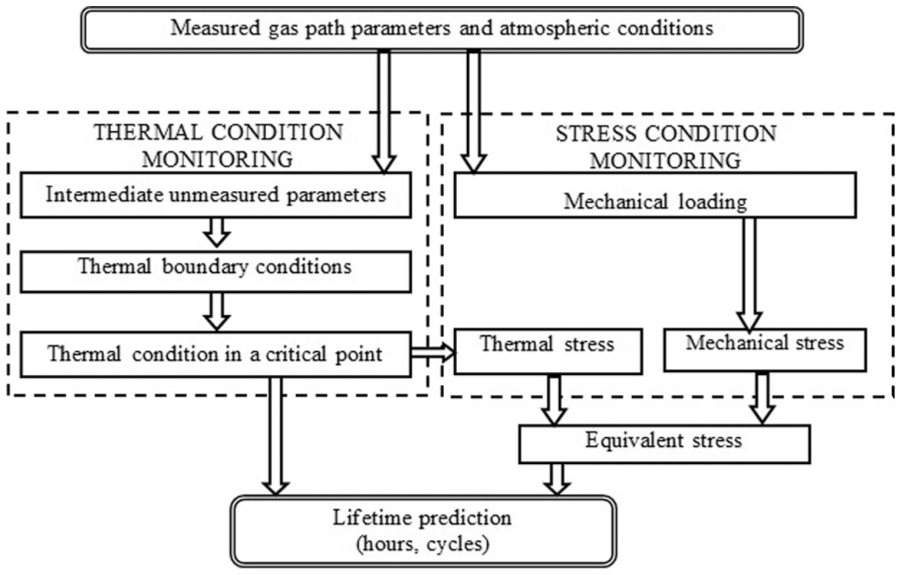
Scheme of the approach used for engine lifetime prediction.
Following the above approach, this article focuses on estimating static thermal boundary conditions, which are necessary to calculate the engine lifetime. Since these conditions are not measured, they are presented by models that employ measured engine parameters as the input data. The article proposes a new method for developing such models using thermodynamic relations between gas path variables. In these relations, some necessary intermediate unmeasured parameters are determined by polynomial functions of the measured quantities. The article emphasizes on the accuracy of the developed models regardless of engine-to-engine differences and an actual healthy or faulty engine condition. The model accuracy is verified on the engine steady-state data simulated by a nonlinear physics-based gas turbine model, also known as thermodynamic model. To take into account different engine health conditions, the data are simulated for both nominal and shifted performance maps of different engine components (compressor, combustion chamber, turbines, etc.). Such simulation of the component degradation is widely used in gas turbine monitoring and diagnostics.18,19 To confirm a high accuracy of the proposed physics-based method, it is compared with the reference method previously developed in Maravilla et al. 20 on the basis of the similarity theory. To finally validate the applicability of the method, the influence of the inaccuracy of the thermal boundary conditions on the errors of engine lifetime prediction is evaluated. To realize and prove the approach briefly described above, a turbine blade is chosen as a test case.
Test case
A turbine blade with three cooling channels (see Figure 2) has been chosen as the critical engine element for which the thermal boundary condition models will be developed. This blade is mounted in the first stage of the high-pressure turbine (HPT) of a two-spool free turbine engine. The eight gas path parameters measured in this engine are as follows:
Gf: fuel consumption;
nLP: low-pressure turbine rotation speed.

Critical points in the turbine blade mid-span section.
Based on the experience accumulated in the Zhukovsky National Aerospace University “KhAI” in the analysis of destruction of gas turbine hot elements, the blade mid-span section has been chosen as a critical place. The two-dimensional (2D) analysis of this section was then conducted using the specialized FEA package developed in the university. A mesh has been first generated on the section, and all nodes (points) of the mesh were numbered. A finite model of the blade was then built, the boundary conditions were set, and the distribution of the blade temperature and stress was finally obtained. After the simulation, the points with the minimal safety factor have been chosen. These critical points are the points with numbers 101, 102, 103, and 69. As shown in Figure 2, the first three points are located at the leading edge and the last point is situated at the trailing edge. To make it easier to analyze these critical points, they are divided into two groups: the first group named ga consists of points 101–103 while the second group gb includes critical point 69. The boundary condition models will be created for both groups.
A thermodynamic model is available for the engine under analysis. Such nonlinear physics-based models are widely used in the area of gas turbine diagnostics and are described in detail, for example, in Yepifanov et al. 21 In this study, the thermodynamic model is not used directly in the boundary condition models developed; it is only a source of data for determining and validating these models.
The rest of the article presents formulation and results related to the test case engine and its test case hot element, turbine first-stage blade. This material is structured as follows. Section “Turbine blade thermal SC” briefly describes the algorithms to compute thermal SCs (temperature and stress in the critical points). This section focuses on the input variables to these algorithms, namely, thermal boundary conditions. Section “Model development methodology” presents a detailed description of the methodology to develop the boundary condition models. Development and verification of these models are given in section “Development and verification of boundary condition models” while section “Models’ accuracy analysis” analyzes their accuracy. Section “Discussion” generalizes the accuracy analysis and shows perspectives of further accuracy enhancement.
Turbine blade thermal SC
In our previous article, 20 the models first proposed in Oleynik 17 for calculating the blade temperature and thermal stress were applied to the same test case blade critical points that were described in the previous section. It was concluded after the comparison that the best model of the blade temperature at the critical points is

where
It was also found that the best model to estimate the thermal stress is given by

where
The dimensionless parameters
The four parameters
Model development methodology
Determination of the boundary condition models
Given that the models of the boundary conditions are intended for on-line monitoring, they must meet the following main requirements:
All the models must use the gas path measuring parameters as the input data.
The models should have a simple structure, making it possible to use them in real time.
The measurement errors of the gas path parameters, which are the input data of the models, must be taken into account.
The models should have a high robustness to changes in engine health conditions.
To meet these requirements, it is proposed to develop models based on the use of basic physical relations, such as mass and energy conservation equations, thermodynamic relations, and kinematic relations, which describe the motion of the working fluid.
Let us introduce the following designations:
Taking into account the requirements previously considered, the general dependence for a boundary condition z can be given by a general function

However, expression (3) cannot be computed in practice as long as the parameters of vector

To better illustrate the above-described algorithm of the development of the boundary condition models, Figure 3 presents the block diagram of this development. Using the mentioned algorithm, the models for the four necessary boundary conditions

Algorithm for developing the boundary condition models.
Model verification
As stated in the model requirements, gas path measured parameters are the input data for the boundary condition models. To choose which measured parameter should be used as an argument in each internal model, a total mean square error (MSE) is computed to be used as a criterion. The total MSE

Truncation error
The mean square truncation error for one health condition is calculated as

and the average error percentage for all conditions is given by

where value zj m is calculated by the boundary condition model, zi j is a true value generated by the thermodynamic model, Nj stands for the sample size (number of the engine operating points) for the engine health condition number j, and n denotes the number of engine health conditions.
Instrumental error
The MSE of the instrumental error is calculated for one health condition according to an expression

and on average is given by

where N is the number of the engine operation modes for a healthy engine.
Robustness analysis
All true data corresponding to a healthy engine and 10 deteriorated (faulty) engine conditions were simulated using the thermodynamic model. 21 These conditions are determined by the fault parameters that shift by 3% the performances of engine components as shown in table 1. The instrumental error was calculated for each of these deteriorated engine conditions using expressions (8) and (9).
Engine component deterioration conditions simulated by the thermodynamic model.
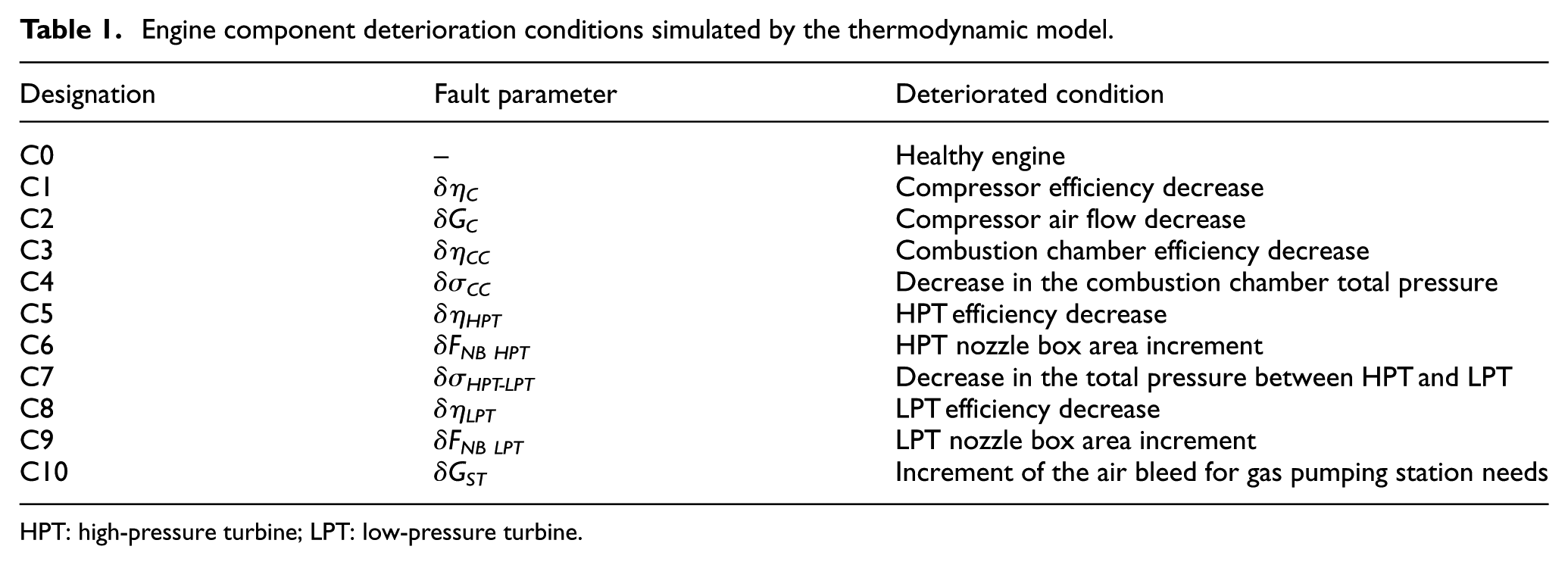
HPT: high-pressure turbine; LPT: low-pressure turbine.
Development and verification of boundary condition models
Models’ development
As described in section “Turbine blade thermal SC,” to estimate the turbine blade thermal SC according to equations (1) and (2), it is necessary to specify the initial data, thermal boundary conditions
For this study, the following particular gas path parameters have been chosen for the boundary temperatures:
The cooling temperature:
The heating temperature:
where
Alternative models for all the four boundary conditions have been developed. Although the compressor discharge temperature is a measured parameter in the test case engine, the models of this parameter were developed as well. This allows estimating a positive effect from the inclusion of parameter
Example 1: model of the compressor discharge temperature
For developing the model, we use the thermodynamic relation that describes the work of compression Lc

where k is the isentropic factor, Cp is the specific heat at constant pressure, and
As in expression (10), the parameters k and
Solving equation (10) for

After an inverse correction, we have the necessary model of the compressor discharge temperature
Example 2: model of the heat transfer coefficient
According to Kopelev, 23 a basic expression for the model is

where
According to Kopelev,
23

To compute this coefficient, the following values were used: A = 0.74, Z = 0.20, L = 3.4 × 10⁻² m, h = 4.57 × 10⁻² m, D = 0.6075 m, d = 0.5, and q = 0.17. To determine the other necessary variables p1, w1, and T1 at the entrance of the blade, the corresponding internal models were developed using polynomial functions.
Structure of the alternative models developed
In total, for all the boundary conditions, the alternative models for the following unmeasured boundary conditions

Scheme of the development of the alternative models.

Structure of the alternative models developed.
Models’ verification
As a result of the internal model verification, the measured parameter used as argument and the degree of the polynomial were chosen for each internal model A(x). Let us consider as an example the model MTG1 that is used to monitor the gas temperature

where
The model MTG1 includes an internal model that describes ATG1 as a function of the mechanical efficiency
All the necessary data to obtain the value of the coefficients in the polynomial are obtained with the help of the thermodynamic model. 21 These data were generated for a healthy engine condition at 245 operating modes uniformly distributed in space of the operating conditions. The generated data were then divided into two sets: reference set of 123 modes and validation set of 122 modes. Using the reference set, the polynomial coefficients were estimated by the least squares method. Many alternative polynomial functions were determined: polynomial degree was changed from 1 to 4 and different gas path parameters were used as a function argument.
After determining the coefficients for all the polynomials that describe the internal model ATG1, the value of

The total error calculated using expression (5) is the main criteria to judge the accuracy of the monitoring models. The necessary truncation and instrumental errors were calculated on the validation set data using equations (6)–(9).
To test the model robustness, the truncation error was computed using expressions (6) and (7). The calculation was performed for one healthy and 10 faulty engine conditions (see Table 1) with the help of the thermodynamic model. The total error in the prediction of
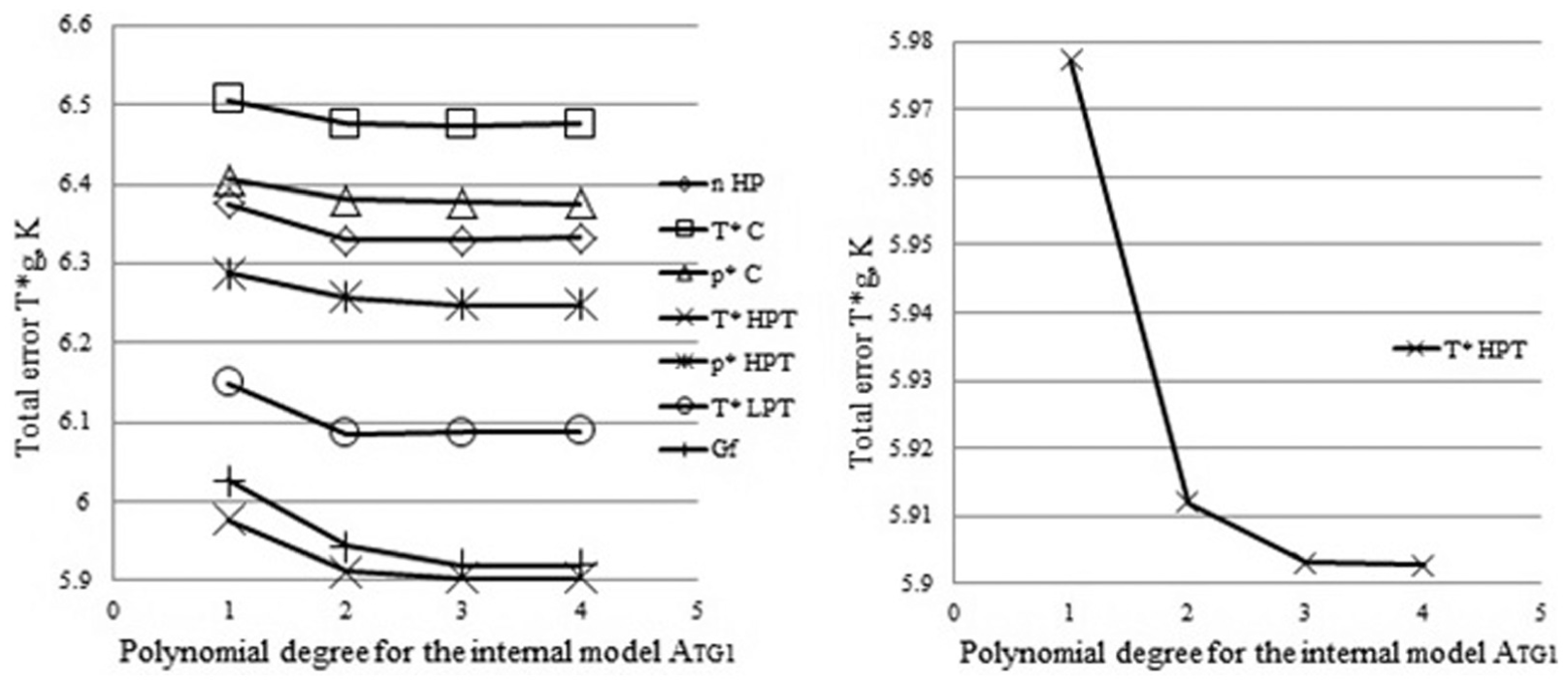
Total
From Figure 6(a), it is clear that the best prediction of

where
In the same way as in the above example of model MTG1, the best measured parameters used as arguments in the i-internal models and the best polynomial degree were selected for all the developed models. After the models’ verification, the finally selected models for all boundary conditions are presented in Figure 7.

Selected models to monitor the thermal boundary conditions of the HPT first-stage blade.
Models’ accuracy analysis
Estimation of thermal boundary conditions
This section compares the accuracies of two different approaches for model development: physics-based models proposed in this article and the models previously developed with the help of the theory of similarity (reference models, see Oleynik 17 ).
The models are compared for each of the four thermal boundary conditions, namely:
Cooling temperature:
Heating temperature:
Relation
Relation
The truncation errors of the estimation of these boundary conditions are presented in Figure 8 for four boundary variables and 11 health conditions. Analysis of these errors shows that on average the proposed models (blue color) are more accurate than the previous models.

Truncation errors in the estimation of the thermal boundary conditions for different engine health conditions: (a)
The above accuracy analysis has been performed using the thermodynamic model as a reference and theoretical distribution of simulated errors. Nevertheless, this type of models has its intrinsic errors, and real measurement errors differ from the simulated ones. Therefore, it is important to try to verify the methodology of estimating unmeasured gas turbine parameters using empirical information. Fortunately, such information is available for the engine under analysis.
Accuracy analysis on real data
For the analyzed engine, the cooling temperature
The empirical information available for the engine presents steady-state measurements averaged and hourly recorded at field conditions, also known as snapshots. Since parameter
Thus, the above two sections dealt with accuracy of thermal boundary conditions themselves. The following two sections analyze how the boundary condition accuracy influences the accuracy of thermal stress and lifetime estimation.
Thermal stress estimation and lifetime prediction when the compressor temperature is not measured
The turbine blades’ thermal SC was assessed using expressions (1) and (2). The prediction of the lifetime of turbine blades is a very complex process in which a significant number of factors influence. Our study analyzes the impact that a new method to develop models has on the accuracy of the lifetime prediction. This makes possible to use a conservative prediction of the lifetime, which will be sufficient to assess the adequacy of the developed physics-based models.
One of the simple and easy practical ways to determine the lifetime is the Larson–Miller relation

where PLM is the Larson–Miller parameter; C is the coefficient that for our test case has the value of 20.
Two cases are considered:
When the thermal boundary conditions are calculated with the physics-based models;
When the thermal boundary conditions are calculated with the models developed using the theory of similarity.
The analysis of the results presented in Figure 9 shows that the use of physics-based models leads to a better estimation of TC (Figure 9(a)) and better prediction of lifetime tr (Figure 9(e)). On the other hand, the prediction on SC is less affected (Figure 9(c)).

Total error in the prediction of TC, SC, and tr. Blue color: physics-based models; red color: models based on the theory of similarity. (a, c, e)
It is clear that the choice of the models to estimate the thermal boundary conditions affects the results in the prediction of lifetime tr for both groups of critical points ga and gb. For example, for the group of critical groups ga, the results show that the use of physics-based models to calculate the thermal boundary conditions reduces the errors of the temperature at the critical point tr from 1.03% to 0.59%. The lifetime errors reduce from 102.8% to 40.94% accordingly. We can observe a similar error change for the group of critical points gb. It can be concluded that the accuracy of the lifetime prediction is enhanced due to a more accurate estimation of the material temperature tcr by physics-based models.
The previous results were obtained when the temperature after compressor
Thermal stress estimation and lifetime prediction when the compressor temperature is measured
A temperature after compressor
The results in the calculations of the TC, SC, and tr are presented in Figure 9. The analysis of this figure shows that for the case of the physics-based models, the level of errors for the critical points ga decreases from 0.58% to 0.44%. This leads to a better prediction of lifetime tr (errors decrease from 45.95% to 27.96%). The accuracy in the prediction of tr for the critical points gb is also enhanced.
Thus, we can conclude that the measurement of the cooling temperature
Discussion
The analysis performed in the previous section proves high accuracy of the developed models for the thermal boundary conditions. However, we need to keep in mind that the reference data employed to determine the models’ accuracy were also simulated. Let us discuss the following two issues:
Proper interpretation of the accuracy analysis performed in section “Models’ accuracy analysis” on simulated data;
Perspectives of further accuracy enhancement using real reference data.
The first issue is related to the boundary condition errors and stress and lifetime inaccuracy. To estimate the boundary condition errors, the thermodynamic model was employed in the article. Unfortunately, this model has its intrinsic errors, and, consequently, the boundary condition errors will possibly grow in practice.
When the stress and lifetime inaccuracy were determined in sections “Thermal stress estimation and lifetime prediction when the compressor temperature is not measured” and “Thermal stress estimation and lifetime prediction when the compressor temperature is measured,” the errors of only the thermal boundary conditions were taken into consideration, and the other errors determined in the thesis 17 were not. This is natural because the boundary conditions are a principal object investigated in this article, and the article results show the possibility of real application of the proposed methodology. However, the above reasoning implies possible growth of the errors of lifetime monitoring under real conditions.
Within the second issue, the possibility of the enhancement of lifetime prediction is discussed. The point is that the thermodynamic model is used in this study only for data generation to determine and validate the boundary condition models. Thus, the thermodynamic model is not a part of the proposed methodology and can be replaced by real data. Although a standard measurement system is not sufficient for this purpose, additional instrumentation can be installed under engine test bed conditions. In this way, we can completely replace the thermodynamic model by real data and exclude all simulation errors.
There is another way to easily enhance the boundary condition and lifetime accuracy. In the analysis described in section “Models’ accuracy analysis,” the simulated measurement errors correspond to a single parameter recording time station. By uniting some consecutive stations for estimating average parameters, it is possible to further enhance the boundary condition and lifetime estimates.
Conclusion
The article proposes the method to develop simplified physics-based models for estimating the unmeasured thermal boundary conditions for hot elements of gas turbines. A turbine blade has been chosen as a test case for the proposed method. The blade is mounted in the first stage of the HPT of a two-spool turbo shaft engine. In the simplified models, the necessary intermediate unmeasured parameters were defined via internal polynomial functions (internal models). To determine polynomial coefficients by the least squares method, a great volume reference set with measured and unmeasured gas path parameters has been generated by the nonlinear thermodynamic model. To choose the best internal model of each intermediate parameter, a total of 31 alternative candidate models were developed. The best measured parameter used as an argument of the polynomial functions and the degree of polynomials was chosen for each candidate model. The candidates tailored in this manner on the reference set data were then compared using a validation set generated by the thermodynamic model for healthy and many faulty health conditions. The truncation and instrumental errors as well as the model robustness to engine faults were the criteria to choose the best candidate for each internal model. Finally, the internal models optimized in this manner were used in the simplified models of the boundary conditions.
Two methodologies for the development of the boundary condition models were compared: physics-based methodology (proposed in this article) and similarity-based methodology (reference). The results show that the physics-based methodology is less sensitive to engine faults and always provides a better estimation. It was found that the use of this methodology improves the estimates of the thermal boundary conditions, which lead to considerable improvement in the estimation of the temperature at the critical point and in the prediction of the lifetime. For example, the results show that the use of physics-based methodology reduces the errors of this temperature from 1.03% to 0.59%, which leads to reduction in the lifetime prediction errors from 102.8% to 40.94%. These results correspond to the case when the compressor discharge temperature is not measured.
It was proven that the measurement of the compressor discharge temperature
In this way, all the results of the accuracy analysis prove that after several stages of optimization, the developed thermal boundary condition models have acceptable accuracy. The discussion section shows the ways of further improvement of these models using real data.
Footnotes
Appendix 1
Appendix 2
Appendix 3
Academic Editor: Yonghui An
Declaration of conflicting interests
The author(s) declared no potential conflicts of interest with respect to the research, authorship, and/or publication of this article.
Funding
The author(s) disclosed receipt of the following financial support for the research, authorship, and/or publication of this article: This study was performed with the support of the National Polytechnic Institute of Mexico.