




Abstract
Most of the physical phenomena located around us are nonlinear in nature and their solutions are of great significance for scientists and engineers. In order to have a better representation of these physical phenomena, fractional calculus is developed. Some of these nonlinear physical models can be represented in the form of delay differential equations of fractional order. In this article, a new method named Gegenbauer Wavelets Steps Method is proposed using Gegenbauer polynomials and method of steps for solving nonlinear fractional delay differential equations. Method of steps is used to convert the fractional nonlinear fractional delay differential equation into a fractional nonlinear differential equation and then Gegenbauer wavelet method is applied at each iteration of fractional differential equation to find the solution. To check the accuracy and efficiency of the proposed method, the proposed method is implemented on different nonlinear fractional delay differential equations including singular-type problems also.
Keywords
Introduction
In functional differential equations, the rate of change of unknown function not only depends upon the values of unknown functions at present time but also on previous time values. Delay differential equations also require information of the unknown function at different time levels including the previous levels also. Numerous applications of delay differential equations occur in mathematical modeling 1 including chemical kinetics, the navigational control of ships, infectious diseases, and population dynamics.
Fractional calculus2–8 has gained a considerable importance over the past few decades, due to the fact that it represents real-time physical models better and more accurately as compared with integer-order derivatives and integrals. Fractional delay differential equation is the generalization of delay differential equation. Over the past few decades, several researchers had devoted their study in finding numerical solutions of fractional delay differential equations due to non-availability of exact solutions in most of the cases. Therefore, different numerical and analytical methods9–12 have been developed and applied for finding approximate solutions. Method of steps 13 is commonly used to convert a delay differential equation into an ordinary differential equation. The procedure of implementing method of steps is easy to understand and simple to use. In Falbo, 14 the method of steps is utilized to solve linear and nonlinear discrete delay differential equations with different types of delay.
Wavelet techniques are one of the relatively new techniques used for finding solutions of differential equations. Due to better accuracy of wavelets over other methods, a number of researchers are being attracted toward these techniques. The most common related schemes are harmonic wavelets of successive approximation, 15 Legendre wavelets,16,17 cosine and sine (CAS) wavelets, 18 Haar wavelets, 19 and Chebyshev wavelets.20,21 Chen and Hsiao 22 used Haar wavelets method for solving lumped and distributed parameter systems. Islam et al. 23 used Haar wavelet collocation method for the numerical solutions of boundary layer fluid flow problems. Rawashdeh 17 implemented Legendre wavelets method to obtain solutions of fractional integro-differential equations. Razzaghi and Yousefi 24 used Legendre wavelets method for constrained optimal control problems. E Babolian and FF Zadeh 20 obtained numerical solutions of differential equations using Chebyshev wavelet operational matrix of integration.
Since these methods are newly developed, these methods had few shortcomings while dealing with nonlinear differential equations of fractional order. In this work, we propose a new method called Gegenbauer Wavelet Steps Method for solving nonlinear fractional delay differential equations and also show that it is strongly reliable method for such nonlinear problems than the other existing methods.
Preliminaries
Some basic definitions of fractional differentiation and integration are as follows:
Riemann–Liouville fractional integral operator of order
Riemann–Liouville fractional-order integral of order

for
Riemann–Liouville fractional derivative operator of order
Riemann–Liouville fractional-order derivative of order

for
Caputo fractional derivative operator of order
Caputo fractional-order derivative of order

for
Xiao-Jun Yang’s fractional derivative operator of order
Xiao-Jun Yang’s fractional derivative of order

where
Ji-Huan He’s fractal derivative:
According to Ji-Huan He, the fractal derivative can be defined as

where
Gegenbauer polynomials and Gegenbauer wavelets
Gegenbauer polynomials, or ultra spherical harmonic polynomials,


Gegenbauer polynomials are orthogonal on

where

is the normalizing factor, and
Legendre polynomials and Chebyshev polynomials are special cases of Gegenbauer polynomials. For
Mother wavelet (basic wavelet) is defined by the basis using scaling and translation parameters as

where r and s are the scaling and translation parameters, respectively.
If we restrict the parameters r and s to discrete values as

where
Gegenbauer wavelets are defined on interval [0,1) by

where
In order to obtain the orthogonality of wavelets, Gegenbauer polynomials have to be dilated and translated using a weight function

At fixed level of resolution say

The solution of the nonlinear fractional delay differential equation can be expanded as a Gegenbauer wavelets series as follows

where

where

The collocation points for Gegenbauer wavelets are taken as
Procedure of implementation
In the present word, we consider the delay differential equation of the form

where
According to the proposed method, first use the method of step to convert the delay differential equation (3) to inhomogeneous ordinary differential equation using initial function,

Using series solution of Gegenbauer wavelets given in equation (2), we have

Solving system of equations given in equation (5), we get values of unknowns
Numerical problems
In this section, different nonlinear delay differential equations of fractional order including singular-type problems are considered and the developed method is implemented on them.
Problem 1
Consider fractional nonlinear pantograph equation 25 is

with initial conditions (ICs)

The exact solution for

Applying method of steps on equation (6), we have

Now considering

Replacing value of

Solving equation (9) using MAPLE, after simplification for

In Table 1, solution by Gegenbauer Wavelet Steps Method for different values of polynomials M is given when α = 2. In Table 1,
Comparison of errors in solutions for different values of M.

Solution at different fractional values of

Comparison of solutions for different fractional values of α for equation (6).
Problem 2
Consider the following fractional inhomogeneous nonlinear delay differential equation 26

with boundary conditions (BCs)

The actual solution for

Applying method of steps on equation (11), we have

Now considering

Replacing value of

Solving equation (14) using MAPLE, after simplification for

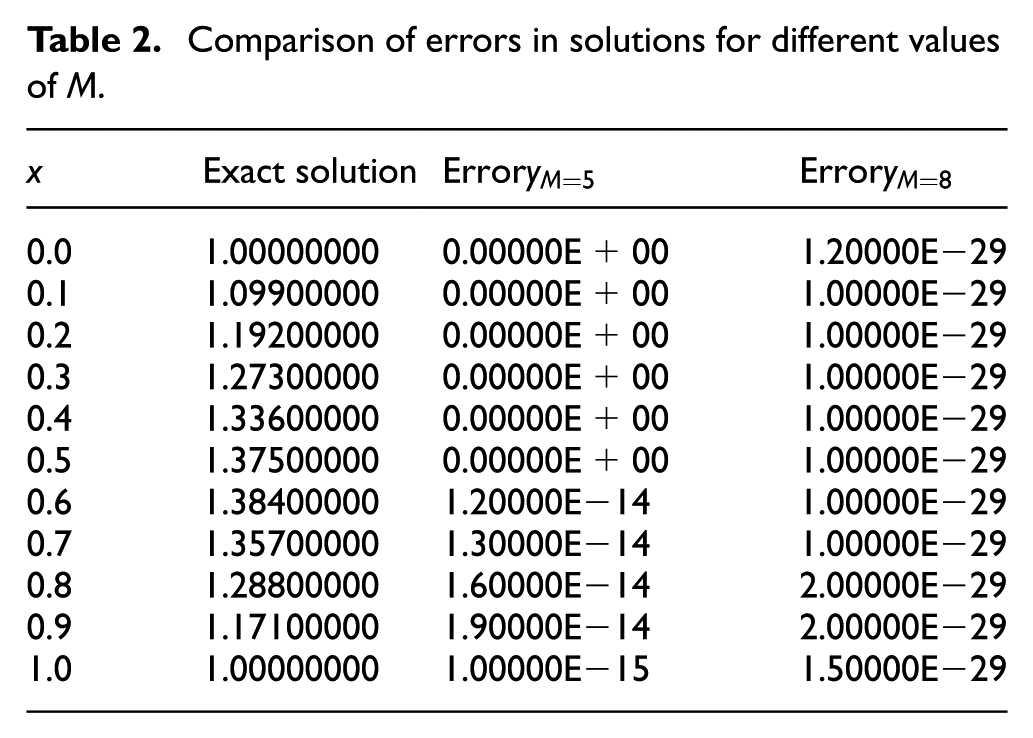
In Table 2, solution by Gegenbauer Wavelets Steps Method for different values of polynomials
Comparison of errors in solutions for different values of M.
Solution at different fractional values of
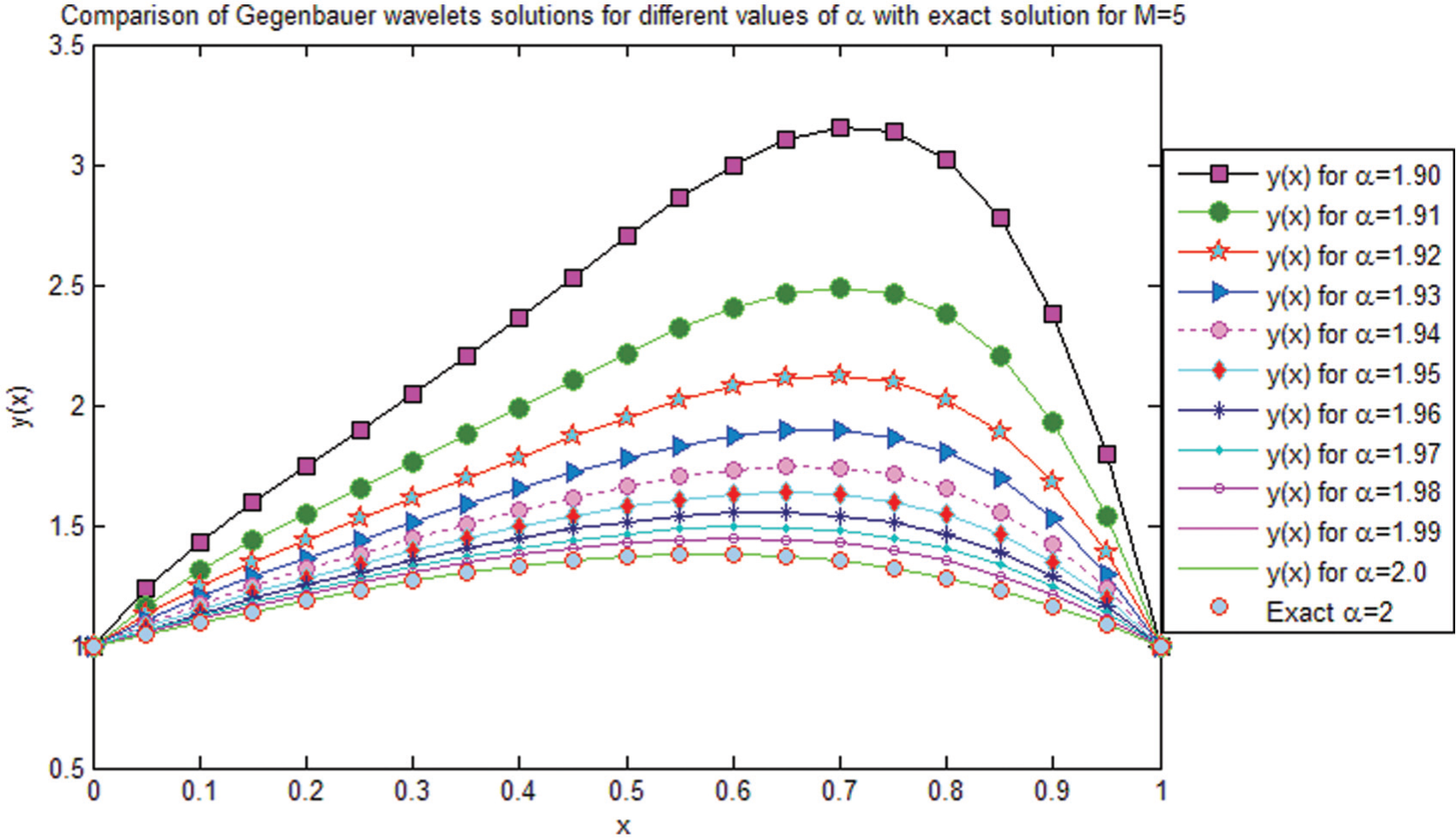
Comparison of solutions for different fractional values of α for equation (11).
Problem 3
Consider the following singular fractional pantograph equation

with conditions

Exact solution of equation (16) is
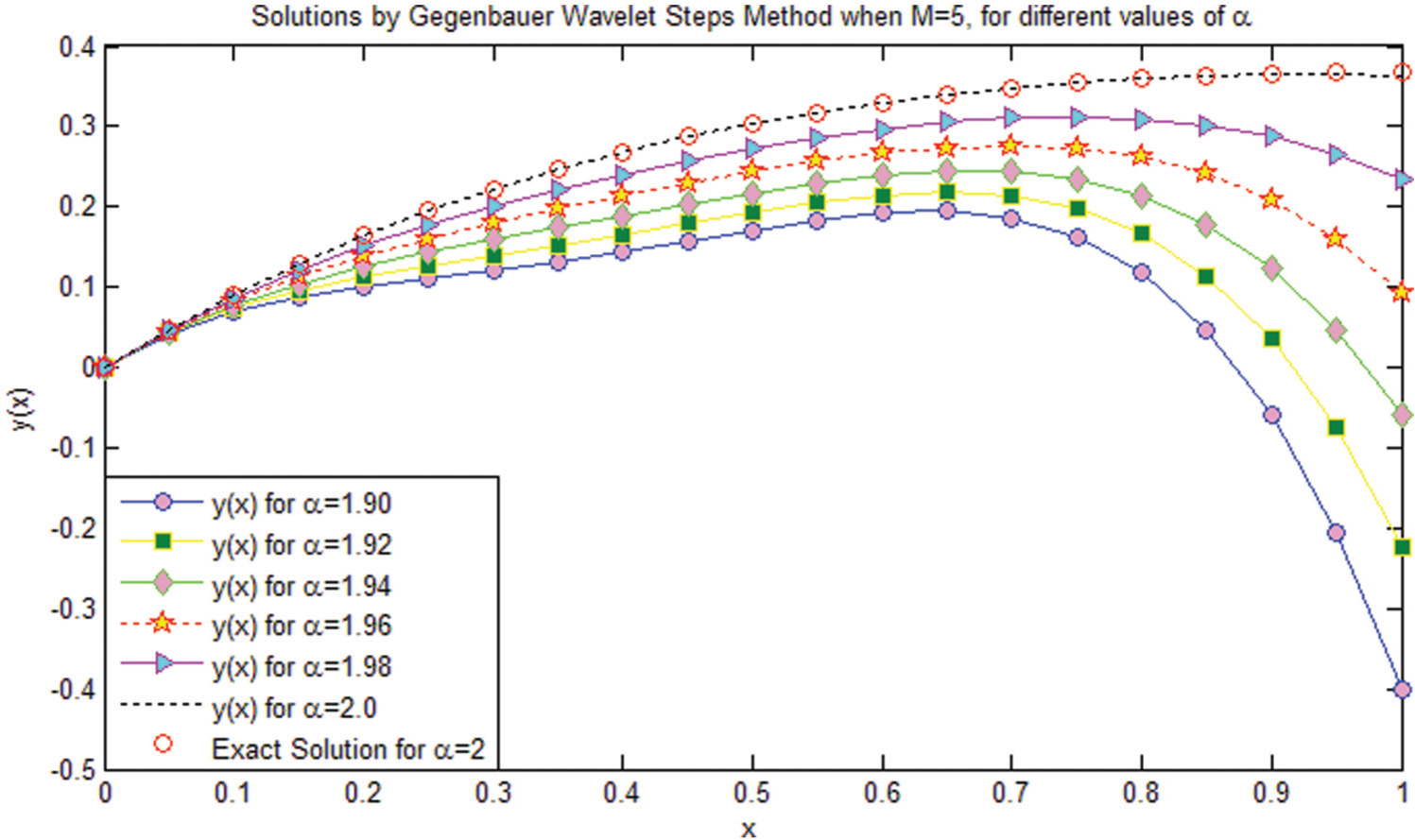
Comparison of solutions for different fractional values of α for equation (16).
Applying method of steps on equation (16), we have

Now considering

Replacing value of
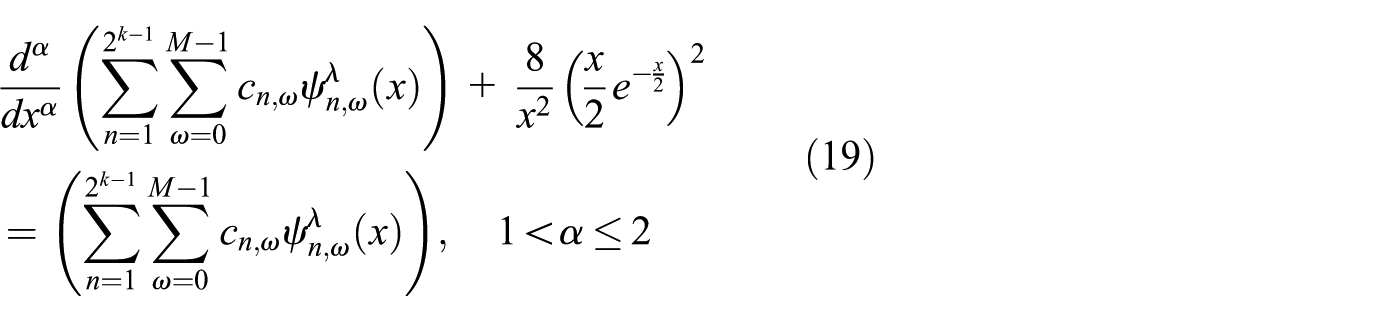
Solving equation (19) using MAPLE, after simplification for
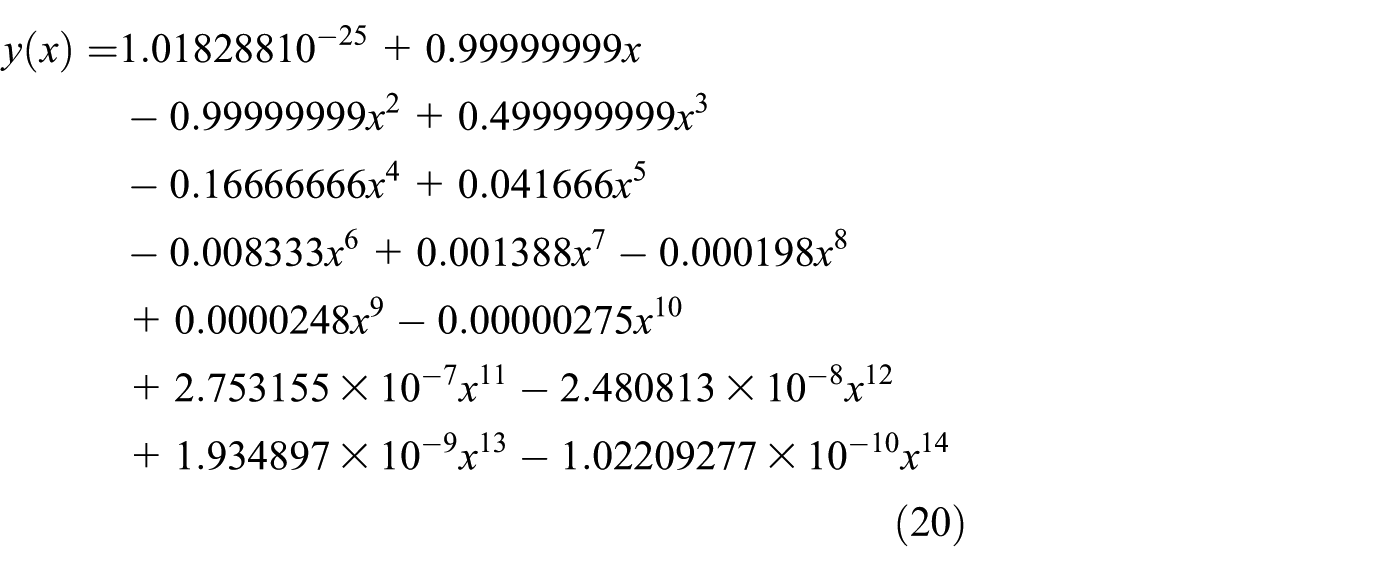
In Table 3, solution by Gegenbauer Wavelets Steps Method for different values of polynomials
Comparison of errors in solutions for different values of M.

Conclusion
In this work, proposed method, namely, Gegenbauer Wavelet Steps Method is developed for nonlinear fractional delay differential equations and is successfully implemented on three different nonlinear fractional delay differential equations including singular-type problems also. The developed method is simple and is easy to implement. The results obtained by the developed method are very encouraging. One important feature of the developed method is that by increasing the degree of Gegenbauer polynomials, the accuracy of the solution can be enhanced, which is verified in each considered problem shown in Tables 1–3. Since the results obtained are quite encouraging, the proposed method can be extended for other nonlinear fractional delay differential equations of various orders.
Footnotes
Acknowledgements
The authors are grateful to the unknown referees for their valuable comments.
Academic Editor: Xiao-Jun Yang
Declaration of conflicting interests
The author(s) declared no potential conflicts of interest with respect to the research, authorship, and/or publication of this article.
Funding
The author(s) received no financial support for the research, authorship, and/or publication of this article.