




Abstract
Structural health monitoring is widely used for maintaining and monitoring various structures in different areas. In general, the structural health monitoring system life span depends on the capability of the batteries, but it can be increased by energy harvesting approaches to autonomously produce power. These autonomously powered structural health monitoring systems have received increasing attention over the past decades. This article reviews recent developments in the ambient energy sources and energy harvesting methods for structural health monitoring applications. First, the earliest and most common method of harvesting energy from sunlight and wind is discussed. Then, vibration and thermal gradient energy harvesting methods are reviewed together with their feasibilities. Finally, radio frequency energy harvesting, a unique method developed in recent years, is highlighted. A double-resonant coil ferrite rod antenna for radio frequency energy harvesting in medium frequency band is proposed. Simulation results indicate that the proposed double-resonant coil ferrite rod antenna can increase the gain by 2.8 dBi and the receiving voltage by 25.77% compared with a conventional single-resonant coil ferrite rod antenna.
Keywords
Introduction
Structural health monitoring (SHM), as a prominent application of wireless sensor networks (WSNs), is widely used in public safety areas, for instance, in hill-creep monitoring, 1 searching and salvaging, 2 and fire monitoring in structures. 3 SHM systems can detect damage in municipal, military, aerospace, and industrial structures, for example, bridges, buildings, vehicles, water pipes, oil pipelines, tunnels, and infrastructures.4,5 However, battery-powered WSNs suffer from severe energy limitation because the lifetime of the batteries is only a few months or years. To overcome this limitation, periodic manual maintenance work, such as recharging or replacing batteries for sensor nodes, is needed. This leads to high manual maintenance costs. Energy harvesting (EH) or energy scavenging is a process of capturing and accumulating small amounts of energy from ambient energy sources, such as sunlight, wind, vibration, sound, heat, and radio frequency (RF). EH has become an emerging, developing technology to supply power for SHM applications since 2004.
The number of research articles on energy harvesting for SHM from the IEEE and Web of Science databases has increased rapidly from 2004 to 2015, as shown in Figure 1. We note that some papers published in 2016 have not yet been indexed in these databases. Therefore, we do not show the number of papers published in 2016 in Figure 1.

The number of EH-SHM articles listed in the IEEE and Web of Science databases over time.
Energy harvesting is a wide area, but a few literature surveys are related to energy harvesting technologies for SHM applications.6–11 This article reviews the developments in the energy sources and energy harvesting methods for SHM systems in civil, industrial, and machinery applications from 2004 to 2016. The method of energy harvesting and its feasibilities are focused on in this article. Various ambient energy sources including sunlight, vibrations, wind, thermal gradients, and RF with their typical power densities have been studied and investigated.10,12–17 A comparison of energy sources, power densities, and harvesting methods is listed in Table 1.
Comparison of energy sources and harvesting methods.

The remainder of this article is organized as follows. First, we introduce the earliest and most common method of harvesting energy from sunlight and wind. Then, we investigate vibration and thermal gradient energy harvesting approaches. Finally, RF energy harvesting, as a promising energy harvesting technology for SHM application, is highlighted. Specifically, a new double-resonant coil ferrite rod (DRCFR) antenna for RF energy harvesting technology is proposed, modeled, and simulated.
Energy sources and harvesting methods
Solar energy
Solar energy or light energy, a traditional ambient energy source, has already been widely investigated for its abundance and renewability. Solar energy has the highest power density among all of the ambient energy sources. 12 Photovoltaic (PV) cells are the key components of solar energy harvesters that generate electricity from ambient sunlight. The method of harvesting solar energy for SHM applications has caused great concern due to its high power density. A vibration monitoring WSN powered by solar energy for bridges was previously proposed in Lee et al. 11 and Chung et al. 18 Due to the high power dissipation and continuous functioning of the monitoring system, the sensor node was only sustained for a few hours. For a longer operating time of the sensor node, a larger solar panel array and an external backup battery are needed. Solar energy is only available during the daytime and also depends on the weather. An embedded rechargeable battery or supercapacitor for solar energy harvesting-based SHM systems is suggested.
Raghunathan et al. designed a wireless heliometer sensor node based on efficient solar energy harvesting, as shown in Figure 2(a), for SHM applications. 19 Several key factors playing a role in the design of a solar energy harvester for an SHM system are discussed and analyzed. Measurement results show that this solar energy harvester can achieve maximum output power of 260 mW at 12:30 pm and 200 mW at 3:00 pm. The battery receives sufficient current from the solar panel each day to be almost fully charged.

(a–c) Solar energy harvesting for SHM applications and (d) harvested solar energy distribution over 10 days.
An improved solar energy–based SHM system for sustainably detecting bridge vibrations, environmental temperature, humidity, wind, and light during the day and night was reported in Cho et al. 20 This system consists of a commercial sensor platform (Imote2), 21 a Solarworld solar cell array, and a built-in battery, as shown in Figure 2(b). The capacity of the rechargeable battery is able to maintain operation for 2 months without solar energy harvesting. S Cho et al. 20 used solar energy harvesting to power a WSN for bridge health monitoring; this energy harvester, as shown in Figure 2(c), can achieve an average output voltage of approximately 4.15 V.
Generally, a wireless sensor node for an SHM system requires continuous operation for damage detection and health monitoring; consequently, consideration of energy harvesting and the design of the power supply are vital for the system. Musiani et al. 22 designed a long-life solar energy harvesting-based WSN (SHiMmer) for an SHM system without any batteries, which was implemented on a bridge for health monitoring. A solar cell harvesting circuit is used in SHiMmer to harvest sunlight, and a supercapacitor is used to store the harvested energy. More than 350 mW of power is generated by a 10 cm × 10 cm solar panel on sunny days, with an estimated 40 mW on cloudy days. The capability of SHiMmer for complex overload computation has also been demonstrated. With no manual maintenance, the SHiMmer system can work autonomously for as long as 20 years.
More recently, solar energy harvesting–based autonomous wireless sensors for SHM applications, such as bridges, transport infrastructures, and environmental conditions, were reported in previous works.23–26 S Nazir et al. 23 presented an autonomous SHM system for bridges and transport infrastructures; more than 1300 mW of power was generated by the solar energy harvester. Ravinagarajan et al. 24 proposed a solar energy harvesting-based dynamic voltage and frequency (DVFS) approach for an SHM system. The system workload and energy consumption can be adjusted according to the available environmental energy and the requirements of the SHM. The harvested solar energy distribution over 10 days is shown in Figure 2(d). Indoor light energy harvesting for SHM applications has also been investigated, for example, YK Tan and SK Panda 25 designed an indoor light energy harvesting system for SHM applications and evaluated the output performance of solar panels under different light conditions. Experimental results showed that the maximum output power of the solar panels was achieved when the output voltage was in the range of 3.5–4 V.
Wind energy
Wind is the second most widely used renewable energy source for generating large-scale power. Large-scale wind power generation technologies have been well developed and studied for many years. However, research on wind energy harvesting in a small-scale area, specifically for SHM systems, has only emerged in recent years.11,27–30 Wind energy can be accessed during the day and at night, and even under rainy and cloudy conditions compared with solar energy. Since many civil structures, such as bridges and high buildings, are located in windy regions, some researchers have paid more attention to wind energy harvesting and regard it as a feasible energy source for wireless sensor nodes in SHM applications. A demonstration case of a bridge health monitoring system was reported in Park et al. 31 The wireless sensor node consisted of Imote2, a buck regulator, charge circuit, and rechargeable battery, as shown in Figure 3(a) and (b). The wind turbine generator (WTG) harvested enough electricity to drive the Imote2 wireless sensor node in a normal environment. A compact wind energy harvester with maximum power-point tracking (MPPT) was designed to power wireless sensor nodes for monitoring wildfires. 32 When the average wind speed was 3 m/s, 770 µW of power was produced by the WTG using MPPT. Park et al.31,33 presented a micro-WTG-based wireless sensor node for bridge health monitoring. Their experimental results showed that the WTG generated 0.4 W of power at a wind speed of 7 m/s. The output power versus wind speed is shown in Figure 3(c).
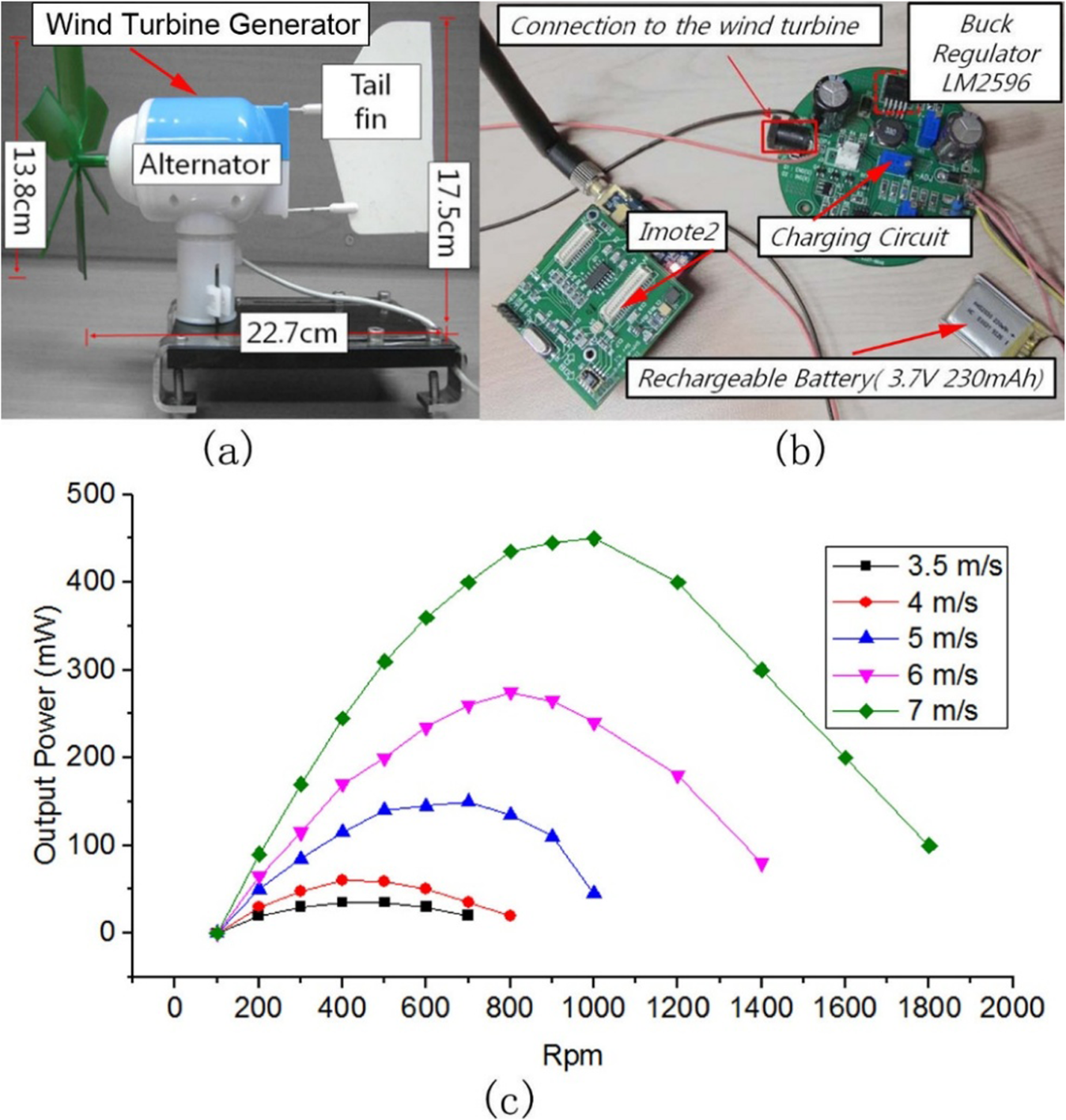
WTG and wireless sensor node for building monitoring: (a) wind turbine generator, (b) Imote2-based wireless sensor node, and (c) harvested output power versus wind speed.
Mechanical vibrations
There are mainly two types of mechanical vibration energy harvesting, piezoelectric material vibrations and electromagnetic generator vibrations. Piezoelectric energy is produced by the mechanical rotation or vibration of piezoelectric patches. Electromagnetic vibration energy is generated by the relative movement of the magnet and coil. A mechanical vibration energy harvester is usually attached to ambient vibrating or moving objects, such as motors, machines, vehicles, and even human bodies. This is regarded as a very efficient approach to harvest energy.
The Sodano research group 34 designed a piezoelectric energy harvester with a structure that comprised a piezoelectric patch and a cantilever plate. The harvester was mounted on a vehicle compressor. The experimental results showed that a battery with a capacity of 40 mAh could be charged in 60 min with the basic excitation of the structure. An improved and optimized piezoelectric energy harvester, as shown in Figure 4(a) and (b), is reported in Roundy and Wright. 35 The voltage and power outputs were improved by 50% and 75%, respectively, by adopting an optimized tungsten regulating mass. The output power was simulated and tested under different loads, as shown in Figure 4(c). A piezoelectric cantilever patch-type piezoelectric energy harvester for a pump condition monitoring system was reported by Discenzo et al. 36 This energy harvester was fixed onto an oil pump to harvest its vibration energy, and 40 mW of peak power was generated.

A regulating mass-based piezoelectric energy harvester and its performance: (a) a piezoelectric generator mounted onto a motor, (b) the structure of the piezoelectric generator, and (c) output power versus different loads.
A new poly-directional vibration energy harvesting technique was presented by Z Yang and J Zu. 37 They designed a novel multidirectional, compressive-mode piezoelectric energy harvester (MC-PEH), as shown in Figure 5(a) and (b). This has the significant advantage of harvesting vibration energy from any direction by means of a sandwiched piezoelectric patch structure. Experimental results showed that high-efficiency output power was achieved from both horizontal (shown in Figure 5(c)) and vertical vibration (shown in Figure 5(d)) across a wide vibration bandwidth.
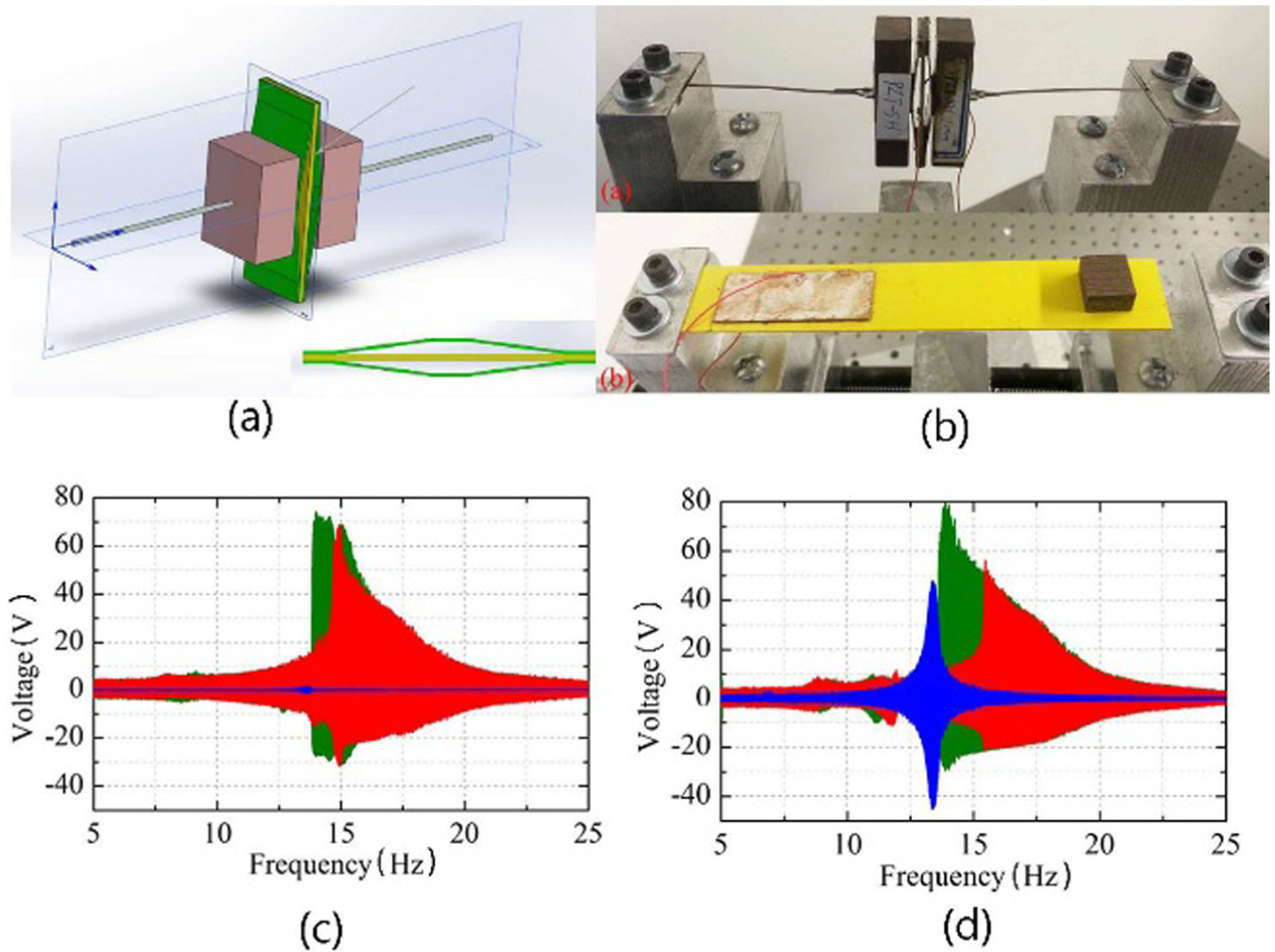
A novel piezoelectric energy harvester for wireless sensor applications: (a) structure of the MC-PEH, (b) experiment conducted on the MC-PEH device, (c) output voltage of the MC-PEH with horizontal vibration, and (d) output voltage of the MC-PEH with vertical vibration.
Due to the restrictions of piezoelectric materials associated with the structure and characteristics, magnetostrictive materials (MsMs) have been used to harvest vibration energy instead of piezoelectric materials. The principle of producing voltage output using MsMs is referred to as the Villari effect. A compact MsM vibration energy harvester was proposed in Wang and Yuan. 38 As shown in Figure 6, the structure comprises an MsM laminate attached to a metallic layer that is bound with a pick-up coil. The MsM energy harvester achieved an estimated 0.6 mW/cm3 power density, which is the same scale as the piezoelectric materials at a resonant vibration of 1100 Hz. An improvement of the MsM energy harvester was reported in Zucca and Bottauscio. 39 A maximum output power of 10 mW was achieved by optimizing the geometry of the laminate and the coil with a bandwidth of 220 Hz.
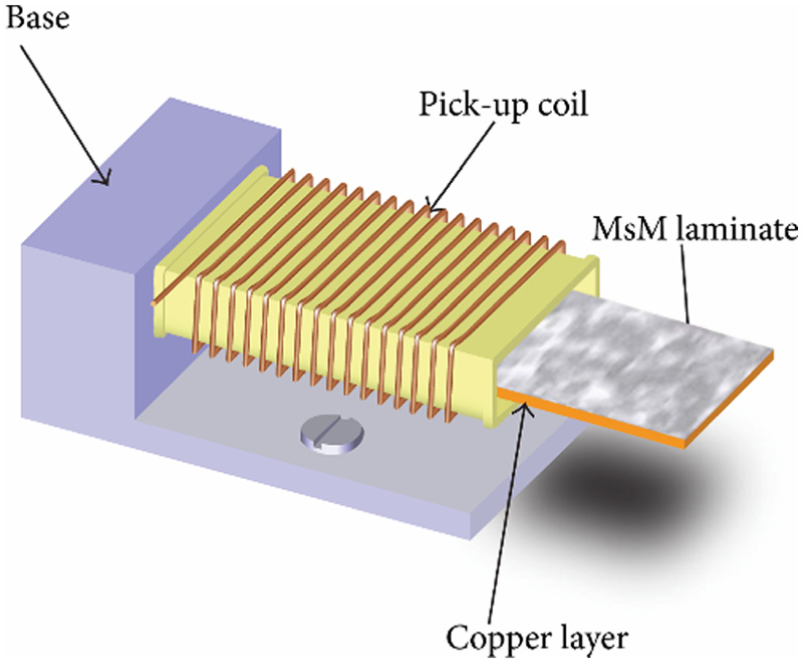
Structure of the MsM energy harvester.
Micro-electro-mechanical system (MEMS)-based micro-scale energy harvesting has received much attention.40–42 For example, miniature MEMS piezoelectric vibration energy harvesters were reported in previous works,41,43 and 0.001 mW of power (3 V) was generated. 41 An autonomous SHM system powered by a MEMS energy harvester was demonstrated by Pasquale et al. 43 A nickel electroplating method was adopted in this system, and the designed vibration frequency bandwidth was improved to 400 Hz.
It is widely demonstrated that the bandwidth restricts the harvesting of energy from vibrations. 44 The maximum power output can only be achieved within a very limited basic resonant frequency zone. Nevertheless, to accurately match an energy harvester with the vibration sources is a challenge due to the accuracy of the manufacturing components, the transformation of the system load, and variation in the vibration energy sources. 45 Hence, a broadband energy harvester, or tunable energy harvester, was recently studied. A recent study on linear-based energy harvesting and nonlinear-based energy harvesting was performed. 46 Erturk et al. 47 adopted piezo-magnetoelastic material and designed a wide bandwidth vibration energy harvester and achieved a 300% increase in the operating bandwidth and a 200% improvement in voltage. More studies using magnets to facilitate the improvement of wide vibration bandwidth for energy harvesters are reported in previous works.48–52 For example, Farid et al. proposed a new vibration energy harvester (EBEH), which uses the principle of electromagnetic induction. The EBEH was fixed on a bridge and harvested energy from both bridge vibrations and wind for bridge health monitoring applications. The EBEH consists of a magnetic rod, a group of coils, an airfoil, and a projecting beam, and 1000 mV voltage and peak power of 0.35 mW were generated. The prototype and the output performance of the EBEH are shown in Figure 7.

Prototype and the output performance of the EBEH.
Thermal energy
Thermal energy harvesting is another way to extract ambient energy using thermal gradients. Thermoelectric generators (TEGs) convert thermal gradients into electricity based on the Seebeck effect. 53 TEG technology has been developed over many years. 8 Compared with vibration energy harvesters, TEGs have no kinetic components. However, TEGs have a low conversion efficiency under small temperature changes, and they are difficult to combine with MEMS technologies due to their construction and size.7,8 A commercial TEG was reported in previous works,53–56 as shown in Figure 8(a). Losada et al. 56 demonstrated a wireless sensor device powered by a TEG for infrastructure health monitoring applications. Peak power (20 µW) was generated at temperature gradient of 20 K. A TEG-based multiple sensor node for an aircraft health monitoring system was presented in previous works.55,56 Continuous power of 200 µW was generated by the TEG under normal working conditions, as shown in Figure 8(b).

(a) Commercial TEG and (b) TEG-based WSN for aircraft health monitoring.
RF energy
RF is a wide frequency band of electromagnetic waves between 3000 Hz and 300 GHz. RF signals are radiated from billions of radio stations across the world. The basic principle of electromagnetic wave power transmission was first presented by Tesla 57 in 1899. RF energy harvesting is the process of deriving energy from ambient RF sources including MF (AM Radio, 526.5–1705 KHz); FM (87.5–108 MHz); TV (41–250 MHz, 470–950 MHz); GSM (850/1900 or 900/1800 MHz); CDMA, 3G, 4G, and ISM (industrial scientific medical, 2400 MHz); and WiFi (2.45/5.0 GHz).58–60 Compared with the ambient energy sources mentioned above, RF energy is independent on environmental conditions, including weather, climate, and temperature. These advantages make broadcast stations attractive ambient energy sources for powering wireless sensor nodes for SHM applications. 61
In the past several decades, RF power transmission only provided µW-scale power through the use of dedicated RF transmitters within a very short distance for contactless communication and object identification application. A typical application is radio frequency identification (RFID) tags. However, using RF energy harvesting to power WSNs has not been well investigated. 7 Thus, a combined energy transmission and signal communication system for SHM was proposed in Farrar et al. 62 RF energy harvesting for WSNs and SHM was experimentally studied in previous works.63,64 Recent studies on RF energy harvesting are focused on harvesting energy from TV and GSM stations. A TV signal-based RF energy harvester was proposed by Sample and Smith. 65 This energy harvester extracts RF power 4 km away from a city TV station. In addition, V Liu et al. 66 proposed an RFID tag powered by a TV station 10 km away with a −24 dBm signal strength. Dolgov et al. 67 presented a GSM signal-based RF scavenger that can scavenge power from a GSM station with a minimum input radiation power of 1 mW. A wireless sensor node powered by a 1000-kW TV station located 10 km away was reported by Parks et al. 68 Vyas et al. 69 extracted 16 µW of power from a local TV station located 6.4 km away using an RF energy harvester. Noguchi and Arai70,71 successfully harvested RF energy from a local FM station using an 80 cm × 40 cm loop antenna. Obviously, the operating frequencies of these reported studies on RF energy harvesting are within the UHF and GSM bands. The radiation and propagation of RF signals between RF energy harvesters and RF stations within UHF, GSM, or WiFi bands require line of sight due to their short electrical wavelengths, and extensive loss of signal occurs due to buildings.
Compared with UHF, FM, cellular, and WiFi bands, RF signals in the AM band have several distinct advantages including high penetration ability, low attenuation inside building materials, and not relying on line-of-sight signal propagation. Additionally, there are numerous commercial high-powered AM stations in cities and around the countryside. T Sogorb et al. 72 demonstrated energy harvesting from AM signals to power a WSN. An energy harvester was designed with a long wire antenna and connected to the earth ground using an LC resonance circuit tuned to a local AM station at 1584 kHz; a maximum current of 8 µA was generated. S Otsuka et al. 75 designed an energy harvester for a wireless sensor by constructing a 62.8-m-long wire antenna; maximum power of 2.39 mW was achieved 50 m away from the AM station. Similar types of experimental methods using RF energy harvesters have recently been proposed to harvest energy from AM bands.74–76 These RF energy harvesters power wireless sensor nodes for SHM applications. However, the long wavelength of AM signals (hundreds of meters) results in their large antenna size, which limits their mobility and feasibility for SHM application. For example, some antennas are 28.3 m, 75 62.8 m, 76 and 64.77 cm × 64.77 cm. 73
T Galchev et al. 77 proposed a small ferrite rod antenna to harvest AM signals and to power WSNs for civil infrastructure monitoring. Wang and Mortazawi et al.17,78 presented an improved RF energy harvester, as shown in Figure 9(a), which consists of a ferrite rod antenna, rectifier, booster, and power management circuit. The size of the antenna was reduced to 20 cm × 3 cm. A minimum output of 0.5 µW power, harvested from a 50-kW AM tower located 3 km away, was used to power a WSN for bridge health monitoring. B Allen et al. 80 investigated the harvesting of energy from AM radio station signals to power low-power devices using a compact ferrite rod antenna. Dyo et al. 81 and T Ajmal et al. 79 designed and optimized compact ferrite rod antennas to harvest energy for WSNs. Based on the results measured under actual environmental conditions, maximum power of 240 µW was harvested from a 150-kW AM station located 20-km away and used to power a WSN for smart applications. The compact RF energy harvester prototype and its performance are shown in Figure 9(b).

Comparison of energy harvesting methods
Based on the above discussion, each ambient energy source has advantages and limitations. For example, solar energy in an outdoor situation has the highest power density with hundreds of mW of power output, but is only available in the daytime. RF energy is available continuously (day and night). RF energy in the AM band has the longest energy harvesting distance among all RF energy sources without the limitation of line-of-sight propagation conditions. A detailed comparison of the advantages and limitations of different ambient energy sources is listed in Table 2.
Comparison of the advantages and limitations of different ambient energy sources.

A DRCFR antenna for RF energy harvesting from the AM band
As discussed in section “Energy sources and harvesting methods,” RF energy in the AM band has numerous unique advantages for RF energy harvesting. There are many high-power AM stations with a transmitting power that ranges from 50 to 1000 kW distributed around the world. Most cities have more than one AM station, which makes it possible to provide energy for SHM applications using RF energy harvesting from AM stations. However, the size of an AM-receiving antenna is relatively small compared with its long electric wavelength. For instance, a 1-MHz AM signal has a wavelength of 300 m, which is several thousand times the length (20 cm) of a typical AM ferrite rod receiving antenna. A typical AM rod receiving antenna has a very low efficiency with no more than 0.04%, which is proportional to its size; 17 therefore, to design an efficient and compact antenna for RF energy harvesting from the AM band is a considerable challenge. In this section, a new, high-efficiency DRCFR antenna for AM RF energy harvesting is presented and verified through simulation.
Principle of operation
A ferrite rod antenna is considered for the construction of a DRCFR antenna because ferrite rod antenna can significantly decrease the size of antenna required for the AM band compared with wire antenna.75–79 Generally, a conventional ferrite rod antenna consists of a coil (many loops of wire), a ferrite rod, and a tuning capacitor. The coil is connected to the tuning capacitor, as shown in Figure 10(a). We termed this the single-resonant coil ferrite rod (SRCFR) antenna. The induced voltage cross the capacitor,

where

and


Prototype of (a) SRCFR antenna and (b) DRCFR antenna.
In Formulations (1)–(3), D denotes the diameter of the coil, ℓ the length of the ferrite rod, E the electric field strength that radiates from the RF transmitter, Q the antenna quality factor, n the number of turns of the coil, L the inductance of the antenna coil, f the RF frequency,
In 2007 and 2008, an MIT research team achieved efficient wireless power transfer in a 10-MHz band over 2 m and a 60-kHz band over 57 m using a dual resonance transmitter and a dual resonance receiver. The enhancement of the electromagnetic field using a dual-resonant LC circuit has been demonstrated in short-distance wireless power transfer.93,94 Motivated by this idea, a DRCFR antenna is proposed to enhance the electromagnetic field in the AM band, which can improve the efficiency of RF energy harvesting. The proposed DRCFR antenna consists of double coils (two groups of loops of wire, L1 and L2), a ferrite rod and double tuning capacitors (C1 and C2). D denotes the diameter of the coil and ℓ the length of the ferrite rod. L1 and L2 are connected to C1 and C2, respectively, as shown in Figure 10(b).
Model and simulation
To verify the performance of the new DRCFR antenna, the commercial simulation software FEKO was used to model the SRCFR
17
and DRCFR antennas. FEKO is a full-wave electromagnetic analysis–based method of moment (MoM) approach. This simulator can solve a wide range of electromagnetic problems including antenna design, antenna placement, electromagnetic coupling and interference, and RF structure performance.92,95 The DRCFR antenna was modeled using FEKO. The key parameters of this model are as follows: µ0 = 400, D = 30 mm, ℓ = 200 mm, C1 = C2 = 60 pF, and n = 88. As indicated in Formulations (1)–(3),

Calculated Q versus the number of wound coils.
The simulation results show that both the antenna gain and

Simulated gain results using the SRCFR and DRCFR antennas.

To compare the performance of the DRCFR antenna with the conventional SRCFR antenna, their size, output voltage, gain, and efficiency are listed in Table 3. Obviously, the proposed DRCFR antenna can significantly improve the antenna performance and harvest more energy from ambient AM RF signals compared with the conventional SRCFR antenna. Future work will focus on optimizing the parameters of the DRCFR antenna, as well as test it in the real environment to explore the feasibility of powering wireless sensor nodes for SHM applications.
Comparison of the performance of DRCFR and SRCFR antennas.

DRCFR: double-resonant coil ferrite rod; SRCFR: single-resonant coil ferrite rod.
Conclusion
In this article, we review the advances in energy harvesting technologies for SHM applications from 2004 to 2016. The energy harvesting method is an essential consideration in the design used to power wireless sensor nodes for SHM systems. Various ambient energy sources such as sunlight, wind, mechanical vibrations, thermal gradients, and RF are briefly overviewed together with their feasibility. Solar and wind energy harvesting is the earliest adopted approaches for powering wireless sensor nodes for SHM systems. RF energy harvesting has been highlighted in recent years. A new DRCFR antenna was modeled, and simulations were conducted. The simulation results showed that the proposed DRCFR antenna performed significantly better than the conventional SRCFR antenna. The development of energy harvesting technologies for powering autonomous and self-powered SHM systems is a promising research field, and it will provide more opportunities and continue to have smarter and potentially feasible applications.
Footnotes
Academic Editor: Chi-man Vong
Declaration of conflicting interests
The author(s) declared no potential conflicts of interest with respect to the research, authorship, and/or publication of this article.
Funding
The author(s) received no financial support for the research, authorship, and/or publication of this article.