



Abstract
Fan is an important rotating part in turbofan engine gas-path. The health condition of fan has a great impact on the health status of the whole aero-engine. Based on belief-rule-base, a novel health estimation model is proposed for fan in turbofan engine gas-path. In this model, the health condition of fan is reflected by the observable information which can represent the system health. In the process of health estimation, the expert knowledge is used fully to improve the precision and speed of the estimation. In the initial health estimation model, some parameters given by expert may not be accurate. To obtain the accurate estimation result, an algorithm for updating the parameters is proposed based on differential evolution algorithm. In order to verify the feasibility and accuracy of the proposed model, back-propagation neural network is applied to comparison. The newly proposed model is applied to an actual test in the aero-engine test bed, which is used to testify the validity of the health estimation model. This model can also provide a reference for the health estimation of turbofan engine gas-path.
Keywords
Introduction
Aero-engine is the “heart” to an aircraft.1,2 Its health condition has a great impact on the safety of the whole aircraft. Many research works indicate that the faults in gas-path system hold a leading post in aero-engine at 90% 3 and are the main factors leading to in-flight shut-down (IFSD). Fan is an important rotating part in turbofan engine gas-path whose health condition has a great impact on the performance of the whole aero-engine.4,5 It is necessary to estimate the health condition of fan that can guarantee the healthy running for aircraft.
In the estimation of the health condition in aero-engine gas-path, three kinds of typical methods have been widely used including model-based method, data-driven method, and rule-based method. 6 The model-based methods are composed of Kalman filter,7,8 least square method (LSM), 9 improved Kalman filter, 10 and so on. The analysis of these methods cannot be separated from the mathematical models which are hard to model consistently with the actual. The data-driven methods can estimate the health condition of gas-path based on the monitoring data and fault data. There are a number of methods such as neural network and support vector machine (SVM). These methods require a mountain of data to guarantee the accuracy of estimation. Both methods mentioned above can make full use of quantitative knowledge but make less use of qualitative knowledge. The simple rule-based methods such as expert system use qualitative knowledge well 11 but neglect the effect of quantitative data. BRB (belief-rule-base) is an outstanding semi-quantitative approach that is capable of representing complicated causal relationships using different types of information under uncertainties. 12
The BRB concept and its inference methodology were proposed by Yang et al. 13 based on the evidential reasoning (ER) approach. Over the years, BRB has evolved an effective method which is used widely in the field of fault detection, fault prediction, security evaluation, and so on.14–16 BRB can model a system accurately by taking full advantage of quantitative knowledge and qualitative knowledge in different varieties. Through a series of rules, BRB can build a nonlinear model between the inputs and outputs which is an expert system in the essence. In BRB, some parameters given by expert may not be accurate, which may lead to the result inaccurately.17,18 In order to solve this problem, some optimization methods have been utilized to optimize the values of initial parameters in BRB by the obtained effective information.
In turbofan engine gas-path, data acquisition is difficult concerning the high cost and difficulties in the experiment. Moreover, small glitches instead of serious faults tend to be disaster through researching the actual accidents and communicating with the maintenance specialist of aero-engine. So, the expert knowledge is also important along with quantitative data to the health estimation for fan.
In this study, the BRB is employed to estimate the health condition of fan effectively and use the expert knowledge fully. The article is organized as follows. In section “Problem description,” the problem is described. In section “The health estimation model based on BRB,” the health estimation model is established and differential evolution (DE) optimization algorithm for updating BRB parameters is described. In section “A case study,” the standard health condition tests are designed. Using the collected data, the proposed health estimation model is trained and compared with other approaches. Using the updated model, an application is estimated. Conclusions are provided in section “Conclusion.”
Problem description
As temperature, blood pressure, and other indicators can reflect the health of the human body system, there are also some characteristics that can reflect the health condition of a complex system. 19 According to these characteristics, the health estimation model for fan can be built. As mentioned above, some methods can be used to estimate the health condition based on the mathematical model of the system. Different from the model-based methods, this article tries to build the estimation model using expert knowledge and some characteristics data. Compared with the neural network, the proposed model is more transparent and intuitionistic.
It is assumed that there are n available features correlating with the health condition of fan. The health condition of fan can be described by the following model

where H denotes the health condition of fan,
Therefore, the key problem in this article is how to build an accurate health condition model f which can reflect the true health condition of fan. Because of the difficulties in volume test data acquired, it is necessary to use some expert knowledge in the process of establishing the health condition model. So, next sections describe the proposed health condition model and the realization process.
The health estimation model based on BRB
Figure 1 shows the structure of the proposed health estimation model. First, the characteristic parameters are selected and measured which can reflect the health condition of fan. Then, the health condition is calculated based on the BRB model. In this process, optimization algorithm based on DE is used to update the parameters in BRB. By the updated model, the more accurate health estimation values can be obtained.

The structure of the health estimation model.
BRB is the basis and core in the health estimation model. The kth rule of health estimation model based on BRB can be described as follow

where
Rule inference using ER
In order to obtain the final output of the system, the belief rules are combined using the ER algorithm 13 in BRB when the input is given. This is the basic thought of belief-rule-base inference methodology using the evidential reasoning (RIMER) approach. RIMER is mainly through the following two sections to realize the BRB system reasoning.
Calculation of the activation weight of the kth rule
The activation weight of the kth rule is calculated as

where
Rule inference using ER
ER analytical algorithm is used to combine the rules in BRB based on ER iterative algorithm. The final output of BRB is

where


where
The individual evaluation results of

where
Then, the output of health estimation model of fan based on BRB, that is,

In the BRB-based health estimation model of fan, the parameters given by the expert are always inaccurate. To estimate the health condition of fan accurately, DE is used to optimize the parameters in the next section.
The optimization model
It is assumed that a set of characteristics and the corresponding health condition values are known which are described as

where
In order to make the

The constraints of the model are as follows

where
The parameters optimization based on DE
To improve the precision of the health estimation model, optimization algorithms are used to update the parameters in the model. There are some optimization algorithms like genetic algorithm (GA), particle swarm optimization (PSO), hybrid methods, and so on. For example, the literature 20 proposed the hybrid GA-SQP (sequential quadratic programming) to optimize the specific fuel consumption of aero-engines.
Based on the optimization model, DE is chosen as the optimization algorithm to obtain the accuracy model. DE is a new algorithm proposed by Storn and Price 21 in 1995. In recent years, it has been widely applied benefiting from that it needs fewer parameters compared with other algorithms.22–24 The algorithm has four steps:
Step 1: Population initialization. The parameters in BRB as the internal parameters of the particles in the population are initialized according to equation (11).
Step 2: Mutation operation. The individual variation is achieved by differential strategy in DE. The mutation operation is

where F is the scale factor, r is a random number, i is a target number, g is the current evolution generation, and
Step 3: Crossover operation. The gth generation population

where CR is crossover probability and
Step 4: Selecting operation. Greedy algorithm is used to get the next generation populations. The better one is retained as

where
The above methodology is the whole process of health estimation for fan. Then, the next section describes the study on the proposed model.
A case study
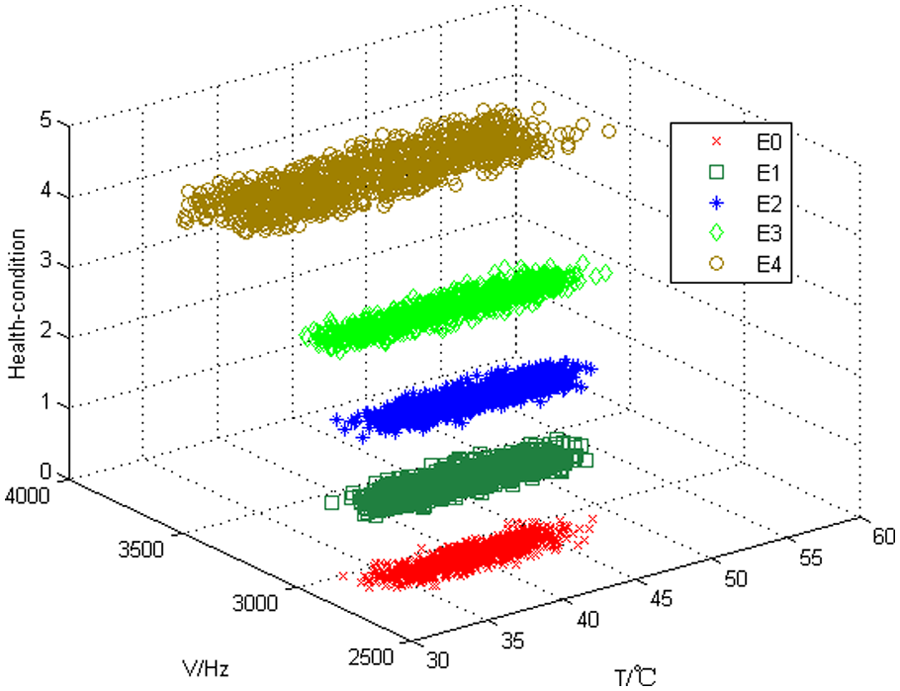
In this case study, the health estimation for fan in repairable faults will be considered which determinate the meaning of health estimation. As mentioned above, the vibration and the fan exit section temperature can reflect the health condition of fan. As the main fault part in turbofan engine gas-path system, crack, fracture, and foreign body adsorption are the frequent fault types in fan part. Compared with the other fault types, the health estimation meaning is small about fracture faults. Because the crack faults are difficult to reproduce in experimental conditions, the faults of foreign body adsorption are simulated to estimate the health condition of fan based the proposed model. The experiment is conducted in a typical turbofan engine test bed. Five standard set experiments are designed in different weights of foreign body: E0, E1, E2, E3, and E4. And the weights increase linearly. It is assumed that the health conditions of the five groups samples are normal, first-degree healthy, second-degree healthy, third-degree healthy, and fourth-degree healthy.
In the aero-engine test, the revolutions per minute (RPM) is 85%, and the value of air input remains constant. The vibration and temperature data are collected at every second and 1000 data are collected in five standard set experiments as shown in Figure 2.
The five standard set experiments data.
Modeling the initial BRB
The number of referential points used for each antecedent decides the size of the rule base. A conventional rule base plays an important role in the BRB. According to the expert knowledge, we use four points for Fan exit section temperature and they are small, normal, little high, and high, represented by S, N, LH, and H, respectively. That is

Similar to Fan exit section temperature, five references are also selected for Vibration as small, normal, little high, and high, represented by S, N, LH, and H, respectively. That is

For the consequent attribute, five references for Health condition are selected as zero-degree, first-degree, second-degree, third-degree, and fourth-degree, represented by Z, I, II, III, and IV, respectively. That is

In order to estimate the health condition of fan, the semantic references should be quantified. Tables 1–3 show the results as follows.
References of Fan exit section temperature.

References of Vibration.

References of Health condition.

Because Fan exit section temperature and Vibration are divided into four terms, respectively, there are 16 combinations of the two antecedents leading to 16 rules in the rule-base in total. Using the equivalent referential numerical values, the conventional rules are established as follows

Training and optimizing the BRB
In order to train the BRB, the first 800 data samples and the last 200 samples are selected as the training data and testing data, respectively. The process is simulated using MATLAB.
Set the initial parameters of BRB
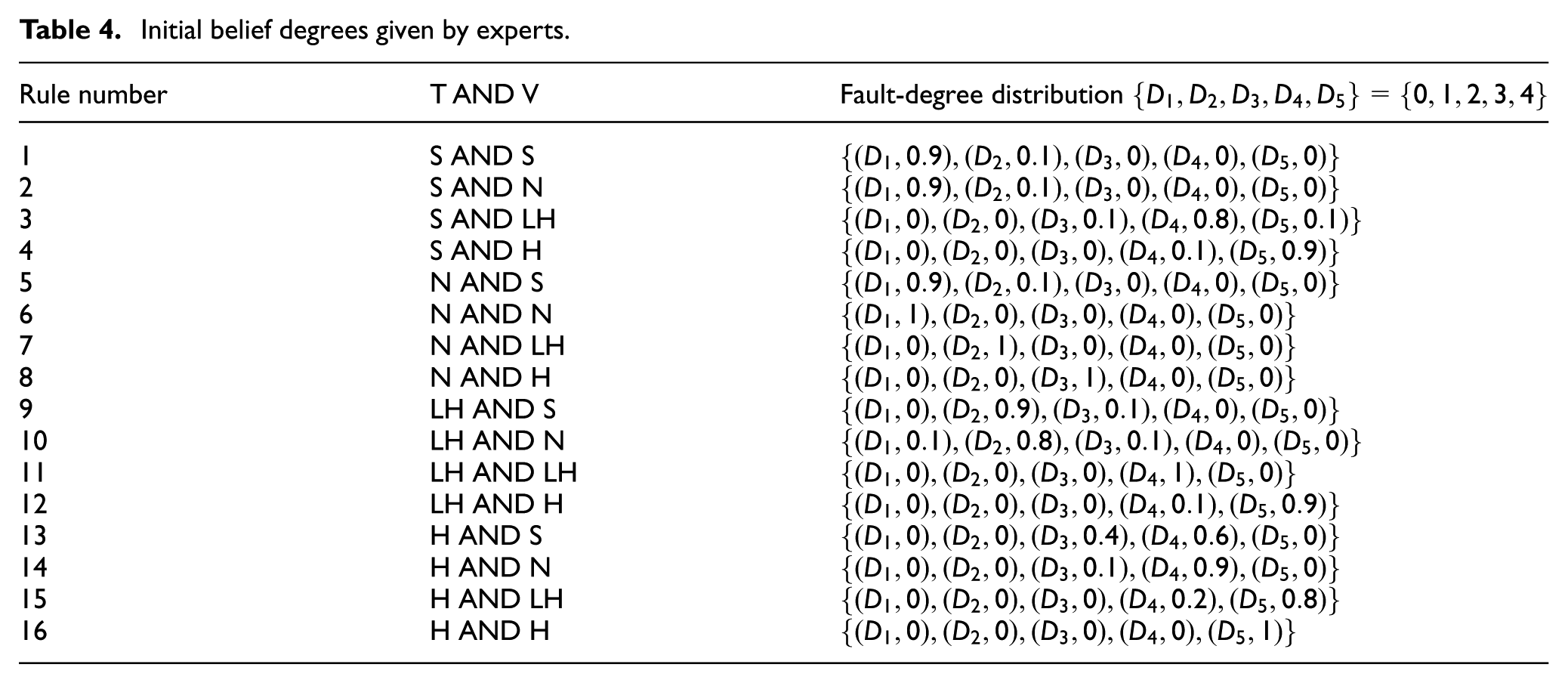
The initial belief degrees are given by experts as shown in Table 4.
Initial belief degrees given by experts.

Estimation results of initial BRB: (a) is the three-dimensional graph and (b) is the two-dimensional graph in the time scale for showing more intuitive.
The model optimization
The optimization model is built as equations (10) and (11). The parameters of initial BRB are optimized by DE algorithm. In the process, F, CR, and NP are set as 0.5, 0.8, and 1000, respectively. The trained parameters of BRB are shown in Table 5. The estimated value in the trained BRB is shown in Figure 4. In this figure, the values estimated by optimization model can fit the training data commendably compared with the initial model.
Updated belief degrees.


Estimation results of updated BRB: (a) is the three-dimensional graph and (b) is the two-dimensional graph in the time scale for showing more intuitive.
Testing
For testing the trained belief rules, the last 200 data samples are used. Figure 5 shows the observed Health condition and the estimated Health condition in the initial BRB and the updated BRB in DE. The result demonstrates that the optimization method DE has a higher accuracy because the estimated results match the observed ones very closely.

Estimation results of testing data: (a) is the three-dimensional graph and (b) is the two-dimensional graph in the time scale for showing more intuitive.
Compared with no experts initial parameters
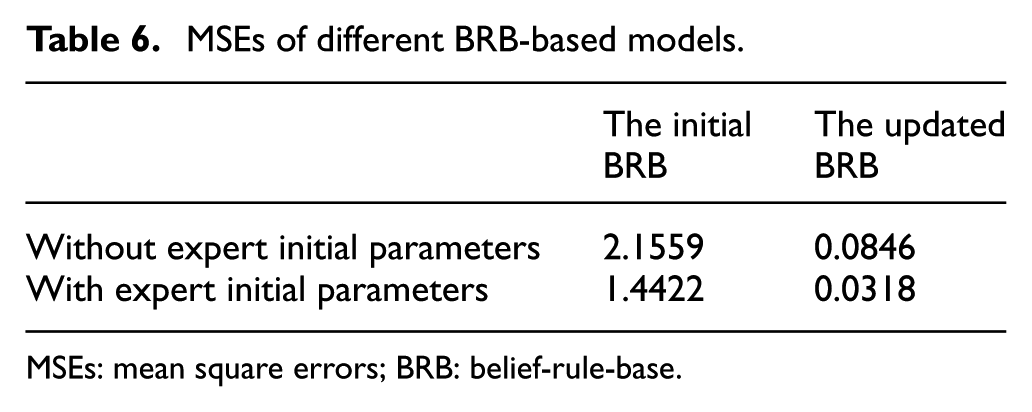
To verify the significance of the expert knowledge, 25 the random initial belief degrees model is used to compare with the expert given initial belief degrees model. Figure 6 shows the training result under the random initial belief degrees. From the result, the output of random initial belief degrees model follows the training data at number 3500–4000. But the estimation result of BRB with expert knowledge can fit the training data well in the early estimation stage. So, we can know that the estimation using the expert knowledge is better than the estimation with random initial belief parameters. In order to further compare the accuracy of the estimation between the proposed model and random initial belief degrees model, MSE is selected as a measure. Table 6 lists the MSEs, respectively.

Estimation results of BRB with random initial belief degrees: (a) is the three-dimensional graph and (b) is the two-dimensional graph in the time scale for showing more intuitive.
MSEs of different BRB-based models.
MSEs: mean square errors; BRB: belief-rule-base.
Compared with back-propagation network
Back-propagation (BP) neural network has a better performance in classification, clustering, and prediction problems.26,27 To verify the advantage of the proposed model, BP neural network is used to compare with the proposed model in the health estimation for fan in turbofan engine gas-path. Similar to estimation in BRB, the first 800 data are selected as the training data and the rest of data as the testing data. The results are shown in Figures 7 and 8. From the figures, we can know that BP neural network can estimate the health condition of fan because the tendency of the result can follow the tendency of training data. In order to further compare the accuracy of the estimation between the proposed model and BP neural network, Table 7 lists the MSEs of the training data and the testing data, respectively. From the figures and table, we can know that the proposed model is accurate and efficient.

Estimation results of BP Network: (a) is the three-dimensional graph and (b) is the two-dimensional graph in the time scale for showing more intuitive.

Estimation results of testing data: (a) is the three-dimensional graph and (b) is the two-dimensional graph in the time scale for showing more intuitive.
MSEs of different models.

MSEs: mean square errors; BRB: belief-rule-base; BP: back-propagation.
Discussion
The results show that BRB has obvious advantages because of using expert knowledge fully in the problem of less available data. Naturally, in the problem of full variety of available data, the results are not different from the other data-driven methods such as neural network because of the multiple rules. When the rules are multiple in a BRB model, the learning ability of model is poor. But now, we devote the rules reduction to research to establish the compact BRB with an excellent learning capability. In the further study, a more accurate health estimation model should be built using more characteristics.
Application of the updated BRB model in health estimation
The proposed health estimation model can estimate the health condition of system well through the above testing and analysis. A case is studied based on the updated model. 1000 groups data are collected when the weight of foreign body falls in the E0–E4. The inputs are shown in Figure 9.

Experimental data: (a) is the data of Fan exit section temperature and (b) is the data of Vibration.
The two sets experimental data are inputted into the updated health estimation model based on BRB. Then, the health estimation of fan is obtained. The result is shown in Figure 10. And the values represent the health condition of fan.
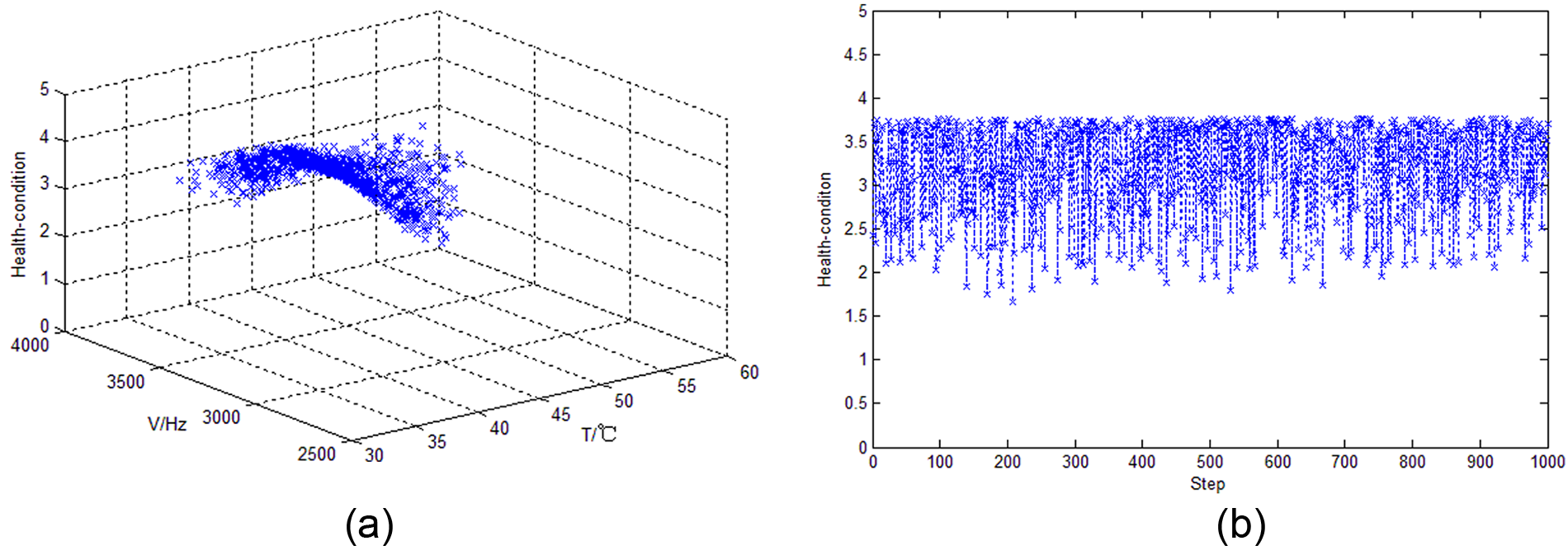
Estimation results: (a) is the three-dimensional graph and (b) is the two-dimensional graph in the time scale for showing more intuitive.
Conclusion
This article describes a health estimation model based on BRB expert system for fan in turbofan engine gas-path. The study demonstrates that the proposed method can estimate the health of fan well. In the health estimation model, the characteristic parameters are chosen as the input of the BRB which can reflect the health condition of fan. Expert knowledge and other qualitative or semi-quantitative knowledge are used sufficiently in the health estimation process. In order to improve the accuracy of expert knowledge, DE is employed to optimize the BRB parameters.
To verify the availability of qualitative knowledge and the accuracy of the model, the proposed method is compared with other approaches. From the results, the health estimation model has higher accuracy and efficiency. This model provides a simple and effective health estimation method without the ideal mathematical model. And the model fuses the seasoned expert knowledge to obtain the more authentic and effective health conditions.
In the turbofan engine, other characteristic parameters are also relevant with the health condition of fan, which can be used to construct the BRB as the antecedent attribute. In the further study, the more thorough BRB-based model will be built for fan, even for the gas-path system in turbofan engine.
Footnotes
Academic Editor: Chuan Li
Declaration of conflicting interests
The author(s) declared no potential conflicts of interest with respect to the research, authorship, and/or publication of this article.
Funding
The author(s) disclosed receipt of the following financial support for the research, authorship, and/or publication of this article: This study was partially supported by NSFC (grant nos 61374138 and 61370031), the Postdoctoral Science Foundation of China (grant nos 2015M570847 and 2016T90938), and the Natural Science Foundation of Shaanxi Province (grant no. 2015JM6354).