




Abstract
Previously compute models usually applied the assumption that people would adopt the shortest route to escape, or be given fixed destination. But the diversity of characteristics mean everyone has an individual determination based on optimal utility including distance, crowding level, and personalized cognition. We focused on the correlation between individual feature and their initial exits strategy in crowded places. By carrying out a questionnaire survey about individual characteristics, spatial cognition, and personalized decision in a market, we found that each pedestrian held different preferences and probabilities of choosing a particular exit for evacuation due to diversity of social background. An emergency exits choice preference model was proposed to analyze escape behavior and to determine the initial preference. The model could balance the influence of differentiated cognition of various pedestrians against the practical evacuating state and surroundings. And also, it could predict the destinations choosing probability in emergency. The result showed the evacuation duration, maximum density, and highest density were more optimal. Applying this model, the pedestrians’ averaged density of exits decreased obviously. Stampede risk was significantly reduced. We expected to make a step that the pedestrian behavior simulation will advance on integrating the human social behavior from theoretical precision.
Introduction
Safety issue in public place has been closely related to everyone, especially considering the disasters frequently occurred in recent years. Many pedestrians lost their lives in the building, transit station, stadium or supermarket, where many people with different characters, targets, and behaviors usually gathered. Taking the Beijing Panjiayuan Antique trading market as an example, the management committee employs 50 persons in charge of the on-site patrol to 47,600 passengers and 4000 merchants each weekend. The area of the antique trading market is only 48,500 m2. Managers should make great efforts to improve crowd controlling to maintain safety for all the public members involved in the crowded public places, and be well trained to be familiar with the responses in case of an emergency by the pre-designed evacuation schemes. It is particularly important how to analyze the pedestrian escape behavior in emergency.
Many researchers simulated pedestrian behavior, that is, leaving a building in the fire emergency and produced quite meaningful outputs like evacuation time estimate,1,2 individual evacuation behavior,3–5 the network-based pedestrian evacuation model, 6 and bottleneck analysis.7,8 Many investigations were discussed of pedestrians’ routing choice behavior in unfamiliar buildings or environment by acquiring cognitive maps. 9 T Nagatani and Nagai 10 discussed the statistical characteristic of evacuation without visibility. T Hyoung and JoonhoKo 11 analyzed the effects of individual and built environment characteristics on the route choice. K Arai and Sang 12 and M Goetz 13 presented an allocation model to rescue disabled persons in disaster area with volunteers help using integration of geographic information system (GIS) and multi-agent-based model. G Sokhansefat et al. 14 discussed the simulation of crowding, panic, and disaster management, and there were more research works in depth based on Agent-Based Indoor Evacuation Simulation of way-finding. 15 A prior assumption in most literatures was the completed spatial knowledge in these simulations. That means each road or exit could be taken into consideration by each pedestrian, which means the spatial knowledge from individual experience was not well considered. Compared with the perfect information hypothesis, D Canca et al. 16 proposed the individual characteristic and behavior based on uncompleted spatial cognitive hypothesis in an international firework display and exhibition event.
However, the pedestrian’s behavior is a complex and dynamic process, and these decision-making processes are mostly based on subjective streamline design, which will seldom consider the individual judgment, probability of keeping rational, personal feature, and personalized spatial cognition. Some pedestrians would not know other exits. A phenomenon is likely to occur that most pedestrians only run to a few limited exits, whereas other exits are used by much fewer pedestrians. Also, the proportion of people familiar with the surrounding environment in the general crowd gathering places (station, mall, etc.) was much higher than that in those special events (concert, stadium, etc.). The survey also found that not everyone chooses his individual route by his own decision, some people would follow the crowd pouring or conductor. It may increase the average evacuation time of all pedestrians, especially when pedestrians are initially distributed in concentration. Parts of pedestrians who are familiar with the location of the evacuation exits consider not only the distances from the current position to the nearest exits but also the crowding degree along the possible evacuation routes.
We proposed an emergency exits choice preference (EECP) model based on the individual judgment, probability of keeping rational, personal feature, and personalized spatial cognition. The key points in this model are that pedestrians with individual features and rational judgment ability prefer to choose their evacuating routes based on their visual condition and personalized cognition. Therefore, this article was supposed to provide assistances to the managers of the general crowd gathering places during an emergency evacuation.
Methodology
To investigate the relationship between individual characteristic and an emergent decision, a study was carried out to identify the impacts of individual cognition and characteristics on route choice and emergent judgment. A survey of random samples in a large market was conducted.
Target
In this article, a supermarket named Beijing Panjiayuan Antique trading market was chosen to carry out our questionnaire survey in August. There are nearly 40,000 customers, 4000 merchants every weekend, and 10,000 customers every workday (Figure 1). It is the largest antique market in China. It covers 48,500 m2 and accommodates more than 3000 booths or merchants. A great population density makes the region with many hidden dangers.

Daily flow of Beijing Panjiayuan Antique market in April.
Experimental design
Aiming at the relations of individual characteristics, personalized spatial cognition, and so on, this article carries out a questionnaire survey and meta-analysis. The questionnaire includes 33 questions and contains three aspects: individual characteristics, spatial cognition, and personalized decision (Appendix 1). In total, 4000 formal questionnaires were assigned in the supermarket, and respondents were asked to complete all the 33 projects.
Individual characteristics
In the different external surroundings, pedestrians can form variant psychological characteristics in emergency. The route choices are relative to the individual characteristics. Various characteristics and impact factors of respondents, like gender, age, education, and residential zone, were collected in the questionnaire survey. People with different gender, age, and background had different cognitive ability and self-awareness, while the factor of different living area had a subtle influence on the individual judgment.
Spatial cognition
In addition, we also took consideration of trip mode chosen by respondents, the route, and the familiarity degree of the market. Judgment and ability to adapt would decline sharply in emergency, and space cognitive ability can dominate to induce people to choose themselves familiar route and form individual escape routes.
Personalized decision
To analyze the personal decision, 10 questions are designed for emergency perception. For example, How to tell that there is an emergency if the following conditions occur? Once there is an emergency, what will you do? Which kind of routes do you prefer to choose in emergency? Finally, an escape map is required to draw so to get the information of each respondent’s possible escape route.
The EECP model
Model framework
We have developed a model, called EECP model, which reduces route complexity by creating user-specific routes based on a prior knowledge of being familiar with routes or landmarks. The model can also judge which routes might be chosen based on practical visual condition, personal feature, and spatial cognitive ability. The social psychological factors influence route preference together with the practical conditions, such as tender, age, education level, living region, trip mode, and visit times.
Model operates in three steps. First, collecting known exits and route data into a personalized attribute. Second, identifying the linkage between known exits and pedestrian’s individual social and economic factors by logistic regression. Finally, using the personalized attributes to undergo route compression and rerouting. Then, it will give the best route by a cost function and suggests this route to the user.
Assumptions
To facilitate crowd evacuation management during potential emergencies, we seek to find typical behaviors of pedestrians in the evacuation at the microscopic level, which has been widely used to simulate pedestrian evacuation behavior in escaping from a building in a fire, hurricane evacuation, and so on. And quite meaningful outputs for practical application on crowd management and evacuation planning have been presented with evacuation time estimation and analysis of bottlenecks.
Incomplete spatial knowledge assumption
The complete spatial knowledge assumption has been applied in most simulation studies, but it may not be suitable for some events in which most visitors or customers may be unfamiliar with the surroundings, just like a large stadium, large trading markets, and the railway station and so on.
In contrast, the incomplete spatial knowledge assumption, which thinks that only part of the entire road network or landmarks could be recognized and available by the evacuating pedestrians, was employed in some simulation studies. These are the most distinct routes in the cognitive map retained in people’s minds. Meanwhile, the differences in recognizing various passages or landmarks were identified. The diversity of spatial knowledge structure implies the possibility that different roads or landmarks contribute different probabilities to look for an escape route during evacuation. Feinberg and Johnson 17 found that the spatial knowledge assumption should be considered seriously for practical evacuation simulation models.
Personalized spatial cognition assumption
In case of a supermarket evacuation taking place in the city, a large population of attendants may comprise diverse groups with different background, such as male and female, teenager and elderly, and living nearby and afar off. Consequently, a wide range of the attendants’ spatial knowledge may be displayed. Thus, we assumed that different pedestrians hold different spatial cognitions in their minds in accordance with their backgrounds of socio-economic situations, and therefore, each one derives his or her individual passageway sub-network, which may greatly have varied from one to other.
Incomplete rational decision-making
In emergency conditions, many people do not acquaint the environment or own less psychological quality, and may lose the ability of decision-making and the basic judgment in the evacuation. Once it happened, the evacuation destination will be unconcern to the person. He may run to nearest door, follow someone, or run along with the major.
Model
It is supposed that pedestrians are diversified decision-makers who seek maximum utility (minimum time, shortest distance, or level of recognition) through continuous evacuation choices (Table 1).
Description of variables.

Traveling on a familiar route may be longer in distance or time than traveling on the most direct one. Pedestrians prefer both familiar routes and shorter routes in emergency. We resolve this conflict through a linkage
The



The meaning of some variables.
The
1. The coefficient of reliability of visual escape route (RRmn)
Every pedestrian perceives the travel time of links in a different “subjective” way. To do that, the length of each link is perturbed in a maximum of L around its real length as follows

Crowding level (LOC) is the extent of pedestrian traffic congestion in evacuating case for some links


where f is the projected area for one person.
2. The coefficient of
The

The


3. The level of cognition (Co)
When searching a familiar route, we usually try to look for some landmark in the way to the destination. So, those landmarks are also the parts of destination attribute. Everyone has his individual collection of personalized landmarks. The route from the starting point to one’s personalized landmark is considered as familiar, and the way from the landmark to the destination is considered as unfamiliar.
To a pedestrian with several socio-economic attributes with the construction of its spatial knowledge, the independent variable was a vector related to the potential attributes of a pedestrian. We supposed that the K is related to the probability of landmarks or destinations being selected. Therefore, for a given landmark or destination, the probability of m being selected in the condition of cognition factors is determined by the logit function as shown in following equation


The
Model implementation
The model was used as a simulation tool to analyze Panjiayuan fairground for evacuation planning, engineering design, and operation analysis from a pedestrian circulation. Here, we use that realistic experience to illustrate how the microscopic cognition-based simulation approach proposed in this article works in practice.
Model calibration and validation
Practical applications require calibration and validation of the model. At the first step, an analysis is performed using logistic regression to calibrate the parameters of model, minimizing deviations from the outputs with respect to the known real values. The calibration involves several parameters:
1. Coefficients
The coefficient



The value of coefficient
2. Calibration of
Under emergency conditions, pedestrians’ route choice may be different when they are facing different passageways, it is crucial to estimate which social and economic factors determine the pedestrian route choice preference.
First, we choose some socio-economic factors (age, gender, times, group, education, arrival mode, and residential zone) as the alternative independent variables. The destinations or landmarks are chosen as dependent variables. To solve
Variables in the equation for exits P1\P2\P3\P4.
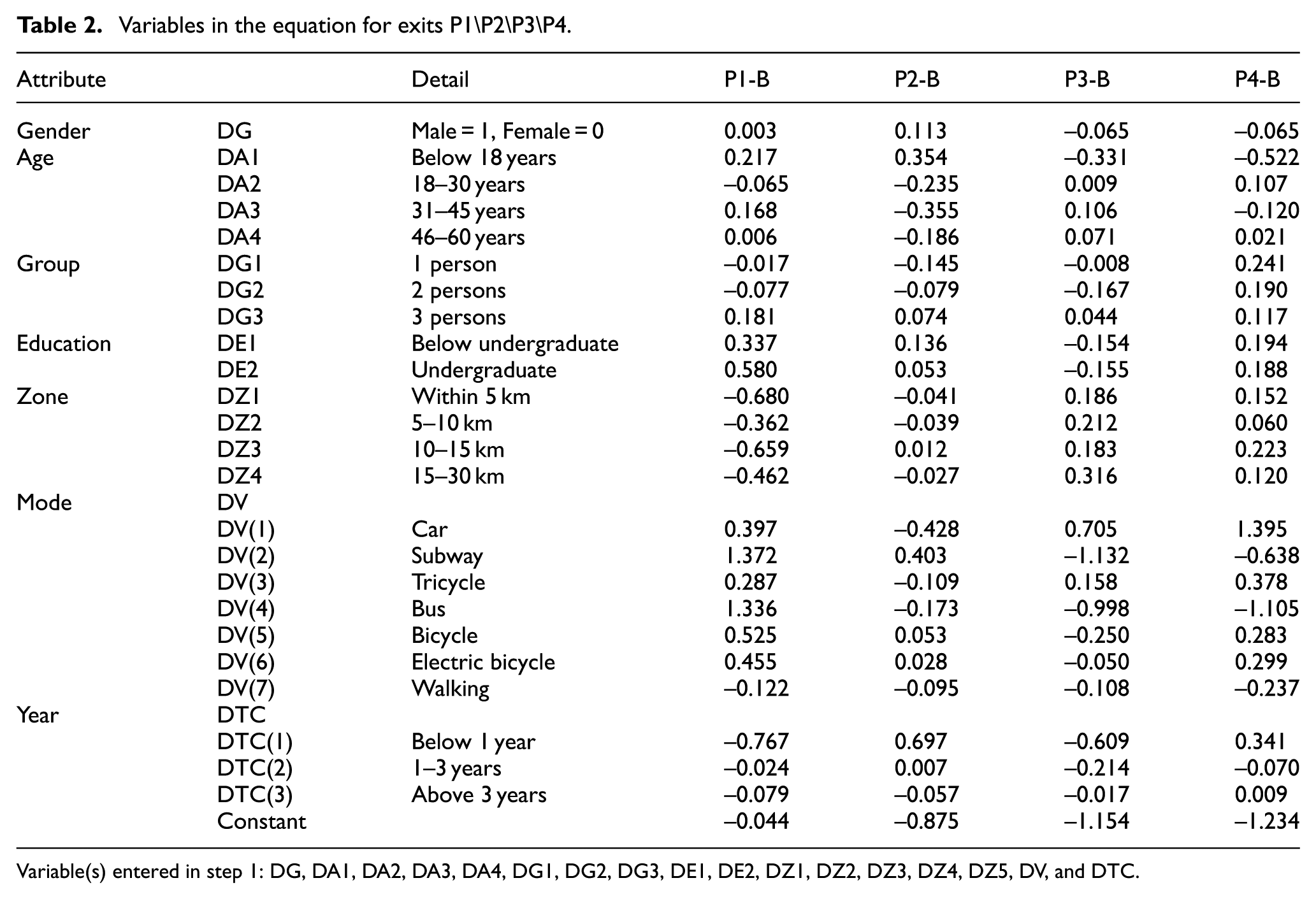
Variable(s) entered in step 1: DG, DA1, DA2, DA3, DA4, DG1, DG2, DG3, DE1, DE2, DZ1, DZ2, DZ3, DZ4, DZ5, DV, and DTC.
Model application
The model describes pedestrian activity and route choice for different types of pedestrians with distinct cognition. Contrary to traditional approaches, more subjective and personalized factors were considered in the model. Applications of the model will be manifold. For one thing, the approach can model choice behavior in pedestrian simulation. Stand-alone applications of the model will be possible to predict choice probability of destination in large public places, such as railway stations, exhibition centers, and stadiums and supermarkets. Such a model is not only valuable to know emergency decision-making behavior but also to reveal the bottlenecks in infrastructure design. For instance, the example of Panjiayuan Antique market shows the ideal passageway width for emergency. In this way, infrastructure layout, escape signs, and method of organization can be optimized. This pertains to regular circumstances, as well as to emergency conditions.
Practical application of this model requires a supplementary investigation to personalized cognition and calibration of the model. This can be done by current empirical studies, which show the importance of different route attributes for differential personalized cognition, and subsequently estimate the relevant weights and the final choice probability based on objective environment and subjective cognition. In fact, distance (travel time), level of crowding, and cognition are quite important in our investigation, and we expect to classify the public places based on pedestrian attribution and pedestrian agglomeration feature.
To solve this problem, we simplified the large trading market into a network diagram (Figure 3), which included common nodes, landmark nodes, links, and exits. The circle shape represents common nodes, and the square shape denotes landmark nodes. The triangle represents the exits (P1, P2, P3, and P4). The gray areas mean the market trading area or hall.

Nodes and links in a scenario example.
In the present brief calculation, we chose the nth person, who had the social and economic feature (in Tables 3 and 4)
The feature of the nth person.

Brief calculation for the nth person.

Simulation result
In order to estimate the effect of modeling evacuation, we took the simulation of evacuation as the example. Figure 4 shows the distribution graph of Beijing Panjiayuan Antique market. Two simple testing schemes were built. We simultaneously loaded 4750 persons in the market based on the data of our investigation. Scheme 1 (S1) simulated evacuation based on shortest route and supposed that 30% persons would think about the crowding. It was more ideal simulation in S1, because every person knew the shortest evacuation route. By contrast, scheme 2 (S2) was built based on our EECP model.

Layout of Beijing Panjiayuan market, 2013.
It was demonstrated in Figures 7 and 8 that the way the pedestrians choose their routes toward their destinations. And it was demonstrated that the place of the maximum density in evacuation was disappeared for S1 and S2 in Figures 5 and 6. From Figures 9–11, comparison of flow rate, averaged distance, averaged speed, and journey time between S1 and S2 were listed.

Cumulative maximum density for S1.
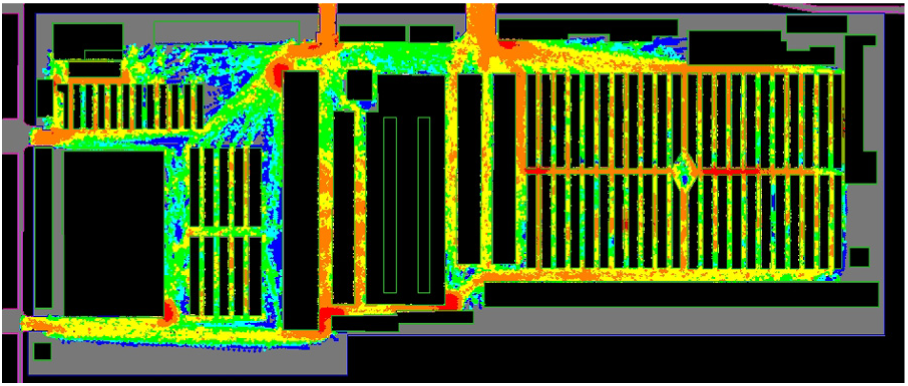
Cumulative maximum density for S2 (EECP model).

Evacuation route for S1.

Evacuation for S2 (EECP model).

Averaged flow rates for S1 and S2.

Averaged distance for S1 and S2.

Advanced averaged entity speed of exits P1, P2, P3, and P4 for S1 and S2.
In Figure 12, the journey time distribution was demonstrated for S1 and S2. We chose the north door area (toward P1), the northwest door area (toward P2), the west door area (toward P3), and the southwest area (toward P4) to research the risk area in an evacuation (Table 5). In Figure 13, it was illuminated that the evacuation density and speed change over time for S1 and S2.

Averaged flow rates for S1 and S2.
Evacuation data contrasting S2 with S1.


Frequency distribution of journey time for S1 and S2.
Discussion
The classical algorithm of way-finding based on the direction and optimal utility to the destination or landmark sometimes failed to give a reasonable route at the macroscopic scale. As the simulation results shown in Figures 5–14, we found that although most pedestrians expect to find the shortest route to escape, they preferred a familiar and uncrowded route, while most routes usually had less difference to each other. By considering the personal factors, the EECP model can balance the influence of differentiated cognition of various pedestrians against the practical evacuating state and surroundings.

Speed and density contrast in area of P1 (north door) and P2 (northwest door) for S1 and S2.
The durations of two strategies of evacuation simulation were 1564.8 s (26.08 min) and 1125.6 s (18.76 min), respectively, and in both of schemes, 90% people escaped the market within 720 s.
1. Journey time and averaged journey time
As illustrated in Figure 12, pedestrians’ averaged journey time toward P1 was significantly higher than other exits in S1, and the largest journey time was 723 s, and the highest averaged journey time was 382 s. The pedestrian averaged journey time in exit P2 was 220 s, and it was much less than 130 s in exits P3 and P4. For simulation of S2, the averaged journey time among four exits was well balanced. The pedestrians’ averaged journey time in exits P1, P2, and P3 were 250, 212, and 208 s, respectively, and it was 344 s in exit P4. The main reason was that parts of pedestrians at southeast area chose exits P3 and P4 to avoid the crowding and panic.
2. Density and risk analysis
Based on the layout of exits, if only in consideration of the trip distance, exit P1 may be better for most people. By simulation, 57.2% of people chose exit P1 to be an evacuating destination in S1, and the percentage of people choosing exit P4 was only 6.85%. It made the passage in southern area of the market to be seldom used in emergency, in contrast, exits P1 and P2 were hot points and very crowded. The averaged maximum density reached 1.95 p/m2, and the local instantaneous maximum density was 4.15 p/m2.
It was obtained from our EECP model that pedestrian route choice could be optimized. 36.09% people chose exit P1, and 25.15% and 22.42% people chose the exits P2 and P4, respectively. The percentage of people choosing exit P3 was 16.34%. In the simulation of S2, the maximum density was 3.94 p/m2 and was little lower than that in S1. According to the high density of S1 and S2, the exits P1 and P2 were very crowded and the duration of high density was 249 s in S1, but it was only 179.4 s in S2.
For S1, the dangerous places were the area of exits P1 and P2, and the averaged density was 1.98 p/m2 that far exceeded alert threshold of 1.33 p/m2 (0.75 m2/p) in outdoor events. Once there was any emergency, stampede may be happened just like historical bitter precedent. These events and states should be avoided at any time and any place. By the simulation of S2, parts of the pedestrians prefer the most suitable routes rather than shortest one basing on their personalized factors and cognition degree to the surroundings. This conclusion was consistent with the fact, showing in our investigation that 62% of people would choose the most familiar routes rather than the shortest ones. Compared to S1, the pedestrians’ averaged density of exits P1, P2, P3, and P4 in S2 decreased obviously, the maximum density was only 1.18 p/m2, and stampede risk could be significantly reduced. Also, the evacuation speed of areas of the north door and northwest door sharply increased, evacuation was much easier than others.
Summary and future work
In our article, subjective and objective factors had been integrated to judge the possibility of exit choice by the pedestrians. This article put forward an EECP model based on the assumptions that each pedestrian had his own subjective cognition, incomplete spatial knowledge, and incomplete rational decision-making. The principles of an algorithm for personalized route choice preference calculation were then proposed. The algorithm used additional data supported by our questionnaire. In emergency, people would choose their routes by diversity of spatial cognition. They correspondingly searched their personalized spatial cognitive pathway network to look for a route to the destination by their practical visual condition and personal behavior pattern. The multivariate binary logistic regression method was applied to identify the linkage between the selected factors and the response variable quantitatively. The EECP model could predict the choosing probability, while someone was in a certain position and going to choose some destinations or landmarks in emergency.
There are many public places with crowded pedestrians, each group of them owns distinctive feature. Frankly speaking, many participants in those places are not familiar with the district, because they are just visitors or newcomers to the areas. Only some obvious landmarks or passages could be available from the selection set. When walking to a destination, you could only be acquainted with some intermediate points, and each one would have different choice. In future, different questionnaires should be carried out in different places. The EECP model still needs to be improved in studying the practical route finding logics of human beings and conducting pedestrian behavior rules. Also, further psychology impacts should be researched in depth. We assumption that no one came in after warning. When the emergency occurred, people may not be aware of the situation on time and would still get into the area. Thus, whether the pedestrian behaviors would be affected should be investigate in future study.
Footnotes
Appendix 1
Academic Editor: Francesco Massi
Declaration of conflicting interests
The author(s) declared no potential conflicts of interest with respect to the research, authorship, and/or publication of this article.
Funding
The author(s) received no financial support for the research, authorship, and/or publication of this article.