




Abstract
According to the influence of the normal contact damping of joint surfaces on the dynamic characteristics of high-precision machinery (machine tool, robot, etc.), in this article, a three-dimensional fractal model of normal contact damping of dry-friction rough joint surfaces based on Hertz theory and fractal theory is established. The three-dimensional surface topography is constructed, according to the modified double variable Weierstrass–Mandelbrot function. The fractal model of strain energy
Introduction
Mechanical joint surfaces is widely existed in all kinds of mechanical systems, such as the joint surfaces of spindle and guide rail of high-end CNC machine tool, joint surface of robot’s moving pairs and rotating pairs, bolted joint surfaces, and so on. The identification and design of the contact stiffness and damping parameters of the mechanical joint surfaces have important influence on the pre-judgment and evaluation of the static and dynamic characteristics of the whole machine. According to the research, 1 >90% of the total damping of the machine tool are contributed by joint surfaces, that is, the contact damping on the joint surfaces is much higher than the structure damping of material. Therefore, it is necessary to carefully make the modeling of contact damping on the joint surfaces, the accurate damping model not only can be used to analyze the contact mechanical behavior of joint surfaces but also provide a basis for the construction of the dynamics model of the whole machine’s, so as to better analyze the nonlinearity of system dynamics which is caused by the nonlinearity of the joint surfaces.2,3
From the macroscopic view, the surfaces of mechanical components are smooth, while from the microscopic view, there are a large number of rough asperities on the surfaces. The analysis of contact behavior on joint surfaces is the study of contact problem of asperities on joint surfaces in essence. The contact between two elastic solids was first studied by Hertz in 1882, the equation of elastic contact mechanics
4
was given, which is a milestone in the study of solid contact. However, the elastic–plastic and plastic behavior of the contact of two solids and the friction factor are not considered in the Hertz theory. Thus, Zhao et al.
5
considered the whole process of elastic to complete plastic flow when asperities are loaded and established a micro contact model. But the elastic–plastic zone is not further divided. Kogut and Etsion6–8 in detail researched the contact process of sphere and rigid plate under external loading by finite element method; the dimensionless deformation
Therefore, this article is based on the literatures above, by considering the influence of dynamic friction coefficient, elastic–plastic deformation mechanism, and three-dimensional fractal dimension, the normal contact damping fractal model of dry-friction joint surfaces based on Hertz theory and fractal theory is derived in detail. The influence of the fractal parameters of joint surfaces on the damping model is simulated, which provides a basis for the design and modeling of contact damping of joint surfaces.
Basis of contact theory
Elastic deformation and plastic deformation of asperity
According to the study of three-dimensional rough topography of engineering surfaces, Yan and Komvopoulos modified the Weierstrass–Mandelbrot (W-M) function. The W-M function is a fractal function, the feature of the function is that any point is amplified, and the obtained regional images and overall image are similar. Moreover, in any case, the images of the function are not more smooth, and there are also no monotonic interval. In other words, the function is continuous and nonderivable everywhere. The modified W-M function’s expression 17 is

where L is the sampling length of surface topography; D is the three-dimensional fractal dimension (

Three-dimensional surface topography.
In order to determine the deformation of asperity, equation (1) is simplified as equation (2) by Yan et al.

Equation (2) is a cosine function, the height difference between the peak and valley of the function is defined as deformation amount

where

Sketch of contact equivalent of asperity.
In Figure 2, the right-angled triangle ode exists in the following relationship by the Pythagorean theorem

Equation (4) can be transformed into

As the R is much larger than the loaded deformation

According to the classical Hertz elastic contact theory, the normal load of a single asperity in the elastic deformation zone is

When the asperity is Hertz elastic contact, the radius 17 r of the actual contact area is

where E is the equivalent elastic modulus of asperity, it can be expressed as

where E1 and E2 are the elastic modulus of two contact asperities, respectively, and
Substituting equation (7) into equation (8) can obtain

Substituting equation (6) into equation (10) can obtain

According to equation (11), in Figure 2, the actual contact area of the equivalent asperity and the equivalent rigid plane is

The elastic critical deformation amount of a single asperity is 13

where

Substituting equation (12) into equation (3) and eliminating

Substituting equation (15) into equation (12) can obtain the curvature radius, which is expressed by the area a

According to equations (13), (15), and (16), the elastic critical deformation area of a single asperity is

The normal load of a single asperity at fully plastic stage is

where
In order to properly associate the elastic deformation of the asperity with the plastic deformation of the asperity, the elastic contact area and the plastic contact area of the asperity can be expressed by a in the classical M-B model. 10 Furthermore, the value of the contact area a is the same in the M-B model, for the sake of simplicity, this article refers to the representation in the M-B model. So, we can substitute equation (12) into equation (18), and the relationship between the plastic load and deformation is

Elastic–plastic deformation of asperity
According to previous studies,6,15,16 the difference between the two elastoplastic zones is deformation value, and according to the size of the deformation, the elastic–plastic zone of asperity can be further divided into elastic–plastic I zone and elastic–plastic II zone, and the critical deformation area of the two deformation zones are


Similarly, the relationship between the contact load and deformation on the two elastic–plastic zones is as follows:
When

When

where
Substituting equation (13) into equations (22) and (23), respectively, which can be simplified as


Damping loss factor of joint surfaces
When the external force acts on the asperity of rough metal surface, the elastoplastic transition deformation includes the elastic and plastic deformation, and they will appear at the same time, regardless of stage. So that when the strain energy and dissipated energy of a single asperity are established, a part of energy brought by the elastoplastic deformation needs to be taken into account.
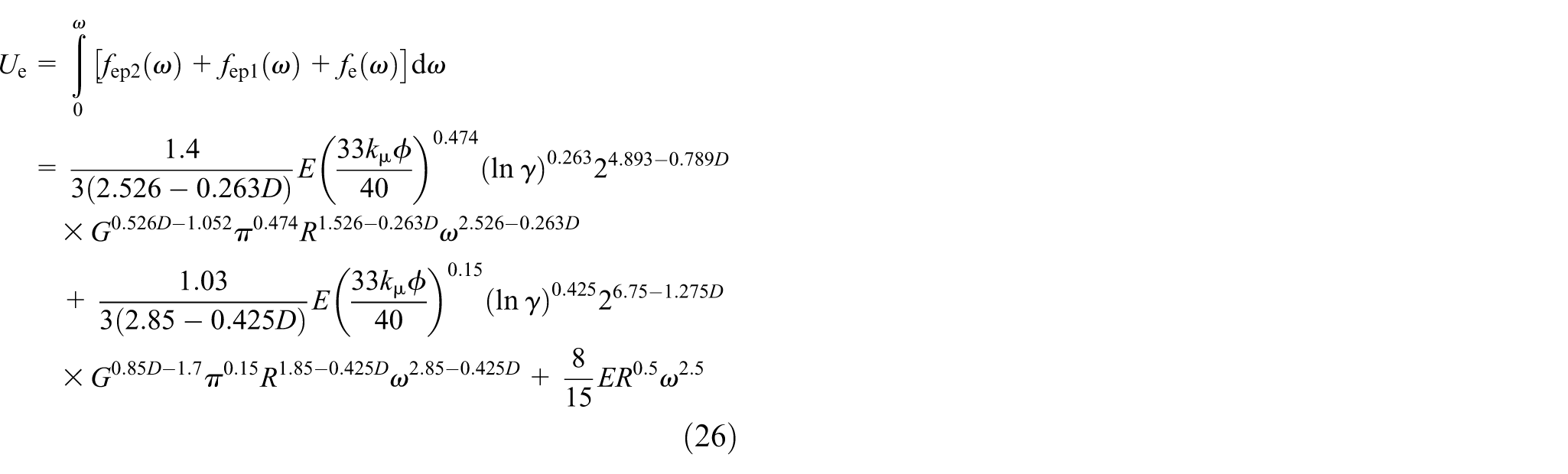
The strain energy is obtained from elastic and elastic–plastic deformation stage of a single asperity, and it can be deduced by integrating of each stage
The dissipated energy is obtained from elastic–plastic and plastic deformation stage of a single asperity, and it can be deduced by integrating of each stage

The area distribution function

where
According to the area distribution function
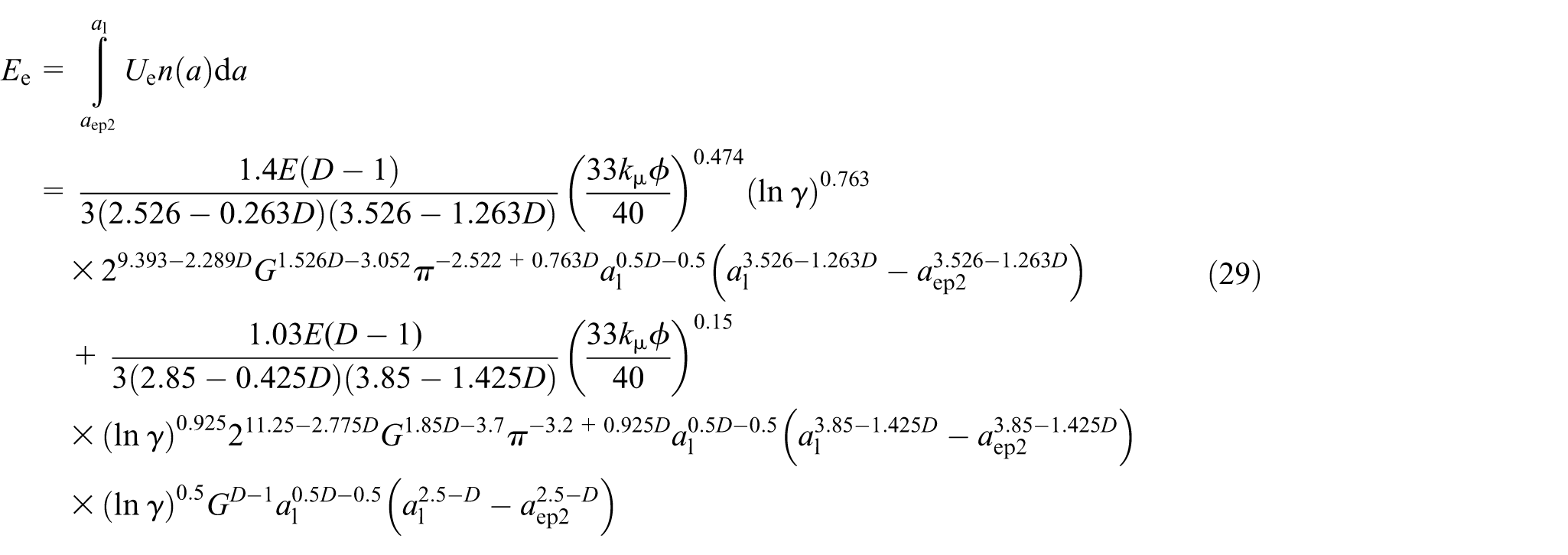
Similarly, the dissipated energy of the whole joint surfaces in a contact loading process is deduced by the integration of the dissipated energy which is obtained from elastic–plastic and plastic deformation stages of all asperities

The dimensionless forms of equations (29) and (30) are, respectively


The damping loss factor

Total normal contact load
According to the continuous integration of the area distribution function on each deformation stage of asperity, the actual contact area can be calculated

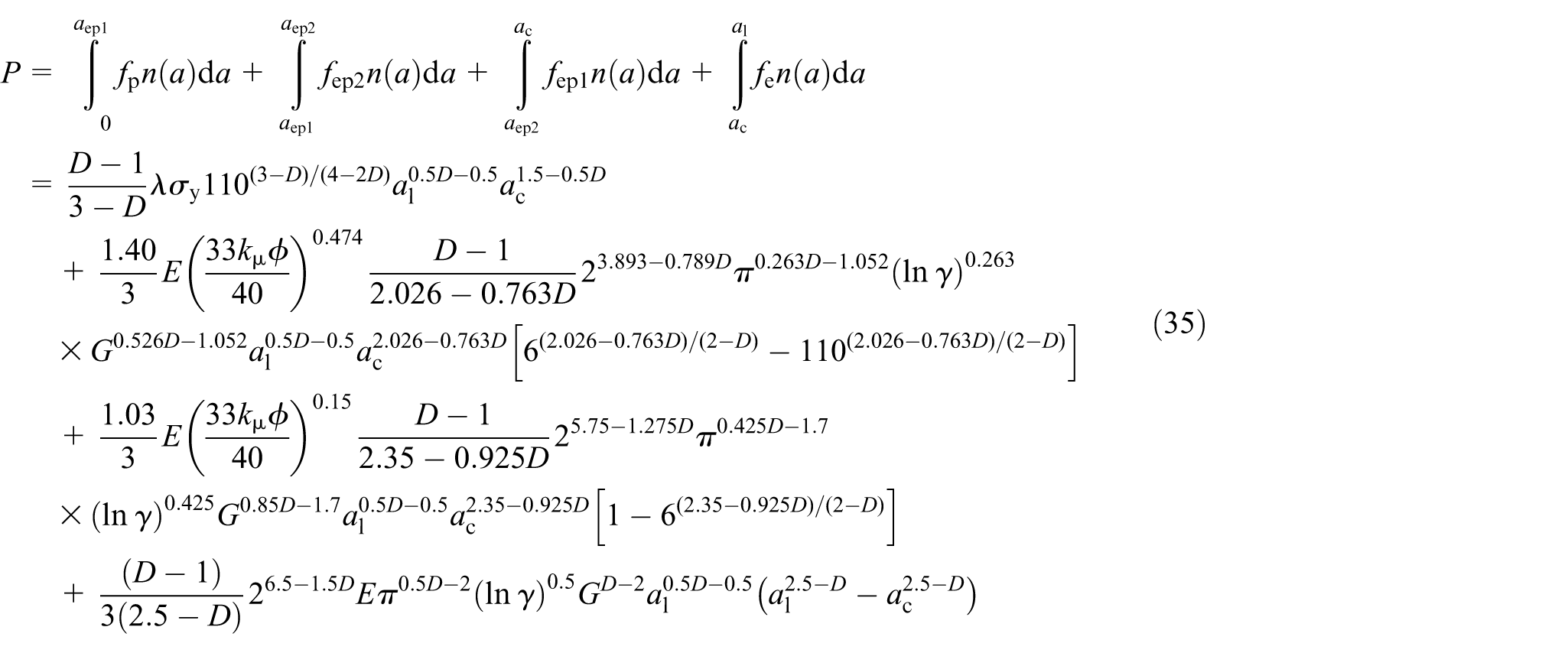
According to equation (7), equations (15)–(18), (20), (21), (24), and (25), multiplying the load by area distribution function on each stage and on each stage integrating on deformation area can obtain the total normal contact load P:
When D ≠ 2.5, there is
When D = 2.5, there is

The dimensionless forms of equations (35) and (36) are

Fractal prediction model of normal contact damping
According to the vibration theory, the relationship between the damping loss factor

where

where m is the mass of the object and Kn is the normal stiffness of joint surfaces. 13
So, the normal damping fractal model of joint surfaces is

The dimensionless form of equation (40) is

where
Numerical simulation analysis and experimental verification
The effect of fractal parameters and dynamic friction coefficient on strain energy
As is shown in Figure 3, the dimensionless strain energy

Effect of D, G*, and µ on
The effect of fractal parameters and dynamic friction coefficient on dissipated energy
As is shown in Figure 4(a) and (b), the dimensionless dissipated energy

Effect of D, G*, and µ on
The effect of fractal parameters and dynamic friction coefficient on damping loss factor
As is shown in Figure 5, the damping loss factor

Effect of D, G*, and µ on Δ: (a) D = 2.510–2.516, (b) G* = 1.15 × 10⁻¹⁰−1.95 × 10⁻¹⁰, and (c) µ = 0.1–0.9.
The effect of fractal parameters and dynamic friction coefficient on the normal contact damping
As is shown in Figure 6, the dimensionless normal contact damping of the joint surfaces increases with the increase in the dimensionless total normal load. The reason is that the total normal contact load increases and then the normal contact stiffness increases, which leads to the increase in the critical damping coefficient and finally represents the increase in the normal contact damping. In Figure 6(a)–(c), the dimensionless normal damping increases with the increase in fractal dimension, fractal roughness, and dynamic friction coefficient is also shown. Therefore, when the total normal load of the joint surfaces is constant, the change in normal contact damping can be achieved by changing fractal parameters and dynamic friction coefficient.

Effect of D, G*, and µ on
Comparison between theoretical and experimental value
In order to verify the reasonableness of the three-dimensional fractal model of normal contact damping of the dry-friction joint surfaces in this article, the comparison analysis of theoretical value and experimental value in Zhang et al.
18
is carried out. The engineering parameters needed for theoretical calculation are
The experimental study on contact damping identification of machine tool ground foot was given in Zhang et al., 18 and the two tangential (x-direction and y-direction) and a normal (z-direction) contact damping test values of joint surfaces were obtained, as is shown in Figure 7. The overall trend of theoretical and experimental normal contact damping curves is consistent, and they both increase with the increase in the total normal contact load P, and the relative error between theoretical value and experimental value is −5% to 25%, <30%. Therefore, the normal contact damping fractal model can be used to predict the normal damping value of joint surfaces under different external loads to a certain extent.

Comparison between theoretical and experimental damping: (a) comparison between theoretical and experimental values and (b) the relative error between theoretical and experimental normal contact damping.
Conclusion
The strain energy
The damping loss factor
The comparison between theoretical calculation of normal damping and experimental results show that their general trend is consistent, and they increase with the increase in total load P, and the relative error is −5% to 25%.
Footnotes
Acknowledgements
The authors greatly appreciate the reviewers’ suggestions and the editor’s encouragement.
Academic Editor: Anand Thite
Declaration of conflicting interests
The author(s) declared no potential conflicts of interest with respect to the research, authorship, and/or publication of this article.
Funding
The author(s) disclosed receipt of the following financial support for the research, authorship, and/or publication of this article: This work was supported, in part, by a grant from National Natural Science Foundation of China (no. 51275079 and no. 51575091) and Fundamental Research Funds for the Central Universities (N160306003).